“It is not what you do
for your children,
but what you have
taught them to do
for themselves
that will make them
successful human beings.”
~ Ann Landers
Two years before the birth of my first son, the world changed — at least, here in the United States. On February 10, 1984, Kevin Collins, a fourth-grade student at Saint Agnes School in San Francisco, disappeared without a trace. At the conclusion of his after-school basketball practice in the school gym, Kevin walked to the corner of Masonic & Oak to catch a bus home. One of his brothers, just a year older, would normally have been with him, but he had stayed home sick that day. Kevin was alone.
The disappearance of Kevin Collins was certainly not the first case of a child gone missing. It was, however, different than other similar situations. Kevin was just a normal kid. His wasn’t considered to be a high-profile case. He wasn’t well known, nor were his parents. There was no ransom note with a demand for cash for his safe return. Kevin was simply gone. What made this case different from others was that Kevin’s family launched a search, in those days before the internet and social media, which went well beyond the limits of San Francisco.
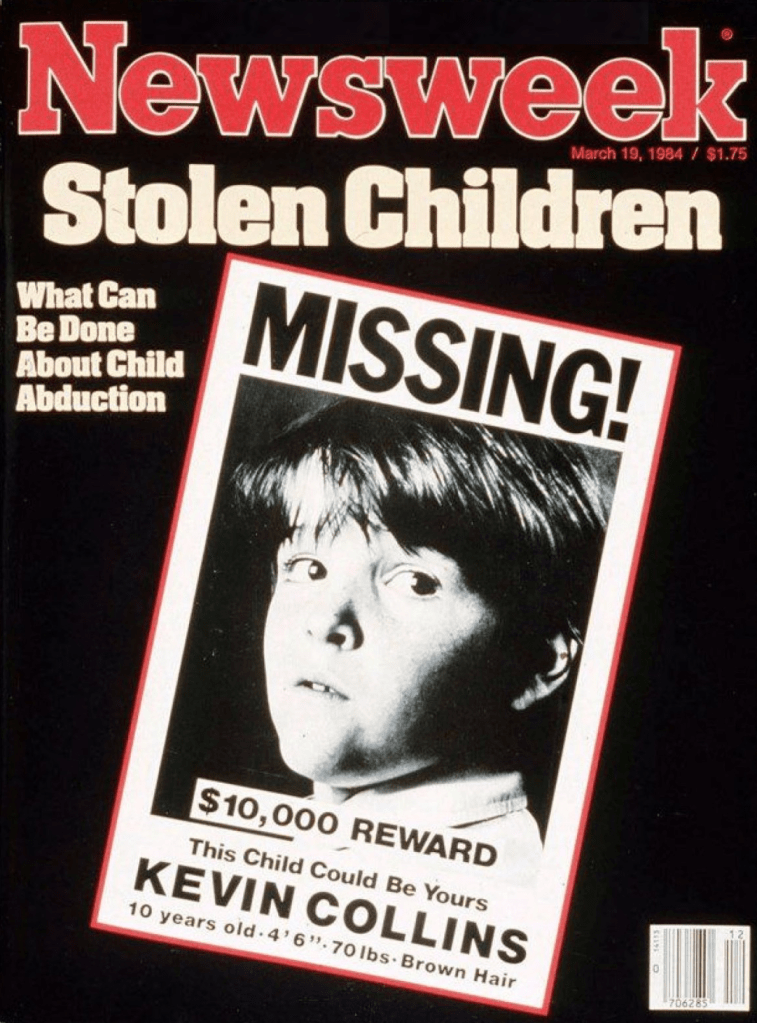
When Kevin’s parents contacted San Francisco Police about his disappearance, the response they received was understandably lackadaisical. The responding officer suggested that, perhaps, Kevin had gone to a friend’s house. Kevin’s parents were certain that their son would not do that. With little help from local law enforcement, Kevin’s parents went public with their concern. They created posters, with Kevin’s photo, and put them up throughout the neighborhood. Soon, that image was being shown on local news channels. There was something about that photo, the haunting look on Kevin’s face, that captured the hearts of parents across The City. Kevin became every parent’s child.
Then the photo appeared on the side of milk cartons across the country alerting consumers of Kevin’s disappearance. National news channels and popular magazines took an interest in the heartbreaking story. It seemed that everyone in the country knew of the disappearance of Kevin Collins.
As a result of the barrage of publicity given to this case, parenting in America changed. Prior to Kevin’s disappearance, children Kevin’s age, and even younger, had far more freedom to explore their neighborhoods and cities. At the age of five in early 1960, I was able to walk unattended from my home on 38th Avenue in The City to South Sunset Playground, two blocks away. I remember this because I fell off the monkey bars one day when I was kindergarten-age and broke my wrist. I walked home alone to tell my Mom that I’d injured my arm. A few years later, I was allowed to take public transportation from my home to the corner of 5th & Market in the heart of downtown San Francisco on my own. From there, I’d walk around the corner to visit my Dad at the fire station on Jesse Street. I had no fear of doing these things without parental supervision.
By the time my boys were born, allowing a child to do such things would have been considered neglectful parenting. For the past 30+ years, parents have driven their kids to school, to athletic practices, to the homes of their kids’ friends, to the movies, or wherever the children need or want to go. The thought of allowing these kids to walk, ride their bike, or take public transportation to their various activities engenders fear in parents. It’s the Kevin Collins effect.
Is there really that much risk in allowing kids today to move about independently? I would like to think not. I honestly believe that most people are good. I trust that most people in the world would be kind to my child, or any child, and do them no harm. Sadly, though, the risk is there. Bad people do exist. Bad things do happen to innocent children. And we don’t want our child’s image adorning the panel of a milk carton.
 A Beacon of Light
Leave a comment