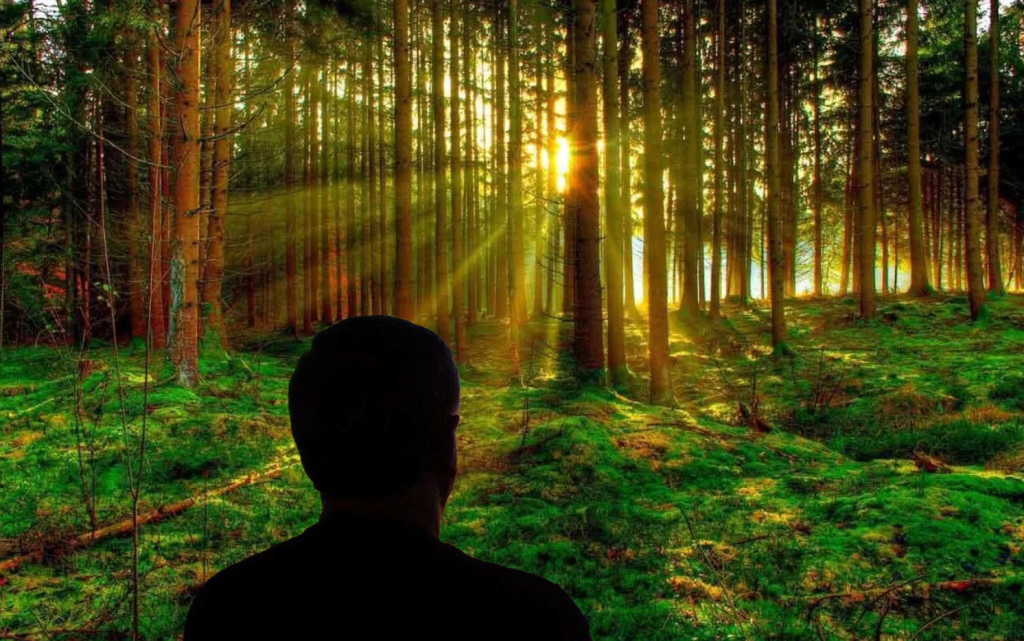
“The forest holds answers to
questions we have yet to ask.”
Surinamese Proverb
Go to a forest (or grove, or park,…). Leave your cell phone in the car. Walk slowly. Open all your senses and take in the sights, smells, sounds, and feelings around you. Breathe deeply. This is the healing experience of Shinrin-yoku.
In the Japanese language, shinrin means “forest.” Yoku apparently has several meanings, depending upon the context. Here it refers to “bathing or basking in.” So Shinrin-yoku can be understood to mean “taking in, using all of our senses, the forest atmosphere.”
While many experiences in Japanese culture are centuries old, this practice was introduced in 1982, when the Forest Agency of the Japanese government introduced a program to encourage Japanese citizens to get out into nature where they could “bathe” the mind, body and soul in the sacredness of the forest. Approximately 64% of Japan is occupied by forest land, so opportunities for Japanese citizens to access such an environment to engage in the practice of Shinrin-yoku are plentiful.
The question is: Why would the citizens of Japan want to participate in this practice? Simply put, forests are a valuable public health resource. Immersing oneself in a forest environment, even for brief periods of time, has healing potential. It can reduce psychological stress, minimize symptoms of depression and hostility, and improve one’s sleep. The experience can also lower one’s pulse and blood pressure. Engaging in the practice of Shinrin-yoku can lower the production of stress hormones, elevate mood states, and increase immune system strength.
While the practice of Shinrin-yoku can certainly be traced to Japan, the concept of seeking healing in a forest environment is not unique to the Japanese. Robert Louis Stevenson wrote:
“It is not so much for its beauty
that the forest makes a
claim upon men’s hearts,
as for that subtle something,
that quality of air,
that emanation from old trees,
that so wonderfully changes
and renews a weary spirit.”
It is providential that our home is bordered on two sides (north and west) by redwood trees. I often sit outside and savor the experience of mindfully appreciating these gifts. I also live just 20 minutes by car from Hakone Gardens, an 18-acre traditional Japanese garden in Saratoga. It is one of the hidden gems of the Santa Clara Valley.
I’m grateful for the opportunity to spend time in nature — and for the awareness of the Japanese practice of Shinrin-yoku. The experience is nothing less than sacramental.
 A Beacon of Light
Leave a comment