“The journey of
a thousand miles
begins with one step.”
Lao Tzu
Dr. Susan Kobasa is one of the leading researchers on the topic of resilience. Resilience is defined as “the capacity to withstand or to recover quickly from difficulties.” Kobasa identified three elements essential to being resilient:
1. Challenge: While some individuals are paralyzed by the trauma of painful events in their lives, resilient people view a difficulty as a challenge. They consider what some might perceive to be a brick wall as an opportunity for growth.
2. Commitment: People who are committed to the goals they have set for themselves, those who have a compelling reason to get out of bed in the morning, are better equipped to be resilient. These individuals tend to be committed not only to their work, but to their friendships and relationships, as well.
3. Personal Control: It’s been said that we have control over only two things in life — our attitude and our effort. People who are resilient focus on those things over which they have control, which enables them to feel more empowered and confident. Kobasa points out that those who worry about uncontrollable events can often feel powerless.
Fortunately, there are things we can do to develop a resilient mindset.
Ensuring balance in our lives enables us to cope more effectively with life’s challenges. This includes getting a sufficient amount of sleep (but not too much), eating well (but not too much), exercising regularly (but not too much), and focusing on our breathing when stressful situations arise.
Positive self-talk also enhances one’s level of resilience. It is counter-productive to beat ourselves up when we make mistakes or fail to achieve a particular goal. It’s critical that we learn from our mistakes rather than allowing them to define us.
Taking charge of our response to stressful situations, rather than simply reacting, allows us to take control and find a solution to the crisis. Remember… attitude and effort. These are the only things over which we truly have control.
Flexibility is also key to resilience. Situations arise when it becomes necessary to make changes, amend, or scrap our plans altogether and start over. Resilient individuals are able to do this and to move on with life.
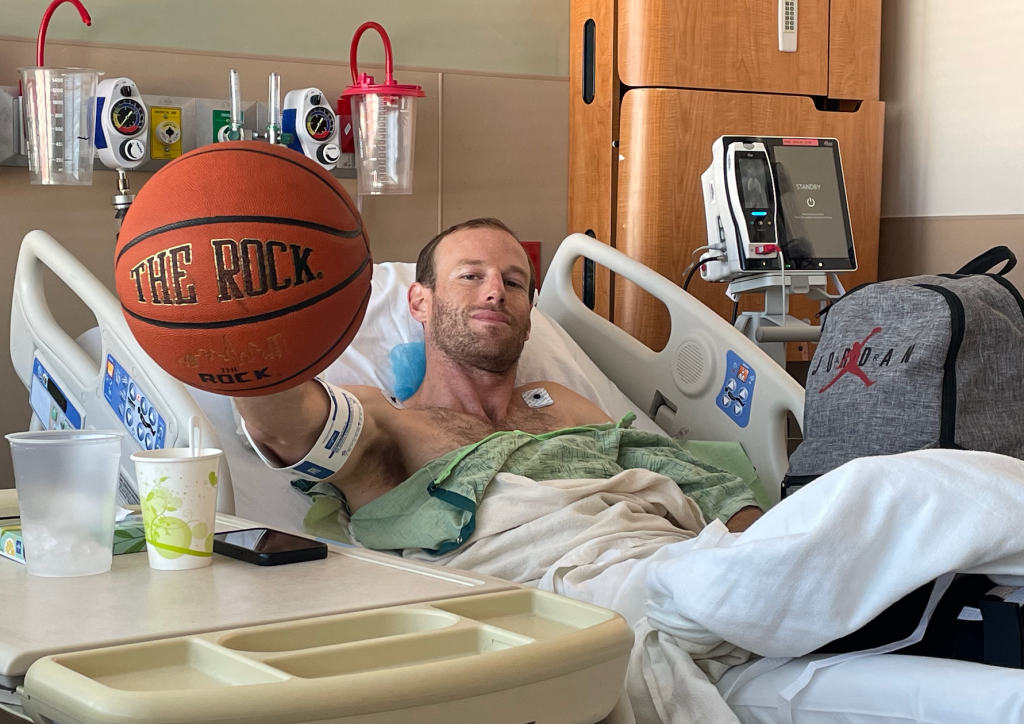
I mention all this today because I’ve been incredibly impressed with Brendan’s resilience this week. Just as his new business of personal basketball coaching was gaining momentum, he had a major setback. The surgery to repair his ruptured patellar tendon was successful yesterday, but it’s going to be a long, slow recovery process. This has not deterred Brendan’s commitment to fulfilling his dream. It requires a detour, for sure, but Brendan is focused and motivated to do whatever needs to be done to get back on track. This impresses me.
Within hours of completion of the surgery, Brendan was up and walking (with crutches) in the hallway of Regional Medical Center. He knows he has a long road ahead. He is also well aware that a journey of a thousand miles begins with a single step.
 A Beacon of Light
Leave a comment