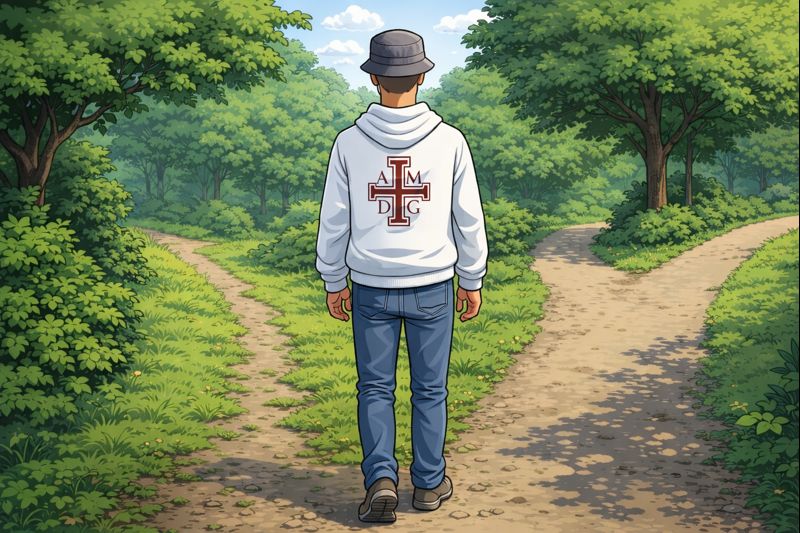
“Two roads diverged
in a wood, and I —
I took the one
less traveled by…”
Robert Frost
The Road Not Taken, by Robert Frost, was first published in The Atlantic Monthly magazine in August 1915. Over the next 110 years, it would become one of the most inspirational and oft-quoted poems in American literature.
Two roads diverged in a yellow wood,
And sorry I could not travel both
And be one traveler, long I stood
And looked down one as far as I could
To where it bent in the undergrowth.
Then took the other, just as fair,
And having perhaps the better claim,
Because it was grassy and wanted wear;
Though as for that the passing there
Had worn them really about the same.
And both that morning equally lay
In leaves no step had trodden black.
Oh, I kept the first for another day!
Yet knowing how way leads on to way,
I doubted if I should ever come back.
I shall be telling this with a sigh
Somewhere ages and ages hence:
Two roads diverged in a wood, and I —
I took the one less traveled by,
And that has made all the difference.
In some ways, I can apply Frost’s words to the life I’ve lived. The expectation that I would follow in my Dad’s footsteps and enjoy a respectable, worthwhile career in the San Francisco Fire Department were high. When opportunities arose in my life which offered me a view down a different path, I had the courage to take that path, knowing full well that it would not be as financially lucrative, nor as highly respected, as the road my Dad had taken. I always thought Frost’s poem was extolling the virtues of taking that less traveled path.
Which road is the better option?
Recently, I’ve come to understand this highly expressive literary piece in a different way. This perspective begs the question Which road is the better option? In fact, I’m even prompted to ask Which road is truly less traveled?
We live in a throw-away society. Use it, then dispose of it. If an appliance breaks, replacing it is significantly easier, and often more cost-effective, than attempting to repair it. For many people, when a newer version of the iPhone is introduced, the one they have loses its appeal and they desire the newer model. At times, those around us consider it foolish for us to hold on to something we’ve had for many years, insisting that we would be significantly happier with the updated, perhaps more reliable, version of the product. Most people, it seems, are intent upon keeping up with the current trends and having the latest and greatest of everything. Why? Three reasons: because they can, everyone else seems to be doing it, and people who know us expect that we should do so as well. If that’s the norm in society, and it seems to be, then the road less traveled might actually describe making a commitment to repair the older, sometimes unreliable refrigerator, watch, television, cell phone, lamp, mattress, faucet, car,…
Whichever road we choose, there is always a risk that we will experience the ache of imagining the road we didn’t take. I find solace in the message of American journalist Katie Couric. While speaking on the value of overcoming challenges along unconventional paths, Couric explained that the road less traveled may be harder to navigate, but the rewards at the end, even though not guaranteed, have the potential to be even greater.
 A Beacon of Light
Leave a comment