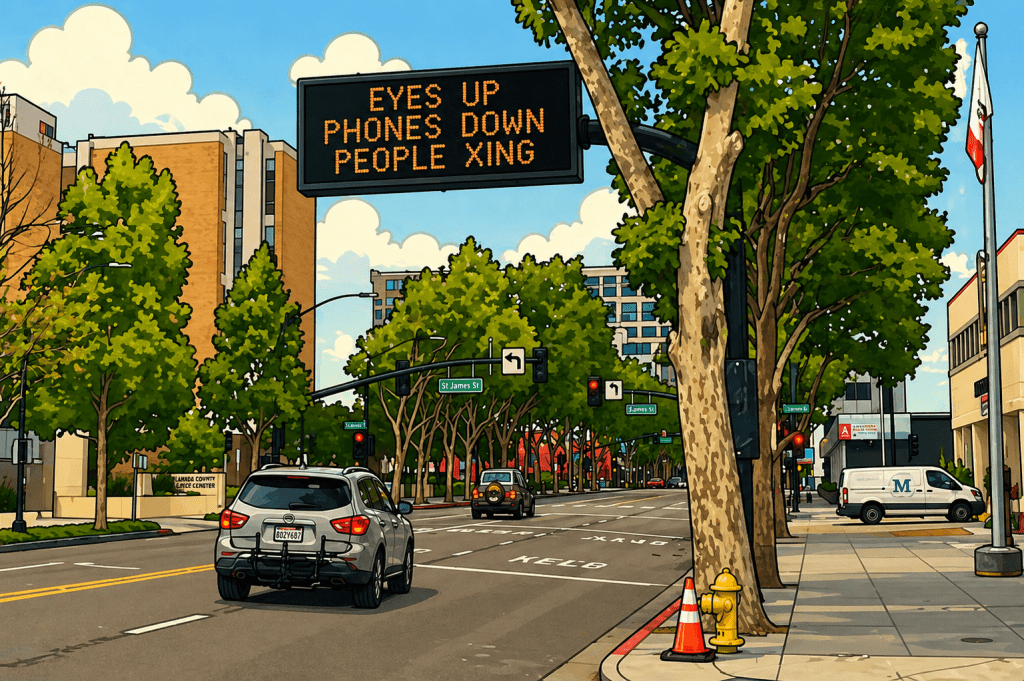
“Drive now.
Text later.”
It happened again on Tuesday morning. I was stopped at a traffic light behind a young woman whose head was down while the stoplight was red. I can only assume she was texting, because when the light turned green, her head did not move… nor did her car. A quick toot of my horn got her to look up, at which time she accelerated sharply and sped up to the next intersection. Again, the light was red, and again, she looked down at her phone. Ironic, since I had snapped the image above at about 7:30 that morning in downtown San José.
Texting and driving seems to be increasingly common. I would even go so far as to call it an epidemic. Apparently, many drivers are convinced that they are skilled at multi-tasking, so texting and driving is manageable for them. Well, it is… until it isn’t.
According to the National Highway Traffic Safety Administration (NHTSA), the average amount of time a driver’s eyes are taken off the road to send or read a text message is five seconds. At 55 miles per hour, a vehicle travels approximately 80 feet per second. In five seconds, it covers about 400 feet — the more than the length of a football field, including the end zones. Can you imagine driving down the street and just closing your eyes for five seconds, regardless of the speed of the vehicle? The thought of it terrifies me.
There are four main types of distractions to drivers: visual (taking one’s eyes off the road), manual (taking one’s hands off the wheel), auditory (hearing distracting sounds), and cognitive (focusing the mind on something other than driving). These distractions can occur individually or they can happen in some combination. All of them have the potential to severely reduce the driver’s awareness, thereby increasing the risk of an accident.
Visual distractions include such things as texting, using a GPS system, checking a phone, or rubbernecking at the scene of a traffic accident. Manual distractions include eating, drinking, or smoking while driving, as well as adjusting in-car systems such as the radio or temperature controls. Auditory distractions are noises from inside or outside the vehicle which hinder a driver’s ability to stay focused on the task of driving. These can include loud conversations, crying or misbehaving children, noisy vehicles in close proximity to the car, or even audio alerts. Finally, cognitive distractions include deep, thoughtful conversations, daydreaming, or a preoccupation with intense thinking about a work or family problem.
Of these distractions, it is believed that texting is the most dangerous distraction, because it combines all four types of distractions.
We are all at risk from distracted driving any time we’re on the road — or the sidewalk, for that matter. Pedestrians must be vigilant about verifying that an oncoming driver sees them. Drivers today must be aware that there are people texting and driving alongside them on the roadways. While we have no control over the actions of others, we have full control over our own actions. I keep my phone on silent when I’m driving. If I hear the buzz of a text message or phone call coming in, I have two options. (1) I can pull off the road at the earliest opportunity to address the text or call, or (2) I can simply wait until I reach my destination to check on the call and respond to the caller.
I share this information today with the hope that, perhaps, I might be able to influence one or two people to put their phone down and keep their eyes on the road. The signs on California highways, you know, the ones we often ignore because we don’t think they apply to us, are powerful: “Stay alive. Don’t text and drive.”


Leave a Reply