“Ghosts and goblins
come to play
on October’s
final day!”
Rusty Fischer
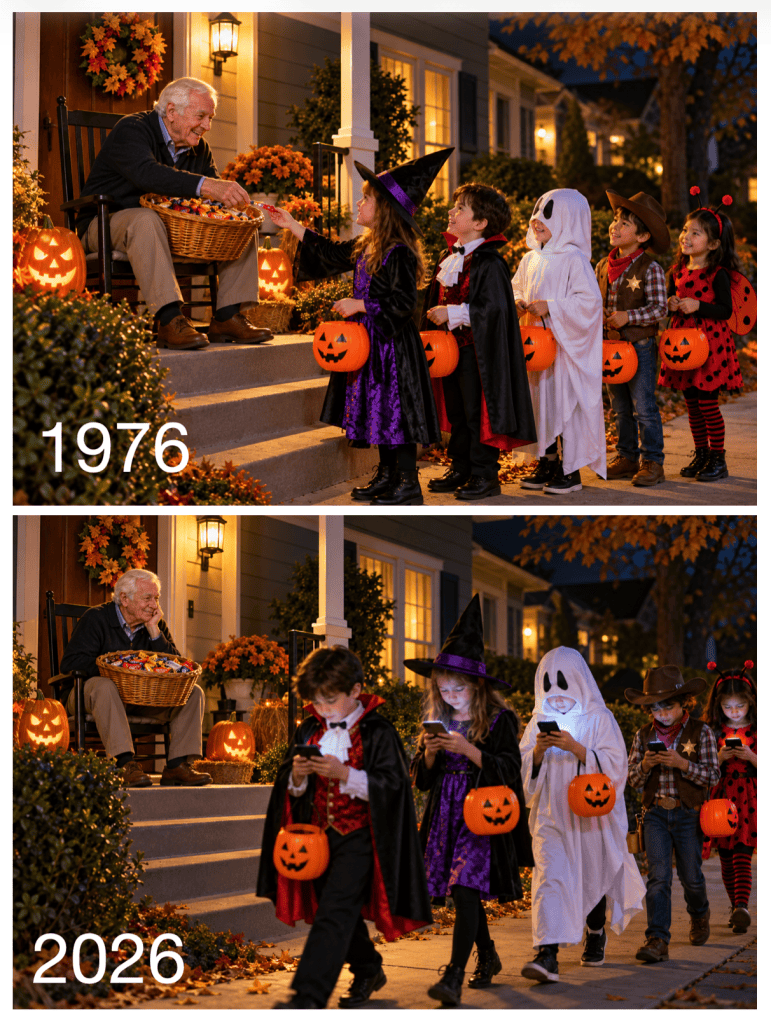
Walk out onto just about any neighborhood street in late October, and you will notice a striking transformation. The landscape of Halloween today bears little resemblance to the holiday of fifty years ago. What was once a low-budget, child-led neighborhood ritual has evolved into a commercialized, adult-driven marketing phenomenon. But perhaps the most profound shift isn’t the elaborate yard inflatables, it’s how children themselves experience the night.
In the 1970s and 1980s, Halloween belonged entirely to children. Costumes were a do-it-yourself affair, quickly assembled from old clothes, cardboard, or a plastic smock and mask set. Groups of neighborhood kids roamed freely for hours without adult supervision. The experience of Halloween involved the rustle of pillowcases filling with candy, the crisp autumn air, and the friendly face-to-face interactions with neighbors.
Over the decades, that unstructured freedom has faded away. Driven by 1980s safety concerns and a growing desire for predictability, the traditional neighborhood trick-or-treating experience was gradually replaced by tightly controlled environments. Today, Halloween events in church or school parking lots and shopping malls have largely supplanted the classic porch-to-porch trek for candy.
As the physical landscape changed, the digital landscape took over. Today’s children are growing up in a hyper-connected world, and this is evident on Halloween night, as well. For many older kids today, the immersive, immediate social experience of trick-or-treating seems to take a backseat to their technological devices.
It’s not uncommon to see groups of kids, many accompanied by parents, walking through the neighborhood with their faces illuminated by the glow of smartphones. Instead of being fully present in the spooky atmosphere and joking with friends, many kids are occupied with capturing the night for an audience. The focus has shifted from experiencing the moment to documenting it — snapping selfies, posting costume updates, and checking notifications between houses. For the younger generation, it seems that a holiday is only as real as its digital footprint.
The allure of the digital world competes directly with the simple appeal of gathering candy. When video games, streaming platforms, and social media feeds offer instant gratification at the press of a button, walking through the neighborhood in the cold for a few fun-size candy bars can feel like a chore to a tech-native child. The neighborhood social network of the past has been replaced by a digital one.
Halloween will always hold a special place in our cultural calendar, but it’s important for us to recognize how much has been lost in the translation to the modern era. While today’s holiday boasts unmatched spectacle and cinematic costumes, it lacks the simple, tech-free community connection that defined it fifty years ago. As we move forward, the challenge will be helping children look up from their screens long enough to catch the real magic of the night.


Leave a Reply