“Teaching kids to
count is fine, but
teaching them
what counts
is best.”
Bob Talbert
On a regular basis, upon meeting someone and revealing that I was a teacher for 43 years, I am asked what I taught. I know what they’re asking, but I love the look on their face when my response is, “I taught students.”
In reality, that is what I taught. Students. To be more specific, I could tell them that, through the years, I taught various courses in religious studies, literature, psychology, philosophy, and English language arts, but who I taught was always more important to me than what I taught — or tried to teach. (Some of the courses I was asked to teach were definitely out of my comfort zone.)
Is it really important that my former students remember that Franz Kafka wrote The Metamorphosis or that Jack London’s The Call of the Wild begins on what is now a Carmelite monastery at the corner of Lincoln and Benton Streets in Santa Clara?
Does it really matter if they can explain, at this point in their lives, the significance of the Edict of Milan, the Council of Jerusalem, or the Western Schism?
Will it make any difference in the lives of my former students if they are unable to recall that the hierarchy of needs was introduced by Abraham Maslow, or that Sigmund Freud is considered to be the founder of psychoanalysis?
Are they at any disadvantage in life if they cannot recall that philosopher René Descartes coined the phrase “I think, therefore, I am” or that William James is widely regarded as one of the most famous American philosophers?
I don’t think so. For this reason, much of what I focused on as a teacher was helping my students become better writers and better human beings. To have the ability to express oneself in writing, clearly and concisely, using correct spelling, punctuation, and grammar, seems far more important, and useful, than the subject matter identified in the curriculum of the courses I was asked to teach. I wanted my students to understand that being a person of good character, a person with integrity, is far more important than anything else I could have taught them in the classroom.
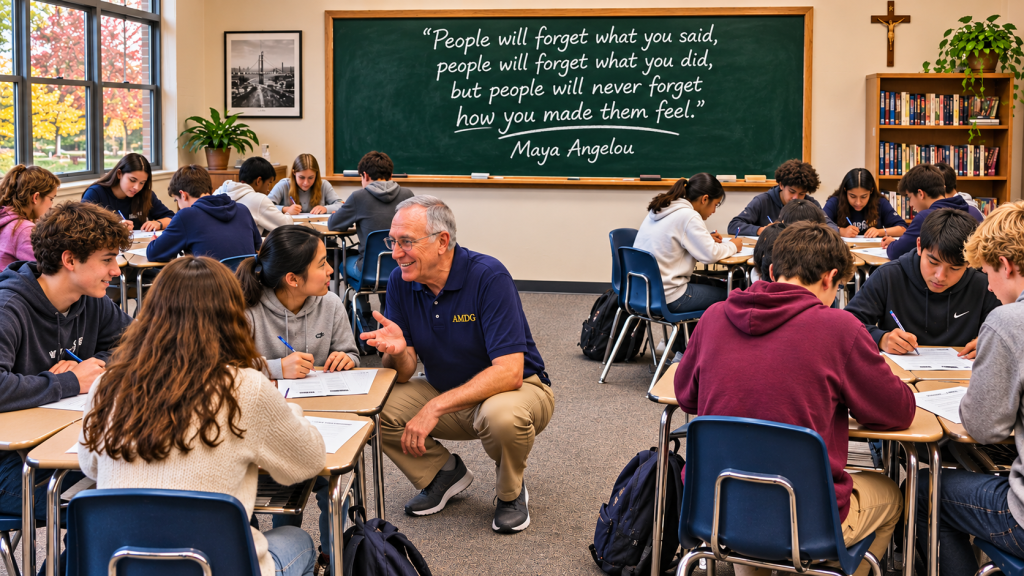
The bottom line is that despite all my efforts to teach any of these things, it is humbling to recognize the validity of Maya Angelou’s words about the impact teachers have on their students. I can only hope that, when my former students reflect back on their experience of me as their teacher, they can do so with a sense of peace — and, perhaps, gratitude.


Leave a Reply