-


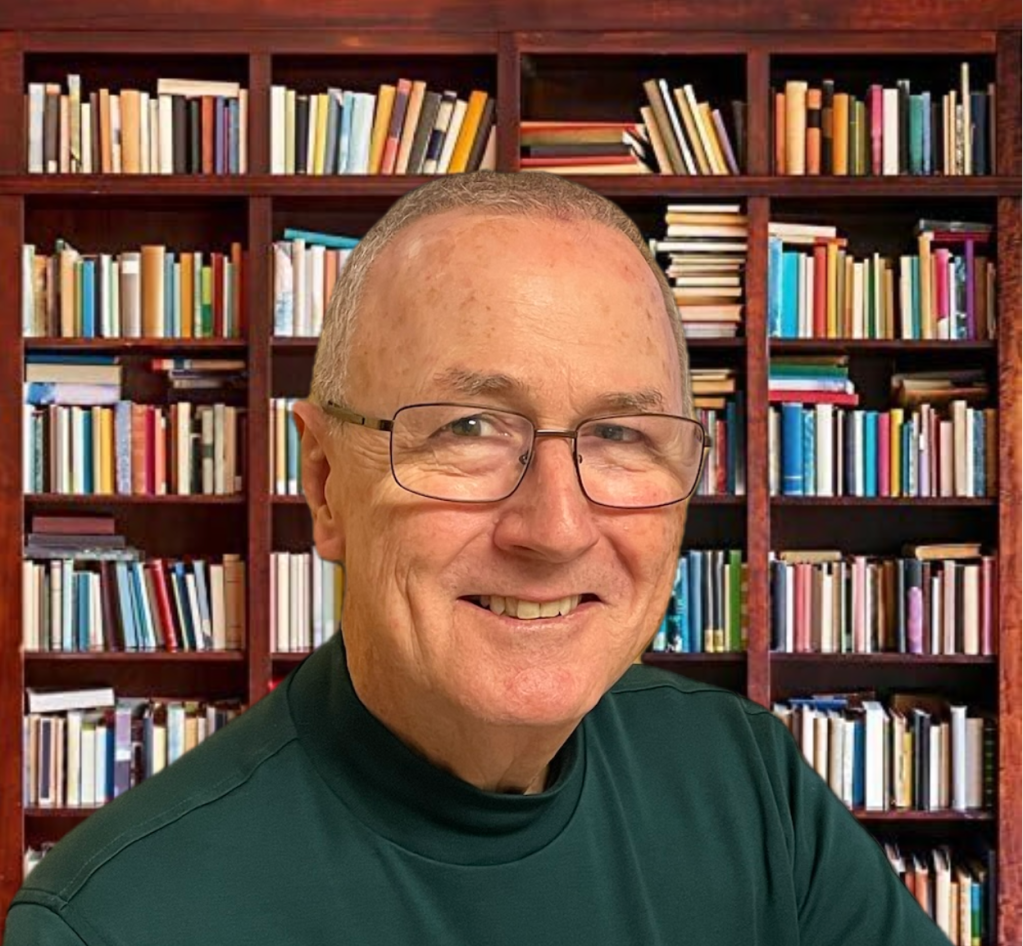
My name is Kevin Carroll. I was born and raised in San Francisco, California, where I attended Saint Ignatius College Preparatory. I am a graduate of both Santa Clara University and the University of San Francisco. Following a 40-year career in teaching and pastoral ministry, I launched a new career as a writer and speaker.
I live in San José, California. My wife, Kathy, and I have three adult sons and five precious grandchildren. I have much for which to be grateful.
I can be reached via email at kmc43sjc@gmail.com
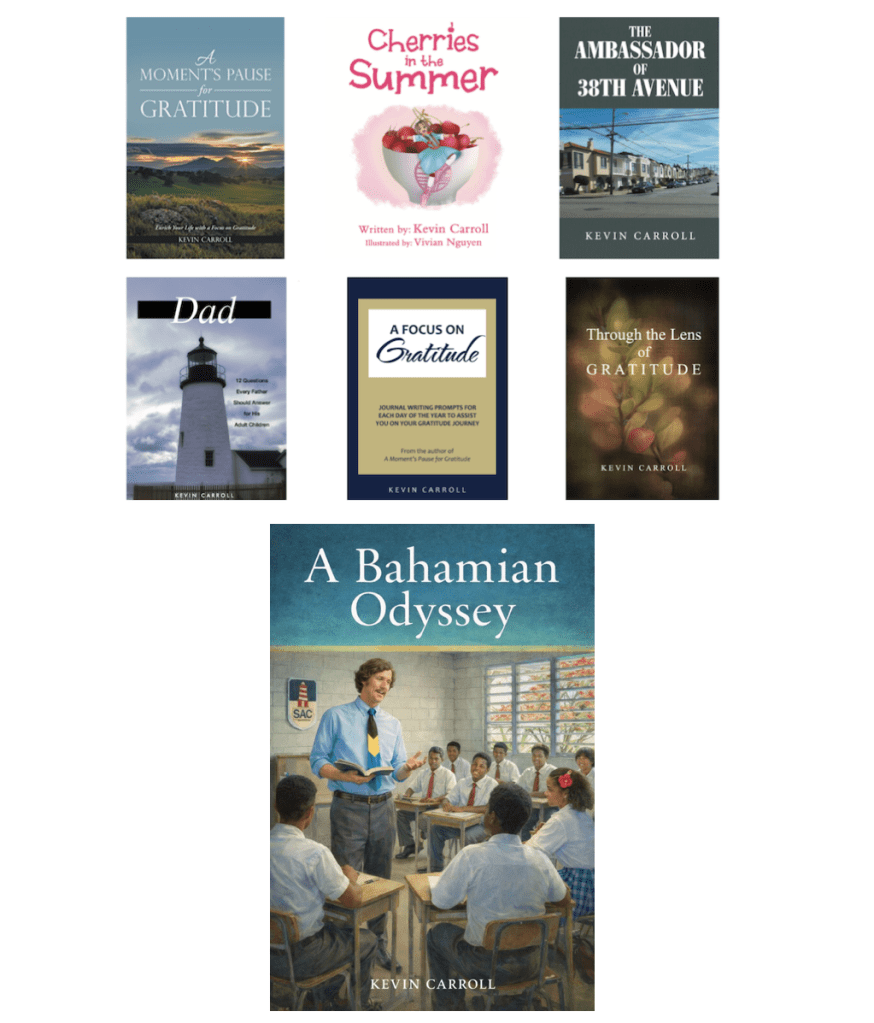
My books are available for purchase online from Amazon. I also have copies of some of these titles at my home for those who would like to buy them directly from me.
A Moment’s Pause for Gratitude (2017)
Cherries in the Summer (2021)
The Ambassador of 38th Avenue (2022)
Dad: 12 Questions… (2023)
A Focus on Gratitude (2024)
Through the Lens of Gratitude (2024)
A Bahamian Odyssey (2026)
-

- April 2026
- March 2026
- February 2026
- January 2026
- December 2025
- November 2025
- October 2025
- September 2025
- August 2025
- July 2025
- June 2025
- May 2025
- April 2025
- March 2025
- February 2025
- January 2025
- December 2024
- November 2024
- October 2024
- September 2024
- August 2024
- July 2024
- June 2024
- May 2024
- April 2024
- March 2024
- February 2024
- January 2024
- December 2023
- November 2023
- October 2023
- September 2023
- August 2023
- July 2023
- June 2023
- May 2023
- April 2023
- March 2023
- February 2023
- January 2023
- December 2022
- November 2022
-
Taiko

“Taiko is the heartbeat
of the Japanese people.”
KodoTaiko is a 12,000-year-old form of Japanese music which highlights the art of drumming. This energetic style of music, which has been used in religious ceremonies and festivals throughout Japanese history, often incorporates dance and athletic movements. Taiko serves as a powerful symbol of community, tradition, and spiritual connection for the Japanese people. Author Gil Asakawa, in his book Being Japanese American, boldly states that “Taiko is beginning to catch on as Japan’s most influential and lasting gift to the world of music.”
Last night, Kathy and I had an opportunity to experience taiko music on the grounds of Hakone Gardens and Estate in Saratoga. The venue is a 110-year-old Japanese garden owned by the City of Saratoga and operated by the Hakone Foundation, a 501(c)(3) non-profit. The performance was the inaugural event of the new benefit series Garden of Culture at Hakone, which will feature Asian performing arts in the historic garden setting. Funds raised at these events are used to promote cultural exchange and support maintaining the Hakone grounds.
The performance featured renowned taiko artist Kenny Endo, along with a variety of guest musicians. Endo, a pioneer of contemporary taiko, is recognized internationally for his innovative fusion of traditional Japanese drumming with global music influences.
The Hakone venue was ideal for Endo’s performance. The outdoor garden space provided the perfect setting for the concert on a comfortable spring evening. Endo and his colleagues didn’t disappoint, playing a number of original compositions to the delight of concert goers at the sold-out event. If you are interested in getting a taste of Endo’s taiko style, watch this YouTube video. I am confident that you will enjoy it.
In a brief conversation with Hiroshi Tanaka, one of the drummers at last night’s performance, he agreed with a quote I had come across about taiko drumming. Mutsuru Ishizuka, a gifted taiko drummer, had said, “The taiko is not an instrument just to hear but to feel with one’s whole body.” This was precisely the experience of those in attendance last night at Hakone Gardens. The inaugural concert of the Garden of Culture at Hakone series was a tremendous success.
-
With Gratitude

“We should do this
every day of the year,
and not just one.”
Beth PenningtonToday is a national holiday, a day off from school or work, and traditionally a day for picnics, barbecues, baseball games, and parades. Memorial Day is the unofficial start to the summer season. While all this may be accurate, none of it reflects the true purpose of the day.
Throughout the history of the United States, countless men and women have died while serving in our nation’s armed forces. It is their sacrifice, the ultimate sacrifice, which has given us the gift of the freedom we enjoy in our country. It is this selflessness that we acknowledge with gratitude each year on Memorial Day.
Today, I would like to share ten quotes about what it is we acknowledge on this day.
• Franklin D. Roosevelt: “Those who have long enjoyed such privileges as we enjoy forget in time that men have died to win them.”
• Winston Churchill: “Never in the field of human conflict was so much owed by so many to so few.”
• G. K. Chesterton: “Courage is almost a contradiction in terms. It means a strong desire to live taking the form of a readiness to die.”
• Harry S. Truman: “Our debt to the heroic men and valiant women in the service of our country can never be repaid. They have earned our undying gratitude. America will never forget their sacrifices.”
• John F. Kennedy: “As we express our gratitude, we must never forget that the highest appreciation is not to utter words but to live by them.”
• Sgt. Major Bill Paxton: “May we never forget our fallen comrades. Freedom isn’t free.”
• Tamra Bolton: “This is the day we pay homage to all those who didn’t come home. This is not Veterans Day, it’s not a celebration. It is a day of solemn contemplation over the cost of freedom.”
• Barack Obama: “Our nation owes a debt to its fallen heroes that we can never fully repay.”
• Lee Greenwood: “And I’m proud to be an American, where at least I know I’m free. And I won’t forget the men who died, who gave that right to me.”
• Jennifer M Granholm: “Ceremonies are important, but our gratitude has to be more than visits to the troops and once-a-year Memorial Day ceremonies. We honor the dead best by treating the living well.”
-
A Global Game

“Success is no accident.”
PeléSome call the game football, not to be confused with American football. Others prefer to call it fútbol. I grew up calling it soccer. Whatever one might want to call it, this game is the most popular sport in the world. According to the World Atlas, soccer has 3.5 billion fans as of 2025. That billion, with a b. And the numbers two, three, and four most popular sports in the world? One might be surprised to learn that they are 2. Cricket, 3. (Field) Hockey, and 4. Tennis. Basketball ranks #7 and Baseball #8. American football didn’t make the top ten.
I was in third grade when my Dad took me down to South Sunset Playground one foggy afternoon to watch a group of kids running around the field kicking a brown ball. (The iconic soccer ball with the black and white pattern of hexagons and pentagons was not introduced until 1970 when it was used to make the ball more visible for television viewers watching the World Cup matches being played in Mexico.) A coach was instructing the kids on the field at the playground about how to play the game. I watched from a distance for a while before Dad asked if I would be interested in playing the game. I responded with an enthusiastic yes. At the conclusion of the practice, we approached the coach and my Dad introduced himself and me. The coach was Ernie Feibusch, a former professional soccer player from Germany and founder of the San Francisco Vikings Youth Soccer Program. This organization introduced thousands of Bay Area kids to the game of soccer. I am grateful to have been one of them.
I played for the Vikings for five years. In those days, soccer had not gained the popularity on the West Coast that it enjoys today. In fact, on several occasions, Coach would take two dozen players by charter bus to places like Petaluma, Sonoma, and Sebastopol to play demonstration matches in front of city officials, recreation leaders, parents, and kids to introduce those communities to the game of soccer. After each match, the host city would have a barbecue for everyone and the kids got to meet those of us who had played in the game. We were treated like celebrities. Now, 60 years later, soccer is well-established throughout California and across the United States.
In August 2023, the California Interscholastic Federation (CIF) published a report on participation in sports by high school students in the state. Soccer was ranked #2 for boys (behind only American football), while it was ranked #1 for girls (followed by volleyball.) The CIF estimates that just under 100,000 high school students play soccer for their school teams each year.
The steady growth of participation in soccer has led to a nation of soccer fans. Today, there are 30 professional men’s soccer clubs, including the San José Earthquakes. There is also a National Women’s Soccer League, featuring 14 clubs, one of those being Bay FC, the Bay Area’s first professional women’s team. It is clear that soccer is alive and well in the Santa Clara Valley.
Last night, I had the opportunity to attend a match at PayPal Park between the San José Earthquakes and the Houston Dynamos. Houston, wearing bright orange jerseys, jumped out to a 2-0 halftime lead, despite the fact that the Quakes had controlled the ball through most of the first 45 minutes. The second half was a different story. San José scored three goals to take a 3-2 lead late in the game. Sadly, the Dynamos scored a tying goal in stoppage time, resulting in the final score of 3-3. With six goals, exceptional ball control by both teams, a number of quality saves by the goalkeepers, and incredible athleticism and effort displayed by the players, it was the most exciting soccer match I’ve ever attended. The feeling in the stadium was electric.
I’m grateful to my friend, Terry, a season ticket holder for more than twenty years, for inviting me to the game.
-
Pool Time!

“I could never in
a hundred summers
get tired of this.”
Susan BranchMemorial Day weekend… the unofficial start to summer. I’m ready!
Growing up in San Francisco’s Sunset District in the 1960s, the only things we needed for a good summer vacation were warm sunshine and a swimming pool. To enjoy these amenities, we spent time at Redwood Rest Resort in Boulder Creek, Pine Grove Resort in Northern California, and many Sunday afternoons at my cousin Dan’s home in the San Carlos hills. When I graduated from high school in 1972, I had the opportunity to live in San José, California, where I again enjoyed warm sunshine and access to a pool.
When Kathy and I purchased our condominium home in 1986, one of the selling points was that our West San José complex has a beautiful pool and spa. Of course, the three-bedroom, two-bath unit with a large, private, enclosed, two-car garage was a significant factor, as well, but the pool was the icing on the cake. I would never want a pool in the backyard of my own single-family home. Liability worries and the cost of heating and maintaining the pool are burdens I have no desire to take on. A community pool, however, is ideal.
In the years when we were raising our three boys, we made good use of the pool and spa facilities throughout the summer months. Normally, the pool heat is turned on by May 1st and remains on until the end of October. In June, July, and August, we used the pool almost every day. There were other kids in the complex who, in those years, used the pool regularly, as well. It was an ideal venue for making friends and building community.
In their high school and college years, our boys used the spa more often than the pool. It was a great way for them to relax after their football, soccer, basketball, or baseball games and practices. I enjoyed late-night visits to the spa, as well. Once the kids were in bed, I could spend 20 to 30 minutes enjoying the hot, healing waters of the spa before getting a good night’s sleep. It was quite a treat.
Time passes quickly. We have now lived in our home for almost 39 years. This summer, we will once again be spending a good deal of time at the pool, only now it will be with our grandkids. Since Steve and Morgan live just two doors down from us, their kids are beginning to use the pool quite regularly. During the summer months, it will be our go-to place. Why? We are blessed to have warm sunshine at the pool, making it a perfect place to hang out on a summer afternoon. There’s no need to leave home to enjoy the ingredients of a good summer vacation.
It’s easy, and quite normal, for us to take things for granted once we’ve had them for a while. Our pool, however, is one thing for which I will always be grateful. Year after year, it has provided a quiet, peaceful place to cool off, relax, exercise, read, visit with neighbors, and, on occasion, take an afternoon nap.
While I may not live long enough to experience “a hundred summers,” I know I’ll never get tired of enjoying our pool.
-
Memorable Moments

“We don’t remember days,
we remember moments.”
Cesare PaveseCesare Pavese was an Italian poet and novelist. While I may disagree with the first part of his statement above — there are certainly many days I do remember — I agree that it is the moments which often provide the most vivid and enduring memories of our lives.
I took some time to jot down one experience, one moment, which I recall from my first twenty-five years of life. I was born in June 1954, but other than backyard picnics with my mother, learning to tie my shoes while watching Captain Kangaroo in the living room of our family home, and going to the horse races at Bay Meadows with my Uncle Bill Carroll, I don’t really recall much prior to 1960.
I do, however, vividly remember…
1960: …falling off the monkey bars at South Sunset Playground and breaking my right wrist.
1961: …throwing up on the sidewalk outside Kaiser Hospital in San Francisco on May 5, 1961, the same day Alan Shepherd became the first American to fly into space.
1962: …being told that Marian McCarthy, one of my Saint Gabriel School classmates who was also my square dancing partner during physical education class, had died.
1963: …sitting on the grass outside South Sunset Playground with yard supervisors Grove Mohr and Don Ybaretta, as well as several of my classmates, listening to news reports of the assassination of President Kennedy on Mr. Mohr’s transistor radio during our lunch break.
1964: …standing at the casket of my classmate and best friend, Mike Celeski, with Sister Mary Roberta, my third-grade teacher, at Carew & English Mortuary at Turk & Masonic.
1965: …watching Bob Portman hit the game-winning basket at Kezar Pavilion to give Saint Ignatius High School the victory over Sacred Heart High School to win the Bruce-Mahoney Trophy.
1966: …learning a lesson about shopping and deferred-gratification after purchasing an over-priced bag of plastic golf balls at a sporting goods store in Monterey, California.
1967: …when a camper at Silver Tree Day Camp, where I was a volunteer junior counselor, fell down the hill from Red Rock and sustained multiple compound fractures.
1968: …seeing Senator Bobby Kennedy in person and hearing him speak at Lakeshore Plaza on Sloat Boulevard in San Francisco thirty hours before he was shot and killed in Los Angeles.
1969: …working my first shift as a PBX switchboard operator at Welch Hall on the campus of the University of San Francisco and being pleasantly distracted by a USF women’s powderpuff football game which was being played outside the office window on the front lawn between St. Ignatius Church and Campion Hall.
1970: …meeting Mari Jo Whelan, my first high school girl friend, at the home of Tim (my mother’s cousin) and Joan (Mari Jo’s aunt) Healy. We had met two years earlier at Tim & Joan’s wedding.
1971: …meeting a small group of high school students from Milwaukee, Wisconsin while staying in Mandeville, Jamaica.
1972: …moving into my room in the dormitory at Bellarmine College Preparatory in San José where I lived and worked during my college years.
1973: …attending my first concert — Sha Na Na at Winterland in San Francisco.
1974: …having an early-morning breakfast and conversation in the dining hall at Bellarmine College Prep with legendary UCLA basketball coach John Wooden.
1975: …saying goodbye to the children at Ranfurly Home, an orphanage in Nassau, Bahamas, the night before returning to the U.S. after a year teaching at Saint Augustine’s College.
1976: …sitting at a picnic table in the backyard of my family home on 38th Avenue on a warm summer day working on lesson plans for my new job teaching at Bellarmine College Prep.
1977: …sitting in the office of the Santa Clara Mission Cemetery, where I had a part-time job as a night security guard, writing a perfect Shakespearean sonnet the night before it was due in my Renaissance Literature class at Santa Clara University.
1978: …walking into a very chaotic San Francisco City Hall at around 3:00 p.m. on the day Mayor George Moscone and Supervisor Harvey Milk were shot and killed. I was there to submit a waiver for the job of firefighter with the San Francisco Fire Department.
1979: …working in the 7-B classroom on a late-summer day, preparing for my first year teaching at Saint Christopher School in San José, when I noticed the inquisitive faces of Molly Giannini and Carolyn Giovanola, two incoming seventh graders, peering in through the open door to check out the new teacher. I put them to work immediately putting up bulletin boards!
Of course, there have been many more memorable moments in my life since 1979. Perhaps I’ll share some of those in a later blog post.
Meaningful memories. Unforgettable moments. While some were happy times, others were regrettable. I am grateful for the ability to remember all of these moments in vivid detail.
What “moments” do you recall from your past?
-
Focus

“We see the world
not as it is,
but as we are.”
Stephen R. CoveyOptimists seem to recognize the good in the world more often than the bad. Pessimists seem to notice the bad in the world more often than the good. The quote above, by Stephen R. Covey, author of The 7 Habits of Highly Effective People, rings true for me.
For those who develop and maintain a mindset of gratitude, those who are able to view the world, and those around them, through the lens of gratitude, life can be a gratifying experience. These are the “cup half-full” folks who always seem to find a way to identify the opportunity in any situation.
Barry Neil Kaufman, author of Happiness is a Choice, agrees with Covey. He wrote, “The way we choose to see the world creates the world we see.”
How do you see the world? What do you do, or what can you do, to see the world in a more positive light?
In his insightful book, 20 Gifts of Life, local author Hal Urban wrote, “What we do with our lives, whether good or bad, will eventually come back to us.” He points out that this is considered by many to be a natural law of the universe. Some refer to it as Karma. Urban continues, “The more good we do, the more it comes back to us. If we’re consistently kind, honest, and hard-working, we’ll eventually reap the rewards… If we’re consistently mean, dishonest, and lazy, we’ll eventually suffer the consequences.”
Most of us, I would think, can cite numerous examples of this not being accurate. Rabbi Harold Kushner even published a book about this — When Bad Things Happen to Good People. Yes, it’s true. Bad things do occasionally happen to good people. Life isn’t always fair. Generally speaking, however, my own experience of life validates Dr. Urban’s claim that, as the Bible tells us, “we reap what we sow.”
Developmental psychologist, Thomas Lickona, is the author of How to Raise Kind Kids, Character Matters, and six other titles. Hal Urban shared this quote by Dr. Lickona in 20 Gifts of Life: “We may not always reap a good harvest in the short run from the good that we sow, but ultimately, later in this life or in the next life, we will indeed reap what we have sown.”
It seems that the ball is in our court. Do we want our experience of the world to be good? If so, we must be good, we must do good, and we must strive to see the world around us through the lens of gratitude. It really is that simple.
-
Driving in 2025

“Honk if you love Jesus.
Text while driving if
you want to meet Him.”
Bumper StickerAs we near the end of the fifth month of 2025, it is imminently clear that driving on the streets of our cities can be perilous. Red light running has grown to epidemic proportions. Texting while driving is considered by many to be a multi-tasking skill, rather than the risky, irresponsible behavior it is. Exceeding the posted speed limit is all too common on many streets and highways. Aggressive driving can be seen more often than I would like to admit. As John Dudley wrote on Instagram recently, “Driving is a full time job. You need to anticipate the move of every vehicle in traffic around you every second.”
I could write all day about the dangers of being on the roads in 2025, but I choose not to do so. Instead, I would like to focus on the fact that most drivers in our community are responsible, conscientious, and courteous when they are behind the wheel.
This crossed my mind yesterday afternoon as I sat at a busy intersection waiting for the light to turn green. Dozens of cars passed through the intersection in both directions while I waited my turn to go. It was a long red light, as there were turning lights at this crossroads, as well. I sat in amazement as I recognized that everyone was doing exactly what they were supposed to be doing,… at least, as far as I could see. Might someone have been texting? Perhaps, but I didn’t notice anyone doing so. The flow of the traffic seemed to be going at or near the posted speed limit. I didn’t see any tailgating or aggressive driving. When the light changed, everyone stopped at the right time. Those of us waiting to cross the intersection waited for the vehicles in the turning lanes to go, then accelerated when the light turned green for us.
Today is not the first time I’ve noticed this. I have become quite accustomed to seeing multiple traffic violations by motorists who put themselves and those around them in danger on a regular basis. For the most part, however, drivers I encounter on the road, a large percentage of them, drive with competence and caution, and comply with the rules of the road.
It is so easy to focus on the negative aspects of our world, but the older I get, the more I realize that we tend to see what we’re looking for. When we expect drivers around us to be rude, careless, and capricious, that is often what we see. Sadly, driving in 2025 requires that we have such awareness, but it should not be our focus. Dangerous drivers do exist and we must be aware of them when they are around us. Still, I want to take this time to express my sincere gratitude to those drivers who take responsibility for their own safety and the safety of those around them. You are noticed and you are appreciated.
-
On Work

“All labor that uplifts
humanity has dignity
and importance and
should be undertaken
with painstaking excellence.”
Martin Luther King, Jr.I will be forever grateful to have lived during the papacy of Pope Francis I. His vision, energy, positivity, and compassion for “the least of these among us” has inspired me and modeled for the world how we are all called to live our lives. With the election of Cardinal Robert Prevost, who chose the papal name Leo XIV, to serve as our next pope, I get a sense that the Church will be encouraged and challenged to revisit issues which Pope Leo XIII addressed in his 1891 landmark encyclical, Rerum Novarum (On the Dignity of Labor).
The selection of a papal name is not random. The moment it was announced that Cardinal Prevost had selected the name Leo, it was clear that he intends to continue the work of Pope Leo XIII who championed the rights of workers and the dignity of both work and workers.
This surely is an issue which needs to be addressed. We live in a world where people are judged by myriad factors, including one’s line of work. Think about it: cardiologist or housekeeper; attorney or farmworker; engineer or gardener; CEO or custodian; architect or fast food worker;… You can see where this is going. As a society, it’s clear that those employed in higher-paying jobs are more highly respected than workers earning minimum wage. It is also clear that many business owners treat their workers in ways which lack basic human dignity.
The situation in our country has gotten so bad that some Americans would rather remain unemployed and rely on government assistance than take what some would consider a menial job. In an interview in the ABC News Special Report The Blame Game: Have We Become a Nation of Victims?, one young man, in response to being asked why he chose to remain unemployed when jobs were currently available in the fast food industry, blurted out, “Flip a burger? Are you kidding me? I ain’t gonna flip no burger.”
It seems that too many young people today fail to understand the term “means to an end.” The news reporter was not suggesting that the young man devote his entire lifetime to working in a fast food restaurant. He was suggesting that starting with that kind of job would be a good way of beginning a history of employment which could open up greater possibilities for him down the line — a stepping stone to a preferred future.
People who know me are aware of my four decades in education. Some know that, since my retirement in 2015, I have published six books and accepted multiple speaking engagements. What most people don’t know is that I also had a few “means to an end” jobs in my younger days, jobs which included landscape maintenance, flipping burgers at McDonald’s, summer camp counselor, night security guard at a cemetery, operations manager for a business machines company, tutoring, shipping and receiving clerk in a college bookstore, courtesy clerk in a grocery store, and PBX switchboard operator. I had no intention of making a career out of any of these positions, but all provided me with valuable experience which enabled me to move on with skills I had not previously possessed.
This seems to be an ideal time to dust off Pope Leo XIII’s document on the dignity of work and workers and remind the world about what the encyclical demands. Perhaps it will provide an opportunity to remind young people that they should not expect to live the lifestyle of their parents before doing the work which will enable them to live such a lifestyle.
Author Charles J. Sykes was spot-on when he wrote, “Flipping burgers is not beneath your dignity. Your grandparents had a different word for burger flipping; they called it opportunity.”
-
Pure Love

“You do not really
understand something
unless you can explain it
to your grandmother.”
Albert EinsteinBritish scholar Richard Garnett reminded us of a basic truism in life: “Love is the greatest gift one generation can leave to another.” My wife, Kathy, who is the mother of our three sons and grandmother to five beautiful grandchildren, understands this statement well. Since May 1986, Kathy has gifted our three sons with unconditional love. Beginning in October 2014, she has blessed our grandkids, now five of them, with the same level of love and affection.
Kathy and I are by no means old. We are, however, getting older. We are constantly reminded of this fact by aching muscles, hearing challenges, occasional forgetfulness, and the inability to do many of the physical activities we once enjoyed with ease. While some complain about getting older, Kathy and I recognize what Mary H. Waldrip, a journalist from Georgia, pointed out when she wrote, “Grandchildren are God’s way of compensating us for growing old.”
Kathy and I are both retired from our professional careers. Retirement provides us with the gift of time — time to do whatever we choose to do. Some retired folks join book clubs or service organizations. Others play golf or travel the world. Author J. R. R. Tolkien addressed this issue with a statement which is both obvious and challenging. He wrote, “All we have to decide is what to do with the time that is given us.”
Since long before her retirement, Kathy has known exactly what she wanted to do with her time during her retirement years, and she’s been doing it for almost eleven years now. In the years before the grandkids started preschool, Kathy has cared for them in our home while their parents worked as professional educators. What a blessing this has been for my two older sons and their wives. What a blessing this has been for our five grandchildren. What a blessing this has been for Kathy! More so than at any point in her professional career, Kathy now experiences a sense of purpose for what she’s doing, as well as a tremendous love for this ministry to which she has been called. She adores our five grandchildren, and they adore their “Mama.”
Of course, just as Kathy made a concerted effort to attend every football, soccer, basketball, and baseball game in which our three sons competed in their younger days, she also does her best to get to games and activities in which the grandkids are involved. Last week, Kathy attended a “States” presentations by the second grade students at Emily’s school. Emily chose to do her report on the State of Vermont. (Her Dad admitted that when he had done his state report in fourth grade, he chose Rhode Island, believing that such a small state would require less work!) The photo above leaves no question about how much Emily appreciated Mama’s presence at the event.
Being a grandparent is one of the greatest joys in Kathy’s life — and in mine. Author Regina Brett hopes the younger generation appreciates the gift of their grandparents. She wrote these words of encouragement to them: “If you’re lucky enough to still have grandparents, cherish them and celebrate them while you can.”
-
A Rare Sighting

“It is an odd thing,
but everyone who
disappears is said
to be seen in
San Francisco.”
Oscar WildeOkay, so it’s not exactly that he disappeared, but my good friend, and former college roommate, Pierce Murphy was seen in The City this past Friday. This I know for sure. We took CalTrain together from Santa Clara to 4th & Townsend in San Francisco to begin a delightful day in the City by the Bay.
I met Pierce in September 1976. We were both undergraduate students at Santa Clara University and both employed to teach part-time at Bellarmine College Prep in San José. Although we had not yet completed our undergrad degrees, we were both 22 years old. No one seemed to mind that we lacked the proper credentials for teaching as long as we did our job and did it well.
Since those years, Pierce has lived in Santa Barbara, Spokane (WA), Seattle (WA), and Boise (ID), while spending time in Costa Rica and Belize along the way. After retiring from a career as an ombudsman for the police departments in both Seattle and Boise, Pierce and his wife moved to Morgantown, West Virginia to be near some of his grandchildren. I have had few opportunities through the years to get together with him. This week, Pierce was in town to spend time with family (he’s originally from Menlo Park) and friends in the Bay Area.
As I mentioned, we caught an early CalTrain to The City, then hopped on the #30 Stockton bus for the quick ride over to North Beach. There we enjoyed breakfast at the legendary Caffé Trieste, a quintessential San Francisco coffee shop. From there, we walked to Ghirardelli Square, Fisherman’s Wharf, and along the Embarcadero to the Ferry Building. Pierce suggested that we take the ferry over to Sausalito for lunch. It was a good call. While the weather in The City was nice, Sausalito was enjoying even warmer temperatures throughout the day. We ate lunch at the Sausalito Bakery & Café before wandering the streets of the downtown area. We then caught the ferry boat back to The City.
Once back in San Francisco, we continued along the Embarcadero, past Oracle Park, and jumped on CalTrain for the ride back to Santa Clara.
It’s no secret that San Francisco is…, well,… unique. Comedian and actor Robin Williams once said, “I can walk down the streets of San Francisco and here, I’m normal.” Yes, The City is filled with a variety of characters, but that’s part of the charm of visiting there. In recent years, the media has portrayed San Francisco as filthy, dangerous, and filled with unhoused people and drug users. While this might be true of a few small neighborhoods, in general the City of Saint Francis is still one of the most beautiful cities in the world, which is why it continues to be a desired destination for global travelers.
The well-known news journalist, Walter Cronkite, once said, “Leaving San Francisco is like saying goodbye to an old sweetheart. You want to linger as long as possible.” This is still true.
I am grateful to have had the opportunity to visit San Francisco once again, but especially since I was able to do so with my friend, Pierce. I have been blessed to know many truly good people in my lifetime. Pierce is, without a doubt, one of those people. To have maintained a friendship with him for almost fifty years has been a true gift.