-

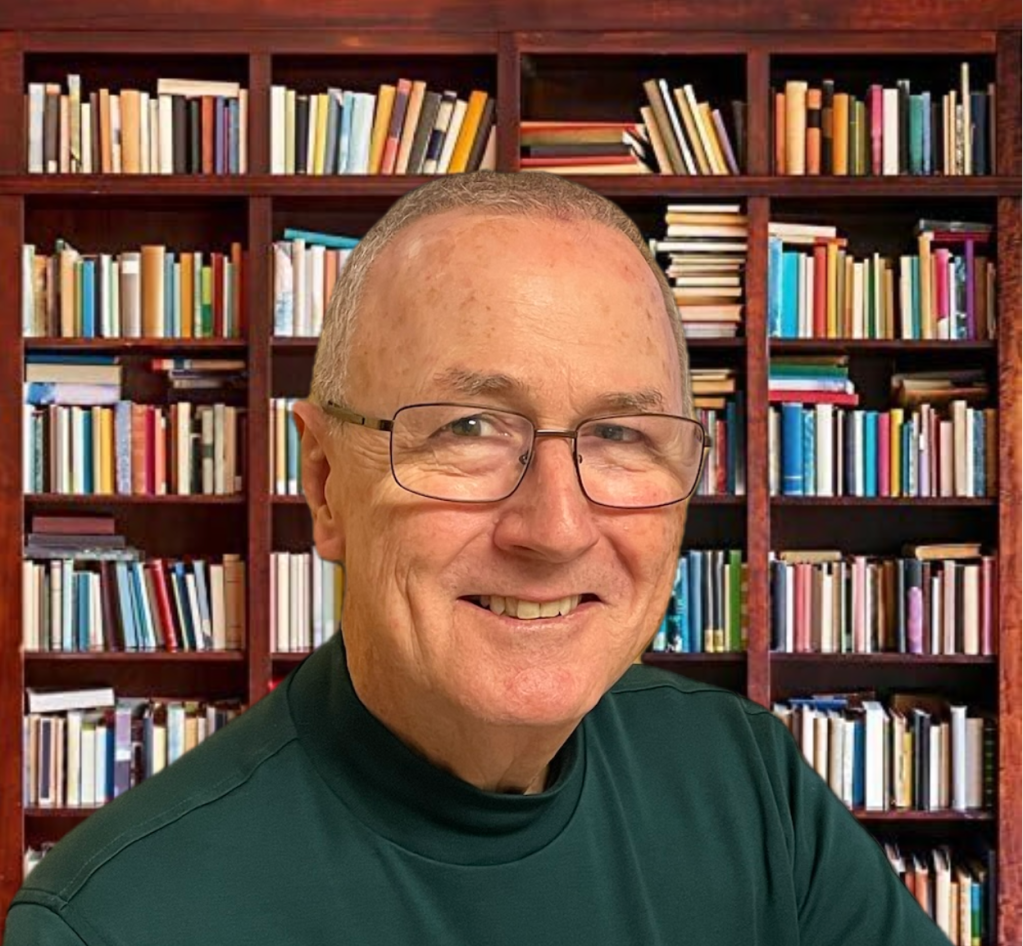
My name is Kevin Carroll. I was born and raised in San Francisco, California, where I attended Saint Ignatius College Preparatory. I am a graduate of both Santa Clara University and the University of San Francisco. Following a 40-year career in teaching and pastoral ministry, I launched a new career as a writer and speaker.
I live in San José, California. My wife, Kathy, and I have three adult sons and five precious grandchildren. I have much for which to be grateful.
I can be reached via email at kmc43sjc@gmail.com
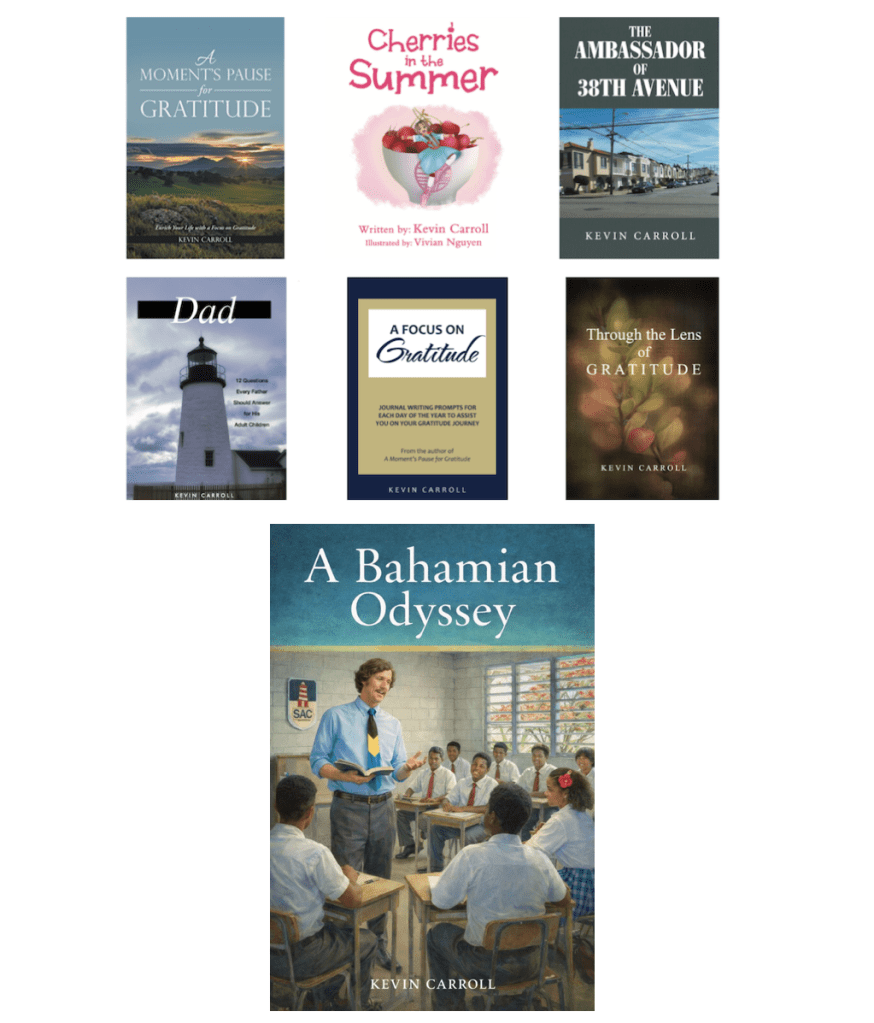
My books are available for purchase online from Amazon. I also have copies of some of these titles at my home for those who would like to buy them directly from me.
A Moment’s Pause for Gratitude (2017)
Cherries in the Summer (2021)
The Ambassador of 38th Avenue (2022)
Dad: 12 Questions… (2023)
A Focus on Gratitude (2024)
Through the Lens of Gratitude (2024)
A Bahamian Odyssey (2026)
-

- October 2026
- September 2026
- August 2026
- July 2026
- June 2026
- May 2026
- April 2026
- March 2026
- February 2026
- January 2026
- December 2025
- November 2025
- October 2025
- September 2025
- August 2025
- July 2025
- June 2025
- May 2025
- April 2025
- March 2025
- February 2025
- January 2025
- December 2024
- November 2024
- October 2024
- September 2024
- August 2024
- July 2024
- June 2024
- May 2024
- April 2024
- March 2024
- February 2024
- January 2024
- December 2023
- November 2023
- October 2023
- September 2023
- August 2023
- July 2023
- June 2023
- May 2023
- April 2023
- March 2023
- February 2023
- January 2023
- December 2022
- November 2022
-
Halloween 2025
“There is a child in every
one of us who is still a
trick-or-treater looking for
a brightly-lit front porch.”
Robert Brault
-
“Be watchful. Be alert.”

“Be watchful! Be alert!”
Mark 13:33[Information in this post was updated November 1, 2025]
Four words… straight from the Bible. How prophetic they have proven to be in my experience as a longterm employee, and now retiree, of the Roman Catholic Diocese of San José. I share this blog post today for the benefit of other retirees of the Diocese, several of whom read this blog on a regular basis.
I began working in the Diocese of San José in September 1979. I was blessed to have an amazing administrative team at Saint Christopher School. Two Sisters of the Presentation, Sister Eileen Diggins and Sister Pauline Borghello, shared the role of principal. Both were professional, supportive, encouraging, and kind. The pastor of Saint Christopher Parish, Monsignor Norman Allen, treated his employees with the same level of dignity and compassionate care. I worked at Saint Chris for four years as a junior high teacher in the school and director of youth and young adult ministries for the parish. I enjoyed my responsibilities immensely. At the recommendation of Sister Eileen, I left Saint Chris in June 1983 to pursue my master’s degree in school administration at the University of San Francisco.
In the remaining 32 years prior to my retirement in 2015, I was employed at two other schools and one other parish in the Diocese of San José. In those years, I served under five different principals, eight pastors, and two bishops.
Having attended Catholic schools from elementary through graduate school, I became quite familiar with Gospel values, though it was clear to me at an early age that such values were not always practiced by some of my teachers. So while I was disappointed, I was not totally shocked to experience, through my professional career, an alarming lack of integrity, basic kindness, competence, and professionalism by several administrators and ordained priests. The four years I spent at Saint Christopher School and Parish had not prepared me for what was to come.
Needless to say, by the time I chose to retire from the Diocese of San José, I’d had enough. I had witnessed first-hand more deception, dishonesty, harassment, and financial corruption than I could ever have imagined when I began my career in ministry. I would readily have shared my concerns in the “exit interview” at the time of my retirement. Sadly, however, that meeting was not an interview at all, despite the fact that I was retiring four years prior to my normal retirement age of 65. I mistakenly believed that someone at the Diocese might wonder or care why I would choose to do so.
I was immensely grateful to sever my ties with the Diocese of San José. Since the Diocesan Pension Plan was handled by a third-party administrator, I had no reason to continue my relationship with the Diocese. I had completed the retirement documents which clearly indicated that the option I selected was a “Life Annuity with 120 Payments Certain and 50% Surviving Spouse Benefit.” This document was signed by Reverend Monsignor Francis V. Cilia, Vicar General of the Diocese of San José, on July 25, 2015.
For the past ten years, I have received my pension benefit through direct deposit to my bank account. It has always been the correct amount. I was confident that my financial future, and that of my wife, was set in stone… until three weeks ago, when I received a Certificate of Participation from Securian Financial Group, Inc. in St. Paul, Minnesota. This correspondence from the current third-party pension administrator, was for the purpose of “evidencing your rights to receive payments under the annuity contract, which is guaranteed by Securian Life.”
The problem with this document is that it indicated that my pension was a Straight Life Annuity, a monthly benefit paid during my lifetime until the last payment on or before my death. There was no mention of the 50% spousal benefit. I called Securian. They confirmed that my benefit was a straight annuity that would end at the time of my death. I mentioned that I had elected a reduced pension with a 50% spousal benefit. I was told that they have no record of this.
I contacted the Benefits Office of the Diocese of San José. They seemed to know nothing about a 50% spousal benefit. So I drove to the chancery to deliver a copy of my Retirement Certification document dated July 25, 2015. Surely this would be sufficient to rectify the error. It wasn’t. I was told to address my concern with Securian.
The next day, I sent the Securian representative a copy of my Retirement Certification document from the Diocese. It took a little more than two weeks, but I finally received a response on Saturday morning, November 1 confirming my claim. A new Certificate of Participation has been issued with the correct information.
What if I had not taken the time to carefully read through the correspondence from Securian? What if I had passed away prior to receiving this correspondence? It seems that no one at either Securian or the Diocese of San José was aware of this “error” in their records. My guess is that Kathy would have been out of luck and my pension would have ended with my death.
I write about this today for one reason and one reason only — to warn other retirees of the Diocese of San José to verify their pension benefits. How many other retirees of the Diocese might have the mistaken belief that the pension benefit to which they agreed, and to which the Diocese agreed at the time of their retirement, might not be in effect due to some “error” in the administration of the Pension Plan? While my situation has been resolved, I feel a moral obligation to follow-up on this issue for the benefit of other retirees whose pensions may also have been compromised.
English philosopher Thomas Hobbes warned over 400 years ago, “Whoever is detected in a shameful fraud is ever after not believed even if they speak the truth.” For me, the credibility of the Diocese of San José has been compromised by the consistent deception, lack of integrity, and unethical practices by Church leaders throughout the past forty years.
In chapter 13 of his account of the Gospel, Mark warned us, “Be watchful! Be alert!” Prophetic words, for sure.
-
Not for Them

“Sometimes the people
around you
won’t understand
your journey.
They don’t need to,
it’s not for them.”
Joubert BothaIn 1974, I opted to take a gap-year from college to accept a teaching position at a high school in the Bahamas. At the conclusion of that academic year, my Dad admitted to me that, at first, he thought I was making “the biggest mistake of my life” by dropping out of school for a year. A visit to Nassau in June 1975 convinced him otherwise.
In 1978, I received a letter informing me that I had been accepted for a firefighting position with the San Francisco Fire Department. Instead of accepting that offer, I opted to take a job teaching junior high literature at a school in San José. My Dad went to his grave believing that was the biggest mistake of my life. I never convinced him otherwise.
Throughout my lifetime, there have been countless decisions I’ve made which have been questioned by others, some of them rightly so. In 1986, Kathy’s employer, AT&T, wanted her to accept a transfer to a new AT&T facility in Aurora, Colorado. The offer was quite attractive. When I mentioned the possibility to my parents, they freaked out. Their first grandson, Tom, had just been born. How dare we consider moving away from the San Francisco Bay Area? That resistance, which was surprisingly tenacious, caused us to investigate the opportunity more fully. In doing so, it became clear to us that a move to Colorado was not in our best interest. Still, I was a bit disconcerted at my parents’ reaction to the opportunity.
We are nearing the end of 2025. In retrospect, I am confident that the decisions I made to teach in the Bahamas and to pass up the opportunity to serve in the San Francisco Fire Department were the right decisions for me. I’m also certain that remaining in California was the right choice. AT&T shut down the Aurora facility just a few years later.
In the past few months, I’ve struggled with a decision made by my youngest son, Brendan. He left a job with a reputable organization, a job which provided a decent salary and excellent health and retirement benefits, to launch his own business as a basketball physical conditioning trainer. This time, I was the one who questioned the wisdom of his decision. How could someone pass up the job security of his previous position to enter the world of entrepreneurship where, according to the U.S. Bureau of Labor Statistics, 20% to 24% of new businesses fail in their first year?
The wise words of South African accountant Joubert Botha apply to me as much as they do to anyone else. I may not understand what Brendan is doing, or why, but I don’t need to understand. It’s not for me to judge. It’s Brendan’s life. The consequences of his actions, whether they be positive or negative, are his to accept, not mine. Just as I didn’t want my parents telling me which path I should take in my life, I owe Brendan the same respect.
The 1950’s TV comedy Father Knows Best is anachronistic in today’s world. The roles of fathers and husbands today are strikingly different than they were sixty-five years ago. For the past 25 years or so, fathers and husbands have been portrayed in the media as clueless, foolish, and incompetent. This portrayal has had a significant effect on how fathers are perceived by their children today. The respect which was once both an expectation and a societal norm has been replace by an attitude that fathers are obsolete and of no real value to their children in the new millennium.
This brings me back to Botha’s quote. The people around me today may not understand my journey at this point in my life, but they don’t need to. It’s not for them.
-
Dad

“All that we love deeply
becomes a part of us.”
Helen KellerI want to keep this short and sweet. If my Dad were still alive today, we would be celebrating his 100th birthday.
Dad died a little more than seventeen years ago — on July 31, 2008. Was he the perfect father? Uh,… is there such a thing? No, he was not perfect. He was as flawed as any other human trying his best to make his way through what can sometimes be a complicated world. I do believe, though, that he did the best he could do, given his own life experiences and traumas, to provide for our family and to care for us.
In my younger years, Dad was my hero — firefighter, lieutenant, captain, and then battalion chief in the San Francisco Fire Department. He worked hard to achieve those promotions. Toward the end of my high school years, we clashed, as many young men do with their fathers as they navigate the transition from adolescence to young adulthood. I made mistakes. He made mistakes. There were some difficult times, but we survived and emerged with a mutual respect for each other.
When I became a Dad myself, I found myself always trying to measure-up to Dad’s expectations, even though he rarely shared what those expectations were. I just knew. I wanted him to be proud of me and proud of the job I was doing fathering my own three sons.
In the end, Dad gave me the greatest gift I could possibly have been given. It was early evening on July 31, 2008. I spoke on the phone with Mom for about 45 minutes. As was always the case, she said, “Here, say a quick hello to Dad.” Usually, those quick hellos weren’t much more than a minute, if that. But that night, Dad and I talked longer than Mom and I had conversed. It was strange. He had lots of questions about a project I had been working on throughout June and July which had just concluded.
At the end of our conversation, I received the gift — a gift I will never forget, and one I will always cherish. Dad said, “I love you,… and I’m proud of you.” An hour later, he fell down the stairs of our family home, sustaining major head trauma which caused his death that night.
No, Dad wasn’t the “perfect” Dad, nor am I, but I will always remember him with tremendous love, respect, and gratitude. In large part, I am who I am today because of him. How could I be anything but deeply grateful?
-
Heaven Sent

“Mochi is a small gift
of deliciousness
from the gods.”
Caroline IshiiAfter dinner last night, I had a craving for something cold and sweet. Not surprisingly, I went to the freezer to see if we had any ice cream. What I found was even better. On the top shelf, I saw a small box of mochi ice cream. What a treat!
Mochi ice cream is a small, round dessert consisting of a soft, pounded sticky rice dumpling (that’s the mochi) formed around an ice cream filling. The mochi I found in the freezer was wrapped around mango flavored ice cream.
For the past couple of years, I have made an effort to be conscientious about what I eat, but I enjoy a sweet dessert now and then. So I did a bit of research to learn if mochi ice cream might be healthier than the normal ice cream we eat. The answer is yes.
Mochi can be healthier than traditional ice cream primarily due to its portion control and lower calorie count per serving. As with any dessert, though, too much of a good thing can be detrimental to one’s health.
Mochi-covered mango ice cream —
what a healthy treat.
Cold and sweet and tasty, too…
a great dessert to eat.The flavor is delicious
and the texture soft and cold.
I plan to keep on eating mochi,
even when I’m old. -
An Unexpected Treat

“Books are uniquely
portable magic.”
Stephen KingMy travels in San Francisco yesterday took me to the halls of Holy Name School on 40th Avenue in the Sunset District. This was a highly unusual excursion for me, as I attended Holy Name’s rival school, Saint Gabriel, for my elementary school years. I had never set foot inside the hallowed halls of Holy Name, though some of my best childhood friends went to school there. I checked into the main office to take care of the business that had brought me there.
Unrelated to my primary purpose for visiting the campus, I had the pleasure of meeting Alice Seher, director of the Holy Name Preschool. She happened to stop by the office while I was there and we had a pleasant conversation. I told her about my book Cherries in the Summer. Since I had a copy of the book in my backpack, I gifted it to her, and offered to read it to her students if she would like me to do so. She accepted my invitation immediately.
There are two preschool groups at Holy Name School. I first met with the younger group, ages three and four. I sat in a chair in front of approximately 15 children and read the poem while displaying the amazing illustrations throughout the book. I let the children know that those illustrations were created by a 12-year-old sixth grade student from San José in 2021.
The second group consisted of an equal number of four to five year olds. They, too, seemed to enjoy the story and the colorful illustrations. In the middle of the story, one little girl gently interrupted to inform me that her father had a hat just like mine! (A reminder to me of why I never felt called to teach that age group during my professional career.)
When I was leaving, Alice extended an invitation for me to return to Holy Name School again to read to the preschool students. I just might do that. As Stephen King said, “Books are uniquely portable magic.”
-
Keep It Simple

“The greatest wealth
is to live content
with little.”
PlatoI visited a friend’s home on Friday afternoon. He lives in a studio apartment in an upscale senior living facility in Los Gatos. The grounds of the facility are neatly groomed, with the perfect a balance of colorful shrubs, plants, trees, and grass throughout the complex. When I entered his apartment, I was unprepared, and pleasantly surprised, to see what I can only describe as a minimalist decor. I was quite impressed.
The apartment has a moderate-sized living room/dining room area adjacent to an adequate-sized kitchen. The bedroom, which is more like an alcove, looks out to the middle of the living space. From the bedroom one can access the bathroom and closet. Opposite the bedroom is a sliding-glass door which opens to a small outdoor patio. At the end of the living space opposite the kitchen there is one more room. It’s small, but large enough to use for a cozy office space. My friend chooses to use it for storage of a few items.
The furniture in the apartment, what little of it there is, is quite functional. A small table is situated just outside the kitchen area in what one could consider the dining room. Next to that is a computer table and office chair. The only other items in the living space are a futon-type couch for two, a 2-shelf bookcase, and a small coffee table. I’m pretty sure I recall seeing two framed images on the wall.
In the bedroom, there was a bed. That’s it. Just a bed. I’m guessing that the bedroom closet provides enough space for a dresser or chest of drawers. As I mentioned, there were a few items in the smaller room, but the space could never be described as cluttered.
What was missing in the apartment? The most obvious omission is a television. He does have internet access, but no cable connection. With no TV, there’s no need for it. There’s also no stereo sound system with speakers. It’s not that my friend cannot afford such items. In fact, he has the financial resources to fill his home with any number of luxury items he might want, but he chooses not to do so. He has what he needs. For him, that’s enough.
American author Vernon Howard would consider my friend to be successful. I do, too. Howard wrote, “You have succeeded in life when all you really want is only what you really need.” How sad that such contentment is so rare in our society today.
It is all too common today for personal happiness to be equated with the accumulation of material possessions. How important it is for so many people to have the 65-inch TV, which is currently the most popular size for new purchases in the United States. And true success and happiness is clearly indicated by the purchase of a Tesla, BMW, Mercedes-Benz, or other high-end vehicle, right?
Bigger, better, more,… American consumers seem to have an insatiable desire to have more than we need. Why? I’m sure the answer varies from person to person. This is precisely why I am so impressed by the simplicity with which my friend chooses to live his life. He is successful. He is happy. He has everything he needs. Wow! I’m impressed.
-
5150
“Pay no attention
to the man
behind the curtain!”
L. Frank Baum
The Wizard of Oz -
Time to Celebrate!
“There is no greater agony
than bearing an untold
story inside you.”
Maya AngelouThere is a great deal of wisdom in these inspiring words of author Maya Angelou, yet I know, from having read his book, All Things Beautiful, that Pat Maguire would respectfully disagree. No greater agony? I’m sorry, but Pat knows a thing or two about coping with deep agony. The reason I share Angelou’s quote here is because for most of us, her words are on-target. Many people I know hold untold stories inside themselves, and no small number of them struggle with the belief that they have no viable way of sharing their stories.
Danish author Karen Blixen wrote, “All sorrows can be borne if you tell a story about them.” There is no doubt that writing about the traumas in our life can be quite therapeutic. The act of putting our story on paper can be a significant step in the healing process, yet some may ask Why bother?
American poet Sean Thomas Dougherty addressed this question when he said, “Why bother? Because right now, there is someone out there with a wound in the exact shape of your words.”
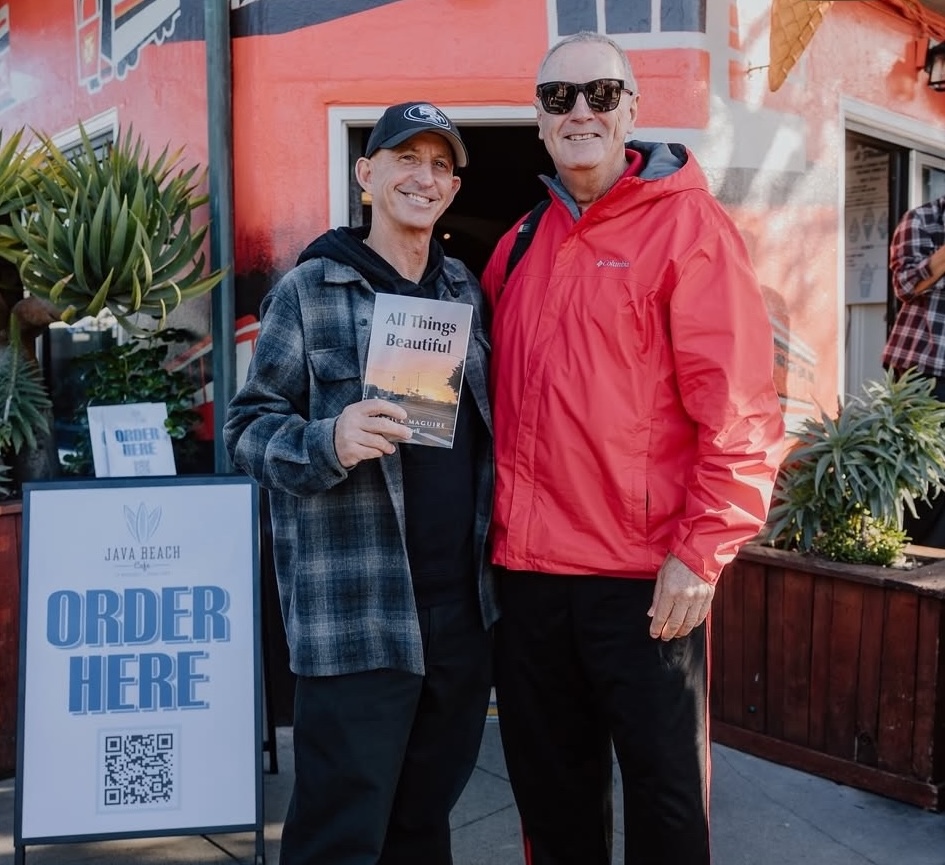
When Pat shared his story with me a couple of years ago, I told him straight-up, “You need to write your story.” I paraphrased Dougherty’s words to underscore why I would suggest he do so. Apparently, many others told Pat the same thing. So when I saw him at Java Beach in the spring, and he told me he was just about finished writing it, I asked him to send me the manuscript and I would edit it for him. This evening, just five months later, we are celebrating the publication of All Things Beautiful with a “book launch” event at Java Beach Café on Judah Street.
Even after writing the manuscript, Pat wasn’t sure he wanted to publish it. He thought it was too private. His friend, Caeli, threatened that if he didn’t publish it, she would. Pat surprised her by handing her the manuscript. The published book is Pat’s story, but Caeli rewrote it so that it’s in the third person — she is telling Pat’s story… in his words… in his style of writing. Even author Oscar Wilde seemed to understand Pat’s reservations about publishing his own story. Wilde wrote, “Man is least himself when he talks in his own person. Give him a mask, and he will tell you the truth.” Honestly, Pat didn’t need a mask. His story, even in his own words, is brutally honest. For readers, however, the fact that they are hearing Pat’s story told by Caeli in such a kind, compassionate way, gives the book a touch of magic.
The words of Pulitzer Prize winning author, Wallace Stegner, explain the need for Pat to write his story. Stegner wrote, “We write to make sense of it all.” And even then, even after writing the entire story, making sense of everything that has happened to us requires more than just writing it down. For Pat, it was his strong faith in Jesus Christ that guided him through the dense fog of despair and into the light of His glory.
Some readers might be taken aback at Pat’s writing style. Rather than expressing himself in grammatically perfect, well-manicured sentences and paragraphs, Pat writes in brief thoughts interspersed with ellipses (three dots). Those ellipses indicate that there is more to the story than what’s been said, and in many cases, much more to the story. I must agree with author Neil Gaiman who said, “If you write with enough assurance and confidence, you’re allowed to do whatever you like. So write your story as it needs to be written.” Without a doubt, Pat writes with such assurance and confidence. His writing style works.
Pat has never said this to me directly, but having read his manuscript more than a dozen times, and knowing Pat as I have come to know him in the past two years, I’m confident that he can relate to the writing experience of C.S. Lewis who said, “I never exactly made a book. It’s rather like taking dictation. I was given things to say.” I’m fairly certain this was Pat’s experience, too.
For those who might feel inclined to write their own story, I again refer to the wisdom of author Neil Gaiman. He wrote, “Start telling the stories that only you can tell, because there will always be better writers than you and there’ll always be smarter writers than you. There will always be people who are much better at doing this or doing that — but you are the only you.”
-
Morning Gratitude

“Coffee…
the favorite beverage
of the civilized world.”
Thomas JeffersonI don’t drink coffee. Why? I dislike the taste. It’s that simple. The aroma of coffee, however, has been one of my favorite smells throughout my lifetime. It brings back vivid memories of times in the early- to mid-1960s when my paternal grandmother would stay at our home after being discharged from the hospital. She was a coffee drinker, while everyone in my family drank tea.
With that said, I am well aware of the importance of that first cup of coffee in the morning for most people. As Thomas Jefferson pointed out, I do believe that coffee is “the favorite drink of the civilized world.”
Throughout my professional career, coffee was provided for attendees at professional development sessions and other large gatherings of educators. Occasionally, tea would be offered as an option, but that was never guaranteed. The same was true for parent meetings at my kids’ schools. It was always coffee on the table in the back of the meeting room.
Despite the fact that I don’t drink it, I appreciate the importance of coffee in the lives of others. While some consume their coffee in a “grab n’ go” mode on their way to work, many take the time to savor that first cup of coffee, either at home, at a local coffee shop, or when they arrive at their workplace. To be honest, I experience a similar feeling when I have the opportunity to begin my day with a cup of hot chocolate. It just makes the morning special.
So here’s an idea I’d like to propose: What if, while sipping that first cup of hot coffee each morning, you made a conscientious effort to take a moment’s pause for gratitude? With each sip of coffee, you could reflect with appreciation on the people in your life for whom you are grateful. You could recall, with gratitude, the experiences in your life which enabled you to be where you are in your life today. You could even identify the physical possessions you own, the ones you so often take for granted (your home, car, bed, clothes, computer, books,…), and take a moment to thank God for these blessings in your life. In an age in which multi-tasking is considered to be a valuable skill, this coffee/gratitude combination seems to provide an ideal opportunity to do just that.
I invite and encourage you to take a moment’s pause for gratitude with your morning coffee each day. Just as the coffee will kick-start your energy level, a focus on gratitude will enable you to experience the day with a more positive mindset, and a greater awareness of the many ways in which you have been blessed.
Gratitude, perhaps even more so than coffee, makes a difference!
-
Subscribe
Subscribed
Have a WordPress.com account? Log in now.

