-


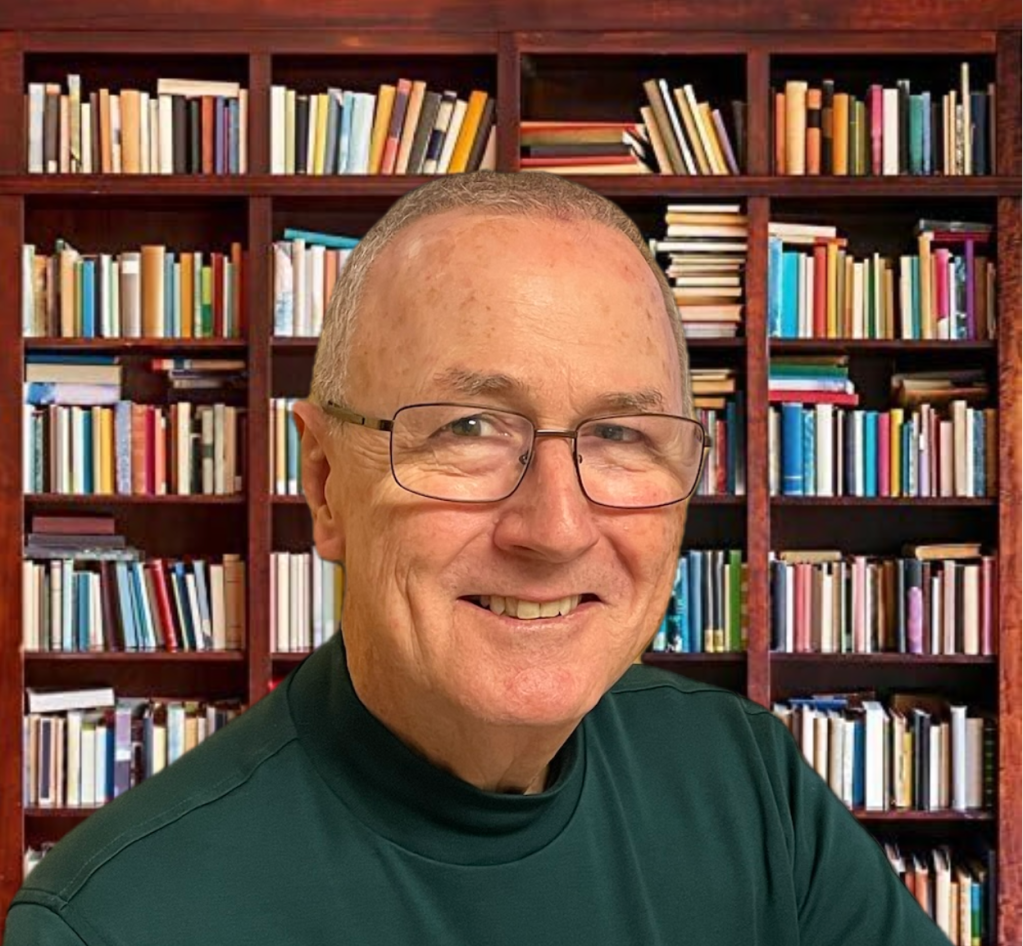
My name is Kevin Carroll. I was born and raised in San Francisco, California, where I attended Saint Ignatius College Preparatory. I am a graduate of both Santa Clara University and the University of San Francisco. Following a 40-year career in teaching and pastoral ministry, I launched a new career as a writer and speaker.
I live in San José, California. My wife, Kathy, and I have three adult sons and five precious grandchildren. I have much for which to be grateful.
I can be reached via email at kmc43sjc@gmail.com
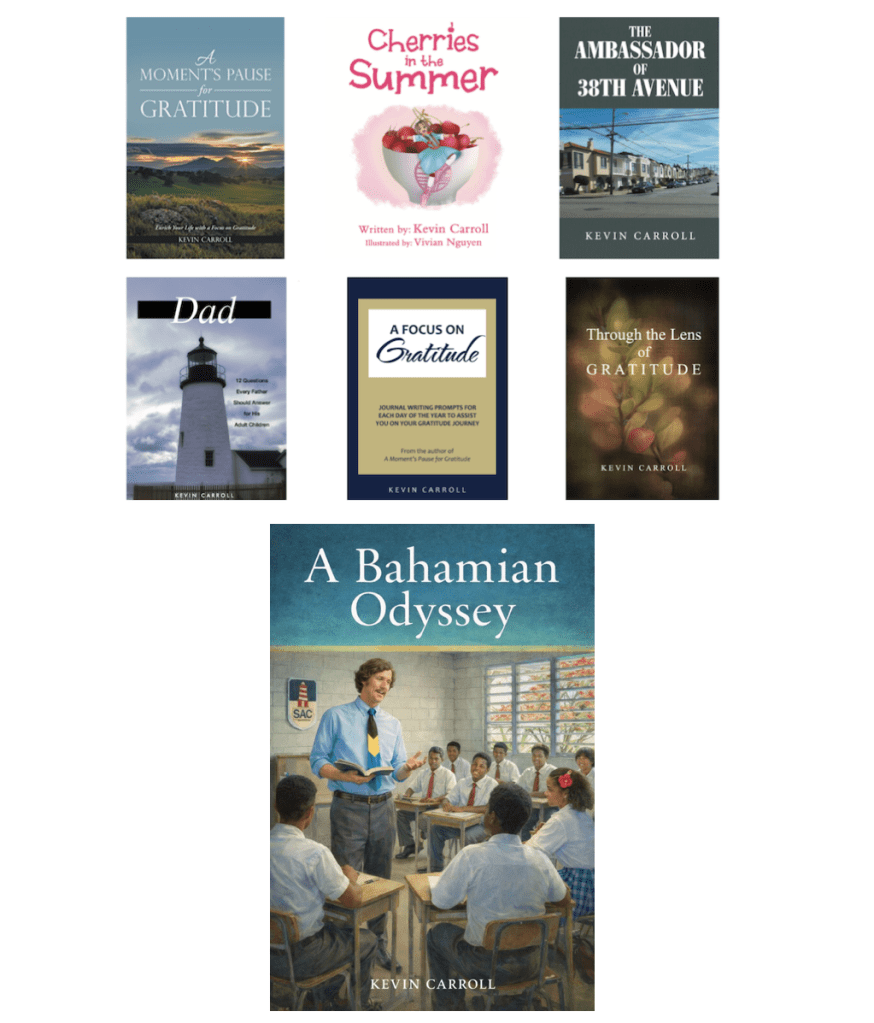
My books are available for purchase online from Amazon. I also have copies of some of these titles at my home for those who would like to buy them directly from me.
A Moment’s Pause for Gratitude (2017)
Cherries in the Summer (2021)
The Ambassador of 38th Avenue (2022)
Dad: 12 Questions… (2023)
A Focus on Gratitude (2024)
Through the Lens of Gratitude (2024)
A Bahamian Odyssey (2026)
-

- April 2026
- March 2026
- February 2026
- January 2026
- December 2025
- November 2025
- October 2025
- September 2025
- August 2025
- July 2025
- June 2025
- May 2025
- April 2025
- March 2025
- February 2025
- January 2025
- December 2024
- November 2024
- October 2024
- September 2024
- August 2024
- July 2024
- June 2024
- May 2024
- April 2024
- March 2024
- February 2024
- January 2024
- December 2023
- November 2023
- October 2023
- September 2023
- August 2023
- July 2023
- June 2023
- May 2023
- April 2023
- March 2023
- February 2023
- January 2023
- December 2022
- November 2022
-
Sunday Morning

“May your Sunday be
blessed with moments
of serenity, laughter,
and profound gratitude.”It’s Sunday,… the first Sunday in May 2025. As I reflect back on the past week, I am filled with gratitude for the countless blessings I experienced. On Tuesday, I visited Hakone Gardens in Saratoga for the first time. On Wednesday evening, I met some wonderful people at a new senior living facility in Santa Clara. On Friday, I enjoyed another delightful lunch with my good friend, Brian, at the Los Gatos Café.
Kathy, Brendan, and I met up with Steve and his family for dinner on Friday evening, then with Tom and his family, along with my sister Cathy, for lunch yesterday afternoon after my grandson Liam’s baseball game. It was a simple, yet amazing week. Today is a day for rest.
The Genesis account of creation tells us that after creating the world, God rested on the seventh day. Whatever one believes about the historical accuracy of the Scriptures, it’s difficult to deny that they contain valuable pearls of wisdom for all of us. Resting on the seventh day is one of those gems.
For many years, attending Mass on Sunday was a given. I never gave it a thought. That’s what we did on Sundays. Through the years, while my faith in God has grown exponentially, my confidence in the integrity of the Catholic Church as an institution has waned significantly. At this point in my life, I have embraced countless alternative ways of “making holy the Sabbath Day.”
On many Sunday mornings, Kathy and I go to the downtown Campbell farmers market. Kathy does the shopping, while I sit with a cup of tea or hot chocolate enjoying the tunes of local musicians. The farmers market provides ample opportunities for us to meet people, to engage in pleasant conversation, and to spread kindness and positivity to those we meet.
Sundays are often a good time to get together with family or friends for lunch or dinner. Last Sunday, Kathy and I attended the Japantown Cherry Blossom Festival in San José. Sundays also provide opportunities for walking, reading, writing, and even napping. It is reassuring to know that resting on the seventh day of the week is not only beneficial for my physical and mental health, it is also consistent with my faith.
While I have often said that I have no regrets about my teaching career, I haven’t been completely truthful with others — or with myself. I do have some regrets. One, in particular, is the number of Sunday afternoons I spent in my classroom preparing for the upcoming week. I had an insatiable desire to be over-prepared for the classes I taught. I wanted to have all papers graded and ready to return to students on Monday. I wanted to be sure I had all the photocopies of handouts I would need for the week. I didn’t want to risk arriving at school on Monday morning and finding that the copier was down and I didn’t have what I needed for my classes. Yes, I spent countless Sunday afternoon hours in Room 3 at St. Lawrence Academy. I wish I had spent that time with my family.
Sundays are sacred. By this I mean that Sundays should be regarded with reverence and secured against infringement. Sundays are a time to rest, a time to spend with family, a time to nourish our body and soul in preparation for the demands and challenges of the upcoming week. And, of course, Sundays are a time for gratitude — a time to reflect back on the previous week with gratefulness for the many blessings we experienced.
This morning, I wish you all a day filled with serenity, laughter, and profound gratitude.
-
Love the Game

“Take me out
to the ball game,…”
Jack NorworthThis is a trivia question which might stump the most devoted fans of the game of baseball: Who wrote the song “Take Me Out to the Ball Game”?
We’ve all heard it. We’ve all sung it. Most people know the lyrics (or something close to the actual words) from memory. The song, composed in 1908 by Albert von Tilzer with lyrics by Jack Norworth, is sung with enthusiasm in every major league ballpark following the final out of the top of the seventh inning, when fans at the stadium stand for the traditional “seventh inning stretch.” Take Me Out to the Ball Game is as much a part of baseball as the National Anthem, hot dogs, and sunflower seeds.
The lyrics of the song include references to familiar things one might associate with the game of baseball, such as peanuts and crackerjacks. Not surprisingly, the song encourages fans to root, root, root for the home team, acknowledging the disappointment associated with a home team loss. It’s the end of this golden oldie, however, to which I can most easily relate.
I began my short-lived baseball career in fifth grade, I played on the Saint Gabriel School 5th grade baseball team. We won the CYO (Catholic Youth Organization) city championship that year, though my contribution to the winning season was negligible. The following summer, that same group of guys participated in the PAL (Police Athletic League) season. Most of those games were played at Park Merced Field, across the street from Harding Park Golf Course. Except for one memorable game, in which I inexplicably ended up pitching the last inning and striking out the side to preserve a win, my contribution to the team was equally inconsequential.
My problem as a baseball player is that I had an absolute fear of getting hit by a pitch. I don’t recall it ever happening, but that might be due to the fact that I was so afraid of the ball that I rarely stayed in the batter’s box long enough for that to be a possibility. As a result, although I had a relatively good arm and a profound understanding of the game, rarely, if ever, did I hit the ball. My goal when I stepped into the batter’s box was to draw a walk. Umpires don’t look favorably upon such weakness.
This brings me back to the song. The lyrics to which I most easily relate are well-known throughout America: “For it’s one, two, three strikes. You’re out!” My entire baseball career can be summed up in those eight words.
Still,… I love the game.
-
A Hidden Gem

“If you look
the right way,
you can see that
the whole world
is a garden.”
Frances HodgsonI’m a bit embarrassed to admit this, but even though I’ve known of the existence of Hakone Estate and Gardens in Saratoga, California for more than forty years, I had never visited the site until this week. Hakone is considered by some to be the best and most authentic Japanese garden outside of Japan. The 18-acre treasure, which expresses the Japanese ideal of the garden as a space in which art and nature merge, offers visitors an unparalleled experience of peace, tranquility, and elegance.
Hakone Gardens is located a mere six miles from my home. One might think that, considering the fourteen trips I’ve made to Japan in the past thirty years, I would have ventured up Saratoga Avenue for a visit to the gardens sooner. I honestly cannot explain why I never did. A visit to Hakone has been on my bucket list for many years. My experience there this past Tuesday was just the first of what I am confident will be many visits in the months and years to come.
According to promotional materials available in the Hakone gift shop, San Francisco Philanthropists Oliver and Isabel Stine attended the Panama-Pacific Exposition which was held in The City in 1915. Isabel was so inspired by her visit to the Japan Pavilion that she decided to build her own private Japanese estate and garden. In May 1915, the Steins purchased the parcel of land on the outskirts of the quiet town of Saratoga. It was there that they constructed their dream project.
In 2000, with the financial backing of David and Lucile Packard, the Hakone Foundation, a non-profit 501 (c) (3) organization, was established. In April 2013, Hakone buildings and gardens were designated a historic landmark. The estate is open to the public to provide an authentic experience of Japan and Japanese culture.
When I visited Hakone on Tuesday, I was warmly greeted by Noriko Ashihara, who was working in the gift shop. I then had the opportunity to visit with Meredith Lee, the Executive Director, and Ian Hamilton, the Cultural Events Coordinator, both of whom Kathy and I had met at the Cupertino Cherry Blossom Festival last Saturday. Meredith led me through the Mon Main Gate and showed me around the lower level of the gardens, including the Cultural Exchange Center. I then wandered off on my own to explore some of the higher elevations.
I walked up the path past the waterfalls to the Moon Viewing House, then continued up the hill to the Upper Wisteria Pavilion. The views were stunning, and benches along the way provided opportunities for me to sit, pause, breathe, and engage in the Japanese practice of shinrin-yoko (forest-bathing.)
My time at the garden was limited on Tuesday, but now I am highly motivated to return to Hakone to allow more time to enjoy the serenity of the gardens and to immerse myself in the beauty of nature.
Hakone Estate and Gardens is located at 21000 Big Basin Way in Saratoga. The facility opens at 10:00 a.m. on weekdays and 11:00 a.m. on weekends. Admission is $12 for adults, $10 for seniors, $8 for children ages 5-17, and free for children 4 and younger. Affordable annual memberships provide complimentary admission to the gardens for one full year, invitations to special events, a discount at the gift shop, early registration for special events, and a quarterly newsletter.
The words of author Hanna Rion ring true for me. She wrote, “The greatest gift of the garden is the restoration of the five senses.”
-
Blogging

(This image and quote were used for my first blog post of 2025.)
“Strive not to be
a success,
but rather to be
of value.”
Albert Einstein“How many followers do you have on your blog?” It was an innocent enough question. It would have been nice if I could have provided an accurate response, but nothing is less important to me than how many followers or subscribers regularly read my blog posts. Would it be important if more people followed it than actually do? Perhaps, but my purpose for writing is not to count the number of readers. Nor do I have any interest in monetizing my blog, which seems to be the thing to do these days. I write because I love writing.
Okay, I’ll admit that I do appreciate feedback from readers. Every now and then, someone will leave a comment, click “Like,” or send me a text or email telling me that they enjoyed a particular post. My motivation for blogging, however, is not linked to any dopamine hit I may receive from such positive feedback.
Benjamin Franklin once said, “Either write something worth reading or do something worth writing.” I believe I have done both in my lifetime. I would like to believe that every piece I post on A Beacon of Light is worth reading. I am also confident that I have had some amazing opportunities in my life to engage in activities worth writing about. Maybe this is why I find it so easy to publish consistently.
Stephen J. Dubner is the award-winning journalist who co-authored the book Freakonomics twenty years ago today. In a discussion about blogging and bloggers, he said, “The typical blogger, like most people who go on diets and budgets, quits after a few months, weeks, or in many cases, days.” I’m sure there is some truth to this, though I have not researched this myself. For this reason, Dubner would describe me as an atypical blogger.
I began blogging about gratitude on December 23, 2006 when I launched Attitude of Gratitude. In 2022, after posting almost 2,000 pieces on my blog, I decided to create a new blog on a new platform. My gratitude blog was hosted by Typepad in San Francisco. In November 2022, I launched A Beacon of Light on WordPress. Rather than focusing exclusively on gratitude, this new blog allows me to write about positivity in general — about what’s good in the world.
Darren Rowse is the founder of Problogger.com. His words about what makes a blog successful are fairly simple. He said, “The key to success in blogging (and in many areas of life) is small but regular and consistent actions over a long period of time.” Using Rowse’s metric for measuring the success of a blog, I would like to think that my 18+ years of consistent blogging speak for themselves.
Kevin Anderson, author of more than 140 books, made this startling analogy about blogging. He said, “The bottom line is that blogging is like sex. You can’t fake it. You can’t fake passion. You can’t fake wanting to engage with the public. If you do, it will ultimately be an unsatisfying experience for both the blogger and their readers.” I guess that works!
So why do I blog? What has motivated me to share my thoughts on my blogs for more than eighteen years? Scott Adams, the creator of the Dilbert comic strips, may have explained it better than I can. He said, “I think the pleasure of completed work is what makes blogging so popular. You have to believe most bloggers have few, if any, actual readers. The writers are in it for other reasons. Blogging is like work, but without coworkers thwarting you at every turn. All you get is the pleasure of a completed task.”
For me, that pleasure is motivation enough to keep writing.
-
Money

“If you buy what
you don’t need,
you steal from yourself.”
Swedish ProverbTalking or writing about money is something I try to avoid. Through a lifelong process of trial and error, I learned the importance of distinguishing between wants and needs. I also learned about the value of deferred gratification and avoiding unnecessary debt. There were many things I wanted in my younger days. There were places I wanted to visit, things I wanted to do, and material goods I wanted to possess. With proper guidance from my primary financial advisor of my youth, my mother, I learned some valuable life lessons which have served me well for more than seventy years.
I mentioned the critical need to be able to distinguish between wants and needs. Asking myself this one simple question has saved me thousands of dollars throughout my lifetime: Do I want it or do I really need it? When I was honestly able to admit that I just wanted something, and didn’t really need it, more often than not I was able to avoid making the purchase. My overall score was not 100% on this life test, but, for the most part, asking the question enabled me to make wise decisions. There are three thoughts I would like to share regarding fiscal responsibility.
Sage financial advice is available from a variety of sources. I was introduced to Benjamin Franklin’s memorable quote many years ago. He said, “Beware of little expenses; a small leak will sink a great ship.” Little expenses,… you know, the daily visit to Starbucks, the frequent decision to go out for lunch or dinner when you have plenty of food at home, that sweatshirt with the clever quote that popped up on your computer screen when you were looking for something else,… Yeah, those little expenses. They seem relatively harmless at the time of the purchase, but they add up.
The most famous philosopher in Chinese history was Confucius. These words may be more than 2,500 years old, but they are as applicable today as they were when they were spoken. Confucius said, “When prosperity comes, do not use all of it.” All too many people subscribe to the earn-it/spend-it lifestyle. We are all barraged with a relentless array of marketing ploys created to convince us to part with our hard-earned cash. Sadly, however, when we spend what we make without setting funds aside for the future, we are doing precisely what the Swedish proverb quoted above warns us about: we are stealing from ourselves. The day will come when our ability to earn money will be limited, if not altogether lost. It is imperative that we begin to prepare for that future when we are young and have both the time and the financial resources to do so. Does this mean going without some things we might like at the present moment? Absolutely! This is what financial responsibility is all about.
Abraham Lincoln also addressed this theme in his lifetime. He said, “You cannot escape the responsibility of tomorrow by evading it today.” Tomorrow will come. How prepared we are financially to address the needs and challenges of our future depends entirely upon how we manage our finances in our younger days. We cannot wait until retirement age to roll up our sleeves and get to work preparing for our future. That’s a task which must be attended to in our youth.
I am not a financial advisor. If anything, I am so financially conservative that I’ve missed many opportunities to enable the money I’ve made work for me. I’m much more of a saver than an investor. With that said, I’ve also done what I needed to do throughout the past fifty years to provide the financial security I now enjoy.
Am I wealthy at this point in my life? Absolutely! More so than I could ever have hoped for. But that has nothing to do with money. In terms of money, I have enough — and for this, I am grateful.
-
Ball Game

“There are only
two seasons:
winter and baseball.”
Bill Veeck, Jr.What a great family tradition! When the San Francisco Giants vacated Candlestick Park and moved their show to 3rd & King Streets in The City, my sister, Cathy, together with a group of her friends, purchased a season ticket package for two seats in the right-field “View” section of the ballpark. In some stadiums, these seats might have been considered “cheap seats,” as they were pretty far removed from the action on the field. In the case of what was then called PacBell Park (then SBC Park, then AT&T Park, and now Oracle Park), these seats offered exactly what they advertised — a view.
Cathy’s seats that first season were pretty much as far down the right-field line as one could be before falling off the upper deck and into McCovey Cove below. The spectacular view, however, more than compensated for the distance from home plate.
In addition to the views of the playing field, the iconic Coca Cola bottle slide behind the left-field bleacher seats, and the San Francisco cable car parked behind the center-field seating area, Cathy’s seats also offered a stunning panorama of the San Francisco Bay, from the Bay Bridge to about Hayward. Of course, it also also provided a bird’s eye view down into McCovey Cove. They were great seats!
With the passing of each season, Cathy and her co-season ticket holders were able to move progressively closer to home plate. Eventually, they ended up in the first row of Section 308, which looks down directly to first base. The view of the Bay continues to be a feature of these seats, but being closer to the action of the game is definitely a bonus.
Cathy has used these tickets as birthday gifts for friends and family members. Each year, she invites her siblings, nephews, and friends to select one game they would like to attend with her from among the games available. Cathy and I celebrated my June birthday a little early this year. We attended the Giants vs. Texas Rangers game last Friday night.
It was a nice outing. I boarded CalTrain in Santa Clara and texted Cathy to let her know which car I was riding in. When the train arrived in San Mateo, Cathy boarded and joined me. We arrived in The City well before game time, so we walked from the CalTrain Station to the Ferry Building to get a bit of exercise before the first pitch. On our way back to Oracle Park, we stopped at Delancy Street Restaurant for an early dinner. The food there is much better and significantly less expensive than the ballpark fare. We were comfortably seated in Section 308 for the first pitch at 7:05.
At the conclusion of the sixth inning, we left our seats to take care of one more component of this birthday tradition. We walked down to the lower level to get hot fudge sundaes at the Ghirardelli Chocolate booth. No Giants’ game is complete without a Ghirardelli hot fudge sundae!
I appreciate Cathy’s kindness and generosity each year — not only for me, but for each of my three sons, too. A Giants’ game with Auntie Cathy is an annual blessing for them, as well.
As for the words of Bill Veeck, Jr. quoted above,… a game at Oracle Park in April enables one to experience both seasons concurrently!
-
Good or Evil?

“If you turn off the
news and talk to
your neighbors,
you’ll find that our
country is far more
harmonious than
you’re being told.”
Rob SchneiderAt the beginning of each of the last twenty years of my teaching career, I would ask my students the same question: “Do you think the world is basically evil with a presence of good or basically good with a presence of evil?” As the years progressed, student responses were increasingly in favor of the world being basically evil with a presence of good.
I certainly understand why they would think this, and why, with each passing year, a greater percentage of students would believe this.
When I started asking this question in the 1994-95 academic year, students did not have cell phones, internet access, or social media profiles. While most students had access to network news on television, they were not bombarded 24/7 with information (or disinformation) about the negativity of the world around them.
Even then, however, students would point to network news as their justification for believing that the world is basically evil. The news they were exposed to was filled with stories of violence, injustice, hatred, corruption, and other forms of negativity. I would point out that while they are correct in their observation, they might want to consider what makes a story newsworthy — the fact that it is not the norm. News stories tell us about things that are happening in the world that are not normally a part of our lived experience. Network news is rarely good news.
With advancements in technology, students could hear these negative news stories online any time of day or night. Text messages, social media posts, YouTube videos, and “tweets” misled people into believing that murders, rapes, assaults, burglaries, carjackings, and so much more were happening around them in their own neighborhoods every day. It should come as no surprise that this barrage of negativity would influence their outlook on the reality of the world in which we live.
I have always been an adamant believer that the world is basically good with a presence of evil. The presence of evil is irrefutable. It’s there. But is there really more evil than good in our world? I don’t think so. My experience of life is that most people are decent human beings doing their best to make a positive difference in the world. Most people are trustworthy. Most people are kind, generous, and compassionate. Why, then, is it so difficult for some people to recognize this?
The quote above by Rob Schneider caught my attention for this very reason. He gets it. What does he get? He gets that what we look for is what we see. What we expect to see is what we see. What we think is real becomes our reality — and our reality is often skewed because of our over-exposure to negative news.
In the past ten years, I have done exactly what Schneider recommends. I have significantly minimized my exposure to the news. Of course, I don’t want to be ignorant. As a responsible member of society, I need to have a basic understanding of what’s happening in the world. But I don’t have to expose myself to negativity 24/7. Instead, I walk. I talk with people — people I know and people I don’t know. (Remember: “A stranger is a friend you haven’t met yet.”)
I make a concerted effort to be positive and to share my positivity with others. When I walk in the mall, I go out of my way to say thank you to the maintenance workers who keep the mall looking so pristine. I thank security guards. I thank busboys at restaurants, who are so often overlooked. When I walk in the neighborhood, I acknowledge everyone I encounter along the way, including disabled people, people of different ethnicities, and the unhoused.
Evil is real. It is a presence in our world. Evil does not, however, dominate our world. As Schneider points out, “…our country is far more harmonious than you’re being told.”
-
The Weekend

“一期一会”
(Ichi-go ichi-e)
Translation:
“One encounter,
one chance.”
– Sen no RikyūThis weekend did not turn out as planned. Perhaps this is due to the fact that I had nothing planned at all. When I woke up yesterday morning, Kathy asked me what I had going on for the day. I mentioned that I had no plans, but I was thinking about going for a walk, then doing some reading at a local coffee shop. I asked her if she would like to join me. She said, “Yes.”
When we left home, I wasn’t exactly sure where we would walk. Being a Saturday, I wanted to avoid the mall and any of the popular walking trails. Those can get incredibly congested. Then I remembered a park in Cupertino which features a nice walking trail around the grounds. Little did I know that yesterday was the 2025 Cherry Blossom Festival at Memorial Park in Cupertino. Yes, it was quite crowded, but Kathy and I decided to partake in the festivities.
Dozens of vendors, selling jewelry, artwork, clothing, flowers, stuffed animals, books, and multiple other items, were set up around the park. There were also a number of booths providing information on a variety of topics: scouting, mental health, spiritual healing, ikebana (Japanese flower arranging), and booths promoting civic organizations. One booth, in particular, caught my attention.
For several years now, I’ve been telling myself that I need to check out Hakone Gardens in Saratoga. It is located a mere six miles (20 minutes by car) from my home. Considering the many visits I’ve made to Japan since 1998 (14 in all), one might think that I would have visited this venue by now. I’m at a loss to explain why I haven’t, but that’s going to change — hopefully, this week.
Kathy and I had the pleasure of meeting Meredith Lee, Executive Director at Hakone Gardens, and her associate, Ian, at their booth at the Cherry Blossom Festival. After a lengthy conversation with them, I was (and am) committed to visiting Hakone Gardens this week. I will write another blog post about that visit in the coming days.
Throughout the afternoon, several individuals asked if we were planning to attend the 2025 Nikkei Matsuri Festival in San José’s Japantown the next day. Again, we had not been aware of the event, but we decided to visit this festival, too.This morning, Kathy and I made our way to Japantown to enjoy the art, culture, music, and food of Japan. We stopped at a restaurant for a quick lunch and shared an order of takoyaki and a plate of pork katsu over rice. Kathy and I both appreciate good Japanese food. Today’s lunch did not disappoint.
Now it’s late afternoon and we’re home. I’m ready for a nap. We logged about 5,000 steps at each of the events this weekend. This supplements the 18,000 steps I walked with my sister, Cathy, in San Francisco on Friday.
While the weekend did not turn out as planned, it certainly exceeded any expectations I might have had for these two days. I am grateful for the cultural diversity with which we are blessed here in the Santa Clara Valley. I am also thankful for my many experiences of Japanese culture, both in Japan and here at home. Each experience is one encounter, one chance to meet new friends and to embrace the positivity in our world.
• • •
NOTE: To subscribe to this blog and receive each new post in your email, click here, go to the bottom of the page, and click on “Subscribe.”
-
43

“Men desperately want
and need the approval
of their father.”
Kevin Carroll
A Moment’s Pause
for Gratitude
p. 146It happened again tonight. I wasn’t surprised by it at all, since it has happened just about every day for the past sixteen years, and, most often, multiple times each day. I opened my computer this evening and was greeted with the time: 7:43.
Throughout each day, I happen to look at digital clocks — at home, in my car, on a train platform, on my cell phone,… — at precisely 43 minutes after the hour. When I wake up during the night, the clock on my nightstand indicates that it’s 43 minutes after the hour more often than I can explain. It’s uncanny how often this happens. And it’s not just clocks. Kathy and I had dinner at a restaurant in Pacific Grove a few years ago. When we got the bill, the amount due was $43.43. At the local gas station, I was pumping gas when my attention was drawn to the brightly illuminated sign indicating the value of the upcoming California Lottery draw. Yes, it was $43M.
One day, about a year ago, my good friend Dan and I were walking down Laurel Street in downtown San Carlos. I had no idea what time it was at the moment, but I was telling Dan about this phenomenon. I reached into my pocket and pulled out my cell phone. Dan and I were both taken aback. It was 12:43.
Even driving around town, it’s incredible how often the last two digits of the license plate on the car in front of me ends in 43. I was watching a college basketball game on TV a few months ago. The score at halftime was 43-43. How can this keep happening? Why is this happening?
I’ve heard people speak of “angel numbers.” I can’t say that I put much credence into their claims, but I read online that the number 43 is “a message of love, peace, stability, and security.” I’m okay with this, I guess, but… angel numbers?
On the website medium.com, I read that “if you see 43 everywhere, you are guided by your spirit guides to be creative with everything.” Again, I’m okay with this, but… spirit guides?
The website astrology.com claims that “43 is a powerful combination of energies from numbers 4 and 3. The number 4 resonates with stability, practicality, and hard work, while the number 3 signifies creativity, self-expression, and joy. Together, the number 43 represents a harmonious balance between your practical and creative sides.” I like this one.
My favorite explanation, however, was found on the website numerologynation.com. This site, too, speaks of angel numbers. They write, “Angel number 43 is sent by the angels so that you develop a sense of confidence in all your decisions and learn to work even harder in life because hard work pays off. The angel number 43 meaning is, therefore, success in every aspect of your life.”
All this is well and good, but the number 43 has a particularly special meaning to me. It was my father’s favorite number. He graduated from Saint Ignatius High School in San Francisco in the Class of ’43. During the many years that his alma mater had an annual raffle for which only 200 tickets were sold, Dad always purchased ticket #43. (He never won the raffle.) And when he was appointed to the position of Battalion Chief in the San Francisco Fire Department, his badge number was #43.
I have no recollection of noticing the number 43 around me so often prior to Dad’s death in 2008. Since then, however, it’s been pretty much an everyday thing. I take this to mean he’s still with me, and that he approves of what I’m doing with my life. This is something for which I am genuinely grateful.
-
San José, California

“Capital of Silicon Valley”
Mayor Tom McEnery 1988San José was the first capital of the State of California. Sacramento has held this honor since 1854. In 1988, however, due to San José’s innovation, cultural diversity, affluence, and pleasing Mediterranean climate, as well as its connection to the booming high tech industry, San José Mayor Tom McEnery adopted the motto “Capital of Silicon Valley.”
San José is Northern California’s largest city by population. It also boasts the largest concentration of technology expertise in the world, hosting over 6,600 companies.
I moved to San José in August 1972. My impressions of the city at that time were mixed. I loved the weather. Having grown up in the Sunset District in San Francisco, I appreciated the warmer climate. On the other hand, the Santa Clara Valley, also affectionately known as The Valley of Heart’s Delight, featured countless orchards of apricots, prunes, peaches, plums, cherries, nectarines, apples, figs, grapes, and persimmons. This was quite a difference from the more urban environment of my childhood in San Francisco.
In reality, the development of Silicon Valley started before I was born. The Hewlett-Packard Company was founded in the garage of a Palo Alto home in 1939. During World War II, the area became a center for radio and electronics research. Varian Associates was founded in 1953, followed by Fairchild Semiconductor in 1957 and Intel in 1968. Then, in the ’70’s, the boom began with the founding of Atari, Apple Computer, and Oracle, followed by Adobe Systems Sun Microsystems, and Cisco Systems in the 1980’s. In the 1990’s, other high tech companies came into existence, including Netscape, Yahoo!, and Google.
Facebook joined the party in 2004, followed by the proliferation of cloud computing services in 2012, led by companies such as Amazon Web Services.
Within half a century, some of the most fertile farmland in California had been replaced with business parks, office buildings, single-family homes, shopping malls, restaurants, new schools, condominium complexes, and apartment buildings.
So here’s the question: Is San José a good place to live? The answer is complicated.
In February 2024, PODS.com posed the same question. Their response was fairly straightforward: “If you’ve always wanted to live in a thriving city with plenty of job opportunities, amazing weather, and lots of cultural events, then moving to San José might be the right decision for you. San José is ranked as the 2nd happiest city in the U.S. — and for good reason.”
In March 2024, U.S. News and World Report put San José in the #4 spot for the 25 best places to live in the U.S.
U.S. News Real Estate wrote this on their website: “Cradled by the foothills of the Santa Cruz Mountains and Diablo Range, San José offers a prime environment for outdoorsy residents, with its proximity to the ocean, the Sierra Nevada, and vineyards — not to mention about 300 sunny days a year.”
This is all well and good, but there’s another side to the coin. An April 2025 analysis by financial technology company SmartAsset found that the median household income in San José was $136,229. While that may seem impressive, the income required for a single adult to live comfortably in San José is $147,430. A family of four requires an annual income of $371,571.
According to Apartments.com, the cost of living in San José is 77.6% higher than the national average. Housing in San José is 222.3% more expensive than the national average. It was also cited that San José residents could expect to pay 15% more for groceries, 46.7% more for utilities, and 38.2% more for transportation.
Realtor.com reported in February 2025 that the median sale price for a home in San José was $1.5 million. In August 2024, CNBC reported that a household needs to earn $463,887 to afford a median-priced home in San José, making it the most expensive of the fifty largest cities in the United States.
So is San Jose a good place to live in 2025? The answer depends upon many factors. The most obvious, I would think, is when you moved here. Kathy and I purchased our San José home in 1986 — a 3-bedroom, 2-bath, 1,417 square foot condominium with an in-unit laundry room and large 2-car garage — for $140,000. According to Redfin.com, the estimated sale price today is a relatively affordable $1,004.753. So for us, since we’re not planning to relocate, San José is a good place to live. I like my neighborhood. I like the ethnic and cultural diversity of the city. I appreciate the entertainment options available to us here. I’m grateful for reliable public transportation and availability of medical services in the area.
For younger individuals or couples starting out, unless they are employed in the lucrative high tech industry or have high-paying jobs in some other sector, San José is simply not affordable. For such individuals to make a living here, one needs to find below market value housing and spend conscientiously to protect their limited financial resources.
The sad truth is that multiple sources have claimed in recent years that an annual salary below $100,000 is considered “low income” in San José. And we wonder why so many people are moving out of the area.