-

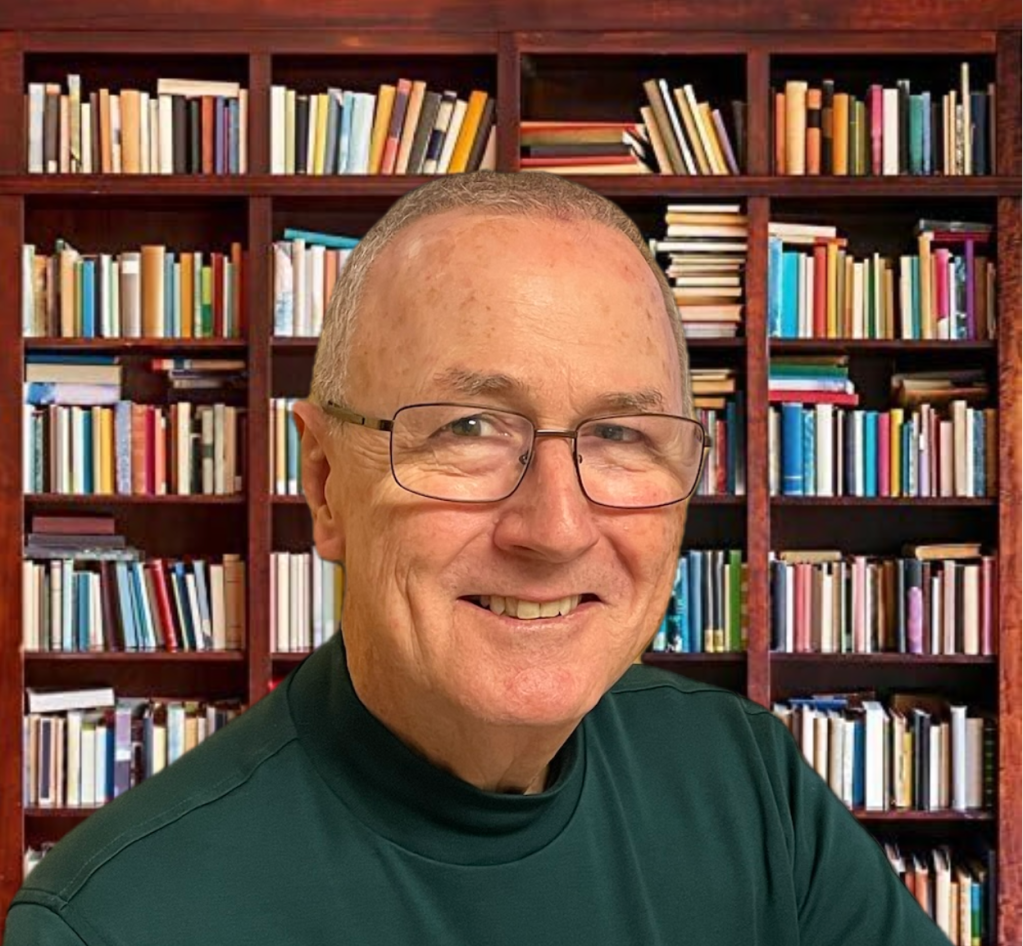
My name is Kevin Carroll. I was born and raised in San Francisco, California, where I attended Saint Ignatius College Preparatory. I am a graduate of both Santa Clara University and the University of San Francisco. Following a 40-year career in teaching and pastoral ministry, I launched a new career as a writer and speaker.
I live in San José, California. My wife, Kathy, and I have three adult sons and five precious grandchildren. I have much for which to be grateful.
I can be reached via email at kmc43sjc@gmail.com
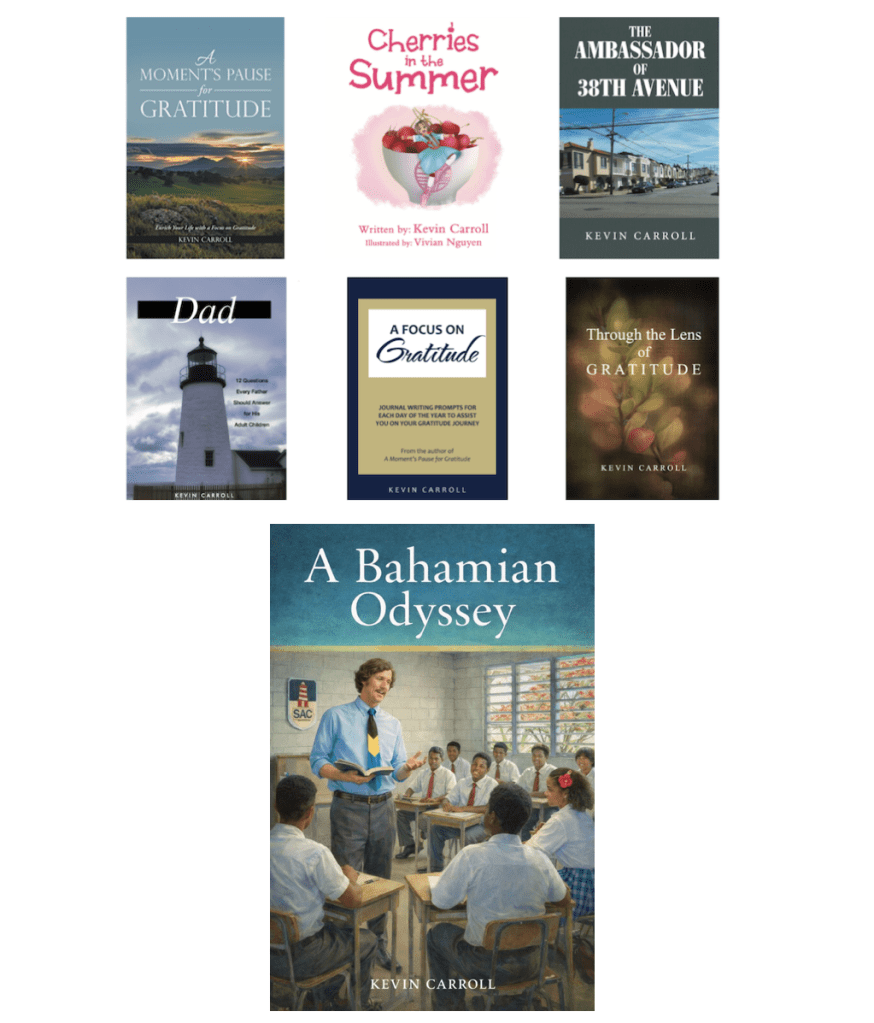
My books are available for purchase online from Amazon. I also have copies of some of these titles at my home for those who would like to buy them directly from me.
A Moment’s Pause for Gratitude (2017)
Cherries in the Summer (2021)
The Ambassador of 38th Avenue (2022)
Dad: 12 Questions… (2023)
A Focus on Gratitude (2024)
Through the Lens of Gratitude (2024)
A Bahamian Odyssey (2026)
-

- October 2026
- September 2026
- August 2026
- July 2026
- June 2026
- May 2026
- April 2026
- March 2026
- February 2026
- January 2026
- December 2025
- November 2025
- October 2025
- September 2025
- August 2025
- July 2025
- June 2025
- May 2025
- April 2025
- March 2025
- February 2025
- January 2025
- December 2024
- November 2024
- October 2024
- September 2024
- August 2024
- July 2024
- June 2024
- May 2024
- April 2024
- March 2024
- February 2024
- January 2024
- December 2023
- November 2023
- October 2023
- September 2023
- August 2023
- July 2023
- June 2023
- May 2023
- April 2023
- March 2023
- February 2023
- January 2023
- December 2022
- November 2022
-
Bonding Time

“The family is the
first essential cell
of human society.”
Pope John XXIII
There’s a clever little sign I’ve seen in a number of novelty stores through the years. It reads:Grandma & Grandpa’s House:
Where cousins become best friends.I’ve always appreciated that quote. It certainly makes me think back to the 1960s when my siblings and I would gather with my cousins, most often at my grandparents’ home. Those were times I always looked forward to, always enjoyed, and still recall fondly. My experience of the past 24 hours has confirmed that this generational phenomenon is happening again — with my own grandkids.
Our home was full last night. Our oldest son, Tom, and his wife, Hillaray, dropped off their two children, Liam (10) and Emily (7). Steve and Morgan, who live just two doors down from us, came by with their three — Penelope (5), Scarlett (3), and Henry (1). We had pizza from Cicero’s Pizza in San José. The kids ate. They played. They had dessert. It was clear that they were all enjoying themselves immensely.
Later in the evening, Steve and Morgan took Henry home to get a good night’s sleep. The other four were planning to spend the night on the living room floor. They talked, watched movies, played more games, and had a great time. When it came time to go to sleep, Scarlett decided that she would rather sleep at home, so Steve came down to pick her up. The others camped out here at “Club Panda” for the evening.
This morning, Kathy prepared a breakfast fit for royalty — fresh fruit, French toast (with chocolate sauce for those who wanted it), a plate of crispy bacon, and hot chocolate. Everyone was happy… and grateful.
After an early-morning visit to the pool, Kathy took the girls on a shopping excursion. Our granddaughters never get tired of going shopping with “Mama.” She spoils them.
While the girls were shopping, Liam went down to Steve and Morgan’s place to hang out with Henry. The age gap between the two certainly doesn’t get in the way of their blossoming friendship. Henry idolizes Liam. It didn’t take long for Liam to realize that Henry enjoys books as much as he did at that age — and still does. They sat on the living room floor while Liam read some of Henry’s favorites to him. Precious moments!
I can only hope that the memories our grandchildren have of spending time with their cousins at our home us will evoke the same type of positive feelings I have when I think back to my own childhood.
-
A Simple Thought
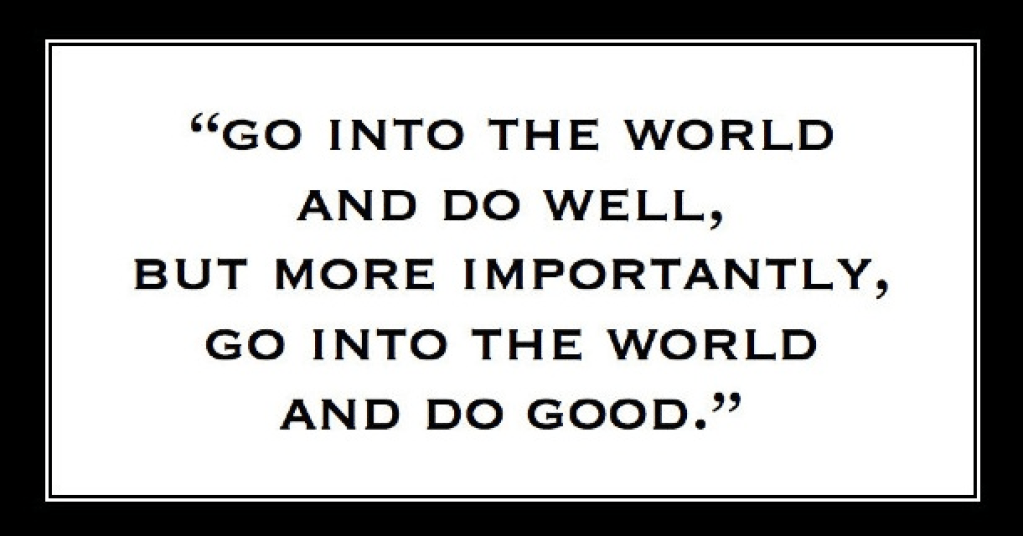
I believe that there are times when a blog post should be like a good Sunday homily: the fewer words, the better.
For this reason, I’m going to let the message of this image speak for itself.
Have a great day!
-
People We Meet
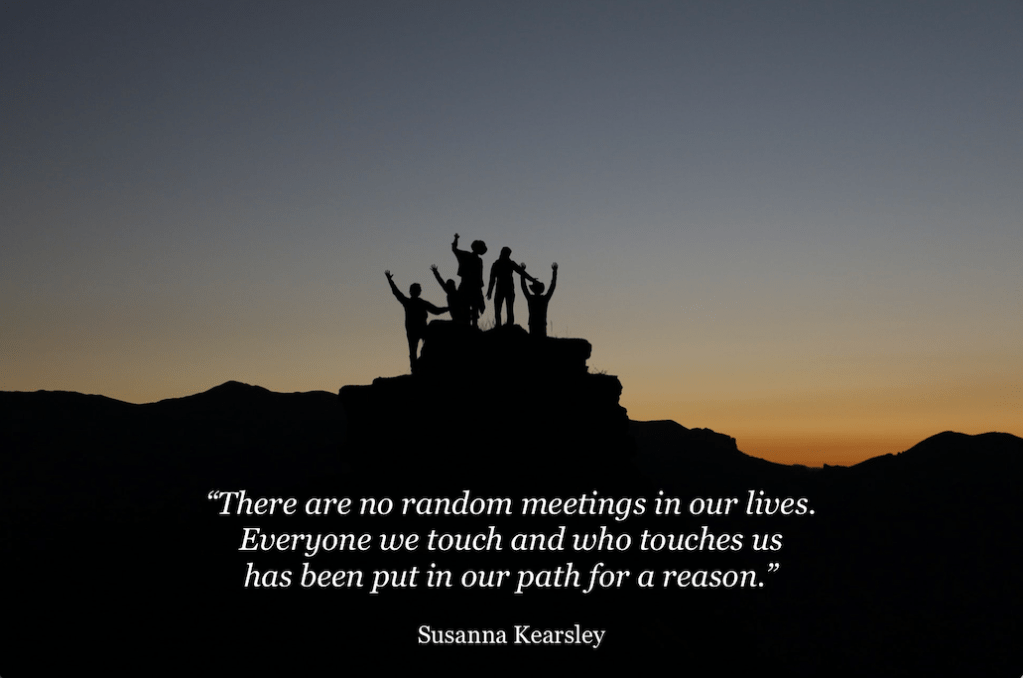
Throughout my lifetime, I have had the pleasure of meeting people — lots of people. I’ve met them in my neighborhood, in schools I’ve attended, in workplaces, at parties or other social events, in coffee shops, in my travels around the world, and in my day-to-day comings and goings. I cannot pinpoint exactly when it happened, but at some point in my life, I began to realize that these seemingly random meetings were anything but random.
I was thinking about how to explain this viewpoint to readers when I came to the realization that no explanation is necessary. Certainly, I am not the only person who has had this insight. Recognizing the significance of seemingly insignificant encounters with others is a universal experience. Still, I am fascinated by it.
During my elementary and high school years, I met a number of individuals who are still very much a part of my life today. One person in particular, who I met on July 31, 1971, had a major role in the career path I followed in life. In the summer of 1972, while working a summer job at a fast food restaurant, I met someone whose friendship I have cherished for more than fifty years. In 1977, I was blessed to have a professor at Santa Clara University who made a positive impact on my life, and with whom I am still in contact today. For the past several weeks, I have had the privilege of collaborating with one of my former students who I taught back in 1982. He is now the principal of a Catholic elementary school in San José. He invited me to work with him and his vice principal to plan a faculty/staff retreat which focused on the theme of gratitude. The retreat was held in Santa Cruz this past Wednesday.
Just last night, I received an email from a guy I met about 35 years ago when he was actively involved in the young adult ministry program at Saint Lawrence Parish in Santa Clara. (I intentionally set him up to work with a young woman as a small-group retreat leader on a Confirmation retreat… an experience which, in time, led to their decision to marry!) I haven’t seen Joseph, nor his wife, Jo-Ann, in many years, as they moved to North Carolina for Joseph’s job. We’re getting together for breakfast on Monday morning.
When we meet someone, we just never know what impact they might have on our life, or how we might affect theirs.
At the faculty/staff retreat this past Wednesday, two members of the school staff turned out to be former students of mine from Saint Lawrence Academy — and they didn’t know each other, as one of them was recently hired. One had graduated in 1987, the other in 2016. It’s a small world.
Those who know me are well aware that I’m fairly outgoing. I love meeting people. I enjoy hearing the life stories, dreams, ambitions, and accomplishments of people’s lives. Kathy once told someone that I could “carry on a conversation with a fire hydrant.” While I understand what she was saying, that’s a bit of a stretch. I prefer two-way communication rather than monologues with inanimate objects!
The quote above, by Susanna Kearsley, is a reminder to us all that every person we meet, even those we might perceive as being difficult at times, have come into our lives for a reason. Perhaps it might be worth the effort to reflect on our relationships with friends and acquaintances and to give mindful consideration to what that reason might be.
-
Santa Cruz
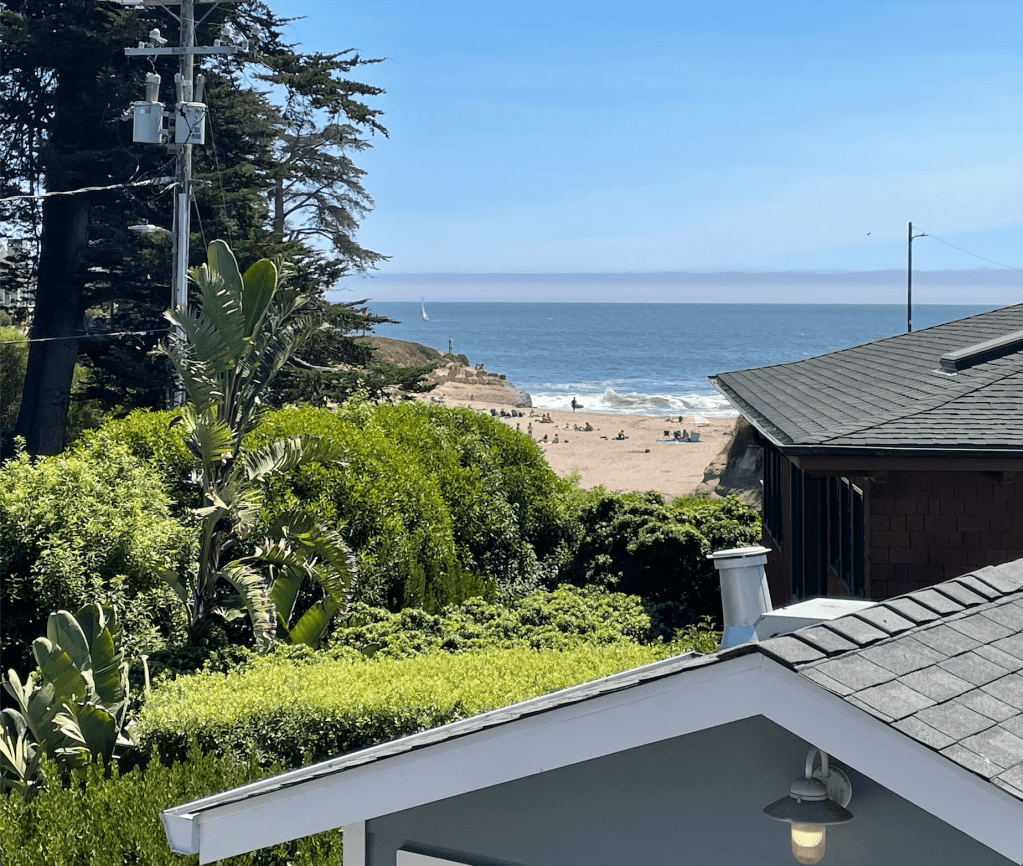
“The churning, churning,
churning of the waves
against the shore revives me
— makes me whole.”
Nallén (poet)I’m sitting at an umbrella-covered table on the patio deck of a hotel in Santa Cruz, California. The air temperature is in the mid-70º range, with a gentle breeze. The view… ah, the view… is a peek at a local beach, a layer of fog well off the coastline. The words of the poet Nallén express my thoughts even better than I can. The repetitive sound of the waves crashing onto the shoreline is like music to my ears.
Is this Heaven? No, it’s Santa Cruz.
When I think about the beach, especially when I reflect on some of the beach music I’ve grown to love and appreciate through the years, I can’t help but think of Jimmy Buffet. It’s been almost two years since the legendary singer/songwriter died. He once said, “If there’s Heaven for me, I’m sure it has a beach attached to it.” I have no doubt that, in some other dimension, beachgoers are enjoying hearing Buffet singing his popular tunes Come Monday, It’s Five O’Clock Somewhere, and his signature song Margaritaville.
I’ve been here for only one hour, yet I already feel relaxed, refreshed, and renewed. I am in Santa Cruz to facilitate a one-day retreat for the faculty of a San José school tomorrow. I wanted to get here a day early to unwind, to get a good night’s sleep, and to avoid having to navigate the sometimes treacherous Highway 17 in the morning. Mission accomplished. I’m here, and tremendously grateful to be here.
The first eighteen years of my life were spent living by the sea — the Pacific Ocean. It was a short walk to the beach from my family home. Sadly, it was a walk I rarely, if ever, took. It wasn’t until I moved to the Santa Clara Valley in 1972 that I realized how blessed I was to have lived so close to the beach all those years.
Oceanographer Jacques Cousteau once wrote, “The sea, once it casts its spell, holds one in its net of wonder forever.” Maybe this is why I feel so much at home when I visit places like Nagasaki, Japan and Nassau, Bahamas.
One of the primary reasons I enjoy visiting San Francisco so often in my retirement is to walk along the water, whether at Ocean Beach, Crissy Field, or on the Embarcadero. It’s the water that brings me such a powerful sense of peace and serenity. Scientists talk about the mental health effects of the negative ions present in ocean air. I don’t know much about that, but I do know that ocean air is like medicine to me. I always walk away from it feeling better than when I arrived.
I will definitely savor each moment of the next 48 hours!
-
A Prayer Request

Rob Gibbs Some of you might recall that in April I participated in a Walk for Life in San Francisco to raise funds for cancer research, specifically Multiple Myeloma. I have two close friends who have been dealing with this specific type of cancer. One friend, Bill Roche, who was one of my classmates at Saint Ignatius College Prep, is doing well. Kathy and I had lunch with Bill, and his wife Penny, last week. He looked wonderful and was in great spirits.
Rob Gibbs is married to Cathy, one of my elementary school classmates at Saint Gabriel School in The City. I got to know Rob when I reconnected with a number of my former classmates about ten years ago. Rob is an avid Giants’ fan, an outdoorsman, a hunter, a cyclist, and a connoisseur of fine foods and wines. Most importantly, he’s one of the nicest people I know.
Tomorrow, August 12th, Rob will have a kidney transplant at the University of California Medical Center in San Francisco. A successful transplant will give him a second lease on life. His kidney donor is his son, Matthew. I have no doubt this will be an incredibly stressful day for Cathy and her entire family.
May I ask those who read this to please take a moment and pray for a successful surgery. Rob is my age, and while he has lived a full and productive life, I’m convinced that God still has work for him to do here on earth. (I know Cathy does!)
Your prayerful support will be greatly appreciated.
-
Two Roads
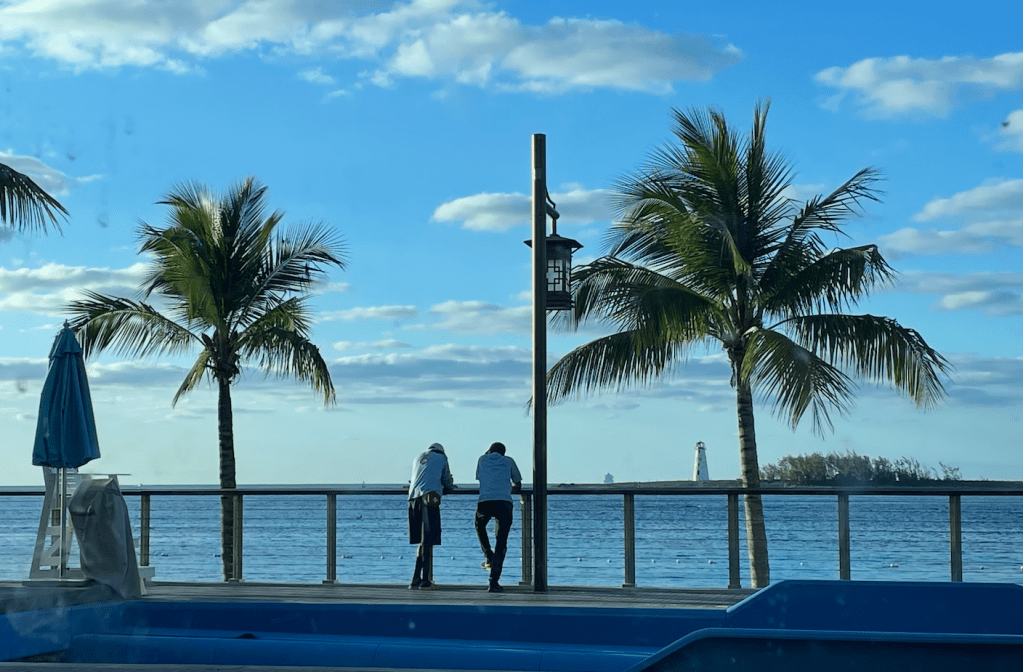
“Two roads diverged in a wood, and I —
I took the one less traveled by,
and that has made all the difference”
Robert FrostIt was the spring of 1979. I would be graduating from Santa Clara University in June. I knew that I wanted to pursue a career in teaching. I had already experienced a one-year full-time teaching job at Saint Augustine’s College in the Bahamas. And for the past three years, while completing my undergraduate degree, I had been teaching part-time at Bellarmine College Prep in San José. With graduation approaching, I knew it was time to begin applying for a teaching position for the 1979-80 academic year.
I dutifully sent out applications to a number of schools. I had already been informed that there were no open positions for the coming year at Bellarmine, so all they could offer me was to continue with the two classes per day I’d been teaching the previous three years. I needed a full-time job, and I knew, in my heart, exactly where I wanted to teach.
When a letter arrived from Mr. Lou Adderley at Saint Augustine’s College, welcoming me back to the SAC faculty for the 1979-80 school year, I was ecstatic. I thought I was so ready to return to the island to continue teaching and coaching there. In the weeks following my receipt of that letter, however, something didn’t feel right.
A retired friend, who owned multiple properties in Santa Clara, had offered to rent one his homes to me — a cozy two-bedroom, one bath house with a front porch and large backyard — for only $200/month. The going rate at the time for such a rental was at least $750/month. I also had a reliable car — a 1972 Volkswagen bug. I began to feel a bit conflicted. In Nassau, I would have to find a place to live and a vehicle to get around the island. Then came the unexpected phone call.
The principal at Saint Christopher School in San José, a school to which I had not applied for a teaching position, asked me if I would consider teaching junior high literature the following year. My name had been given to her by my friend, Al Trigueiro. Al had been teaching fifth grade at Saint Christopher for several years, but was moving on to a new job. Sister Eileen’s call caught me off-guard, but I didn’t say no to her offer. I asked for a little time to think about it. In the following days, using the tools of Ignatian discernment I had learned, it was clear that I was being called, literally, to teach at Saint Christopher School.
Mr. Adderley, one of the kindest people I’ve ever known, was quite understanding when I wrote back to him to explain my change of plans. He wished me well. I felt guilty for not returning to SAC, but I knew in my heart that Saint Christopher was the right choice at that time.
I’ve often wondered,… what if? What if I had accepted the job at Saint Augustine’s College? What if I had moved back to Nassau, found a place to live and a car to drive, and had lived out my adult years in Nassau? I was 25 years old at that time. How would my life have been different than it turned out to be?
I guess I’ll never know the answer to these questions. I made a decision in the spring of 1979 which set me on the course I’ve experienced in the 50+ years since that time. As Robert Frost described in his poem The Road Not Taken, “Two roads diverged in a wood, and I…” Well, this is where the comparison ends, because I, I took the one which was more convenient at the time, and that has made all the difference.
-
Warm Summer Evenings
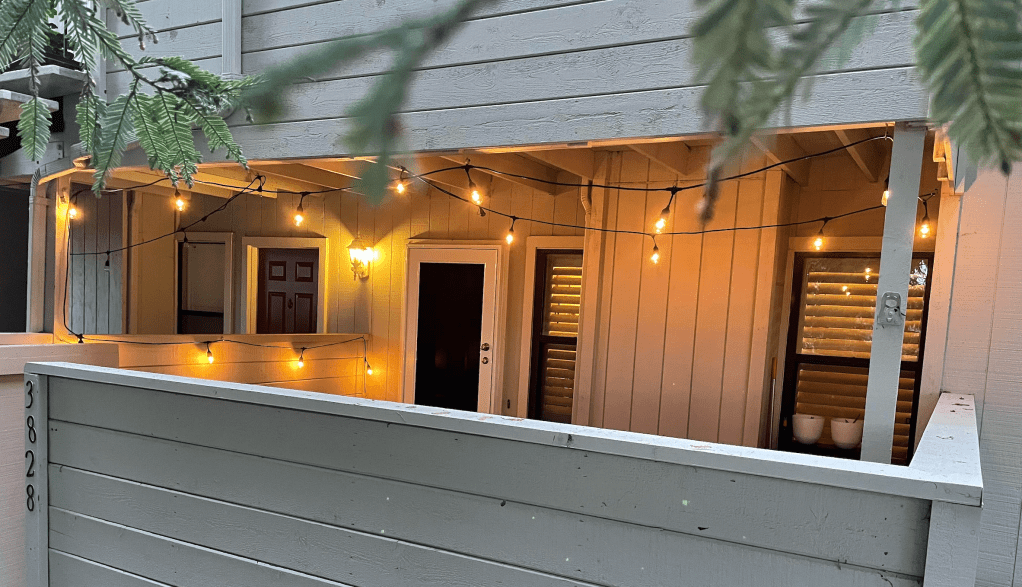
“What good is the
warmth of summer,
without the cold of winter
to give it sweetness?”
John SteinbeckAh, yes… warm August nights. How I dream of them in February when they are just a faint memory of summers past.
At this point in my life, enjoying such an evening here at home, sitting outside on the patio enjoying a cold drink and, perhaps, a chocolate chip cookie or two, is an absolute joy. For the most part, just as February’s “California cold” really isn’t all that cold, “California hot” in August is most often comfortably warm. Tonight was one of those evenings.
In my younger days, I made an effort to escape to the Bahamas for a vacation in the first two weeks of August. In 1979 and 1981, I made enough money teaching summer school to cover the cost of my trips. In 1985, I took a group of young adults from Saint Lawrence Parish in Santa Clara to Nassau to meet up with young adults from local parishes on the island.
Now, August nights in Nassau are too warm for me. I could probably get used to them easily enough, but my days of spending hours on a beach getting a sun tan and partying at The Rum Keg in the Nassau Beach Hotel at night are history. My visits to Nassau now are preferably in the more temperate months of March and November.
Here at home, though, I can enjoy the solitude of a summer evening right outside my front door. It’s amazing that with a bit of imagination, sitting outdoors with patio lights strung around the perimeter of the deck, it’s fairly easy to imaging that I’m back in the islands. I can play a little reggae music on Pandora and feel the island vibe. When I do this, I’m in my happy place.
-
The Lens We Choose

“Gratitude is not only the
greatest of virtues,
but the parent of
all the others.”
Marcus Tullius CiceroWhen I began writing about gratitude in December 2006, I had no idea that the concept would become a popular topic in the years to come. I also didn’t realize that I had so much to learn about gratitude in my own life. All I knew at the time was that I had spent many years taking people and things for granted. This was not something I was doing consciously. I never intended to be ungrateful. My perception of my life at that time, however, was clearly one of achievement, rather than one of giftedness. I had this mistaken belief that I was where I was in my life because of things I had accomplished, and that I had somehow earned the status I enjoyed in this world. I could not have been more misguided.
It’s interesting, and a bit disheartening, to realize that despite having attended a Jesuit high school and two Jesuit universities for undergraduate and graduate studies, I had somehow missed learning about the most foundational virtue to be drawn from Ignatian spirituality: gratitude.
Ignatius of Loyola agreed wholeheartedly with Cicero in stating that gratitude is the foundational virtue, the virtue from which all other virtues flow.
Humility is a highly-valued virtue. This is the virtue which should have informed me that all that I have is not the result of my own efforts, but of God’s grace. My perspective on life changed dramatically when I acknowledged that my talents, opportunities, and accomplishments have been gifts, rather than achievements.
Generosity, too, is a highly-respected virtue. When I came to the realization that what I have is the result of God’s giftedness, rather than my own accomplishments, I was able to understand that nothing is truly mine in the possessive sense. Rather than considering myself to be the owner of knowledge, experience, or material possessions, I am able to see that my actual role in the world is to be a good steward of these things. They’re not mine to keep. They are mine to share with others, who, in turn, will share with others.
The virtue of joy is also a byproduct of a grateful heart. By embracing an attitude of gratitude, and consciously choosing to view the world through the lens of gratitude, I am better able to recognize God’s presence in the ordinary, everyday experiences of my life.
In addition to being a virtue, gratitude also has the potential to serve as a barometer of our spiritual health. A focus on gratitude helps me to recognize, and to remember, that we are recipients of God’s love and grace before we are capable of being achievers.
In his article The First Virtue: Saint Ignatius on the Power of Gratitude, author Andy Otto reminds us that in the garden of life, “gratitude isn’t simply one virtue among many.” Rather, he writes, it is “the soil from which all others naturally grow.”
It’s been almost 20 years since I began my gratitude journey. I’ve learned much about the importance of being grateful in life. I’ve also learned how essential it is that we express the gratitude we feel to those responsible for it. As William Arthur Ward said so eloquently, “Feeling gratitude and not expressing it is like wrapping a present and not giving it.”
-
Dad’s City
Herb Caen was a columnist for the San Francisco Chronicle for more than 50 years. His witty and insightful writing earned him the title “Mr. San Francisco.” One his most famous quotes about The City makes me wonder about my Dad’s experience of arriving in Heaven following his death in 2008. Caen had written, “I hope I go to Heaven, and when I do, I’m going to do what every San Franciscan does when he gets there. He looks around and says, ‘It ain’t bad, but it ain’t San Francisco.’”
In memory of my Dad, on the anniversary of his death, I spent the day yesterday walking in The City. That’s something Dad did on a regular basis after his retirement from the San Francisco Fire Department. These photos, and the captions provided, will tell the tale of my experience in The City on July 31, 2025.
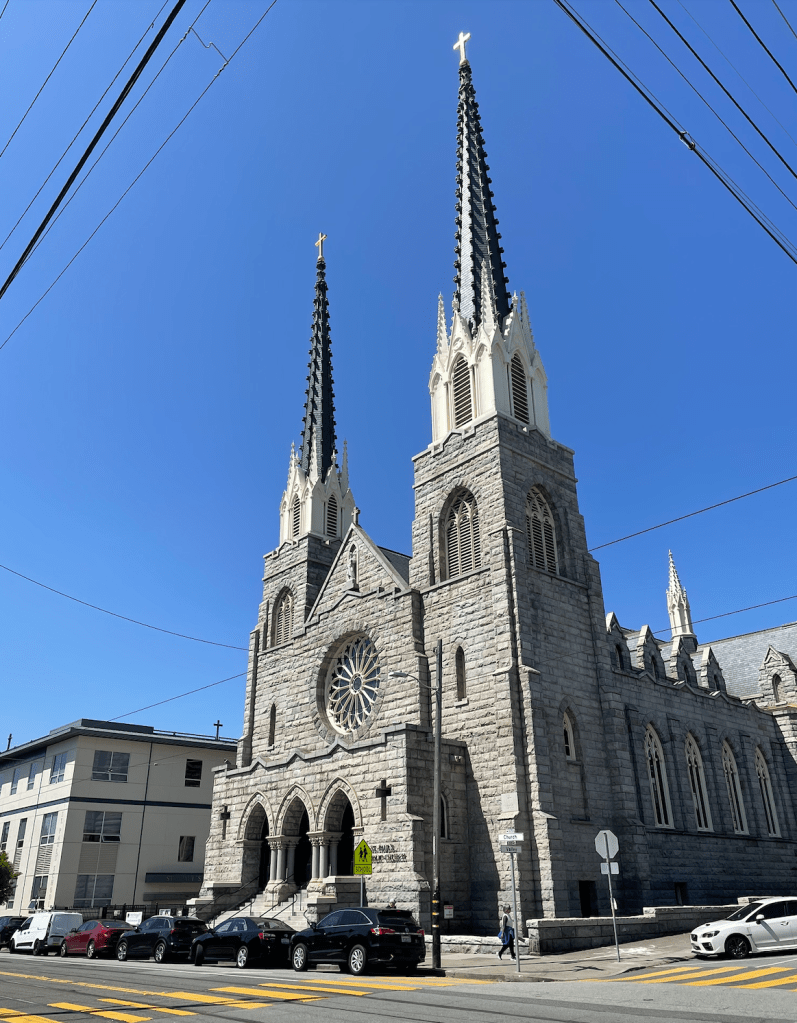
I took CalTrain to San Francisco from the station in Santa Clara. When I arrive in The City, I took public transportation to St. Paul Catholic Church and school. This is where my Dad was baptized and where he attended elementary school. I attended the 8:30 a.m. Mass.

After Mass, I walked from the church to 25th & Sanchez Street to the childhood home of my Dad. Immediately after taking this photo, the garage door opened. I explained to the owner that this had been my father’s childhood home. “I don’t think so,” he replied. “My family has owned this house since 1947.” I explained that Dad was born in 1925 and had lived in this house until the mid-40’s. Surprised, the man asked me, “Was your grandfather a San Francisco firefighter?” I assured him he was. Apparently, the owner is well aware of the history of his family in this home, which includes purchasing it from an Irish firefighter!

After a quick breakfast at Chloe’s Café at 26th & Church, I set out on my walk. I didn’t have any particular agenda, so I walked over to Clipper Street… and looked up. I thought to myself, I can do this! So I began the climb up the hill, thinking that I would take it all the way up to Portola Drive. When I got to Clipper & Diamond, another thought crossed my mind. What a nice day to take Diamond Street over the hill to the south and visit Silver Tree Day Camp in Glen Canyon. So I changed directions. Along the way, I was reminded of the unique architecture of homes which had been built on the hillsides in Diamond Heights.
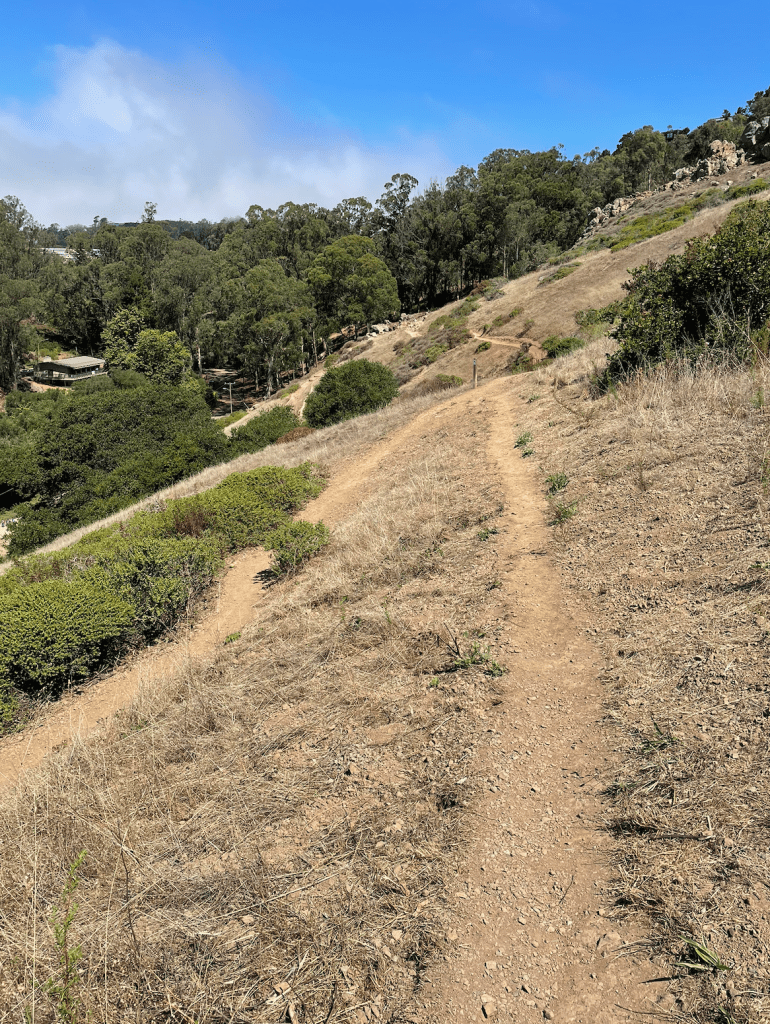
I made it to the top of Diamond Street and headed down into Glen Canyon, where I had worked at Silver Tree Day Camp back in the late 60’s and early 70’s. At that time, these paths along the hillside did not exist. In recent years, the San Francisco Recreation & Parks Department has made Glen Canyon a treasured hiking venue in The City. I carefully worked my way from the top of the hill down to the road leading to the camp.

From the hillside, one can get a glimpse of the Silver Tree Day Camp building. Color-coded picnic tables behind the building were the setting for daily lunch and snacks for the campers.
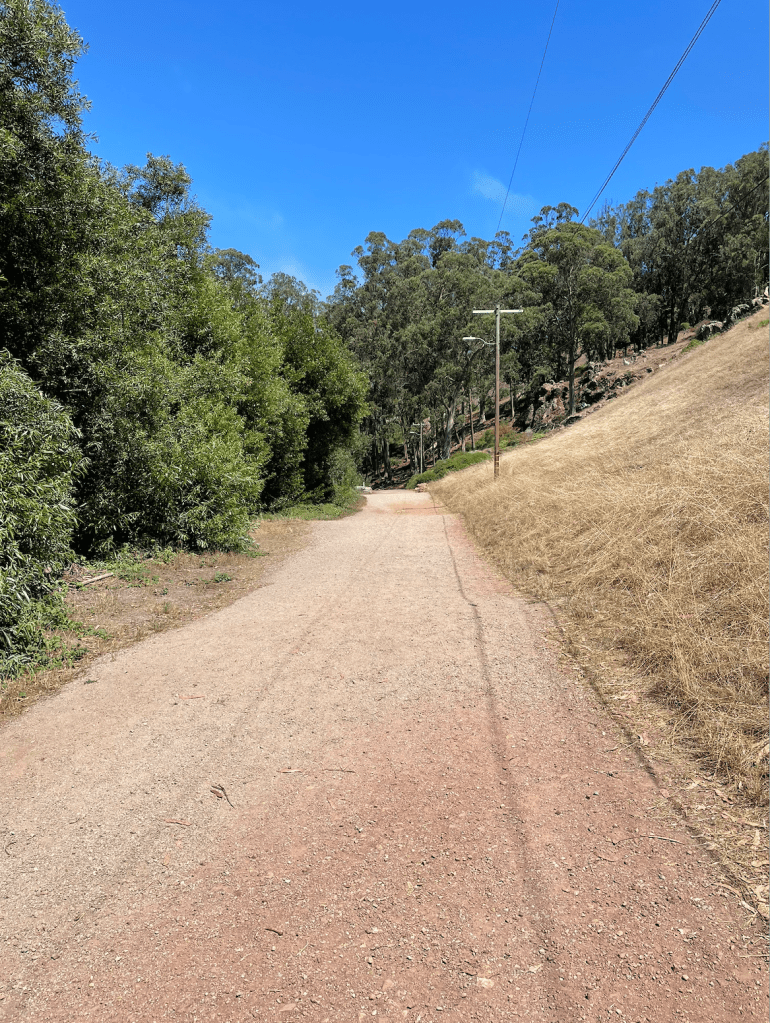
This dirt road is the only access by car from the front entrance of Glen Park Playground on Elk Street to the main building of Silver Tree Camp. I took this road, often on foot, and occasionally on my bicycle, to get to work each day.

One of my favorite spots on the summer camp property has always been the porch overlooking the play area and the main camp site, where campers would gather for assemblies and singing. There was also a stage at main camp where campers put on skits for their parents when they would visit the camp at the end of the day on Thursday evenings.

After a rigorous hike up O’Shaughnessy Boulevard and then down Portola Drive, I enjoyed lunch at the Bull’s Head Restaurant in West Portal. From there I continued walking down Sloat Boulevard to 19th Avenue. At that point, I had another idea. I had not been down into Sigmund Stern Grove for many years, so I ventured down the hill into the valley to check it out.

The driveway down into Sigmund Stern Grove is spectacular. It’s hard to believe that right there in the midst of a congested urban area, one can find such a remote, peaceful, nature-filled paradise.
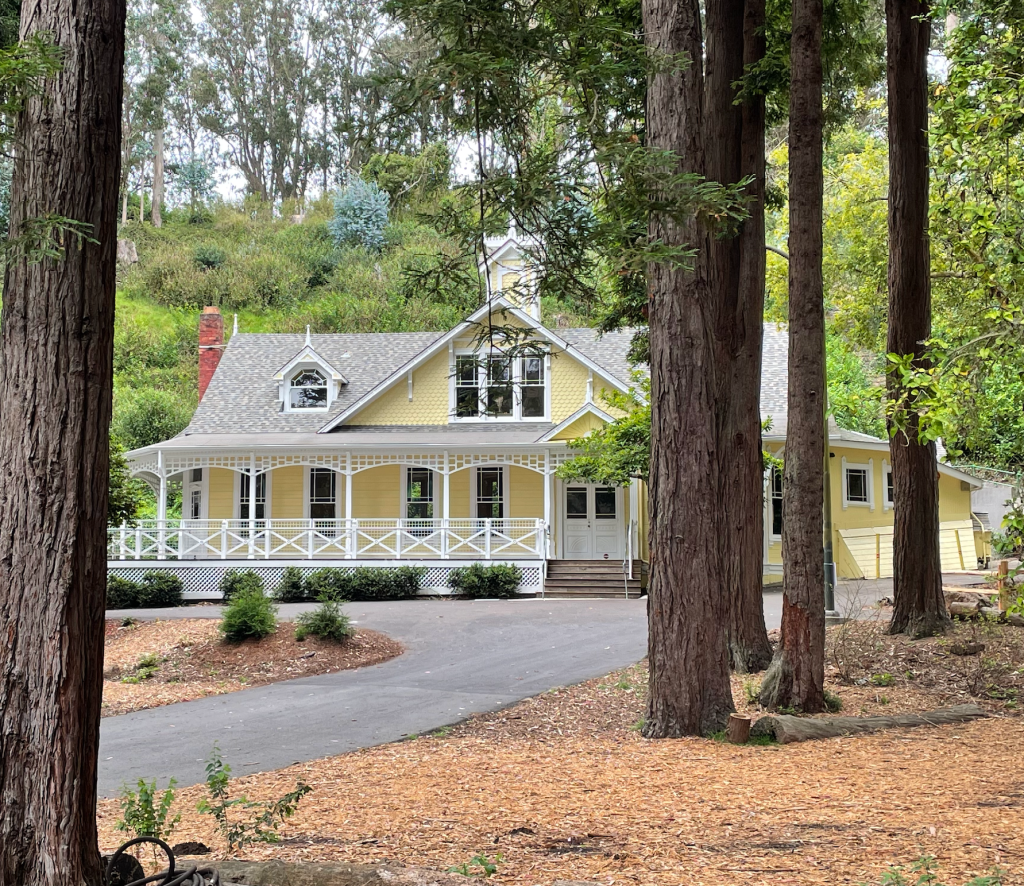
At the east end of Sigmund Stern Grove is the Trocadero Club house, which was constructed in 1892. In the early 20th century, this building was used as a road house, offering dancing and gambling at roulette tables. Today, the venue may be rented for weddings, family gatherings, or other social events.

I walked to the west end of Sigmund Stern Grove and up the hill near Pine Lake. By then, I was close to my own childhood home at 38th Avenue between Vicente and Wawona Streets. Of course, I had to make a stop. Ironically, it was here, 17 years ago last night, that my Dad fell down the back stairs, sustaining a traumatic head injury which ended his life.

Continuing west on Wawona Street, I got to 40th Avenue where I snapped this photo of the ball field at South Sunset Playground. This is where I played soccer and baseball. In the background, up the hill, is Saint Gabriel Church and school, where I attended grades one through eight.

Continuing down Wawona to 45th Avenue, then one block south to Sloat Boulevard, I made a quick stop at Java Beach Café. For me, no trip to The City is complete without a visit to Java Beach, either this one on Sloat or the original shop at a Judah and LaPlaya Streets.

After a long day of walking, I finally made it to Ocean Beach. I met two San Francisco Fire Department ambulance drivers who were taking a break in the parking area at the end of Sloat Boulevard. Of course, we talked a bit about Dad before I snapped this photo of the surf and went on my way.
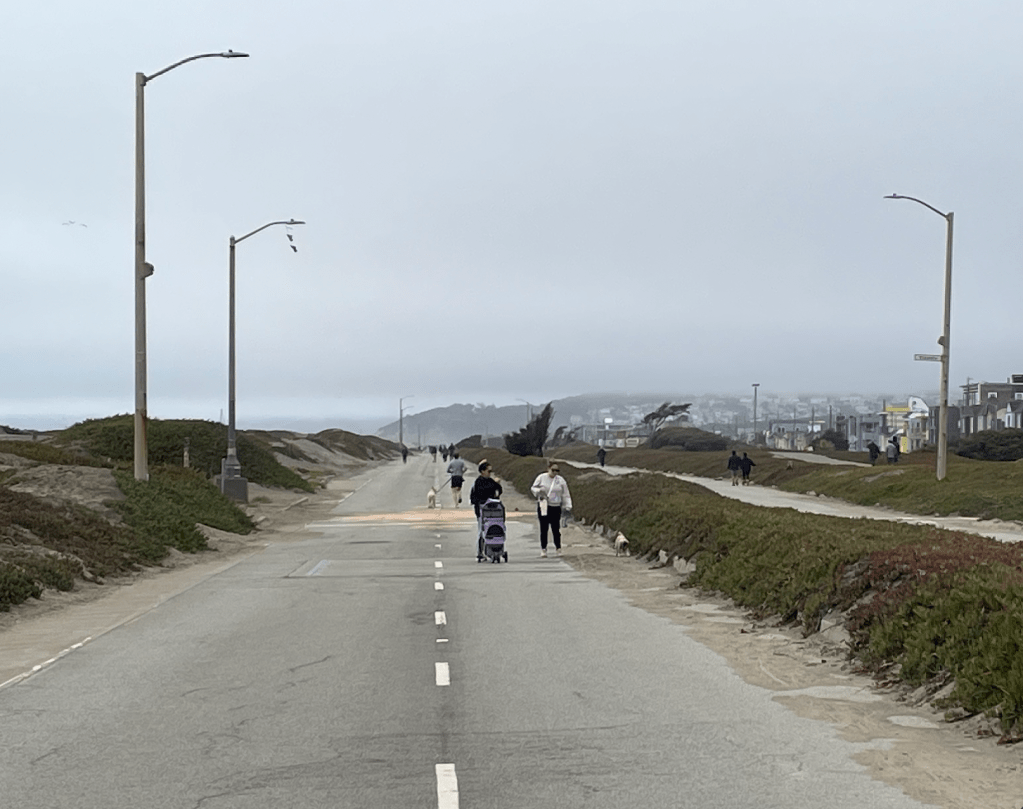
There was one final leg of my walking journey through The City. I walked along what was once known as The Great Highway. Recently, the road was closed to traffic and converted into what is being called Sunset Dunes, a walking, running, biking recreation area that runs parallel to Ocean Beach. I walked from Sloat Boulevard to Judah Street, where I would finally have an opportunity to rest my tired feet.
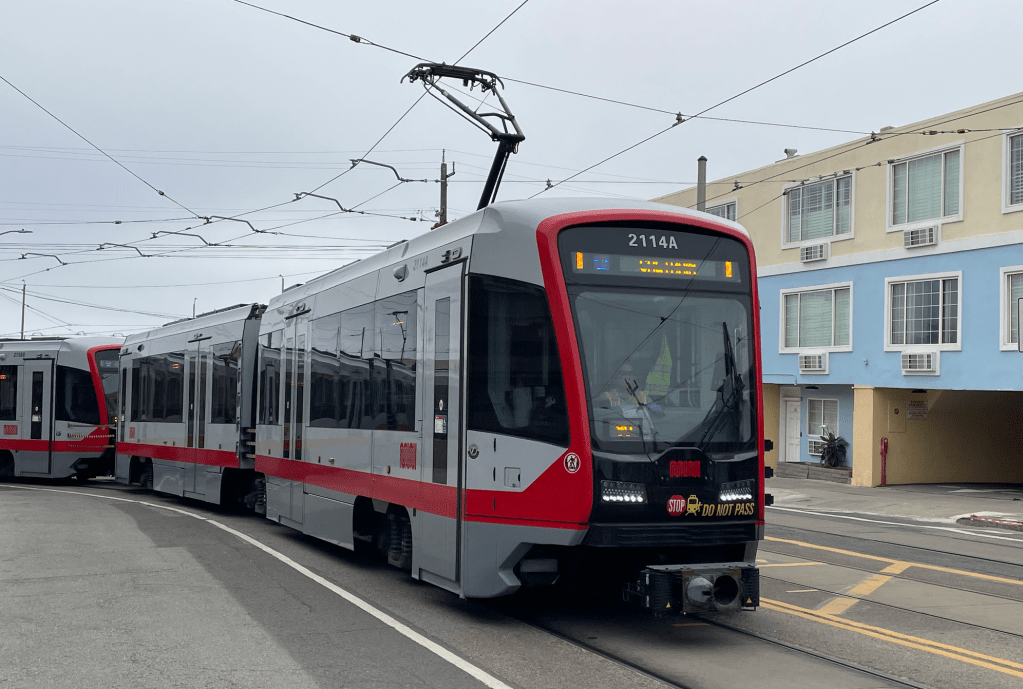
At the west end of Judah Street, the N-Judah streetcar turns around for the return trip downtown, and eventually to the CalTrain Station at 4th & King Streets. I enjoyed a comfortable ride through The City and along the Embarcadero past Oracle Park, home of the San Francisco Giants baseball team. I got off at the end of the line, walked across the street, and boarded CalTrain for the ride back to my car in Santa Clara. It was an absolutely amazing day, resulting in some pretty nice stats:

Mark Twain once said, “The person who does not read has no advantage over the person who cannot read.” I believe the same is true for walking. By the grace of God, I have the ability to walk — even the challenging hills of San Francisco. I am grateful for this gift, and for the opportunity to honor my Dad with yesterday’s adventure.
-
Dad
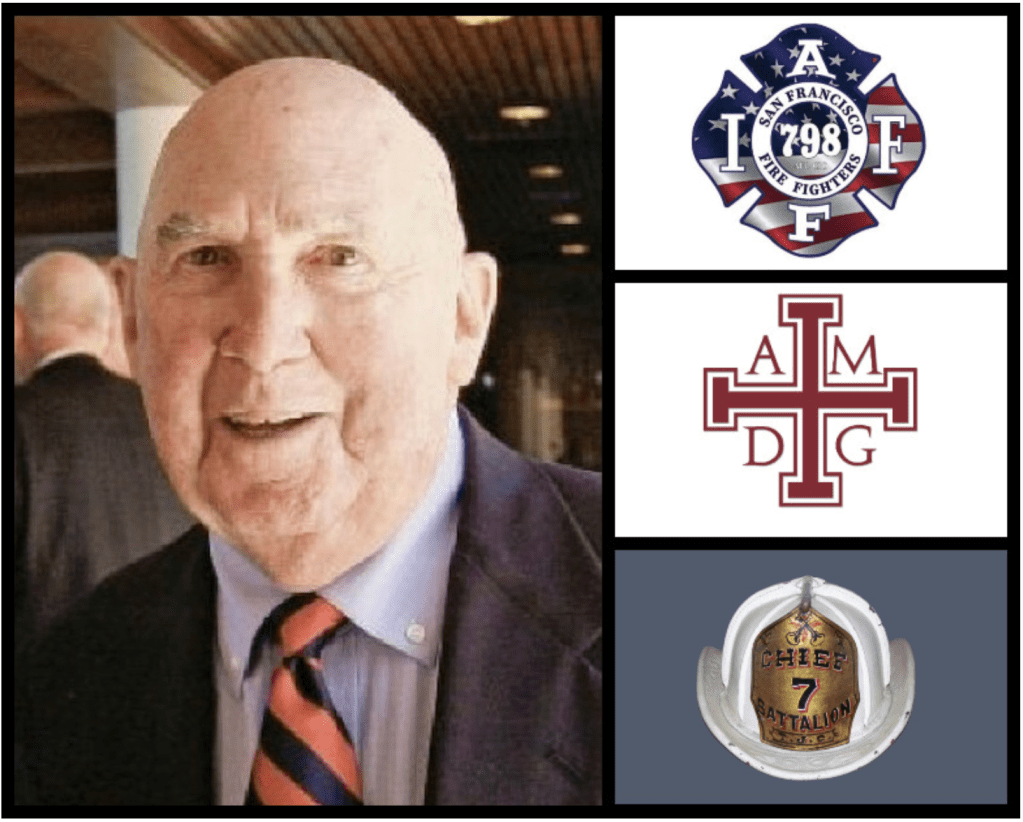
A friend shared this song with me last night. I wanted to share it with you this morning. Today, July 31st, is the anniversary of my Dad’s death. He passed away unexpectedly in 2008. This song, by the group Westlife, is called “I’ll See You Again.” Click HERE to listen to it. Here are the lyrics:
Always you will be part of me
And I will forever feel your strength
When I need it most
You’re gone now, gone but not forgotten
I can’t say this to your face
But I know you hear
I’ll see you again
You never really left
I feel you walk beside me
I know I’ll see you again
When I’m lost, I’m missing you like crazy
And I tell myself I’m so blessed
To have had you in my life, my life
I’ll see you again
You never really left
I feel you walk beside me
I know I’ll see you again
When I had the time to tell you
I never thought I’d live to see the day
When the words I should have said
Would come to haunt me
In my darkest hour I tell myself
I’ll see you again
I’ll see you again
You never really left
I feel you walk beside me
I know I’ll see you again
I’ll see you again
You never really left
I feel you walk beside me
I know I’ll see you again
I will see you again
I’ll see you again
I miss you like crazy
You’re gone but not forgotten
I’ll never forget you
Someday I’ll see you again
I feel you walk beside me
Never leave you, yeah
Gone but not forgotten
I feel you by my side
No this is not goodbyeSongwriters: Andrew Gerard Hill / Michelle Lena Poole
I’ll See You Again lyrics © Kobalt Music Publishing Ltd.Rest in peace, Dad.
-
Subscribe
Subscribed
Have a WordPress.com account? Log in now.

