-

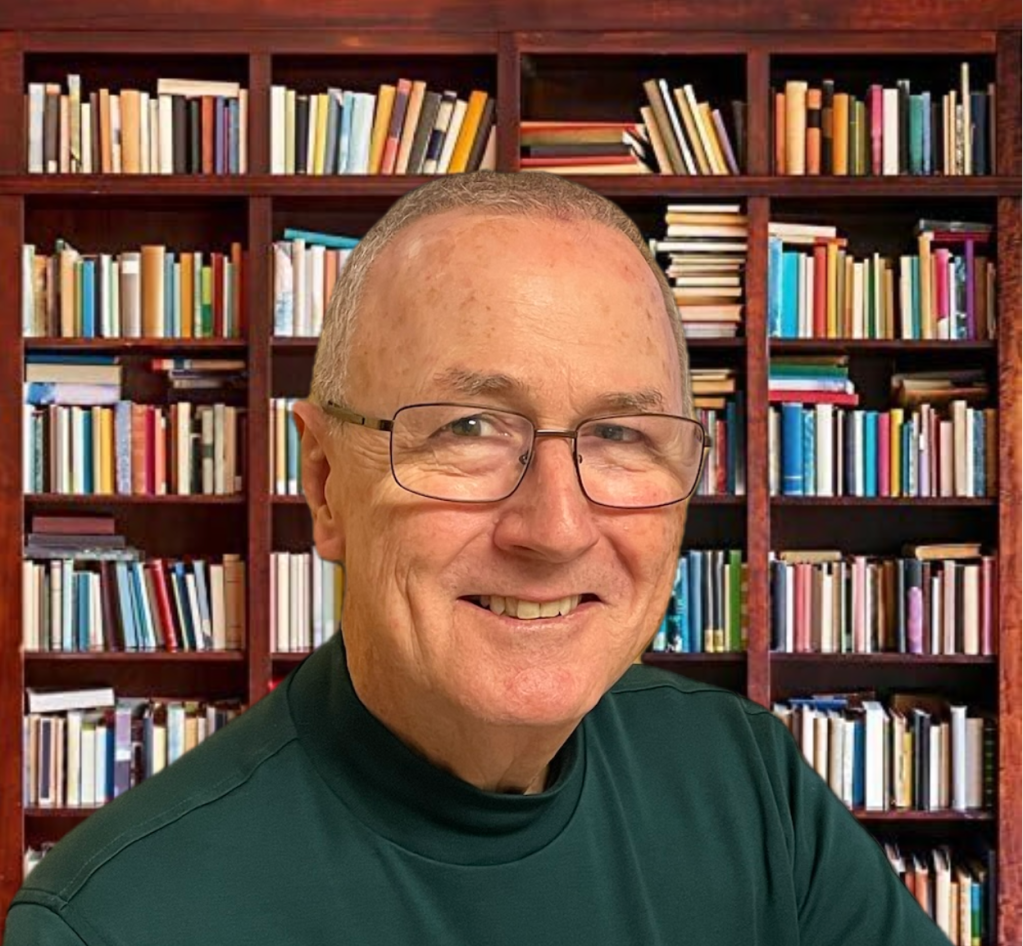
My name is Kevin Carroll. I was born and raised in San Francisco, California, where I attended Saint Ignatius College Preparatory. I am a graduate of both Santa Clara University and the University of San Francisco. Following a 40-year career in teaching and pastoral ministry, I launched a new career as a writer and speaker.
I live in San José, California. My wife, Kathy, and I have three adult sons and five precious grandchildren. I have much for which to be grateful.
I can be reached via email at kmc43sjc@gmail.com
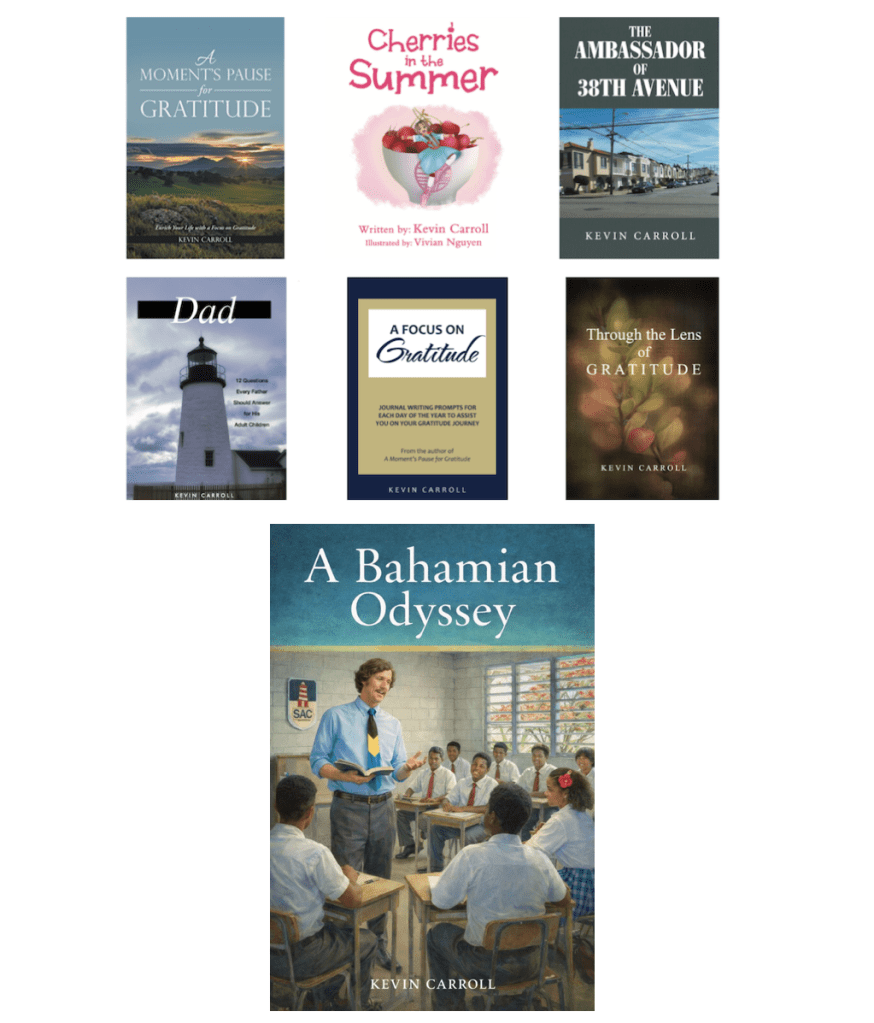
My books are available for purchase online from Amazon. I also have copies of some of these titles at my home for those who would like to buy them directly from me.
A Moment’s Pause for Gratitude (2017)
Cherries in the Summer (2021)
The Ambassador of 38th Avenue (2022)
Dad: 12 Questions… (2023)
A Focus on Gratitude (2024)
Through the Lens of Gratitude (2024)
A Bahamian Odyssey (2026)
-

- October 2026
- September 2026
- August 2026
- July 2026
- June 2026
- May 2026
- April 2026
- March 2026
- February 2026
- January 2026
- December 2025
- November 2025
- October 2025
- September 2025
- August 2025
- July 2025
- June 2025
- May 2025
- April 2025
- March 2025
- February 2025
- January 2025
- December 2024
- November 2024
- October 2024
- September 2024
- August 2024
- July 2024
- June 2024
- May 2024
- April 2024
- March 2024
- February 2024
- January 2024
- December 2023
- November 2023
- October 2023
- September 2023
- August 2023
- July 2023
- June 2023
- May 2023
- April 2023
- March 2023
- February 2023
- January 2023
- December 2022
- November 2022
-
Attitude is Everything
“The last of the
human freedoms:
to choose one’s
attitude in any
given set of
circumstances.”Viktor Frankl
I first read Viktor Frankl’s Man’s Search for Meaning in the fall of 1976. It was assigned reading for a Spiritual Autobiographies course at Santa Clara University. There are a number of memorable quotes from this book which I’ve applied to my life through the years. Like so much of the wisdom we acquire in our lifetime, it’s so often easy to forget. Such is the case with these words by Frankl.
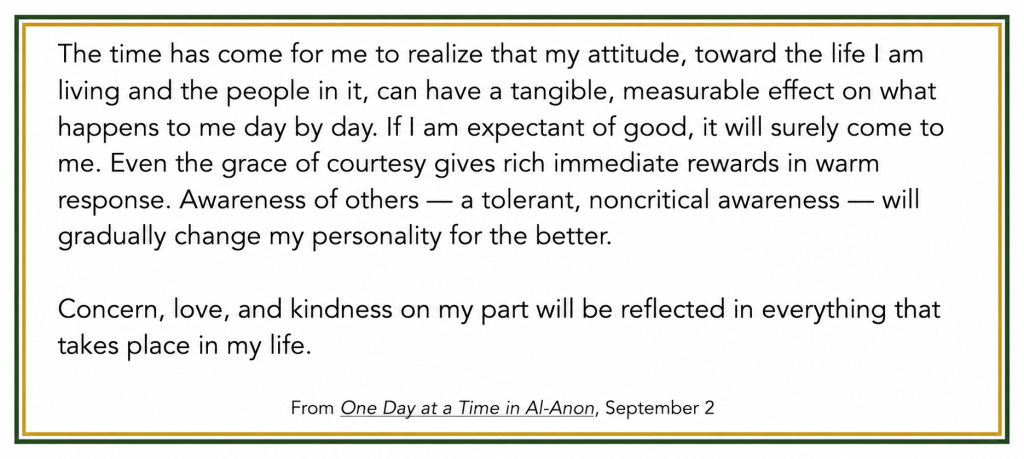
Each morning, I read an excerpt from the book One Day at a Time in Al-Anon. The reading for September 2, which I read yesterday, hit me like a pie in the face. Yes, attitude is everything. I believe this. I’ve shared this pearl of wisdom with my sons, my students, and in my writing. Yet, in the midst of my own life struggles, I often fail to recall this valuable life lesson I learned many years ago. I got a much-need wake-up call yesterday morning.
One Day at a Time in Al-Anon is a daily reader for family and friends of those who struggle with alcohol addiction. From my earliest days, my life has been impacted by alcoholism in a variety of ways. My favorite uncle, my Dad’s brother Billy, died as a result of drinking too much. Countless aunts and uncles, as well as three of my four grandparents, suffered from alcoholism. And when I was in fifth grade, my best friend died when his mother, in an alcoholic stupor, failed to recognize the medical distress my friend was experiencing when his appendix ruptured. So yeah, I’m no stranger to the world of addiction and its consequences.
My Dad, himself an alcoholic, warned me countless times during my early adolescence to be careful when it came to drinking, reminding me that alcoholism is a family disease to which I would be vulnerable. I had a few experiences of excessive drinking during my college years, but by the grace of God, I’ve been spared the addiction to alcohol gene (if there is such a thing). My addictions leave me vulnerable to vices like chocolate, baked goods, and ice cream.
Every now and then, and sometimes inexplicably so, I find myself wallowing in a funk. At such times, I can see only the negative things going on in my life and around me. I know it’s within my power to change my attitude, but that’s the thing I often fail to remember. When this happens, I mistakenly convince myself that there is little, if anything, to feel good about — little, if anything, for which to be grateful.
Frankl’s message, summed up nicely in yesterday’s reading from One Day at a Time, was a much-needed reminder that life is good. There’s no denying that there is evil in the world. There’s no way to ignore the day-by-day deterioration of the society in which I’ve grown up, but I am still able to choose my own attitude despite these concerns.
By making a concerted effort to focus my attitude and attention on the positive aspects of life — specifically concern, love, kindness, and, of course, gratitude — all these things will be reflected in everything that takes place in my life. This seems to be a good recipe for happiness and contentment.
Managing our attitude is a challenge we must accept… one day at a time.
-
“Fill ‘er Up!”

“The service stations
are centers of business
and conversation…
they are like the
old general stores.”John Steinbeck
in Travels with Charley“Fill ‘er up!” Now there’s a phrase you don’t hear any more. The term “service station” itself is basically obsolete here in California, where patrons must pump their own gas and, in many cases, pay for their purchase without any human contact whatsoever.
You want the windshield washed? There’s a tool for that,… sometimes. Check the air in your tires? You’re on your own for that, too. Sadly, there are many places where an additional fee is charged for adding air to your tires. Things sure ain’t what they used to be.
I mention all this because of a unique experience I had at the local gas station the other day. I pulled into the Rotten Robbie facility at Saratoga Avenue and Williams Road to refill the tank of my 2005 Honda Accord. As I stepped out of my vehicle, I recognized a friend, Steve, who had just paid for refueling his vehicle. Much to my surprise, and his, too, perhaps, we had a lengthy and meaningful conversation about kids, parenting, and life in general. Fortunately, our mid-day conversation did not inconvenience any other customers. We had an amazing heart-to-heart discussion as we caught up on each other’s lives.
This unexpected conversation gave me a sense of hope. In recent months, I’ve been struggling with the realization that I have very few authentic male friends. Oh, sure, I know lots of people. There are neighbors, relatives, former coworkers and classmates, and friends of friends, but I was hard-pressed to identify even three individuals I could legitimately call a true friend.
A plethora of information is available to confirm my observation, articles detailing the problem men have with maintaining quality friendships with other men. I’ve read much of this literature without giving it much thought. I accepted that that’s just how it is in the world today. I was wrong.
Like any healthy relationship, men’s friendships with other men require nurturing. They require time, attention, consistency, resilience, vulnerability, and so much more. As I reflected on my lack of male friendships these past few months, I didn’t recognize that I was doing nothing to nurture these relationships. I spent my time complaining, mostly to myself, that no one reached out to me, when I was failing to reach out to them, as well. The brief encounter with Steve at the gas station the other day reminded me that nurturing friendships requires conscientious effort on my part.
For this reason, I sat down at my desk that night and created a list of guys who are a part of my life. From that list, I identified my “starting five.” My experience coaching basketball taught me the importance of knowing my starting five players. These were the athletes I could depend upon to get the job done. Then I filled in my friend roster with the remainder of players. And just as is done in competitive athletics, I had to cut a few players — guys who, for whatever reason, could not be relied upon to consistently commit to the betterment of the team.
The next step has involved nurturing my relationships with my starting five — letting them know how much they mean to me and how much I need them in my life. I will then increasingly devote my attention to the rest of the guys on my team, making a concerted effort to be more attentive to them, to their needs, and to my need for them in my life.
No longer am I too preoccupied with my career and raising kids to devote time and attention to nurturing much-needed male friendships. I don’t need to be close friends with every guy I know. It doesn’t matter to me if I’m not one of their starting five. What matters is that they know how much they mean to me. How they respond, one way or another, is their gift to me.
-
New Beginning
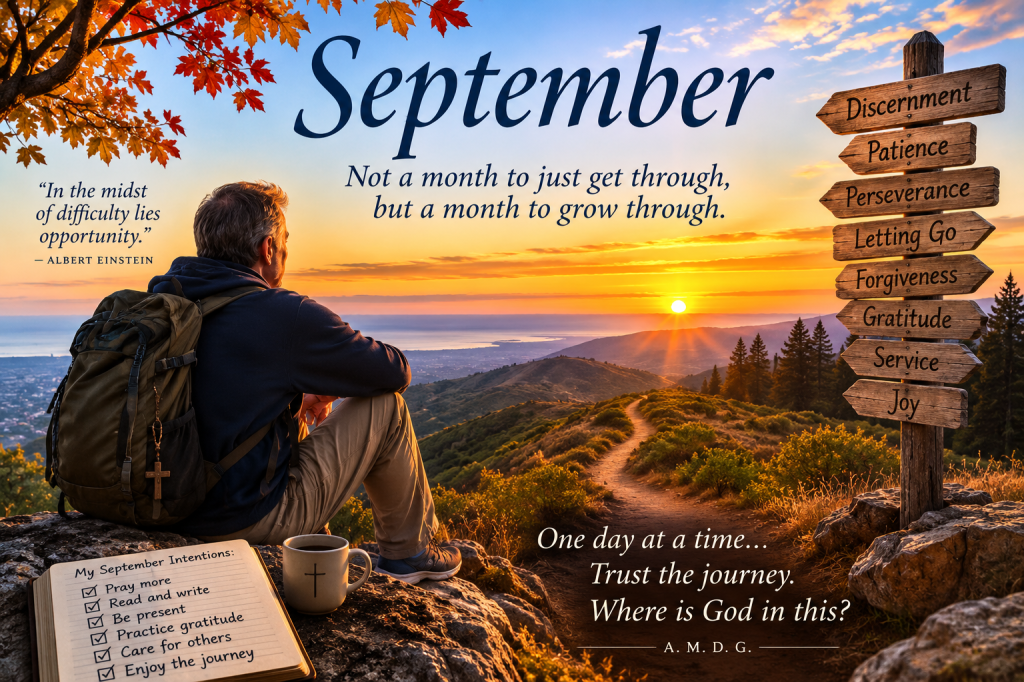
“I have come to believe that caring for myself is not self-indulgent. Caring for myself is an act of survival.”
Audre Lorde
-
A Night to Remember
“To care for those
who once cared
for us is one of
the highest honors.”
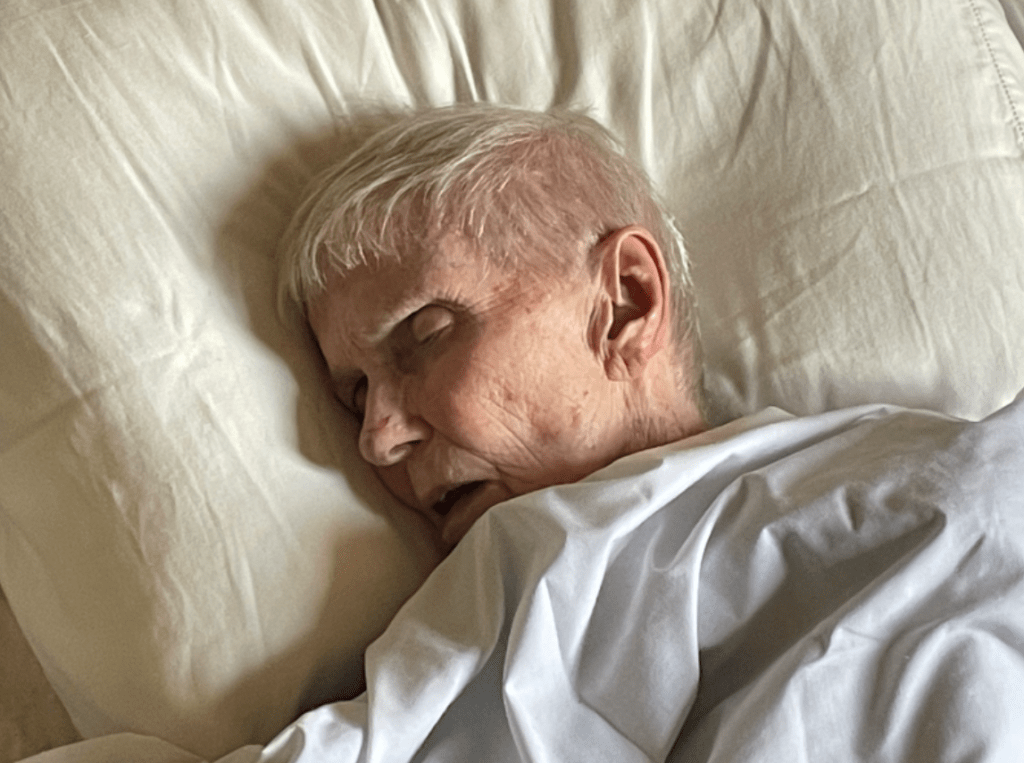
Tia WalkerMy previous blog post mentions that I’m “On Vacation” until September 1st. This has not changed, yet I feel compelled to write this blog post tonight. It was on this date four years ago that I had the honor of spending the entire night sitting at my mother’s bedside at the Villa Siena Retirement Community in Mountain View, California. It would be her last night on earth.
Mom’s death was imminent. For two weeks, my siblings and I had been taking turns being with her during the daytime and early evening hours. A professional caregiver stayed with Mom through the nights. By August 17, 2022, it was clear that it was a matter of hours, not days, until Mom’s earthly life would come to an end. Some of my siblings were with her throughout that day. I had volunteered to take over around 9:00 p.m. and spend the night with Mom.
I did not consider this responsibility to be a burden at all. It was pure gift. As Tia Walker wrote in her book The Inspired Caregiver: Finding Joy While Caring for Those You Love, “To care for those who once cared for us is one of the highest honors.”
Mom cared for me. She cared for my brother, Tom, and my sisters, Cathy and Peggy, as well. It took many years for me to realize that Mom was the personification of unconditional love. As emotionally challenging as it was for me to be with Mom that night, knowing that the end was near, I cherished the opportunity to be there with her,… and for her.
It’s ironic that when my maternal grandmother was nearing the end of her life in 1992, Mom spent countless hours sitting at her bedside at Saint Mary’s Hospital in San Francisco. On Monday, December 14, I stopped by the hospital to visit Mom and Grandma. Mom looked exhausted. She had been by Grandma’s bedside for too many hours. I suggested that she go home and get a good night’s sleep. I assured her that I would stay with Grandma through the night. Several times that night, I thought Grandma had taken her last breath, only to hear her gasp and continue breathing. Mom returned to the hospital the next morning and spent the day with her mother. She and her sister, Kathleen, were by Grandma’s bedside around 6:00 p.m. when Grandma passed away.
I had a remarkably similar experience four years ago tonight while sitting with Mom. On more than one occasion, I thought she had stopped breathing, but just like her mother, she would gasp and then continue breathing. In the morning, on August 18th, my sister, Cathy, arrived to take over. I went home to sleep. Peggy and Tom arrived a little later in the day. In the late afternoon, just about the time I was waking up at home and preparing to return to Villa Siena, Mom died. I was the only one of her children not to be with her when she passed.
Throughout my life, Mom taught me how to live my life with integrity. In her final days, she taught me how to die with dignity. Mom was not afraid of death. She had lived a good, though difficult, life. She had learned how to view the world through the lens of gratitude. She had mastered the ability to recognize God’s presence in all people and in all situations. She taught me the importance of being kind, generous, compassionate, patient, and grateful.
My formal education may have come primarily from the Jesuits, but the most influential teacher in my life was, without a doubt, my Mom.
I love you, Mom, and I miss you.
-
Taking a Break
-
Take Control
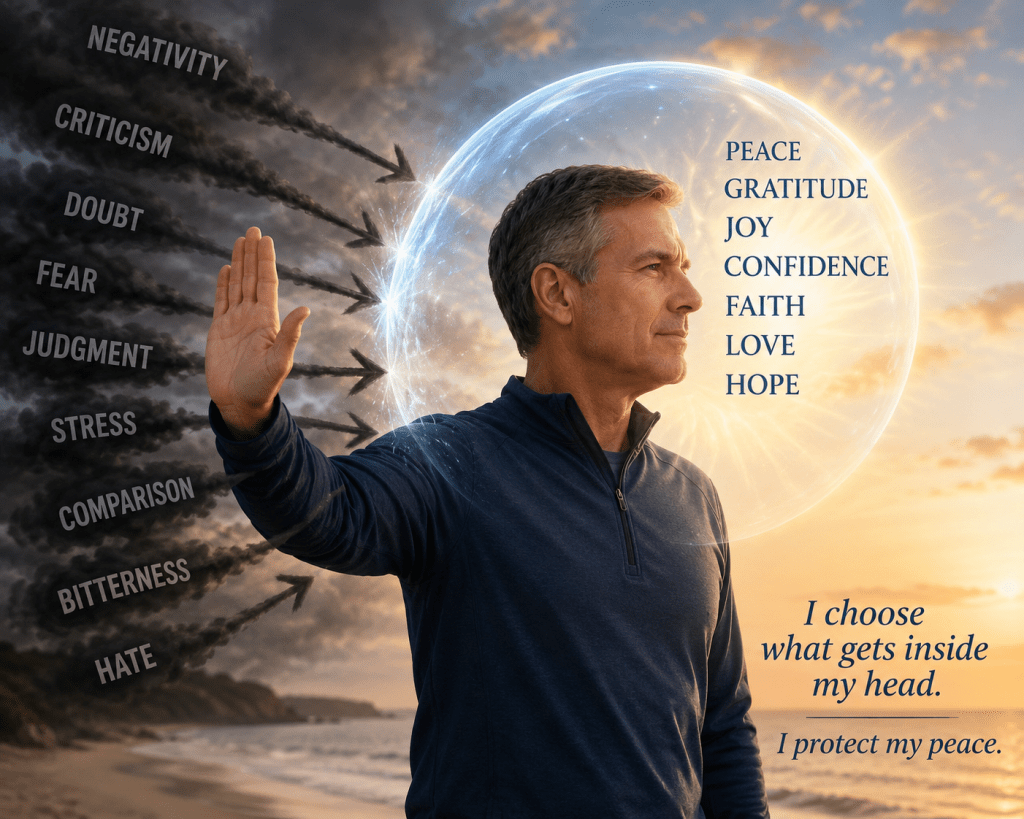
“An entire sea of water can’t sink a ship unless it gets inside the ship. Similarly, the negativity of the world can’t put you down unless you allow it to get inside you.” ~ Goi Nasu
-
Get Out There!

“All truly great
thoughts are
conceived while
walking.”
Friedrich NietzscheWho am I to write about walking? Sure, every now and then I take a long walk through San Francisco. Given that The City is only seven by seven (yes, 49 square miles), a 12-mile walk is fairly impressive. For the most part, though, I continue to live a dangerously sedentary lifestyle. I don’t walk every day, even though I know how important it is for me to do so. Today’s blog post is a reminder… to myself — 11 quotes, from a variety of sources, which I believe are worth embracing… and sharing. I’m hoping that, once again, I can find the motivation to make daily walking a higher priority in my life.
• • •
“If you only walk on sunny days, you’ll never reach your destination.”
Paulo Coelho“If you are in a bad mood, go for a walk. If you are still in a bad mood, go for another walk.”
Hippocrates“Walking isn’t a lost art. One must, by some means, get to the garage.”
Comedian Evan Esar“An early-morning walk is a blessing for the whole day.”
Henry David Thoreau“In every walk with nature, one receives far more than he seeks.”
John Muir“Walking is the best possible exercise.”
Thomas Jefferson“The best way to lengthen out our days is to walk steadily and with a purpose.”
Charles Dickens“The best remedy for a short temper is a long walk.”
Jacqueline Schiff“A vigorous five-mile walk will do more good for an unhappy, but otherwise healthy adult than all the medicine and psychology in the world.”
Paul Dudley White“Go outside. Don’t tell anyone and don’t bring your phone. Start walking and keep walking until you no longer know the road like the palm of your hand. Just walk, see, sit down if you like. And be. Just be, whatever you are and with whatever you have, and realize that that is enough to be happy.”
Charlotte Eriksson -
Attentiveness

“The most precious
gift we can offer
anyone is
our attention.”
Thich Nhat HanhIt’s a strange feeling to be engaged in conversation with someone and to realize that you don’t have their attention. I’ve experienced this many times. One person I used to get together with on a fairly regular basis would ask me a question about something or someone in my life. Then, right in the middle of my response, he would begin to tell a story that was only somewhat related to something I had mentioned, despite the fact that I had not yet answered his question. Later in the conversation, he would ask me a question I had previously answered for him, as if we’d never spoken on the subject. I have very little interest in meeting up with him again.
Another person I know is consistently inattentive in a different way. From the moment we greet each other, while I’m looking him directly in the eye while we shake hands, his eyes are scanning the room to see who else is there. That same inattentiveness continues during our conversation over lunch. In his distractedness, he is most likely unaware that he never asks about me, my life, or my family. When we get together, the entire conversation most often revolves around his life, his experiences, and his interests. At some point several years ago, I lost interest in continuing our “let’s get caught-up” lunches.
When we give someone our full attention, we communicate some important messages — that they matter to us; that they are important; that they are worthy of our time.
When we give someone our full attention, we are able to build deeper relationships. Genuine attentiveness creates trust, invites vulnerability, and strengthens relationships.
When we give someone our full attention, we are able to better understand the other person’s story, feelings, and perspective without feeling the need to judge or offer unsolicited advice.
When we give someone our full attention, they are more likely to feel heard and understood. This attentiveness promotes both confidence and hope. Our time with another person is time we will never get back. Giving a person our undivided attention shows that we cherish the time they are sharing with us.
The gift of attentiveness is one of the greatest gifts we can give another human being.
-
A Moment’s Pause
A great way to
begin and end
your day. -
Sacred Spaces
“Just be,
and enjoy being.”
Eckhart TolleEvery now and then, I find it refreshing to set aside a little time to do nothing. Yesterday was one of those days.
I woke up around 9:00, a bit later than usual, but certainly acceptable for a Sunday morning. My calendar for the day was empty, so I gave serious consideration to how I might spend my precious time. I knew that a trip to The City was out of the question, because the Outside Lands Festival would draw thousands of people to the west end of Golden Gate Park. Staying here in the South Bay would give me an opportunity to enjoy a warmer-than-usual day. The high for the afternoon was predicted to be 90º. I decided that would be my best option.
After showering and dressing, I enjoyed a bowl of oatmeal with dried cranberries for breakfast. Kathy had a list of things to do during the morning hours, so I had the early part of the day to myself. I did a little reading and a little writing, then walked to every unit in our condominium complex to hand-deliver invitations to an upcoming event celebrating the 40th anniversary of Williams Commons, our homeowner association. Kathy and I were among the first to move into this complex when it was constructed in 1986.
In the first ten or fifteen years we lived here, random realtors would knock on our door and ask when we were planning to “move up.” I knew what they meant, but I chose to play dumb and reply, “Oh, I prefer a downstairs unit.” Believing that I was simply ignorant, they’d explain that they were asking when we would be planning to buy a “real house.” My response, delivered politely, but with conviction, was always the same. I’d say, “This IS a real home — and I have no plans whatsoever to move.”
Yes, the 1980’s lifestyle certainly was one about “upward mobility” — of beginning with a starter home, then getting something bigger (and better?) down the line. When we moved in here, I liked this place. I still do. Realtors often speak about the three top priorities for finding a new home: (1) location; (2) location; and (3) location. We have that.
It has been easy for me to embrace the words of Sodo Yokoyama, a Japanese Zen teacher, who urged his followers, “Decide that wherever you are is the best place there is.”
In my home, I have two particular areas I consider to be sacred spaces. The first is my office. This is where I do most of my writing. This is also where I do most of my communicating with family and friends by phone, via email or text messages, or handwritten notes sent by way of the United States Post Office. I’ve also been known to catch a nap in my recliner every now and then.
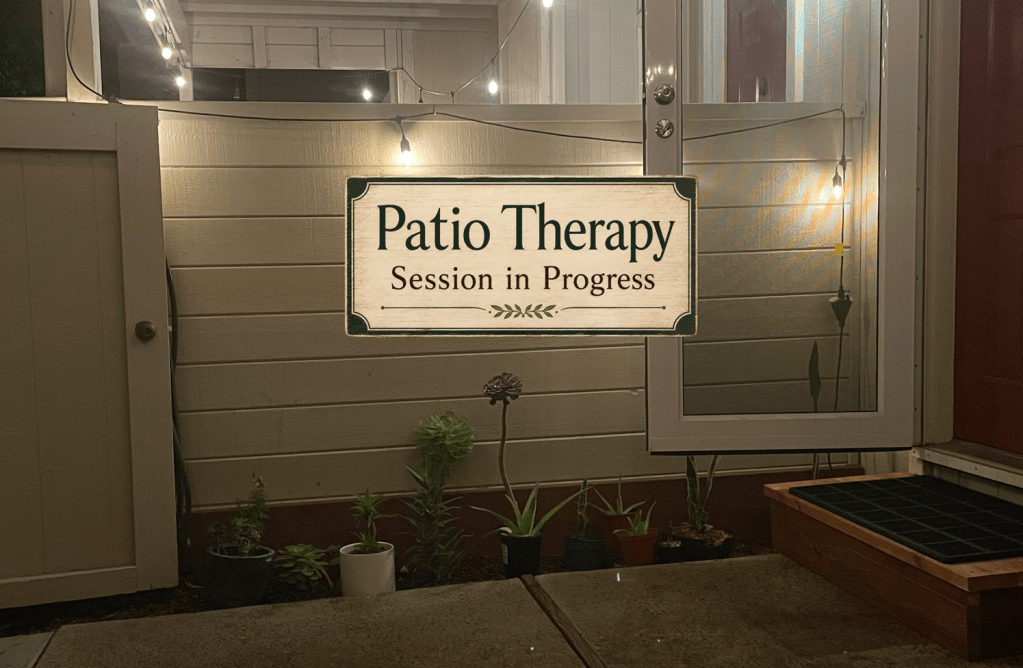
The other sacred space in my home, a small area which has recently been renovated, is the patio outside our front door. Especially on comfortable summer days, it’s an ideal place to visit with people, read, listen to music, or just relax and enjoy the nearby redwood trees. And on warm summer nights, with a string of lights hanging from the deck above, it is a nurturing venue where I can spend time simply letting my mind wander… and being grateful for the countless blessings in my life. I refer to this as my patio therapy.
Bestselling author Sally Clarkson, wrote, “You have the power to create a small, life-giving world within your home.” Yes, we do.
-
Subscribe
Subscribed
Have a WordPress.com account? Log in now.

