-

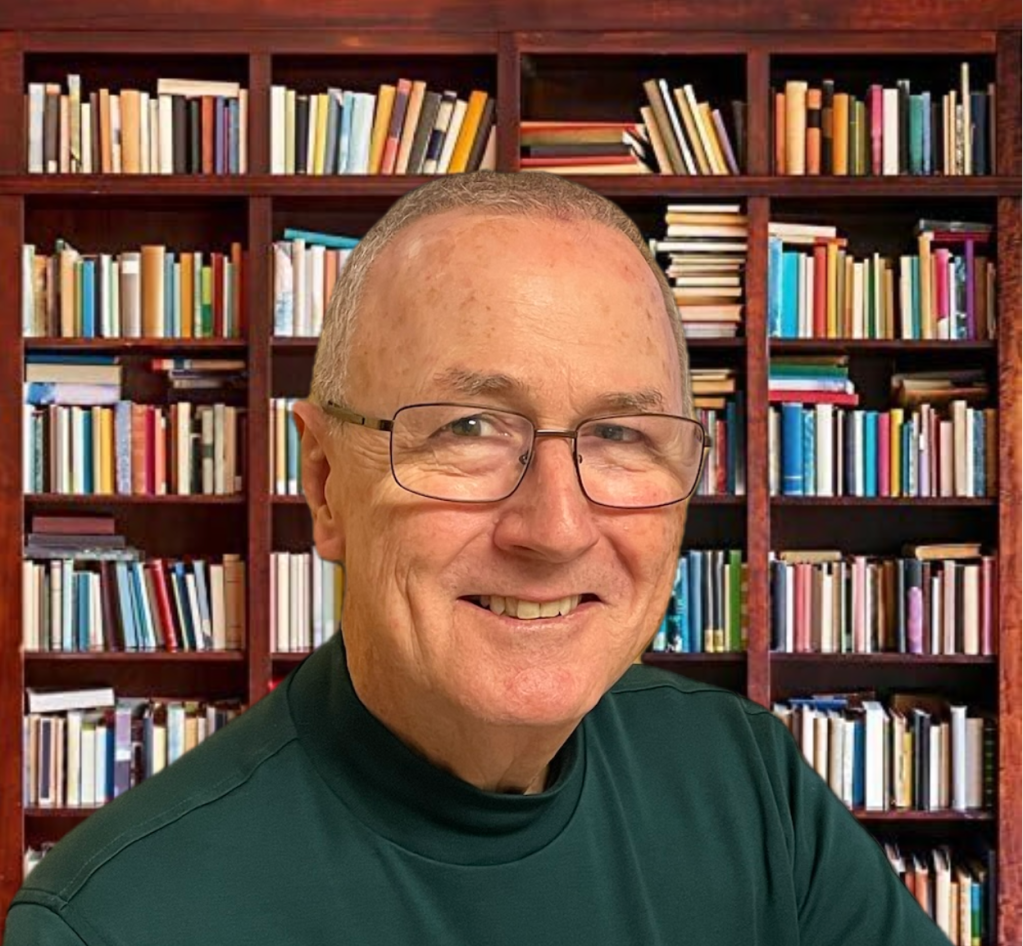
My name is Kevin Carroll. I was born and raised in San Francisco, California, where I attended Saint Ignatius College Preparatory. I am a graduate of both Santa Clara University and the University of San Francisco. Following a 40-year career in teaching and pastoral ministry, I launched a new career as a writer and speaker.
I live in San José, California. My wife, Kathy, and I have three adult sons and five precious grandchildren. I have much for which to be grateful.
I can be reached via email at kmc43sjc@gmail.com
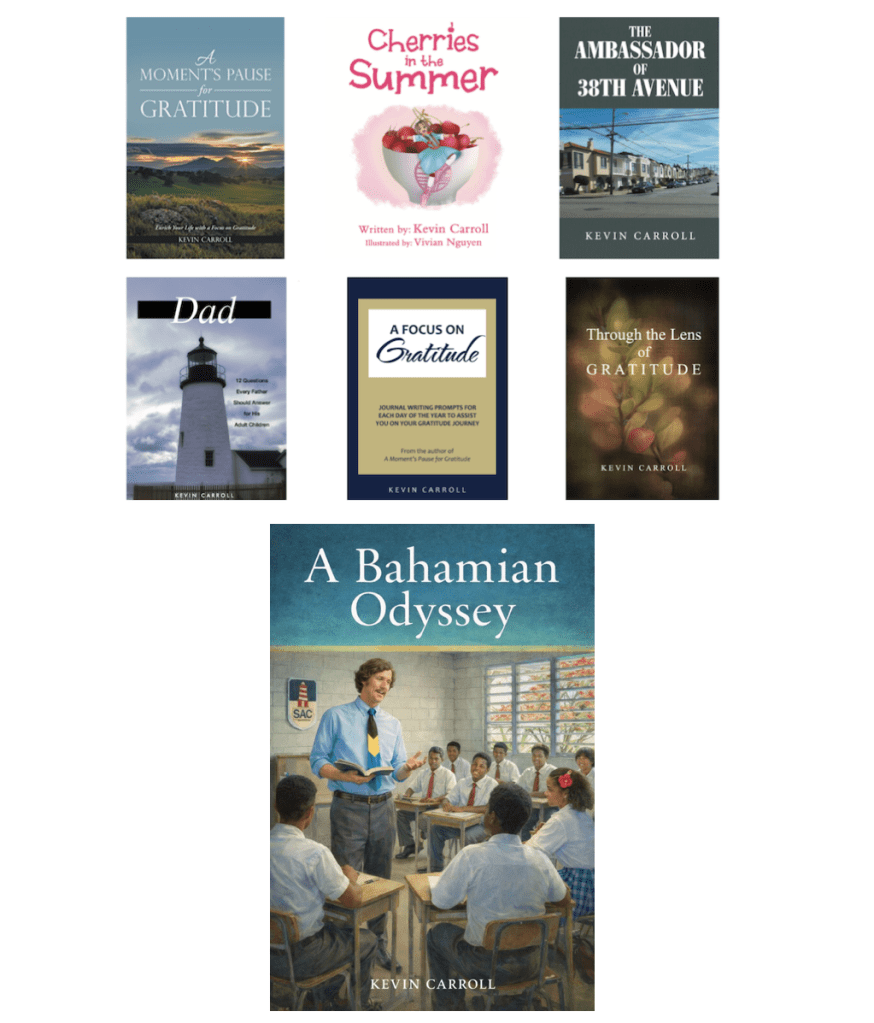
My books are available for purchase online from Amazon. I also have copies of some of these titles at my home for those who would like to buy them directly from me.
A Moment’s Pause for Gratitude (2017)
Cherries in the Summer (2021)
The Ambassador of 38th Avenue (2022)
Dad: 12 Questions… (2023)
A Focus on Gratitude (2024)
Through the Lens of Gratitude (2024)
A Bahamian Odyssey (2026)
-

- October 2026
- September 2026
- August 2026
- July 2026
- June 2026
- May 2026
- April 2026
- March 2026
- February 2026
- January 2026
- December 2025
- November 2025
- October 2025
- September 2025
- August 2025
- July 2025
- June 2025
- May 2025
- April 2025
- March 2025
- February 2025
- January 2025
- December 2024
- November 2024
- October 2024
- September 2024
- August 2024
- July 2024
- June 2024
- May 2024
- April 2024
- March 2024
- February 2024
- January 2024
- December 2023
- November 2023
- October 2023
- September 2023
- August 2023
- July 2023
- June 2023
- May 2023
- April 2023
- March 2023
- February 2023
- January 2023
- December 2022
- November 2022
-
43
“Men desperately want
and need the approval
of their father.”
Kevin Carroll
A Moment’s Pause
for Gratitude
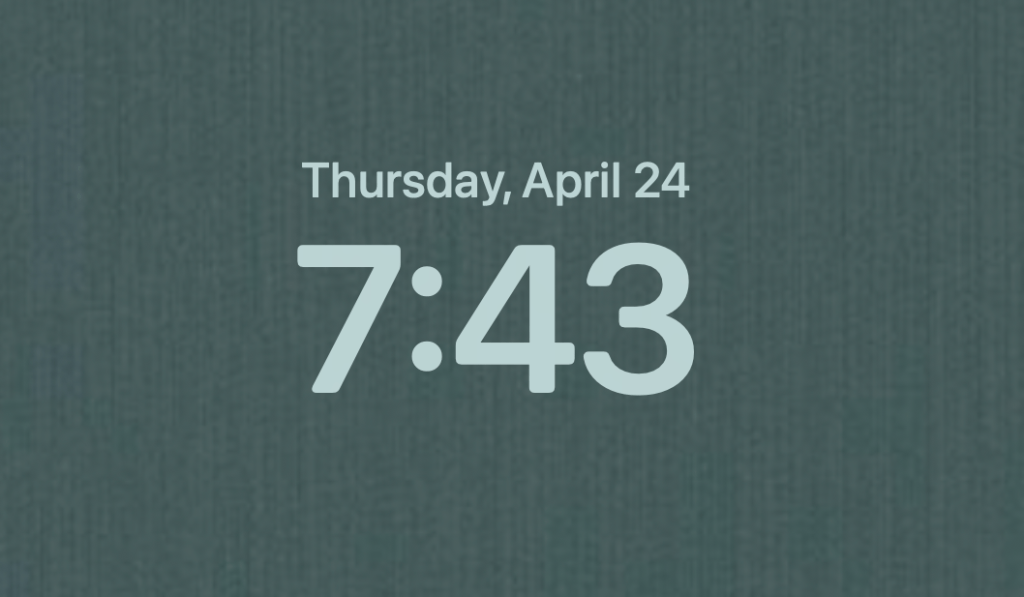
p. 146It happened again tonight. I wasn’t surprised by it at all, since it has happened just about every day for the past sixteen years, and, most often, multiple times each day. I opened my computer this evening and was greeted with the time: 7:43.
Throughout each day, I happen to look at digital clocks — at home, in my car, on a train platform, on my cell phone,… — at precisely 43 minutes after the hour. When I wake up during the night, the clock on my nightstand indicates that it’s 43 minutes after the hour more often than I can explain. It’s uncanny how often this happens. And it’s not just clocks. Kathy and I had dinner at a restaurant in Pacific Grove a few years ago. When we got the bill, the amount due was $43.43. At the local gas station, I was pumping gas when my attention was drawn to the brightly illuminated sign indicating the value of the upcoming California Lottery draw. Yes, it was $43M.
One day, about a year ago, my good friend Dan and I were walking down Laurel Street in downtown San Carlos. I had no idea what time it was at the moment, but I was telling Dan about this phenomenon. I reached into my pocket and pulled out my cell phone. Dan and I were both taken aback. It was 12:43.
Even driving around town, it’s incredible how often the last two digits of the license plate on the car in front of me ends in 43. I was watching a college basketball game on TV a few months ago. The score at halftime was 43-43. How can this keep happening? Why is this happening?
I’ve heard people speak of “angel numbers.” I can’t say that I put much credence into their claims, but I read online that the number 43 is “a message of love, peace, stability, and security.” I’m okay with this, I guess, but… angel numbers?
On the website medium.com, I read that “if you see 43 everywhere, you are guided by your spirit guides to be creative with everything.” Again, I’m okay with this, but… spirit guides?
The website astrology.com claims that “43 is a powerful combination of energies from numbers 4 and 3. The number 4 resonates with stability, practicality, and hard work, while the number 3 signifies creativity, self-expression, and joy. Together, the number 43 represents a harmonious balance between your practical and creative sides.” I like this one.
My favorite explanation, however, was found on the website numerologynation.com. This site, too, speaks of angel numbers. They write, “Angel number 43 is sent by the angels so that you develop a sense of confidence in all your decisions and learn to work even harder in life because hard work pays off. The angel number 43 meaning is, therefore, success in every aspect of your life.”
All this is well and good, but the number 43 has a particularly special meaning to me. It was my father’s favorite number. He graduated from Saint Ignatius High School in San Francisco in the Class of ’43. During the many years that his alma mater had an annual raffle for which only 200 tickets were sold, Dad always purchased ticket #43. (He never won the raffle.) And when he was appointed to the position of Battalion Chief in the San Francisco Fire Department, his badge number was #43.
I have no recollection of noticing the number 43 around me so often prior to Dad’s death in 2008. Since then, however, it’s been pretty much an everyday thing. I take this to mean he’s still with me, and that he approves of what I’m doing with my life. This is something for which I am genuinely grateful.
-
San José, California

“Capital of Silicon Valley”
Mayor Tom McEnery 1988San José was the first capital of the State of California. Sacramento has held this honor since 1854. In 1988, however, due to San José’s innovation, cultural diversity, affluence, and pleasing Mediterranean climate, as well as its connection to the booming high tech industry, San José Mayor Tom McEnery adopted the motto “Capital of Silicon Valley.”
San José is Northern California’s largest city by population. It also boasts the largest concentration of technology expertise in the world, hosting over 6,600 companies.
I moved to San José in August 1972. My impressions of the city at that time were mixed. I loved the weather. Having grown up in the Sunset District in San Francisco, I appreciated the warmer climate. On the other hand, the Santa Clara Valley, also affectionately known as The Valley of Heart’s Delight, featured countless orchards of apricots, prunes, peaches, plums, cherries, nectarines, apples, figs, grapes, and persimmons. This was quite a difference from the more urban environment of my childhood in San Francisco.
In reality, the development of Silicon Valley started before I was born. The Hewlett-Packard Company was founded in the garage of a Palo Alto home in 1939. During World War II, the area became a center for radio and electronics research. Varian Associates was founded in 1953, followed by Fairchild Semiconductor in 1957 and Intel in 1968. Then, in the ’70’s, the boom began with the founding of Atari, Apple Computer, and Oracle, followed by Adobe Systems Sun Microsystems, and Cisco Systems in the 1980’s. In the 1990’s, other high tech companies came into existence, including Netscape, Yahoo!, and Google.
Facebook joined the party in 2004, followed by the proliferation of cloud computing services in 2012, led by companies such as Amazon Web Services.
Within half a century, some of the most fertile farmland in California had been replaced with business parks, office buildings, single-family homes, shopping malls, restaurants, new schools, condominium complexes, and apartment buildings.
So here’s the question: Is San José a good place to live? The answer is complicated.
In February 2024, PODS.com posed the same question. Their response was fairly straightforward: “If you’ve always wanted to live in a thriving city with plenty of job opportunities, amazing weather, and lots of cultural events, then moving to San José might be the right decision for you. San José is ranked as the 2nd happiest city in the U.S. — and for good reason.”
In March 2024, U.S. News and World Report put San José in the #4 spot for the 25 best places to live in the U.S.
U.S. News Real Estate wrote this on their website: “Cradled by the foothills of the Santa Cruz Mountains and Diablo Range, San José offers a prime environment for outdoorsy residents, with its proximity to the ocean, the Sierra Nevada, and vineyards — not to mention about 300 sunny days a year.”
This is all well and good, but there’s another side to the coin. An April 2025 analysis by financial technology company SmartAsset found that the median household income in San José was $136,229. While that may seem impressive, the income required for a single adult to live comfortably in San José is $147,430. A family of four requires an annual income of $371,571.
According to Apartments.com, the cost of living in San José is 77.6% higher than the national average. Housing in San José is 222.3% more expensive than the national average. It was also cited that San José residents could expect to pay 15% more for groceries, 46.7% more for utilities, and 38.2% more for transportation.
Realtor.com reported in February 2025 that the median sale price for a home in San José was $1.5 million. In August 2024, CNBC reported that a household needs to earn $463,887 to afford a median-priced home in San José, making it the most expensive of the fifty largest cities in the United States.
So is San Jose a good place to live in 2025? The answer depends upon many factors. The most obvious, I would think, is when you moved here. Kathy and I purchased our San José home in 1986 — a 3-bedroom, 2-bath, 1,417 square foot condominium with an in-unit laundry room and large 2-car garage — for $140,000. According to Redfin.com, the estimated sale price today is a relatively affordable $1,004.753. So for us, since we’re not planning to relocate, San José is a good place to live. I like my neighborhood. I like the ethnic and cultural diversity of the city. I appreciate the entertainment options available to us here. I’m grateful for reliable public transportation and availability of medical services in the area.
For younger individuals or couples starting out, unless they are employed in the lucrative high tech industry or have high-paying jobs in some other sector, San José is simply not affordable. For such individuals to make a living here, one needs to find below market value housing and spend conscientiously to protect their limited financial resources.
The sad truth is that multiple sources have claimed in recent years that an annual salary below $100,000 is considered “low income” in San José. And we wonder why so many people are moving out of the area.
-
Pope Francis

“We all have the duty
to do good.”
Pope Francis IPope Francis was not your typical pope. He was down-to-earth. His papacy was characterized by his humility and his constant concern for the poor and vulnerable. Born in Argentina in 1936, Jorge Mario Bergoglio served as Archbishop of Buenos Aires. During his years as archbishop, unlike bishops and pastors I’ve known personally, he lived in a simple apartment, did his own cooking, and regularly relied on public transportation to get around town. To the best of his ability, he continued his minimalist lifestyle at the Vatican.
In February 2001, Pope John Paul II appointed Bergoglio to the rank of cardinal. For the celebration of his installation to the College of Cardinals, he asked friends and loved ones not to travel to Rome for the ceremony. Instead, he asked that they donate whatever money they would have spent on that trip to the poor.
Bergoglio was elected to the papacy on March 13, 2013 following the resignation of Pope Benedict XVI. He was the first pope from the Americas, and the first Jesuit elected to the papacy.
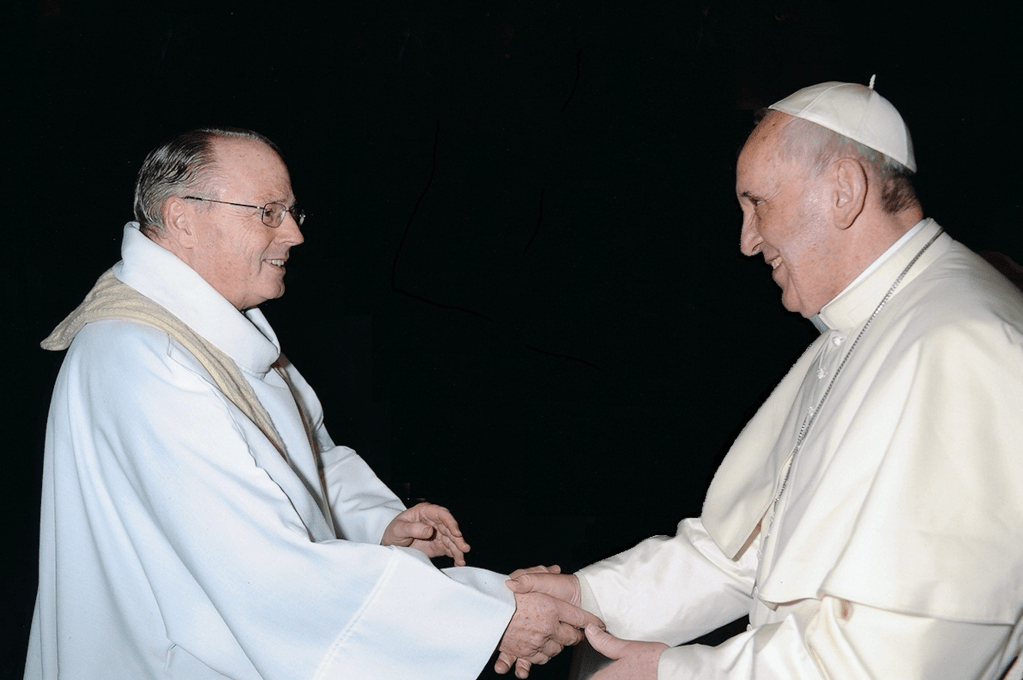
In January 2014, my brother, Tom, a Jesuit priest who was living in Rome at the time, had the opportunity to meet Pope Francis. This image is one of my favorite photos of both Tom and Pope Francis.
All leaders face opposition from time to time. The stiffest resistance faced by Pope Francis came from ultra-conservative clerics in the United States for, among other things, softening the ban on giving Communion to divorced and civilly-remarried Catholics. It was heartwarming for me to realize that Francis understood the Eucharist to be an unconditional God-given gift, rather than a prize for those who complied with the man-made rules of the Church.
Of all the words attributed to Pope Francis during his papacy, I find his words about forgiveness to be the most impactful. He said, “The Lord never tires of forgiving. It is we who tire of asking for forgiveness.”
The next few weeks will certainly be interesting as the cardinals gather at the Vatican once again for a conclave to elect the next pope. Having recently seen the movie “Conclave,” I can only wonder if the backstabbing, plotting, and manipulation portrayed in that movie might play out again in real life.
-
Sue Nan Shoppe
“Customers now are
much more aware of
who they’re buying from
and want to buy from
businesses that care
about their products
and their customers.”
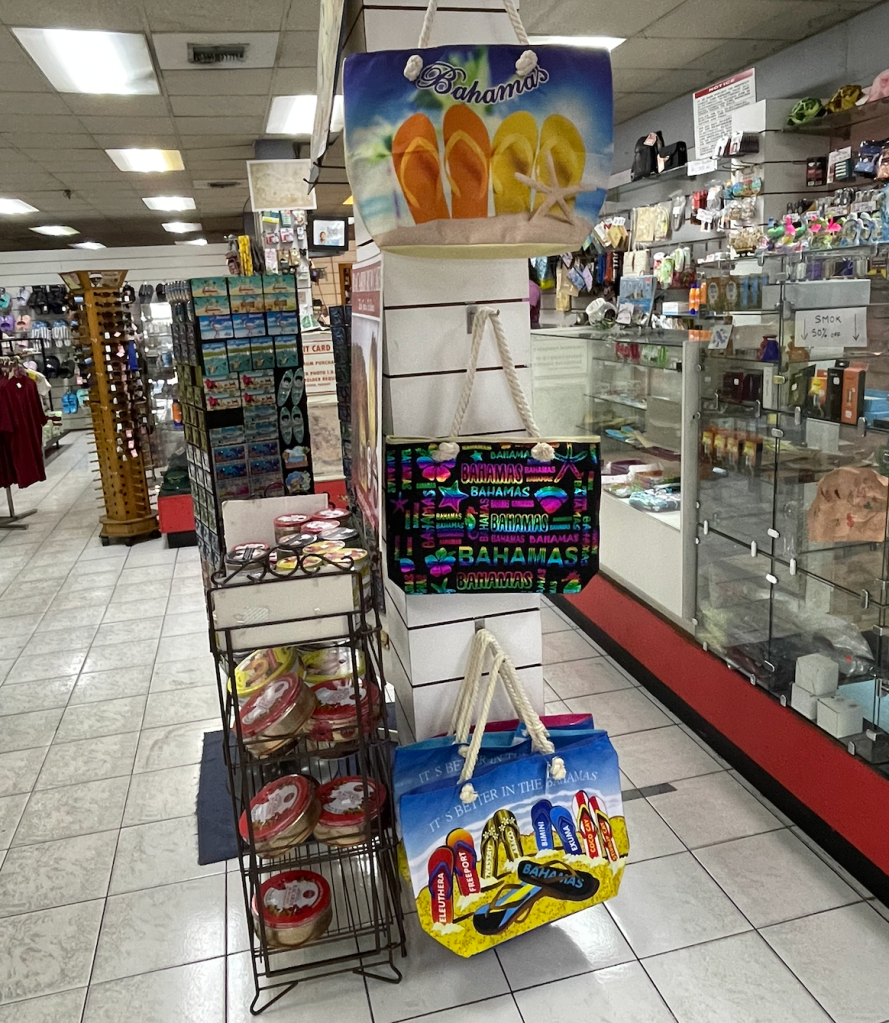
Deborah SparksDowntown Nassau, most notably on and around Bay Street, offers dozens of small shops that sell souvenirs of The Bahamas. Of all the stores along this main downtown street, my favorite is the Sue Nan Shoppe, a charming family-owned business located on Bay Street, just east of East Street. The store is a short walk from the Nassau Cruise Terminal, so it’s a convenient shopping venue for those visiting Nassau by cruise ship.
I purchased a few items for myself and a variety of souvenirs for my grandkids. For myself, with the assistance of Christine (one of the managers), I picked up four colorful shirts with stunning prints of Bahamian themes and a Bahamian key ring for our pool key at home. For the grandkids, I bought small coin bags, refrigerator magnets with Bahamian images, a delightfully illustrated book, The ABCs of the Bahamas, a Bahamian coloring and activity book, and a deck of Bahamian playing cards.
The Sue Nan Shop serves as a treasure trove for tourists seeking authentic, yet affordable Bahamian crafts and unique gifts. From hand-made trinkets to stylish footwear, the store is filled with items that reflect the rich cultural heritage and artistry of The Bahamas.
It’s important for me to mention that the Sue Nan Shoppe is more than just a local retail space. This business embodies the warmth and hospitality of the Bahamian culture. The friendly staff are eager to share stories behind the products they sell, making the shopping experience both personal and memorable. I learned so much about Nassau and the history of the downtown area from my conversations with Christine.
A visit to the Sue Nan Shoppe is not just about shopping, it’s about connecting with the local Bahamian community and taking a piece of The Bahamas home with you.
Please feel free to share this post with anyone you know who will be visiting Nassau in the future. A stop at the Sue Nan Shoppe will be one of the highlights of their trip.
-
Heading Home
“If you go anywhere,
even paradise,
you will miss your home.”
Malala YousafzaiOne week in paradise — it’s been wonderful. I stayed at a hotel (Courtyard by Marriott) where I had the pleasure of staying two years ago. Many of the hotel staff greeted me warmly when I arrived. I met a number of other employees for the first time during this visit. The atmosphere here at the hotel is like being with family.
Walking in downtown Nassau brought back memories of previous visits to the Bahamas with friends and family members. I enjoyed a dinner at The Poop Deck on East Bay Street, which is owned by two of my former students, lunch at Bahamian Cookin’ on Parliament Street just south of Bay Street, and a few breakfasts at Vacation Café, located in the Margaritaville Hotel adjacent to Junkanoo Beach. I even indulged in a couple of scoops of Ben & Jerry’s Cherry Garcia ice cream during my visit.
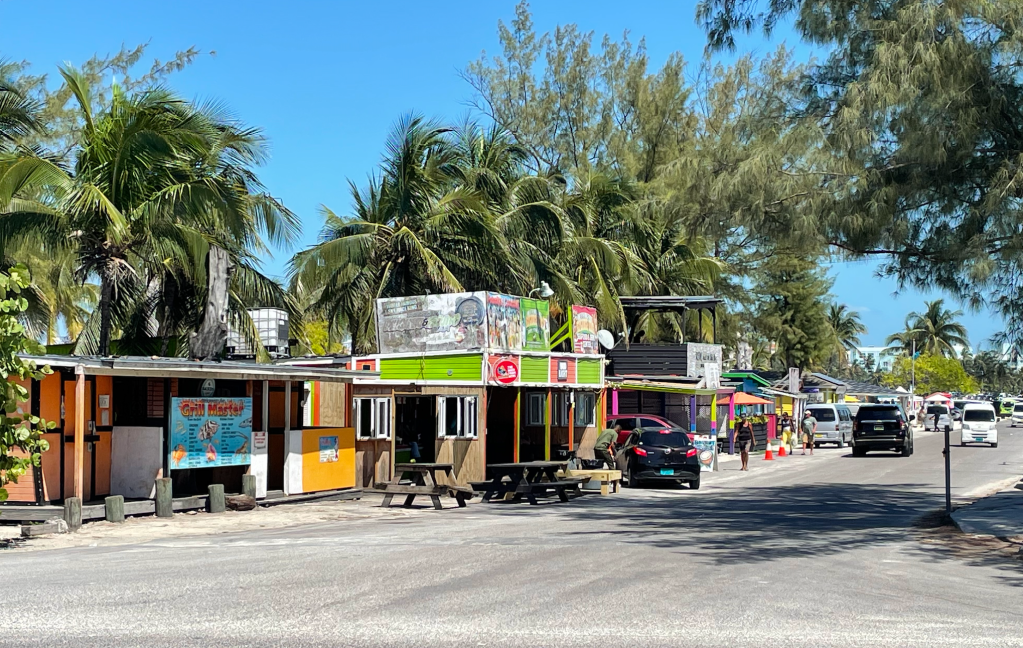
I experienced the local “fish fry” for the first time, spent a considerable amount of time at the beach, met dozens of locals with whom I share mutual friends and acquaintances, and even took a look around the local Straw Market to pick up some goodies for the grandkids.
Most importantly, I had the opportunity to meet up with a number of my former students. When speaking with them, fifty years doesn’t seem like all that long ago.
While on the island, I made a few connections which will be helpful for marketing my next book. Kathy has been telling me for years that I should write a book about the one year I spent teaching at St. Augustine’s College here in Nassau. I am finally ready to do so. I had a wonderful conversation with a SAC alum who has a radio talk/interview show. We’re planning to promote the book in the spring of 2026. I also met the owner of the Logos Bookstore, located in the Harbor Bay section of Nassau. I’m hoping to do a book signing event there next April.
As is always the case, good things come to an end. In just a few minutes, a taxi will pick me up here at the hotel and take me to the airport. I am scheduled to arrive in San José just a little before 11:00 tonight. As I prepare to depart, I am filled with tremendous gratitude for the opportunity to visit Nassau again, for the hospitality extended to me by hotel and restaurant workers around town, and for the chance to spend a little time on the campus of St. Augustine’s College as they celebrate their 80th anniversary. Seeing so many friends from fifty years ago was truly a blessing for which I will be forever grateful.
-
Sangena
“The six best doctors:
sunshine, water, rest,
air, exercise, and diet.”
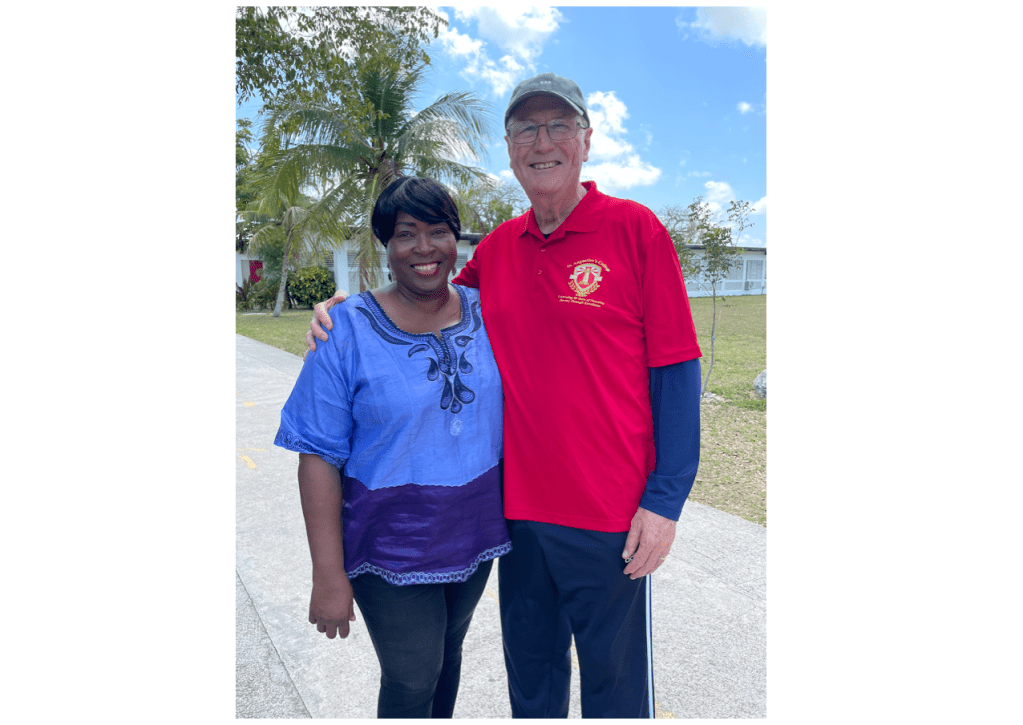
Wayne FieldsI most certainly agree with these insightful words by Wayne Fields, author of several books, including What the River Knows. While I find his list insightful, I believe it is incomplete. I can’t blame the author for this, however. Clearly, he has never met Sangena McClain.
Sangena was one of my students at St. Augustine’s College in Nassau, Bahamas fifty years ago. Her energy and ever-present smile motivated me to put forth my best effort in my first year of teaching. People here in the Bahamas keep telling me that Nassau has changed a lot in the past fifty years. In many ways, this is true. One constant, however, is the positivity exuded by Sangena.
I arrived in Nassau last Thursday afternoon. After checking in to my hotel room, since there was still a fair amount of time before the sun would set, I took a walk to Bay Street in downtown Nassau. I was overwhelmed with memories, not just from fifty years ago, but also from visits I made to this island with groups of friends in 1979, 1981, and again in 1985. As I strolled down the normally congested shopping district, I enjoyed impromptu conversations with a number of locals. When I mentioned that I’d taught at SAC, the conversations inevitably turned to identifying people we knew in common. It’s a small island, so this is a fairly common experience.
By the time I headed back to my hotel, it was already dark. I am quite familiar with the area, so I wasn’t worried about getting lost. My familiarity with the neighborhood did not, however, include the uniqueness of the curb at the corner of West Bay Street and Nassau Street. When I approached that intersection, the light was red, so I pushed the button to activate the pedestrian crossing light. When it illuminated, I conscientiously looked around for cars which might be coming from three different directions. Acknowledging that it was safe to do so, I stepped off the curb. I had no idea, at that time, that the curb was 18” high.
I ended up doing a face-plant into the crosswalk. I was in the state of shock… and pain. I tried to move, but for a few moments I was unable to do so. A car pulled up and I heard a woman’s voice asking me if I was okay. I tried to respond, but nothing came out. Within moments, she and two men were standing at my side offering their help. They got me up and off the street onto the sidewalk. I was shaken, bloodied, and thoroughly embarrassed, but I assured them that I was okay to walk the half-block to my hotel.
The front desk team was awesome. They got a first aid kit, cleaned up the cuts on my hands, applied some antiseptic cream, and gave me a few bandages to apply after I showered. What concerned me most about this mishap is that I hit my face on the ground too, causing the lenses of my glasses to pop out of the deformed frame. Without my glasses, I would be unable to see my computer screen, text messages, or menus in restaurants. Sangena came to the rescue.
On Friday morning, she picked me up at the hotel and took me directly to the Bahamas Sight Center where her niece was employed. Fortunately, within thirty minutes, they were able to repair the frames and reset the lenses, and they did this without charging a fee. I could see again!
Sangena and I spent much of the day together. We visited the St. Augustine’s College campus, enjoyed lunch at a small café specializing in local Bahamian cuisine, and in the evening, we enjoyed dinner at the Poop Deck, one of my favorite restaurants in Nassau. They serve some of the best conch fritters in the Bahamas.
Sangena is not only my former student, she’s also my angel, my caretaker, and my friend. I am so grateful to have her in my life fifty years after we first met.
-
Vitamin Sea

“At the beach,
time you enjoy wasting
is not wasted.”
T. S. EliotI spent a considerable amount of time at the beach today. Notice that I said “at” the beach, not “on” the beach. I love being at the beach. I’m not such a big fan of being on the beach. There is a difference.
I wanted to do some writing again today, so this afternoon I settled down at a poolside bar table overlooking Nassau harbor. I was at the beach, but not on it. No sand in my shoes. No worries about getting hit by a misguided frisbee tossed by a student on spring break. No worry about overexposure to the sun. I was in the shade, comfortable, with my shoes on my feet, my feet on the ground, and a stunning view of Nassau harbor. It was an ideal setting for writing… and thinking.
In the early morning hours, I had run a few errands before enjoying a late breakfast at the Logos Bookstore in the Harbor Bay Center on East Bay Street. The quaint establishment is one of the few good bookstores on the island. On the upper-level loft, they offer an impressive assortment of greeting cards. Books and other random products are available on the main level. In the corner of the first floor is a café which serves a delicious breakfast. I made good choices today. The cinnamon rolls looked good. So, too, did the banana and pumpkin breads. The menu was complete with omelets, French toast, pancakes, breakfast sandwiches, and grits. I opted for scrambled eggs with wheat toast and a glass of mango-peach juice. I felt sufficiently nourished throughout the remainder of the day.
I spent most of the afternoon and early evening sitting at the table in my beachside office space. Before it got dark, I ordered a chicken Cesar salad and iced tea for dinner. While walking back to the hotel, I enjoyed watching the sun set beyond the western end of the island. It was the perfect ending to a productive and enjoyable day.
Tomorrow is my last full day in Nassau. Again, I have a few chores to run. Most of the day, however, will be devoted to walking, reminiscing, taking photos, talking with people I encounter along the way, and breathing the fresh ocean air. I am so grateful for the opportunity to spend this week here to celebrate both the 80th anniversary of St. Augustine’s College and the 50th anniversary of my experience teaching at the school.
I will be home on Friday, but I am confident that the energy and sense of tranquility I have accumulated this week will be with me for a long time. It is said, and rightly so, that you can’t buy happiness. No, you can’t. But you can buy a ticket to the Bahamas!
-
50 Years!

“The Bahamas is the
most ideal and inspiring
location for firing
the creative imagination.”
Sean ConneryI mentioned in a previous blog post that I would like to visit Nassau again. At the time I penned that piece, I had no concrete plans for such a visit. In the days that followed, I got to thinking. I’m 70 years old. If not now, when? 2025 happens to be the 80th anniversary of the founding of Saint Augustine’s College. It is also the 50th anniversary of the memorable year I spent teaching and coaching at the school. It didn’t take much for me to convince myself that this would be an appropriate time for a visit.
I arrived in Nassau on Thursday afternoon. After checking-in to my room, I took a walk downtown, just a few blocks from my hotel. As I walked along the edge of Nassau Harbor, then along Bay Street, I found myself engaged in multiple conversations with locals. In almost every discussion, we realized that we knew a number of people in common. Yes, the island is that small.
On Friday, one of my former students, Sangena McClain, picked me up and took me to Devine Café on Mackey Street, one of her favorite lunch spots for authentic Bahamian food. Then we headed up to the SAC campus. Students and faculty had just completed an annual walk-a-thon on campus. When we arrived they were gathered under a large tent in the convocation area for music and entertainment, which included some impressive student performances. I had the opportunity to connect briefly with a few of the SAC faculty I’ve gotten to know through the years. No one from the faculty fifty years ago is still working there.
The tropical spring weather in Nassau has been ideal for walking, so I spent a good part of Saturday walking around town, reminiscing and observing the changes that have taken place in the past fifty years. Again, as I walked, I found myself engaging in conversations with a number of native Bahamians with whom I shared a history and a number of mutual friends and acquaintances. That evening, Gena and I enjoyed dinner at my favorite Bahamian restaurant — the Poop Deck, on East Bay Street. They serve the best conch fritters on the island, while the venue offers a gorgeous view of Nassau Harbor.
I attended Palm Sunday Mass at St. Francis Xavier Cathedral, where I was greeted warmly by the archbishop, a graduate of Saint Augustine’s College. I also had a nice conversation with one of my former students who now serves as a minister of the Eucharist at the church. Following the Mass, I wandered down to the popular fish-fry, a short walk west of my hotel. Did someone say conch fritters? Yes, again I ordered conch fritters for lunch. Chatting it up with the bartenders, again, we had mutual friends and acquaintances.
I wanted to do a little writing today, and get some current photos around town. I arrived on Bay Street about 10:30. In just the few days I’ve been here, I’ve talked with so many people that as I strolled along the busy shopping district today, I was greeted warmly by people I’d met just a day or two earlier. More conversations, more reminiscing. I also stopped into the famous Nassau Straw Market. Kathy had texted me a photo of some jewelry she purchased there when we visited Nassau together in 1985. She still has the gorgeous handmade necklace, but through the years, lost one of the earrings. She asked me to see if I might be able to replace it. With a little help from some of the vendors, I was introduced to a woman whose mother used to make the necklaces. After her mother passed, she took over her family business. I’m going back to see her tomorrow. Hopefully she will be able to put something together for us.
Now it’s dark again. I just finished dinner and I’ll be heading back to my hotel for a good night’s sleep. I am tremendously grateful for the opportunity to be here in the Bahamas once again and to connect with so many friendly, hospitable people. I love this place!
-
Critical Thinking
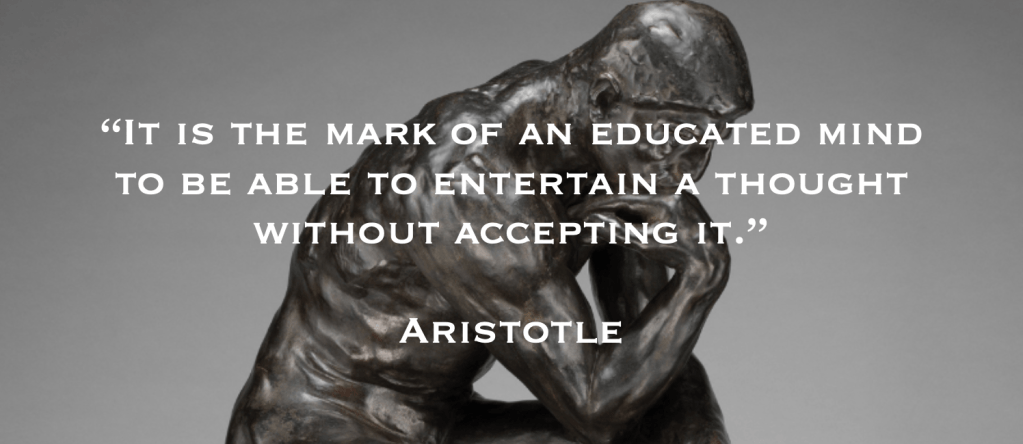
I’m sitting in a café at O’Hare Airport in Chicago right now. I have a few minutes before my next flight, so I thought I’d use this opportunity to share some wisdom from the Global Digital Citizen Foundation. The chart below speaks for itself and has much to offer all of us.

-
Anticipating Needs

“The opposite of love
is indifference to the
genuine needs of others.”
Max AndersMost of us have, at one time or another, completed some form of assessment tool. These instruments are used to determine compatibility, to assess personality strengths and weaknesses, for employment purposes, or simply for personal growth. I’ve taken a number of these questionnaires through the years — the Kudor Occupational Test, the Myers-Briggs Personality Inventory, the Enneagram, and a number of other inventories. While individual questions contained in these documents may seem absurd (“Would you rather eat an apple or help an old woman across the street?”), the participant’s collective responses often provide a surprisingly accurate assessment of the individual.
The question posed in the image above got me thinking. My response would be “Strongly Agree.” I don’t know if those around me would agree, but I honestly believe that anticipating the needs of others is one of my strengths. Where did it come from?
I’m sure my parents were influential in my adopting this practice. I don’t recall specific examples to support this claim, but I’m confident that this would have been a parenting priority for them.
One thing I do vividly recall is talking with my brother, Tom, back in late 1968. He had just completed a 30-day Ignatian silent retreat at the Jesuit Novitiate in Montecito, California. Of course, thirty days of silence seemed a bit extreme to me, so I had some questions. One simple question led to a life lesson I’ve never forgotten.
I asked Tom, “What if you’re sitting at dinner and someone at your table wants the salt shaker, but it’s out of his reach. Can’t he ask for it?” Tom explained that part of the discipline of the silent retreat was anticipating the needs of others. In other words, when one of the novices was looking toward the out-of-reach salt shaker, it was the responsibility of others at the table to recognize this and respond accordingly. Words were not needed.
The teaching of the Dalai Lama speaks to this practice. He said, “When you engage in fulfilling the needs of others, your own needs are fulfilled as a by-product.” This reciprocity of kindness and attentiveness is something to which each one of us is called in our daily lives.
The Dalai Lama spoke of this on a larger scale, too. “Concern yourselves more with the needs of others, with the needs of all humanity, and you’ll have peace of mind.” An insightful invitation, and a formidable challenge.
There are so many things, simple things, that each of us could do every day to make life better for those around us. By anticipating the needs of others — holding a door open, letting a driver merge into our lane, offering a bottle of cold water to a laborer on a hot day, or picking up and returning an item dropped by someone walking ahead of you — we contribute to making our world a better place for everyone.
Some might think that they are simply too busy to be concerned about the needs of others. Thomas Jefferson has words of encouragement for them. He said, “May I never get too busy in my own affairs that I fail to respond to the needs of others with kindness and compassion.”
NOTE: To subscribe to A Beacon of Light, click the link below and scroll down to the bottom of the page where you will see a “Subscribe” button. There is no cost to subscribe and all future blog posts will be sent to your email. https://abeaconoflight.life/home/
-
Subscribe
Subscribed
Have a WordPress.com account? Log in now.

