-

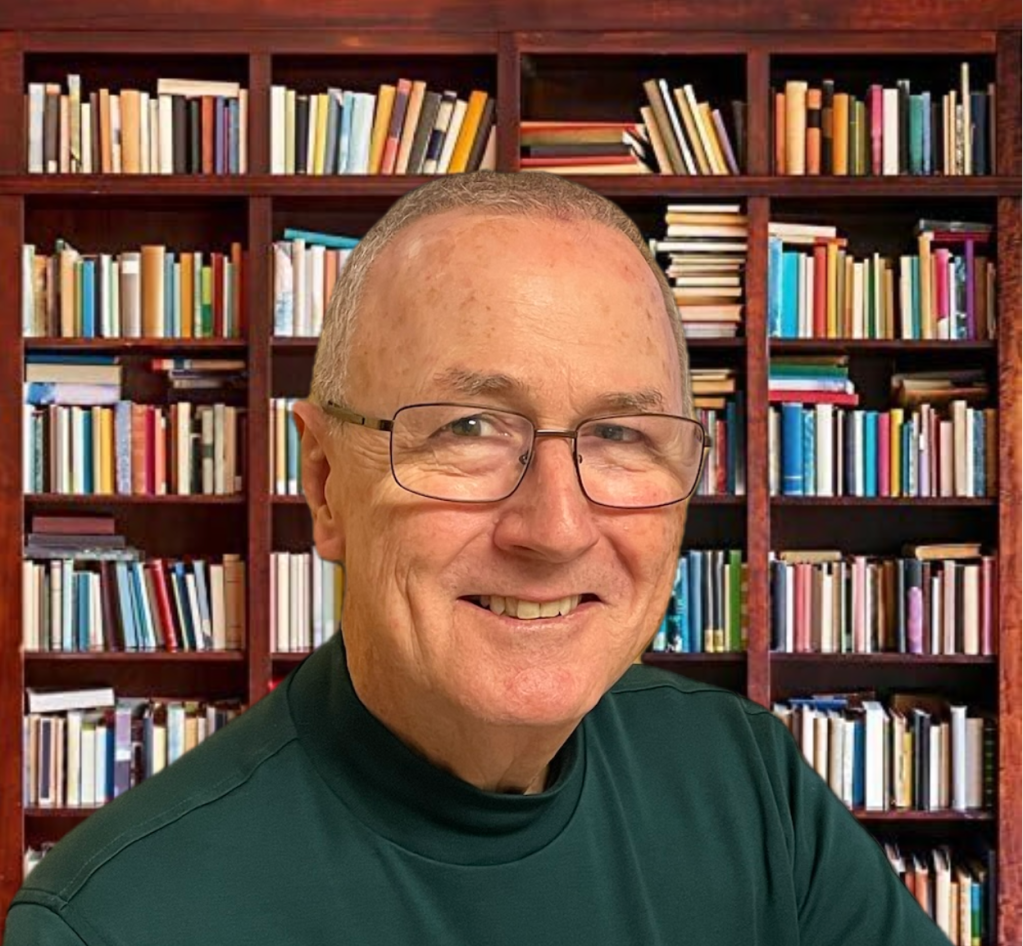
My name is Kevin Carroll. I was born and raised in San Francisco, California, where I attended Saint Ignatius College Preparatory. I am a graduate of both Santa Clara University and the University of San Francisco. Following a 40-year career in teaching and pastoral ministry, I launched a new career as a writer and speaker.
I live in San José, California. My wife, Kathy, and I have three adult sons and five precious grandchildren. I have much for which to be grateful.
I can be reached via email at kmc43sjc@gmail.com
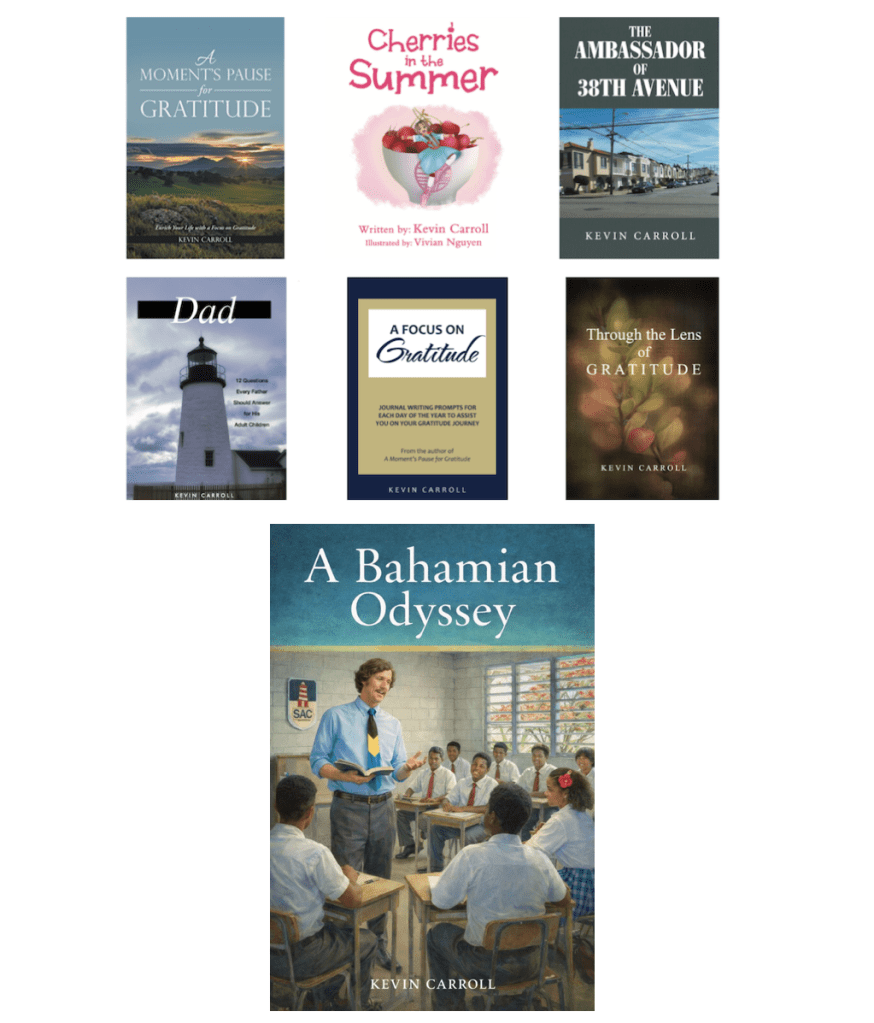
My books are available for purchase online from Amazon. I also have copies of some of these titles at my home for those who would like to buy them directly from me.
A Moment’s Pause for Gratitude (2017)
Cherries in the Summer (2021)
The Ambassador of 38th Avenue (2022)
Dad: 12 Questions… (2023)
A Focus on Gratitude (2024)
Through the Lens of Gratitude (2024)
A Bahamian Odyssey (2026)
-

- October 2026
- September 2026
- August 2026
- July 2026
- June 2026
- May 2026
- April 2026
- March 2026
- February 2026
- January 2026
- December 2025
- November 2025
- October 2025
- September 2025
- August 2025
- July 2025
- June 2025
- May 2025
- April 2025
- March 2025
- February 2025
- January 2025
- December 2024
- November 2024
- October 2024
- September 2024
- August 2024
- July 2024
- June 2024
- May 2024
- April 2024
- March 2024
- February 2024
- January 2024
- December 2023
- November 2023
- October 2023
- September 2023
- August 2023
- July 2023
- June 2023
- May 2023
- April 2023
- March 2023
- February 2023
- January 2023
- December 2022
- November 2022
-
Seven Minutes

“The world is waiting
for your words.”
Arvee RobinsonOn Wednesday, August 28, 1963, when I was nine years old and preparing to begin fourth grade at St. Gabriel School in San Francisco, an estimated 250,000 people arrived in Washington, D.C. to attend the March on Washington for Jobs and Freedom, perhaps the most noteworthy event of the civil rights movement of the 1960’s. This monumental gathering was organized by civil rights leaders, including Dr. Martin Luther King, Jr.
To make certain that the event ended punctually, each of the ten scheduled speakers at the Lincoln Memorial that day were limited to just seven minutes to convey their message to the crowd… and to the world. Dr. King was the last to speak.
The most memorable segment of the historic convocation, often replayed in media sound bites and studied in classrooms across the country, is Dr. King’s I Have a Dream speech. I was surprised to learn that these powerful words, etched in history and in the minds of most Americans, were not part of the original draft of King’s speech.
As Dr. King reached the end of his seven minutes, he sensed that something more was needed — something which articulated the vision of the civil rights movement, something that expressed the pride, courage, and determination of those committed to the cause. King ignored the seven-minute time limit and spoke passionately about his dream for the future of America. “I have a dream…”
King spoke for a total of nineteen minutes, inspiring America and the world with his hopeful vision for the freedom movement.
Learning this interesting tidbit of information about Dr. King’s speech, I started wondering what I would say if I had the opportunity to speak to the people of our nation and the world for just seven minutes. Some who know me well may assume that I would address the topic of gratitude. I certainly might, but there is so much more I’d like to say — but only seven minutes to say it.
I would want to speak of personal integrity, forgiveness, self-acceptance, and compassion. I would want to talk about the joys and challenges of fatherhood, personal responsibility, self-care, service to others, and the process of discernment. I would definitely mention our shared responsibility to seek the common good. Yes, there are many topics I would like to address, but in only seven minutes?
Despite the fact that I’ve given this question serious consideration, I still don’t know exactly what I would say. Seven minutes. That’s it. How could I best utilize this brief time to make a memorable impact on listeners?
I’ll end today’s blog post by turning the table and flipping the question right back to you. What would YOU talk about if you had the world’s attention for seven uninterrupted minutes? I’m seriously curious to know your response? If you have one, please share it with me via email at kmc43sjc@gmail.com.
-
Storytelling
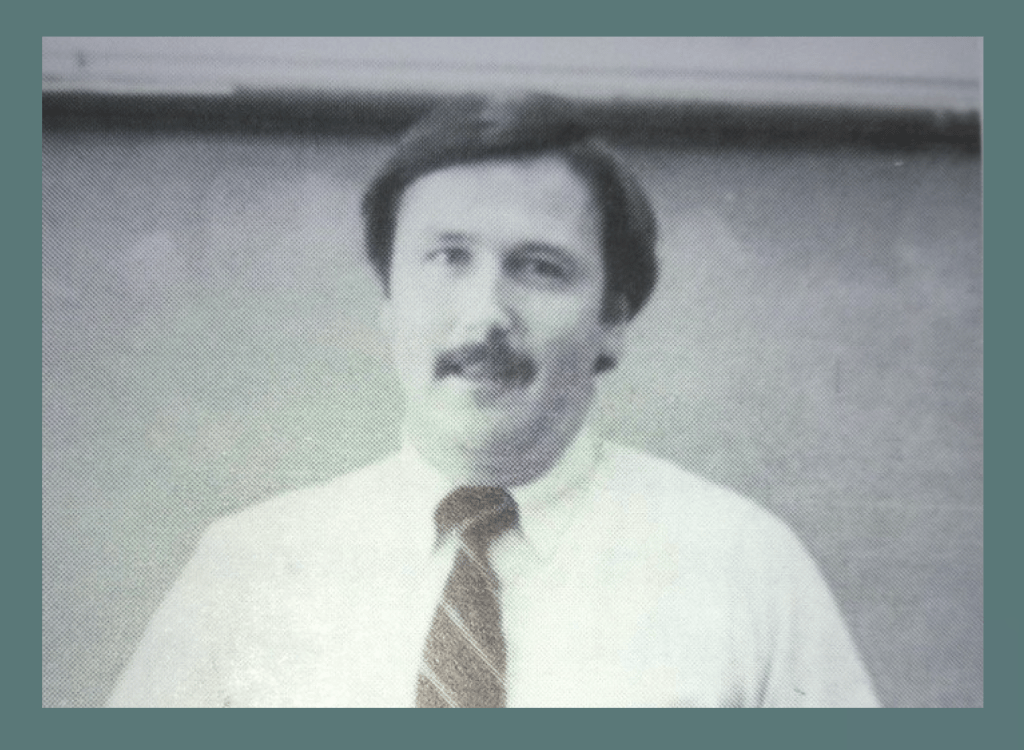
Back in 1985, when I was still considered a “young” teacher. “In the realm of education,
storytelling stands as a
timeless and transformative
tool that bridges the gap between
information and understanding.”
Hannah YoungI learned many things in my teaching career. One important lesson is this: “Some kids get it, and some don’t… and never will.”
As pessimistic as these words might sound, I am in no way referring to a student’s intellectual ability to grasp a concept. I can work with that. Rather, I’m talking about a student’s attitude toward learning. Some kids enter a classroom believing that they already know everything they’ll ever need to know, and that they are wasting their time in the formal school setting. A smaller number of students simply have no desire to learn anything from anyone.
At the end of each academic year, students in most high schools are invited and encouraged to evaluate their teachers. Forms are provided by the administration. The principal then discusses the results of these student evaluations with the teacher. Of course, administrators do their own in-class observations and evaluations, as well.
Sadly, it seems to be human nature for teachers to focus on the few negative student responses, rather than to bask in the light of the positive evaluations. I’ve been retired from teaching for almost ten years now. Of all the comments written by students in their evaluations, I recall only one: “Mr. Carroll doesn’t teach us anything. All he ever does is tell stories.”
Hmmm… Yeah, some kids just don’t get it.
Storytelling was one of the primary tools I used to teach important concepts in my classes. Why? Well, in November 1972, the United States Conference of Catholic Bishops published To Teach as Jesus Did for the purpose of providing insights to support and guide catholic school educators in their ministry. Anyone familiar with the Christian Scriptures knows that Jesus used parables to teach many important lessons. These parables were simple stories used to illustrate a moral or spiritual lesson. If the use of storytelling was good enough for Jesus, I felt confident that it would be a useful educational tool for me, too.
In her September 2024 article “The Power of Storytelling in Education,” educator Hannah Young writes, “The art of storytelling has been woven into the fabric of human communication for millennia, playing a crucial role in how we convey knowledge, values, and cultural heritage.” She goes on to say that educators today are “rediscovering its profound impact on teaching and learning, driven by its ability to engage emotions, enhance memory retention, and foster cognitive development.”
Reading Young’s article makes me realize that, perhaps, storytelling simply was not a common pedagogical tool during my forty-plus years in the classroom. As I mentioned, I felt that if was good enough for Jesus, it was good enough for me. Now I feel vindicated as I read that educators today are “rediscovering” the profound impact of storytelling on teaching and learning.
My former students may not recall the factual information pertaining to everything I presented in class, but, in recent years, many of them have told me that they have vivid recollections of the stories I told in class. I am confident that these students intuitively grasped the valuable messages and meanings contained in these stories.
-
With Gratitude

“Life isn’t about waiting
for the storm to pass.
It’s about learning how
to dance in the rain.”
Vivian GreeneWould it be an exaggeration for me to claim that yesterday was one of the best days of my life? I don’t think so. I had the opportunity to join my friend, Rob Gibbs, and others who are living with the nightmare of Multiple Myeloma, in a 5K fundraising walk in San Francisco. When Rob first invited me to participate in the event, I thought I was doing him a favor. After my experience on a picturesque San Francisco day yesterday, I realize that Rob had done me a favor.
The annual walk began at the Marina Green, on the north side of The City. Dozens of cancer patients, along with their families and friends, gathered to celebrate hope — hope that, some day, there will be a cure for Multiple Myeloma. I was reminded that “hope” is an acronym: Have Only Positive Expectations. Following the opening ceremony, which was highlighted by an optimistic and inspirational testimonial by a woman who continues to struggle with the cancer in her life, walkers headed out for the 5K course which took us on a loop through Crissy Field. As I mentioned, the weather was spectacular, as were the views of the iconic Golden Gate Bridge, Mount Tamalpias, and Alcatraz Island.
I had the pleasure of walking with a variety of interesting people, many who I had not known prior to yesterday’s event. Conversations were lively. They seemed to mirror the unwavering positivity of the keynote speaker.
The walk was short (five kilometers is just over three miles) and easy, as it involved none of San Francisco’s challenging hills. For me, however, it was just the beginning of another day of walking in The City. At the conclusion of the fundraising event, I walked from the Marina Green to Fishermans’s Wharf, where I enjoyed lunch at Capurro’s Restaurant. From there, I continued along the Embarcadero and past Oracle Park to the CalTrain station on Fourth Street. In all, I logged 26,000 steps on the day — a little more than ten miles.
For more than sixteen years now, I have enjoyed viewing my life, and life around me, through the lens of gratitude. Yesterday I experienced a mega-dose of gratefulness. I was grateful for the opportunity to participate in the event. I was grateful for the physical ability to walk the 5K course… and more. I was grateful to spend time with Rob, his wife Cathy (one of my elementary school classmates), and a number of their family members. I was grateful to reconnect with some of Rob’s friends who I had met previously, and to have been introduced to several others. I was grateful for a sun-filled spring day in The City. But there’s more.
I am especially grateful to those who made contributions through my fundraising site to financially support Multiple Myeloma research by sponsoring me on yesterday’s walk. Your generosity is greatly appreciated. Together, we added almost $1,500 to the $180,000 raised in this event. These funds are needed now, more than ever, as federal funding for cancer research is being withdrawn. There is still no cure for Multiple Myeloma, but improvements in treatment through the years are allowing cancer patients to live longer, more productive lives. Hope for a cure is still very much a reality.
-
Spring 1975
“We didn’t realize we
were making memories.
We just knew that
we were having fun.”
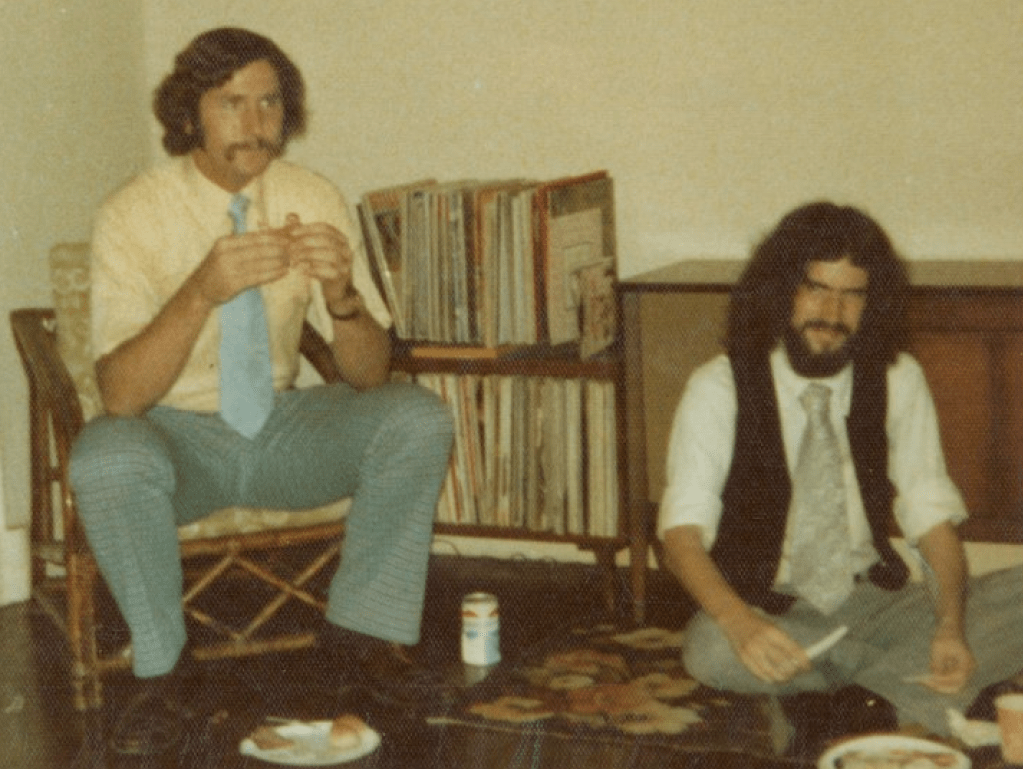
Winnie the PoohFifty years ago, in the spring of 1975, my high school classmate Dan Pasini and I spent the academic year teaching in the Bahamas. It hardly seems possible that so much time has passed since that life-changing experience.
The photo above was taken at a reception following a liturgical celebration of the 25th anniversary of one of our Saint Augustine’s College colleagues as a Sister of Charity of New York. Dan and I had been asked to be the music ministers for the event at Saint Francis Xavier Cathedral in Nassau.
Our experience in the Bahamas was a once-in-a-lifetime opportunity. At no point during the year did Dan or I give much thought to the fact that we were making some incredible memories for ourselves. Like Winnie the Pooh, we just knew we were having fun.
To say that Dan and I were under-qualified for our teaching jobs would be an understatement. We each had two years of college under our belt — no degree, no credential, and no full-time teaching experience. What we had to offer included our experience working with youth in a variety of other settings, our willingness to accept a challenging invitation, our unexplainable confidence that we would be successful in the endeavor, and our faith in God. The words of Dr. Seuss proved to be prophetic. He said, “Sometimes you will never know the value of a moment until it becomes a memory.” So true.
Our stay in the Bahamas was for just one year — a perfect length of time for such an extraordinary experience. As author Robert Breault said, “The happiest memories are the memories that ended when they should have.” As inviting as a second year at Saint Augustine’s College might have been, Dan and I knew our future was not in the Bahamas. Dan returned to complete his undergraduate degree at Loyola-Marymount University in Los Angeles, while I completed my bachelor’s degree at Santa Clara University. One year of memories, it seems, was enough for one lifetime.
Why, after fifty years, would I still have vivid memories of my Bahamian adventure? Writer Oscar Wilde had something to say about this. He wrote, “Memory is the diary that we all carry about with us.” Although the 1974-75 academic year was a blip in my career, it was the first and, perhaps, most significant of my 43 years in education. As I mentioned previously, Dan and I were not conscious of the fact that we were making memories in Nassau. I know I never gave it a thought, and I doubt Dan did, either. American essayist Barbara Kingsolver, however, made this astute observation: “It’s surprising how much memory is built around things unnoticed at the time.” Again, so true.
As Dan and I acknowledge the fiftieth anniversary of our island adventure, Saint Augustine’s College is celebrating the 80th anniversary of the founding of the school. I would love to jump on a flight to Nassau sometime in the next two months to spend a week or so reminiscing, reconnecting with former students and colleagues, visiting the campus, hanging out on Bay Street, and enjoying a plate of conch fritters and a pint of Bahamian beer at The Poop Deck on East Bay Street. I think Dan might be up for such a journey, as well. Much has changed in fifty years, but much is just as it was in 1975.
Where our memories were made, when those memories were made, and with whom those memories were made are important. So, too, are the memories themselves. While I would certainly like to revisit the island in spring 2025, American singer and songwriter Bob Dylan offered this pearl of wisdom: “Take care of all your memories, for you cannot relive them.” So true, yet again.
-
On Being Nice
“Be the reason
someone feels loved
and believes in the
goodness in people.”
Roy T. BennettWith joy, enthusiasm, and gratitude, on August 1, 1984 I began a new job in Santa Clara, one to which I would devote the next 31 years of my life. A job, like any relationship, I suppose, has its ups and downs. There were times, more often than not, when I loved the work I did and the people with whom I collaborated. On most work days, when I woke up in the morning, I looked forward to the new day and the challenges it would offer. In fact, I found it difficult to think of what I was doing as “work.” I enjoyed my responsibilities, the opportunities which opened up for me, and the people with whom I interacted day-in and day-out. Some might say I had a dream job. I did.
The reality of life, however, is that circumstances change. Leadership changes. Coworkers come and go. The climate of a workplace is significantly affected by such transitions. Many of the changes were beneficial to the organization and rejuvenating for me personally. Some, unfortunately, had just the opposite effect.
By March 2015, the effect of a series of changes in the workplace made it perfectly clear to me that it was time for me to move on with my life. Each day had become a burden. I felt intensely unwanted and unappreciated by leadership and by a number of my colleagues. I dreaded getting up each morning. I began to question the integrity of continuing to work in such a toxic environment. I was proud of the number of years I had devoted to the institution, but in my heart, I was resenting each and every work day. I knew that it was time to go. Ten years ago this month, I gave notice of my decision to retire in June 2015.
Throughout the past ten years, I have struggled to leave that job. When I am awake, the job, with all its highs and lows, is a part of my past — a chapter of my life story which I closed a decade ago. When I’m sleeping, however, I am continually haunted by dreams of nonsensical situations, none of which actually happened, involving vivid images of real-life characters. Most of these dreams involve conflict, frustration, anger, and feelings of alienation. They happen more often than I would like to admit, as recently as two nights ago.
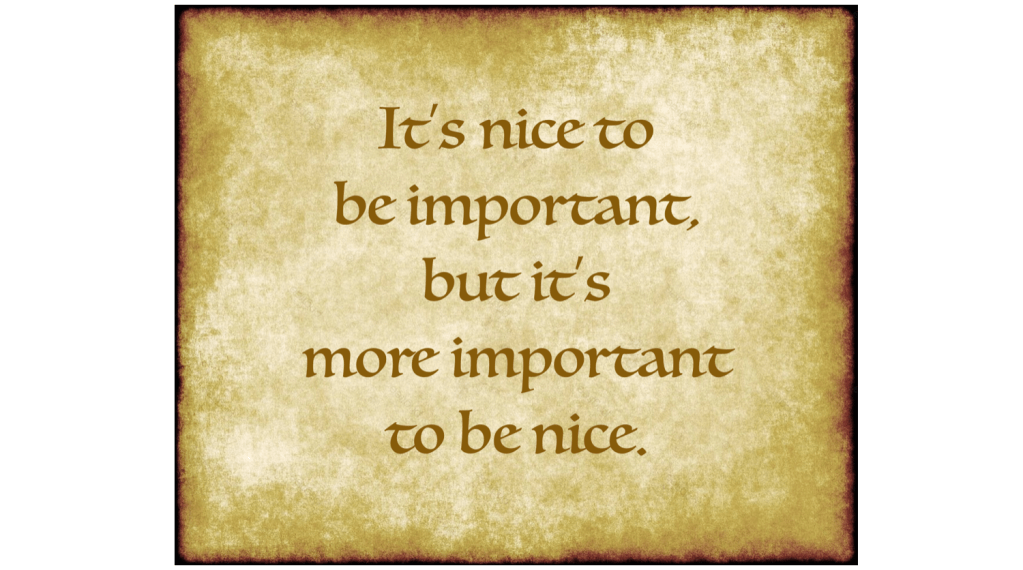
As I reflect back on the last ten years in that workplace, I realize that I made a costly mistake. I thought it was more important to be right than to be nice. I constantly challenged decisions and policies which I perceived to be inconsistent with the principles of Catholic Social Teaching I was being paid to share with my students. Political correctness was given a higher priority than integrity and justice. Rather than join-in and simply go with the flow, which would have enabled me to maintain the approval of my colleagues, I chose to rock the boat in an attempt to help my coworkers see the potentially harmful consequences of their views. I paid dearly for this decision, though I have no regrets about having done so.
In my retirement, I have enjoyed a very different approach to life. Hardly a day passes that does not offer me multiple opportunities to be nice to people. Walking through the mall, in my neighborhood, or even in The City, I make it a point to greet people, establish eye-contact, and, when possible, strike up a conversation. I also look for opportunities to help people with small tasks — picking up something that had been dropped, holding a door open, helping someone to cross a street safely, or keeping an eye on a stray child until he is reunited with his parent. These are simple things I can do to make a positive contribution to the world. I may not remember all the things I do for others, but I’m guessing that the recipients of my kindness might remember them longer than I do.
Be nice. It really is that simple.
-
The City

“I can get away
before the storm hits.”
Neil GaimanNeil Gaiman had the right idea. This past weekend, the local news channels were predicting that a series of significant storms would hit the San Francisco Bay Area beginning on Wednesday, so I took advantage of the opportunity to get away for a walking day in The City on Tuesday. It could not have been a better day.
I left my home in San José around 6:15 in the morning, hopped on CalTrain in Santa Clara, and arrived in San Francisco just after 7:30. I took the #30 Stockton bus to North Beach, stopped into Caffé Trieste for a raspberry danish and hot chocolate, then got back on the #30 bus and took it to the end of the line at Crissy Field. It was there that I began my 9-mile, 22,000-step adventure along the San Francisco Bay.
The weather in The City was ideal. When I arrived at Crissy Field at 10:00, the temperature was a mild 58 degrees. By the time I got back to the CalTrain station around 3:30, it had warmed up to a comfortable 66 degrees. The strong winds predicted for later in the week had not yet arrived, so conditions were perfect for my walk.
My journey took me from Crissy Field, past the Marina Green, and through Fort Mason to Aquatic Park. I made a quick stop at the Argonaut Hotel (it’s nice to know where there are clean restrooms along the way) and proceeded through Fisherman’s Wharf and past Pier 39.
As I approached the Ferry Building at the foot of Market Street, I decided to check-in to see how the English Language Institute of San Francisco is doing. The school is located in the #3 Embarcadero Center building. In the summer of 2008, I helped my friend Yoko, who owned the school, to secure reaccreditation of the institution after it had been revoked. Yoko has since passed away. The new owner of ELI is an energetic educator who has enabled the school to thrive, despite the pandemic years. It is so rewarding for me to see classrooms full of foreign students studying the English language in such a healthy setting.
After a quick bite of lunch at Harrington’s Bar on Front Street, I returned to the Embarcadero for the remainder of my walk back to the CalTrain station. As I passed Oracle Park, it was clear that they were already preparing for the Giants’ return to The City. The team is scheduled to host the Detroit Tigers in a preseason match-up on Monday, March 24th. The Giants’ home opener of the 2025 season will be on Friday, April 4th when they take on the Seattle Mariners at Oracle.
My timing was fortuitous, as I arrived at the CalTrain station just in time to hop on one of the new electric trains and enjoy a relaxing ride back to Santa Clara.
My next visit to The City is scheduled for Saturday, April 5th, when I will join my friends Rob & Cathy Gibbs for the Multiple Myeloma fundraiser walk and picnic. Hopefully, we’ll be blessed with agreeable weather that day, too.
As columnist Herb Caen so insightfully expressed, “If one day I do go to Heaven, I’ll look around and say, ‘It ain’t bad, but it ain’t San Francisco.”
-
Choose Your Battles
“Wisdom is knowing
what to overlook.”
William JamesI’ve experienced a good amount of self-induced stress in my lifetime. When I say the stress was “self-induced,” I mean that I made a decision to allow myself to become stressed. Maybe it’s a personality trait or quirk, but it’s easy for me to let things get to me. When I see someone run a red light at an intersection, it bothers me. When I hear of someone not doing what they should be doing in the workplace, it bothers me. When my expectations for customer service in a department store, a restaurant, or anywhere else are not met, it bothers me. And when I see someone smoking in a designated non-smoking area, it bothers me. Even though some of these scenarios don’t have a direct impact on my life, I am often annoyed and frustrated by the situation. Why?
William James, who is often referred to as the father of American psychology, reminds us that we have the option to overlook some things in life, and that doing so is often the better, wiser option. Like so many life lessons I’ve learned, I wish I had learned this one at an earlier point of my life.
We all have expectations — of situations and of people. Therefore, we constantly set ourselves up for disappointment. I tend to be incredibly punctual. I think it’s a matter of respect. This view is not shared by many others. I don’t like smoking, and I don’t like being exposed to second-hand smoke, yet for many, smoking is not an issue. I tend to drive safely. I don’t run red lights, I don’t speed, and I don’t tailgate, yet some drivers do all of these things on a daily basis. That’s the reality of the world in which I live. I can let these things infuriate me, or I can learn to choose my battles.
Yes, “wisdom is knowing what to overlook” — at home, on the road, in the workplace, and just about anywhere in life. When we learn to overlook the faults and failings of others, when we become more tolerant of the ways people are different than ourselves, we can relax and enjoy life more. Being tolerant, however, is not to be confused with accepting or approving of the behavior we’ve chosen to overlook. It simply means that we will no longer allow that behavior to dictate our moods or actions.
Life is challenging enough as it is. I’ve learned to believe that most people, even when they appear incompetent, irresponsible, or just plain ignorant, are doing the best they can. Overlooking their shortcomings provides an opportunity to be more accepting of and appreciative of them as individuals deserving of respect.
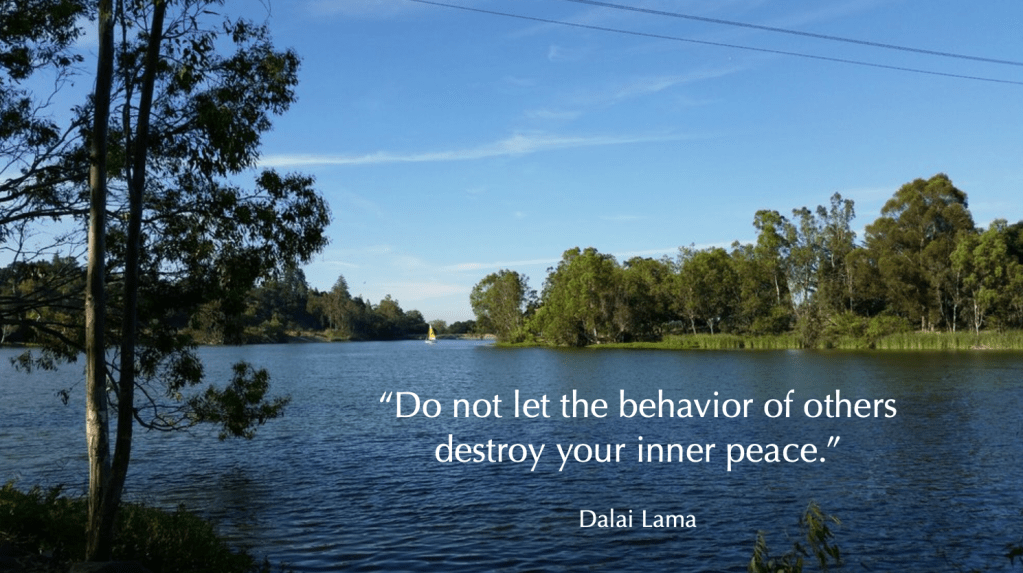
“Inner peace begins the moment you choose not to allow another person or event to control your emotions.” ~ Pema Chödrön
-
It’s There

“What we see
depends mainly on
what we look for.”
John LubbockLook for the good… A pleasant phrase, for sure, but what exactly does it mean?
Let’s begin with looking for the good in the people we know: family members, friends, neighbors, coworkers, and others we may encounter on a consistent basis. It seems that the faults and failings of others are easy for us to see. What might happen if we made a conscientious effort to intentionally look for the good in these individuals?
Throughout each day, we also encounter people we do not know: cashiers at stores, servers in restaurants, other patrons of shops and eateries we visit, drivers with whom we share the roads, and people we pass on the street, to name just a few. Most often, we don’t pay much attention to these women and men unless something, most often something that bothers us, catches our attention. Then, much like our encounters with those we know, we notice their faults and failings. What if we made an effort to be particularly attentive to the good things these people do for us and for those around them?
Our environment is also something we often take for granted: our home, our place of work, stores and malls where we shop, or the neighborhood in which we live. It seems that we have a tendency to notice the negative aspects of these venues, too, while overlooking the good things these places have to offer us. What if…?
We encounter countless situations each day, many of which can cause us stress or irritation: driving on congested roadways, collaborating with difficult colleagues, and waiting in lines at the bank, the grocery store, or the snack bar at a high school athletic event. Such experiences can be tedious and annoying. What if, while dealing with such situations, we consciously pause to look around and notice the good that people are doing around us, rather than focusing on those things that bother us?
From time to time, we all experience times of crisis: a medical emergency, an auto accident, the death of a loved one, a fracture in a relationship,… This list could go on forever. What if, instead of allowing these crises to overwhelm us with stress and negativity, we recall the fact that in the Chinese language, the word “crisis,” as we understand it in English, requires two characters, each of which has its own stand-alone meaning. One character means “danger.” No surprise there. The other character, however, offers a much more optimistic outlook on the situation. This character means “opportunity.”
Finally, how we see and understand ourselves is crucial to how we see and interact with others. For this reason, it would be prudent to make self-care, self-acceptance, self-forgiveness, and self-love a top priority in our lives. All too often, we are harder on ourselves than anyone else we encounter in our day-to-day activities. Being kind to ourselves is a prerequisite to caring effectively for others.
With all that said, a person of faith might elect to see life from a slightly different perspective. Instead of simply looking for the good in all these people and situations, we might intentionally look for the presence of God in all things. Seeing the world around us in this way changes everything.
-
The Calm Before…
“Not all storms come
to disrupt your life.
Some come to
clear your path.”
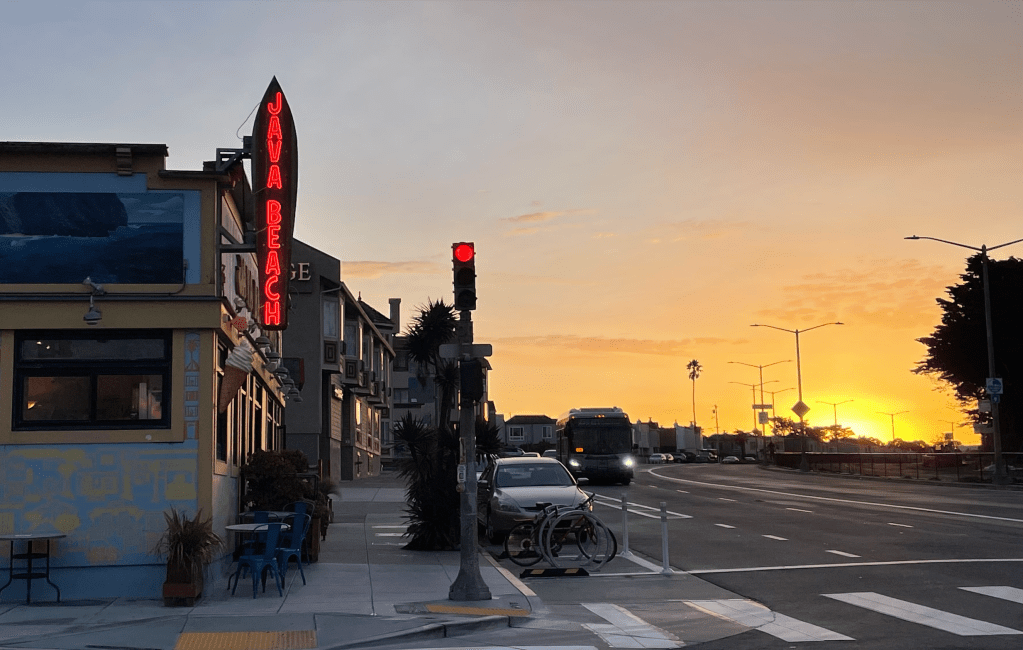
Paulo CoelhoI was in The City again this morning for the second of five funerals I will attend in a two-week period. Like last Friday’s service at Holy Name Church, today’s Mass at Saint Gabriel Church was truly a celebration of a life well lived — 100 years of life, to be exact. I began my day, as I begin many visits to San Francisco, at Java Beach Café on Sloat Boulevard at 45th Avenue.
When I arrived at the café, the morning sun was just revealing itself in the east. It was such a spectacular sight, I felt compelled to snap the photo above. (Yes, that’s my car behind the bike rack.) A significant storm is predicted to arrive late tonight and wreak havoc on the San Francisco Bay Area tomorrow. Meteorologists have been using the term atmospheric river to describe what’s coming our way. Today, however, was a beautiful day in The City.
Not surprisingly, the phrase “the calm before the storm” came to mind when I gazed at the rising sun this morning. Dictionary.com defines this idiom as “a lull or temporary period of quiet before a tumultuous event, such as a storm or an episode of excitement, activity, violence, etc.” As an educator with years of experience teaching middle school and high school students, and as the father of three sons, I have experienced many tumultuous events in my lifetime. Some of these were preceded by the eerie calm described in the definition. It is a serene experience, despite the awareness that things are about to change.
Here at my home in San José, the rain is expected to begin within the hour. By 9:00 tonight, both the rain and the winds are predicted to intensify significantly. The overnight hours could be quite eventful. Local newscasters have warned of dire implications for the morning commute, with the storm continuing to pound the region throughout the day.
In anticipation of this weather event, I’ve cleared my calendar. I have no intention of leaving our home tomorrow. I’m hoping it will be a good day for writing, reading, and getting some laundry done. More than likely, I’ll also set aside some time for an afternoon nap.
We’ll have to wait and see how the storm pans out through the course of the day tomorrow, but I am grateful to have “cleared the path” to allow me to do some things here at home that I’ve been putting off for too long. I thoroughly enjoy stormy days, especially when I can enjoy them from the warmth, comfort, and safety of my home.
-
That One Person

“Writing is its
own reward.”
Henry MillerIn the past eight years, I have published six books. Are they good books? I would like to think so, but that’s not for me to say. Only those who have read my books could make such a claim. Throughout my lifetime, writing has been, and continues to be, an enjoyable task. In the era prior to social media, email, and texting, I was an avid letter writer. For many years, I corresponded with a number of people by means of handwritten notes and letters which were sent via what is now referred to as “snail mail.” I am convinced that my writing skills developed significantly as a result of this practice.
When I enrolled at Santa Clara University, I declared my major as English, with an emphasis on writing. In those years, I was challenged to hone the skills I had developed through my high school years.
It wasn’t until many years later that I first considered the possibility of writing a book myself. That seemed to be something other people did,… you know, smart people! The more books I read, however, the more inspired I became to publish some of my own work.
My six books, as well as pieces I’ve published in my blog through the years, are not for everyone. I have no doubt that there are those who are unchanged, perhaps even uninspired, as a result of reading what I’ve written. The truth is, I don’t write for them. I write for myself, and I write for those, even if it is only one person, who just might need to read exactly what I’ve written on a specific topic at a particular time in their life.
Will there be a seventh book for me? Most likely, yes, though I have not yet settled on a topic or genre. Through my experience of writing and publishing, I am convinced that many others could benefit from writing and sharing their own unique stories. Everyone has a story to tell, but most people I know seem reticent about putting that story into writing.
Ann Lamott is a novelist and nonfiction writer based here in the San Francisco Bay Area. While we are the same age, Ann is a much more prolific writer than I could ever hope to be. Her writing has inspired me both personally and professionally. In her book, Bird by Bird, Ann encourages readers to write, even if publishing one’s work is not a priority for them.
She wrote, “I still encourage anyone who feels at all compelled to write to do so. I just try to warn people who hope to get published that publication is not all that it is cracked up to be. But writing is. Writing has so much to give, so much to teach, so many surprises.”
What story do you have inside you? What life experiences might inspire others if they had the opportunity to read about them?
Do it for yourself… and for that one person.
-
Subscribe
Subscribed
Have a WordPress.com account? Log in now.

