-

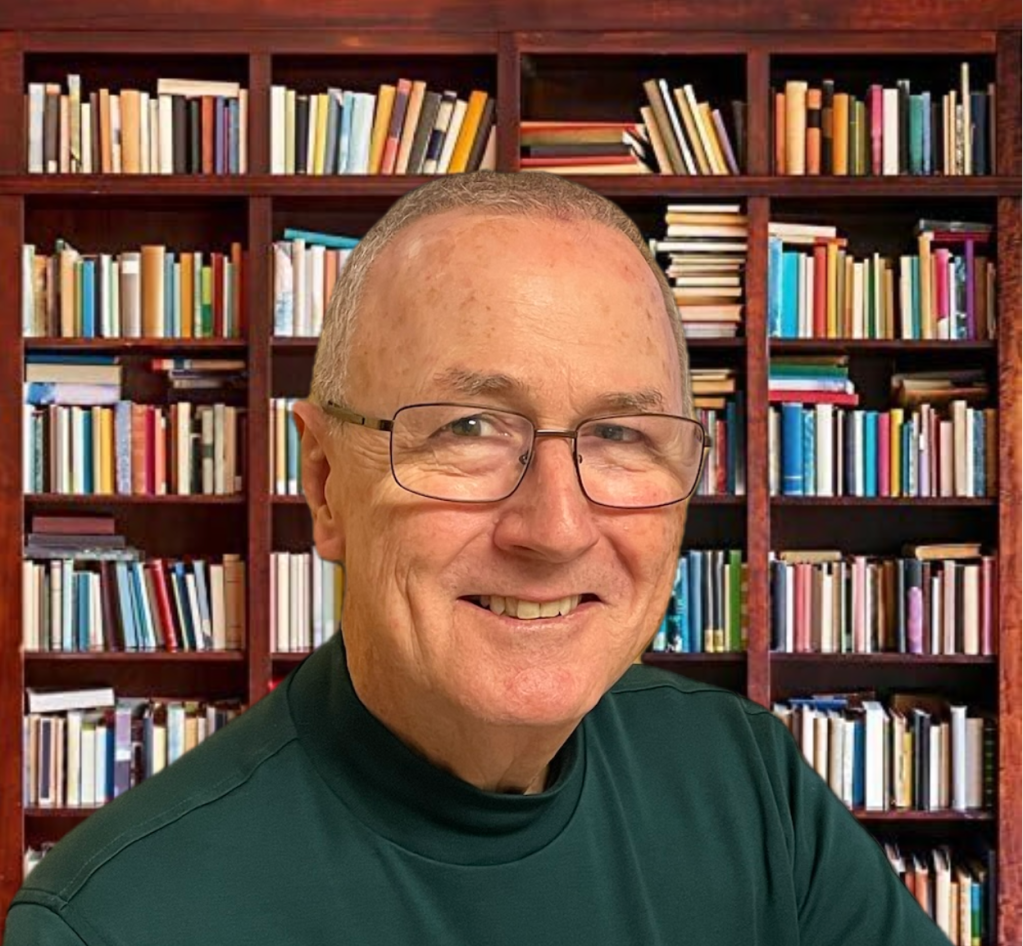
My name is Kevin Carroll. I was born and raised in San Francisco, California, where I attended Saint Ignatius College Preparatory. I am a graduate of both Santa Clara University and the University of San Francisco. Following a 40-year career in teaching and pastoral ministry, I launched a new career as a writer and speaker.
I live in San José, California. My wife, Kathy, and I have three adult sons and five precious grandchildren. I have much for which to be grateful.
I can be reached via email at kmc43sjc@gmail.com
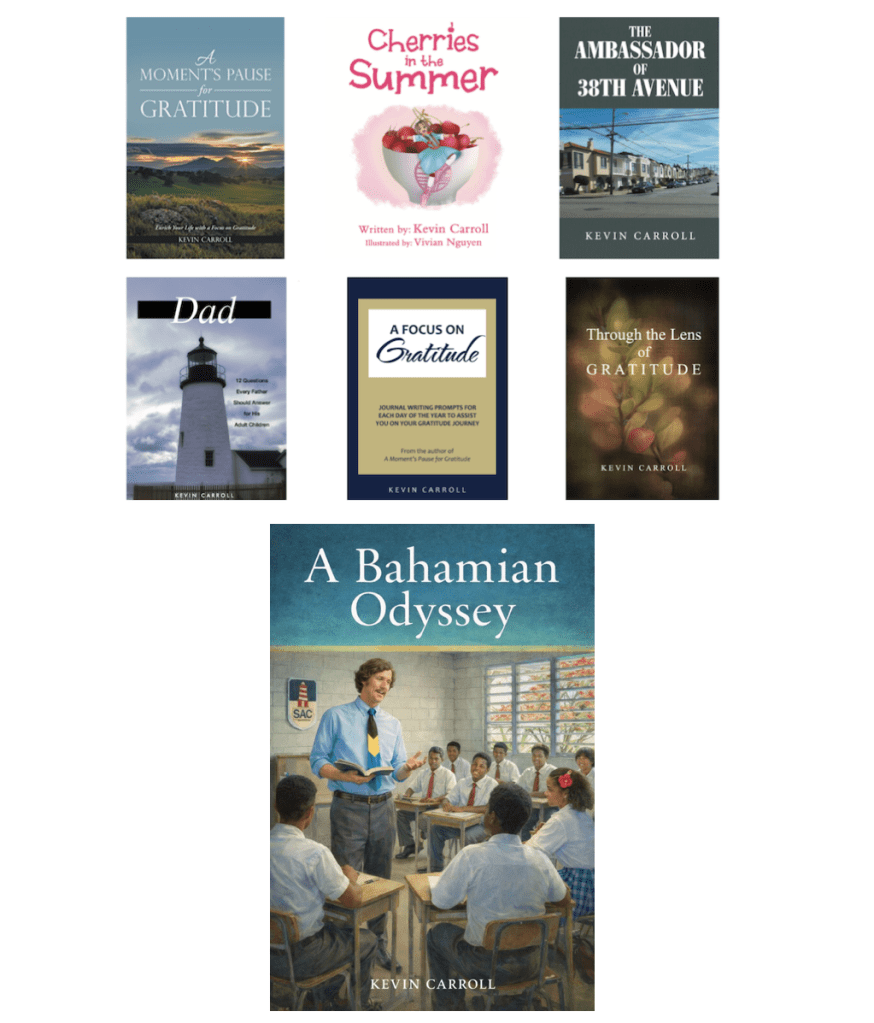
My books are available for purchase online from Amazon. I also have copies of some of these titles at my home for those who would like to buy them directly from me.
A Moment’s Pause for Gratitude (2017)
Cherries in the Summer (2021)
The Ambassador of 38th Avenue (2022)
Dad: 12 Questions… (2023)
A Focus on Gratitude (2024)
Through the Lens of Gratitude (2024)
A Bahamian Odyssey (2026)
-

- October 2026
- September 2026
- August 2026
- July 2026
- June 2026
- May 2026
- April 2026
- March 2026
- February 2026
- January 2026
- December 2025
- November 2025
- October 2025
- September 2025
- August 2025
- July 2025
- June 2025
- May 2025
- April 2025
- March 2025
- February 2025
- January 2025
- December 2024
- November 2024
- October 2024
- September 2024
- August 2024
- July 2024
- June 2024
- May 2024
- April 2024
- March 2024
- February 2024
- January 2024
- December 2023
- November 2023
- October 2023
- September 2023
- August 2023
- July 2023
- June 2023
- May 2023
- April 2023
- March 2023
- February 2023
- January 2023
- December 2022
- November 2022
-
Helping Others

“He who wishes
to secure the good
of others has already
secured his own.”
ConfuciusFrom time to time, we have an opportunity to make a small, but positive contribution to the world. Such an offer has been extended to me, and I would like to extend it to you. On Saturday, April 5th, I will participate in a fundraising walk for Multiple Myeloma research and treatment in San Francisco. My good friend, Rob Gibbs, has been battling multiple myeloma for the past thirteen years.
Please take a look at my fundraising page and consider whether this might be something you are willing to support at this time. Also, if you feel comfortable doing so, please share this link with others who may consider supporting this worthy cause.
-
I Arise

“The morning
will surely come;
the darkness
will vanish.”
Joyce RuppThis morning, I would like to share a few words by the author of the bestselling book Anchors for the Soul. Joyce Rupp was one of my mother’s favorite writers. Mom gave me a copy of this book of daily inspiration and wisdom in early 2022. Rupp’s encouraging words can get us off on the right foot on this California-cold winter morning.
I arise today with gratitude for life.
I arise with hope that all shall be well.
I arise with courage to meet what will be difficult.
I arise with conviction to do what is life-giving.I arise with eyes ever alert for beauty.
I arise with openness to greater truth.
I arise with desire for continued transformation.
I arise with compassion for hurting ones.I arise with willingness
to help those who need my care.May you have a blessed day today.
-
Why Are We Here?
“Our prime purpose
in this life is to
help others. And if
you can’t help them,
at least don’t hurt them.”
Dalai LamaWhy are we here?
Is it possible that there are individuals in the world today who have not given serious consideration to this fundamental question?
I don’t recall when I first pondered the question myself. Could I have been in elementary school? High school? Certainly, by my college years, the question of why I’m here was on my radar. By the time I turned 20, I had already experienced a number of incredible, unexpected, and undeserved opportunities which caused me to wonder why these things had happened to me. It seemed natural, at the time, to consider my purpose in life.
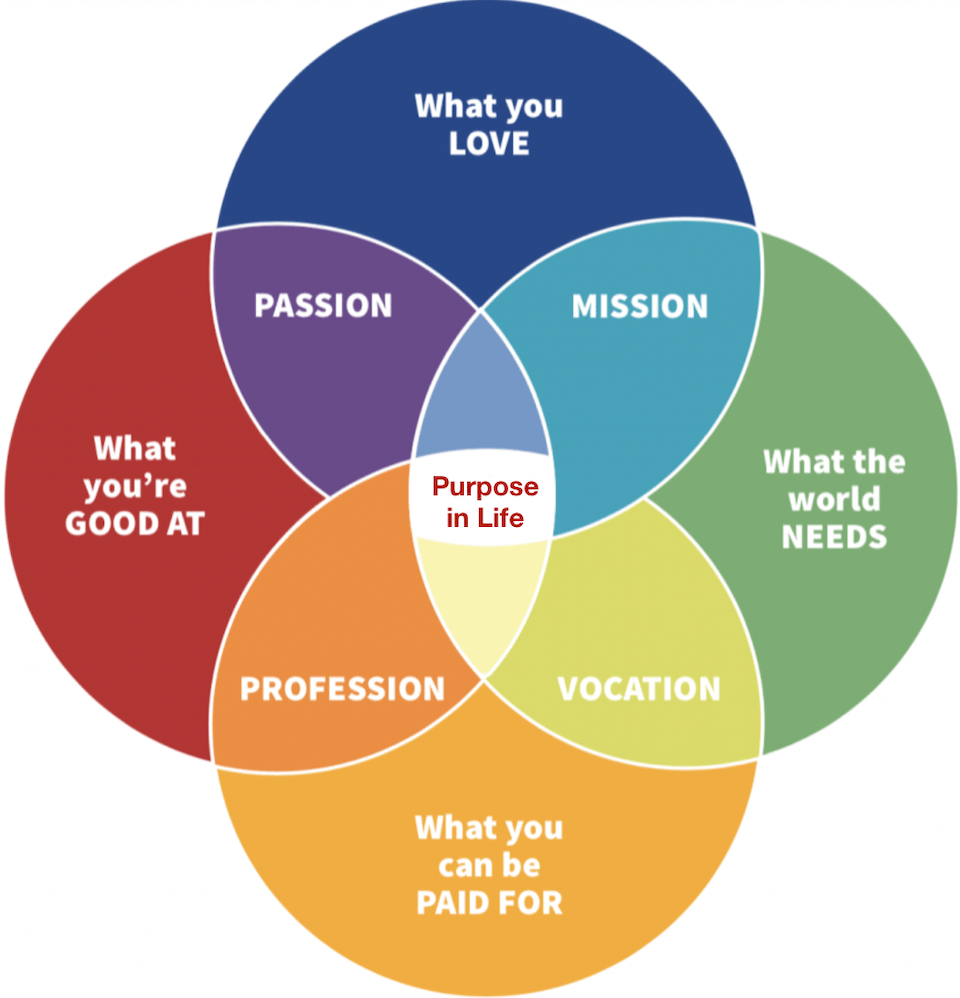
As the years progressed, I revisited the question multiple times. A number of people I respected advised me to follow my passion. I often wondered if I had chosen my profession (teaching) or if my profession had chosen me. As a product of Catholic education, I had been encouraged to contemplate the distinction between one’s occupation and one’s vocation. And on more than one occasion, I was asked to explain my mission in life, something I was often unable to clearly articulate.
These were all excellent questions, but there were four more basic questions I had to answer for myself before I could begin to adequately respond to the questions which had been posed to me. In my younger days, my Dad had urged me to do what I love to do. Of course, the first thing I had to do was to ask myself What do I love to do?
I also had to assess what things I was actually capable of doing — and doing well. I was able to identify a number of jobs I thought I would love to do, but it was humbling to honestly answer the question What am I good at?
It’s important to identify what we love to do and what we’re good at, but practically speaking, I had no choice but to consider these things in light of the question What can I be paid to do? There would, of course, be bills to pay in life.
One final question I had to contemplate is What does the world need? More specifically, What does the world need of me?
All things considered, I am confident that my 40+ years of teaching truly was my purpose in life. But are we limited to just one purpose in life? And if so, what do I do now that I’ve been retired from teaching for almost ten years?
The graphic above clearly illustrates how best to identify one’s purpose in life. Even now, with my teaching career behind me, I have a clearly defined purpose, one which is in line with the Dalai Lama’s words quoted above. My purpose, at this point in my life, is to help others. Do I love to do this? Yes! Am I good at it? I think so, yes! Does the world need this? Absolutely! Can I be paid for it? Well, if payment refers only to cash, then no, but I don’t limit my understanding of payment in that way. I am paid in countless other ways for helping people — most notably, with gratitude.
For me, helping others is not about money. The most valuable payment I can receive for helping someone is their gratitude. When someone expresses their gratefulness for something I’ve done for them, the feeling is much more satisfying than just a paycheck.
Why are you here?
-
Just Forget It!
“Often the future is
shaped not by what
we remember,
but by what
we forget.”
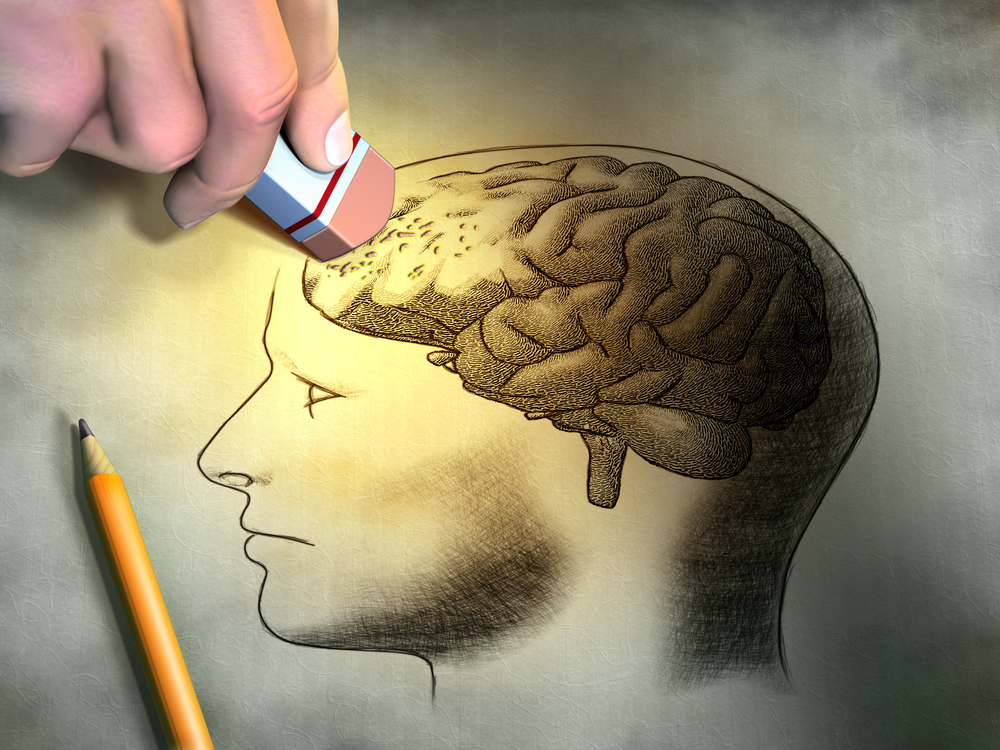
Wendy DonigerForgetfulness is a seriously misunderstood phenomenon. It can be embarrassing to forget someone’s birthday or the name of someone you’ve known for many years. It can be frustrating to forget your sunglasses when you leave home on a sunny day or to forget to set the alarm clock to wake you up in the morning. It can be expensive to forget to turn off the air conditioning when you leave home for work in the morning, or miss a scheduled medical or dental appointment. It can also be alarming, indicating that a loved one might be developing Alzheimer’s or some other form of dementia.
I know I’ve experienced my fair share of forgetfulness through the years. And yes, at times it has been embarrassing, frustrating, expensive, and alarming. There is, however, a bright side to forgetting things.
Forgetfulness can be an absolute blessing, too. It can help us cope effectively with serious trauma from our past. It can help us to continue to nurture relationships with those who, at some point, may have disappointed us in some way. It can enable us to live a joy-filled and productive life even when we are no longer able to engage in activities we enjoyed earlier in our lives.
In a March 2024 article published in Psychology Today, Dr. Robert Kraft spoke of the benefits of forgetting. He wrote, “Forgetting allows us to manage our complicated lives — encouraging us to remember what’s important, inspiring us to experience the present moment more fully, and restoring us after painful events in our lives.”
Kraft explained that “forgetting disconnects the intrusion of memory, placing us more in the perceptual moment and pushing away memories that might distract us from the pleasure of appreciating the present.” He goes on to say that “much of this forgetting is necessary for healthy functioning in a blooming, buzzing, vibrant, complicated, and occasionally disturbing world.”
So the next time we have an experience of forgetfulness, perhaps it might be beneficial for us to go easy on ourselves and consider its benefits.
-
20’s vs. 70’s

“The longer I live,
the more beautiful
life becomes.”
Frank Lloyd WrightI loved being in my 20’s. The period from 1974 to 1984 was the most transformative era of my life. I unexpectedly began a teaching career in September 1974 when I accepted a position on the faculty at Saint Augustine’s College in the Bahamas. I was invited to teach part-time at Bellarmine College Prep in San José from September 1976 to June 1979, at which time I completed my undergraduate degree at Santa Clara University. After a few years of teaching at Saint Christopher School in San José, and coordinating the youth and young adult ministry programs at Saint Christopher Parish, I enrolled in a Master’s program at the University of San Francisco, graduating in June 1984.
During those years, I made a lot of mistakes, from which I learned a multitude of valuable life lessons. I also found myself in a number of relationships with some amazing women. These experiences prepared me fairly well for entering into a marriage relationship in June 1985.
Some memorable travel opportunities came up in my twenties, as well. After teaching in the Bahamas for one year, I had the opportunity to return to Montego Bay, Jamaica for a brief visit in June 1975 with my parents. I had spent six weeks working there in the summer of 1971. Following my graduation from Santa Clara University, I returned to Nassau for vacations with friends in 1979 and again in 1981.
In August 1980, a friend asked me if I might be available to drive his car from San José to his home in New Jersey. He and his wife had returned home to the East Coast, but Rob had left one car at his cousins’ home here in the South Bay, so my cousin, Dan, and I took a road trip across the United States to deliver the car.
I was also quite active physically in my 20’s. I put countless miles on my 1970 Raleigh Grand Prix bicycle, as I used it for both transportation and recreation purposes. In my spare time, I played tennis and golf regularly. In the summers of 1980-82, I played eighteen holes of golf three mornings a week, as my work day didn’t begin until 1:00 p.m. My participation in recreational basketball and softball leagues enhanced both my physical well-being and my social life.
Yes, my 20’s were wonderful years, but I don’t look back with regret or envy. Although I’m only seven months into my 70’s now, I am thoroughly enjoying this era in my life. My activities are a little different than they were fifty years ago. I don’t travel as much these days. Kathy and I enjoyed a riverboat cruise in the Northwest last summer, and we’re looking forward to another one this year on the East Coast. I spent a few days visiting my brother in Los Angeles a few months ago, too. Other than those excursions, my travel has been limited to what is accessible from CalTrain between San José and San Francisco.
No longer do I engage in athletic competitions. Tennis, golf, softball, and basketball are all potential sources of pain and injury for me now. For this reason, I have embraced the practice of walking every day, averaging more than 8,000 steps per day. I also devote a significant amount of my time to reading, writing, and corresponding with friends via email, postal mail, the phone, or in-person visits at local eateries. In all, I have to say that my 70’s are just as fulfilling for me as my 20’s, if not more so.
A focus on gratitude is a key ingredient to my happiness at this point in my life. While I am unable to do many things I enjoyed doing in my 20’s, I am aware that I am a much more whole person today than I was fifty years ago. As Ingrid Bergman once said, “Getting old is like climbing a mountain; you get a little out of breath, but the view is much better.”
-
Light One Candle
“All of the darkness
in the world
cannot extinguish
the light of
a single candle.”
St. Francis of AssisiIn the past few years, Kathy and I have increasingly enjoyed the ambiance provided by scented candles in our home. We’ve purchased dozens of them from a number of stores, including Yankee Candle, CVS, Target, and Hallmark. We have candles in the living room, dining room, kitchen, bedroom, bathroom, and my home office. These candles contribute significantly to the warm, nurturing environment in our home.
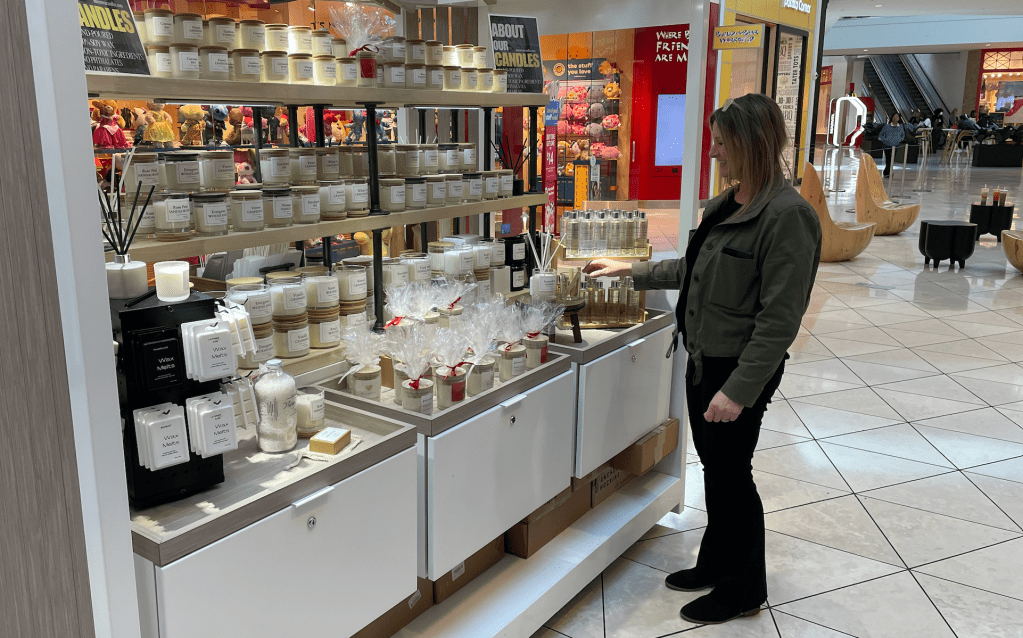
Today, because of the cooler temperature outside, I did my daily walking at the Westfield Valley Fair Mall, located just over two miles from our home. After enduring the weekend crowds at the mall the past two days, it was an absolute delight to get my steps in today in a less hectic environment. This enabled me to be far more attentive to the various businesses I passed along the way. One particular vendor caught my attention.
In addition to the plethora of stores lining both sides of the mall, there are a number of kiosks situated in the middle of the walkway which offer a variety of products. I notice one such business today — Maynova Candle Company.
Maynova is a local business specializing in scented candles. Available in three sizes: 3 oz,, 7 oz., and 15 oz. with triple wicks, these candles are made with high-quality essential oil infused fragrances and premium all-natural soy wax. They are hand-poured by Brandi, the owner of Maynova.
Brandi launched her business in 2023 with the goal of providing customers with unique, affordable, high-quality candles that would enhance any space. The ingredients of her candles include 100% natural soy wax, fragrance oils that are non-toxic, and premium cotton wicks. The candles are free from harmful chemicals, making them safe for both users and the environment.
I purchased two 7 oz. candles today — one vanilla and one passionfruit mango. The scents are luscious. These will be used in my home office to enhance the environment of my writing space.
The company name is an interesting story. When Brandi decided to venture into the candle-making business, she did not have a name for the company. After consideration, she decided to use the birth months of her parents, May and November, and created the name Maynova.
Check out the Maynova Candle Company website at maynovacandles.com, and follow Brandi on Instagram @maynovacandles or Facebook: Maynova Candle Company. Better yet, visit Brandi’s kiosk at the mall. It is located on the lower level near California Pizza Kitchen, Wetzels Pretzels, and Starbucks. What a great opportunity to support a local small business while enhancing the environment in your home.
-
This Moment

Tom, Steve & Brendan meet Roger Craig “As if you could
kill time without
injuring eternity.”
Henry David ThoreauOnce-in-a-lifetime experiences are more common than one might realize. As I reflect on my own life, I recall seeing Senator Robert Kennedy in San Francisco approximately thirty hours before his assassination in June 1968; watching a spectacular sunset in Montego Bay, Jamaica on August 11, 1971; enjoying an unexpected breakfast conversation with UCLA men’s basketball coach John Wooden in the summer of 1974; and sitting in a comfortable chair outside my home in Santa Clara at about 3:00 a.m. watching a total lunar eclipse in July 1982.
I have vivid recollections of sitting at a table for lunch with 49ers’ head coach Bill Walsh, former Raiders’ head coach John Madden, and 49ers’ defensive coordinator Bill McPherson (the father of one of my former students) at the Niners’ training facility in Rocklin, California in August 1983; being present for the birth of our first son, Tom, on May 2, 1986; seeing Pope John Paul II (from a distance of about 20 yards) as he entered Candlestick Park to celebrate Mass in September 1987; and meeting 49ers’ Hall of Fame running back Roger Craig at a high school football game in the fall of 1996.
I say that such experiences are more common than one might realize because the ones I’ve described involve, for the most part, famous people. In reality, everything we experience each day we are alive is a once-in-a-lifetime event.
This morning, I enjoyed a bowl of oatmeal with dried cherries for breakfast. In some ways, it was nothing special, as that’s what I eat for breakfast almost every day. Today, however, after learning a valuable life lesson yesterday, eating my breakfast was an entirely new experience.
Never before had I eaten THAT bowl of oatmeal or consumed those particular cherries. It was “California cold” here this morning — 32º outside. Rarely do we experience freezing temperatures here in the Santa Clara Valley. I ate my oatmeal sitting here at my desk in my home office, something I rarely do. As I savored each bite, I was grateful for the warmth it provided on such a cold morning and aware of the uniqueness of the moment.
The lesson I learned yesterday is about a Japanese concept known as ichigo ichie, which can be translated to “one time, one meeting.” This idiom calls us to acknowledge that each interaction and experience in life is singular and irreplaceable. It reminds us to cherish every moment of every day, recognizing that these precise times and events cannot be duplicated.

Since each life encounter is, in reality, a once-in-a-lifetime experience, we are invited and encouraged to treasure each moment, recognizing its uniqueness.
Embracing ichigo ichie allows us to be more aware of the richness of everyday experiences. This also allows us to enjoy a more meaningful engagement with life’s fleeting, but precious moments, and to do so with mindfulness and gratitude.
-
Faith in Humanity

“You must not lose
faith in humanity.”
GandhiI have always considered the Santa Clara CalTrain Station parking lot to be a safe place to park a vehicle. The headquarters of the Santa Clara Police Department is located directly across the street from the north end of the lot. Santa Clara University is across The Alameda to the west. A small business area with a bagel shop, sandwich shop, and Starbucks sits to the south of the lot. The CalTrain station and tracks are to the east. I’ve parked my car there many times without concern for the safety of the vehicle.
It was a little after 10:00 a.m. when I parked my car in this lot one week ago today. I paid the daily fee for parking, then walked across the street to the campus of Santa Clara University. After a number of brief meetings, I returned to my car around 2:00 p.m. I was a bit disheartened to see, upon my return to the vehicle, that the trunk was partially open. I had left my backpack, containing my computer and day planner, inside the trunk. There was also a box containing a number of my recently-published books. My stomach sank.
Apprehensively, I lifted the lid of the trunk. Much to my surprise, everything was there — my backpack, computer, day planner, and books. I breathed a sigh of relief, but I was curious. Why was my trunk open? Then I noticed that the driver-side door was unlocked, as well. Again, everything inside was as it should be. Only then did I realize that what probably happened is that after parking the car in the morning, as I walked away, preoccupied with the purpose of my trip to the university, I inadvertently hit the trunk release button on the remote rather than the lock button. That would explain almost everything.
What is still difficult for me to comprehend is how a car with an open trunk in a public parking lot could sit untouched for four hours. Yes, I consider the lot to be a safe place to park, but my inattention that morning had certainly created what one might describe as an attractive opportunity.
I am a firm believer that the world is basically good, with a presence of evil, rather than what seems to be the more commonly-held belief that the world is basically evil, with a presence of good. My experience at the Santa Clara CalTrain Station last week was a good reminder to me that we must never lose faith in humanity.
-
When Things Get Real
“It is during
our darkest moments
that we must focus
to see the light.”
Aristotle OnassisIt has been more than two weeks since the Pacific Palisades fire broke out in Los Angeles, destroying hundreds of homes belonging to some of Southern California’s most wealthy and well-known residents. It is currently 68% contained. Sadly, the destructive inferno was not the only casualty of the vicious Santa Ana winds. Later that evening, the Eaton fire ignited in the Altadena area of Los Angeles County, devastating entire neighborhoods of homes of working-class families. That fire is now 90% contained.
It is always tragic to see news coverage of these types of events. For some, the magnitude of the fires became more real when they recognized the names of well-known celebrities whose homes were destroyed: Mel Gibson, Jeff Bridges, Mandy Moore, Julia Louise-Dreyfus, Rikki Lake, and Billy Crystal to name just a few. We feel a sense of compassion for them, and rightly so. For me, the fires became real just a few days ago when I learned that someone I know lost her home in Altadena.
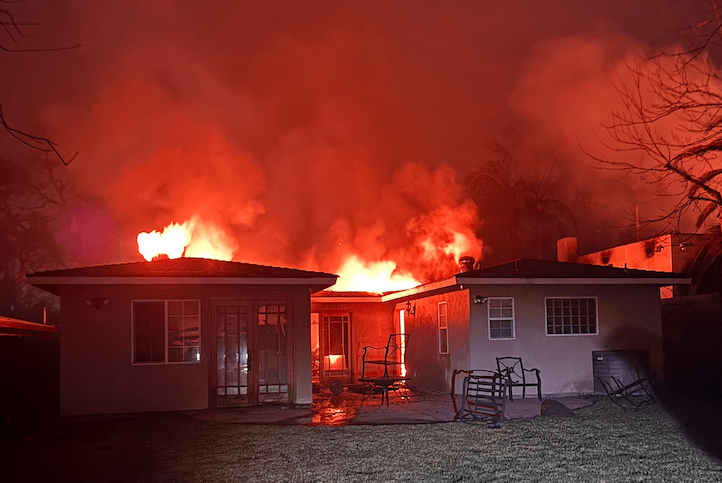
Bernadette, her husband, and their 18-year-old son woke up at 3:00 a.m. one morning to find the flames inching dangerously close to their property. They had not received an official evacuation order, but they wisely packed up what they could and prepared to move to a safer location. By 6:00 a.m., their home was engulfed in flames. Virtually everything they owned was lost in the fire. (The photo above was taken by Bernadette as she watched the flames devour her home.)
Speaking with my friend, hearing her harrowing account of escaping the inferno with her husband and son, and seeing photos she took of her home going up in flames, made the L.A. fires of 2025 all too real for me.
I also saw images of what little remains of the burned-out Will Rogers home in Pacific Palisades. I visited this property just a few months ago while touring the Los Angeles area with a good friend. The home, and its surrounding property, had been donated to the State of California and became a popular State Park.
It is difficult to comprehend how many individuals were impacted by these fires, but knowing Bernadette’s story, and hearing that thousands of others experienced the same fate, reminds me that even in our darkest moments, we are challenged to “see the light” and ask ourselves, “Where is God in this?”
-
A Crisis of Spirit

“Community [is] a
potent source of
health and well-being.”
Vivek MurthyIn his recently published letter, My Parting Prescription for America, outgoing U.S. Surgeon General Vivek Murthy addresses the epidemic of loneliness in the United States. He calls the current situation in our country “a crisis of spirit.”
Murthy urges Americans to work at developing and participating in community, pointing out that “…the loss of community has become one of the defining challenges of our time.”
Why would this be a concern to the Surgeon General? Murthy writes, “The fracturing of community in America is driving a deeper spiritual crisis that threatens our fundamental well-being.” He points out that “being socially disconnected increases our risk of heart disease, dementia, depression, anxiety, and premature death.”
Murthy introduces the Triad of Fulfillment (relationships, service, purpose), which gives us both meaning and a much-needed sense of belonging. He then contrasts this concept with the socially-accepted Triad of Success (fame, wealth, power), a formula which often fails to bring fulfillment to the individual, resulting in a deterioration of our physical, spiritual, and mental health.
What is your experience of community? Where do you feel a sense of belonging?
I invite and encourage you to check out the Surgeon General’s letter: https://www.hhs.gov/sites/default/files/my-parting-prescription-for-america.pdf
-
Subscribe
Subscribed
Have a WordPress.com account? Log in now.

