-

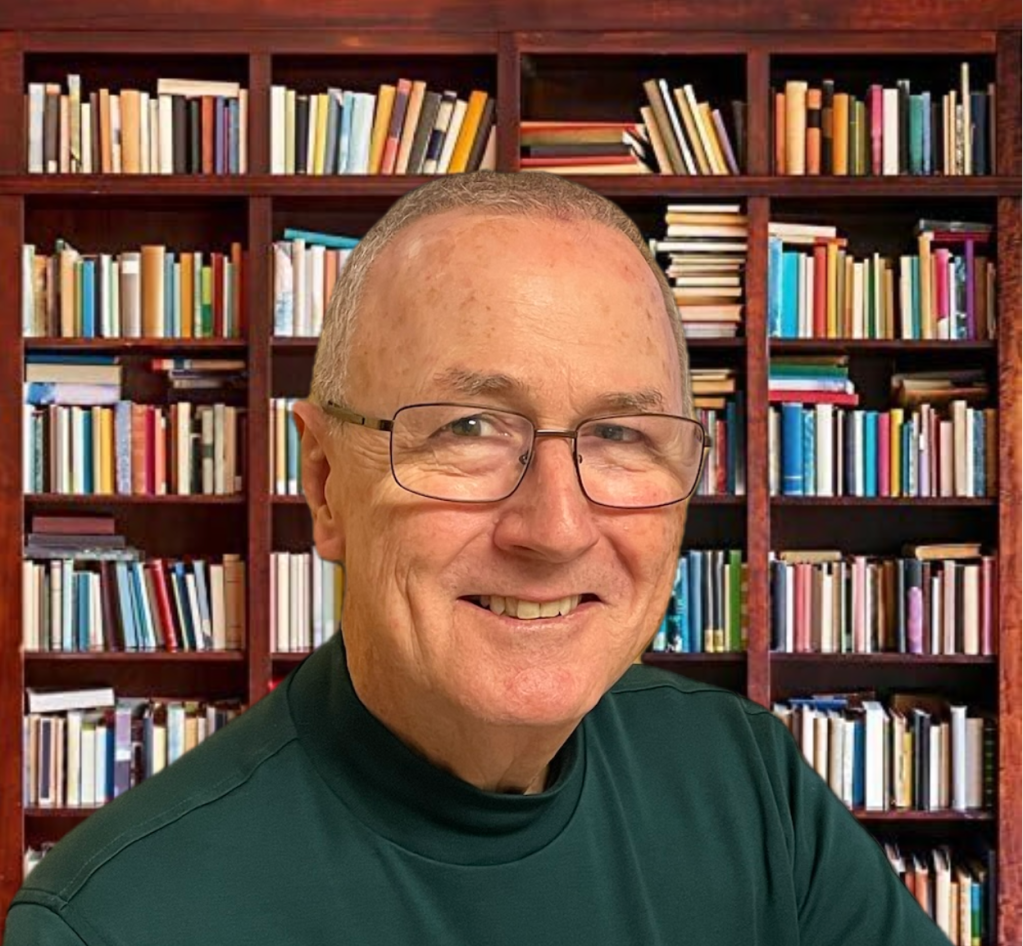
My name is Kevin Carroll. I was born and raised in San Francisco, California, where I attended Saint Ignatius College Preparatory. I am a graduate of both Santa Clara University and the University of San Francisco. Following a 40-year career in teaching and pastoral ministry, I launched a new career as a writer and speaker.
I live in San José, California. My wife, Kathy, and I have three adult sons and five precious grandchildren. I have much for which to be grateful.
I can be reached via email at kmc43sjc@gmail.com
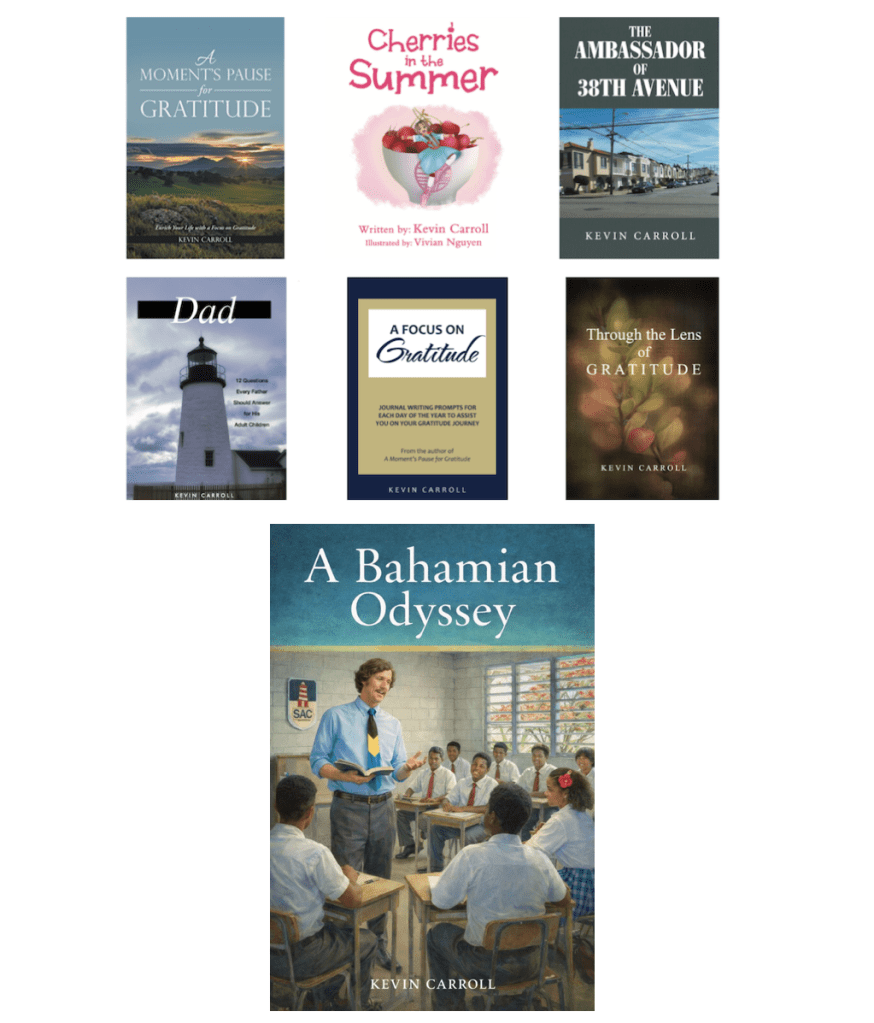
My books are available for purchase online from Amazon. I also have copies of some of these titles at my home for those who would like to buy them directly from me.
A Moment’s Pause for Gratitude (2017)
Cherries in the Summer (2021)
The Ambassador of 38th Avenue (2022)
Dad: 12 Questions… (2023)
A Focus on Gratitude (2024)
Through the Lens of Gratitude (2024)
A Bahamian Odyssey (2026)
-

- October 2026
- September 2026
- August 2026
- July 2026
- June 2026
- May 2026
- April 2026
- March 2026
- February 2026
- January 2026
- December 2025
- November 2025
- October 2025
- September 2025
- August 2025
- July 2025
- June 2025
- May 2025
- April 2025
- March 2025
- February 2025
- January 2025
- December 2024
- November 2024
- October 2024
- September 2024
- August 2024
- July 2024
- June 2024
- May 2024
- April 2024
- March 2024
- February 2024
- January 2024
- December 2023
- November 2023
- October 2023
- September 2023
- August 2023
- July 2023
- June 2023
- May 2023
- April 2023
- March 2023
- February 2023
- January 2023
- December 2022
- November 2022
-
Just Not Right

“No good deed
goes unpunished.”
Brendan GillIt was a beautiful day — Sunday, May 19, 2024, the second day of the annual Downtown Campbell Boogie Festival. Spirits were high. Attendance was excellent. The performers, for the most part, were quite good. The smells emanating from the various vendor booths serving everything from grilled kabobs and sausage links to kettle corn and lumpia permeated the midday air. This was my first year volunteering at the event.
I had been invited to sell tickets to those who wanted to purchase beer or wine. After checking each person’s identification to verify they were 21 years of age or older, I would sell as many tickets, wine glasses, and beer mugs as customers wanted. The people were friendly. During the five hours I worked, we didn’t encounter one difficult person. I got to know some of the other volunteers in the booth, as well. It was a delightful day.
When I returned to my car, which I’d parked in the Second Street Parking Garage, I noticed that someone had clipped the back corner of my vehicle. The damage was substantial. I checked to see if a note had been left on my windshield. No such luck. The car was drivable, but the damage to the car was significant and needed to be addressed.
I received an estimate from a local body shop which had been recommended by the guys at Stevens Creek Honda. I filed a claim with my insurance company. The claim was approved and now it’s just a matter of time before I get the car into the shop for the actual repairs to be made. The deductible on my insurance is $1,000.
I’ve parked in the Second Street Garage in downtown Campbell countless times. Never before had I experienced any difficulties there. Sadly, this Sunday morning volunteer stint will cost me $1,000 out of pocket. It’s true. Life isn’t always fair.
I still look back on that day as a pleasant one. The event was a tremendous success. The multi-generational, multi-ethnic attendees seemed to enjoy everything the festival had to offer them. Residents of the City of Campbell had every reason to be proud of their community for offering such an enjoyable experience for the larger Silicon Valley population. Those visiting Campbell that day had every reason to be grateful for the work of so many vendors, organizers, and volunteers who made the event such a memorable one.
It would be easy for me to stay focused on the damage to my car and be resentful of the injustice of the responsible party leaving the scene without putting a note on my car, but situations such as this invite me to recall the wise words of the Dalai Lama who said, “Do not let the behavior of others destroy your inner peace.”
-
Good Neighbors

“There is nothing in the world
so good as good neighbors.”
Laura Ingalls WilderIt is often said that the value of real estate is determined by three factors: location, location, and location. While that might be a clever comment, it’s anything but true. Certainly the location of a piece of property is a consideration, but so, too, is the quality of neighbors one finds at that location. When Kathy and I purchased our home in San José in 1986, we hit the good neighbors lottery jackpot. Through the years, we’ve been blessed with a variety of amazing neighbors, many who are owners and some who rent.
For me to identify and acknowledge all our neighbors who have enriched our lives with their friendship, I would need more space than a simple blog post allows. For the purpose of today’s post, I would like to mention two in particular. Both have undertaken the often thankless roles of Homeowner Association Board Members for several years.
Dennis Willerton is our HOA president. With a background in engineering, an impressive work ethic, and a desire to seek what is best for the common good of our association members, Dennis has done an exceptional job of orchestrating a number of projects in the community which required attention. From deck repairs, plumbing issues, and hot water heater repairs to the challenging task of replacing the fence along the entire west side of our property, Dennis has consistently and conscientiously negotiated acceptable rates from the various vendors who serve our community. The time, attention, energy and professionalism he devotes to homeowner association business is greatly appreciated.
The other current Board member is Laura Fitzsimmons. Laura and Dennis work collaboratively to ensure that everything around the complex is in good working order. It seems that the best HOA Board members are much like game officials in an athletic contest. If you don’t notice them, they are probably doing their job exceedingly well. This is certainly true of Laura and Dennis. Through the years, in addition to her work and HOA responsibilities, Laura has nurtured a number of vulnerable kittens and cats that have found their way to her doorstep. She has done this with compassion and kindness. I should mention, as well, that today is Laura’s birthday!
As is true in any community, we have a few neighbors who are difficult to deal with for one reason or another. While they exist, they are significantly outnumbered by genuinely good folks who treat their neighbors with respect and who care for the needs of others in the community.
I’ll end today’s blog post with a quote by Harold Kushner, author of the bestselling book When Bad Things Happen to Good People. He wrote, “The happiest people I know are people who don’t even think about being happy. They just think about being good neighbors, good people. And then happiness sort of sneaks in the back window while they are busy doing good.”
That sounds like a respectable plan of action for all of us.
-
The Challenge is Real

“A friend may be waiting
behind a stranger’s face.”
Maya AngelouIt was so easy when I was younger. In my early childhood, I could walk up to another young person in the sandbox at the park and innocently ask, “Can I play with you?” It was a simple question, and the intention of the question was quite clear. That same question today, if posed to someone my age in a social setting, might result in a slap across the face.
During my high school years, it was fairly easy to strike up a conversation with another high school age student by asking where they attend school or where they went for elementary school. This could lead to a conversation about possible mutual friends and interests.
In my college years, the first conversation with someone new might involved the double-question: “Where are you from? What’s your major?” They were fairly safe, generic questions which had the potential to get the ball rolling.
When I happen to meet someone who tells me they’re from San Francisco, there’s a tried and true script which must be followed. The first question is “Where’d you go to school?” If they are truly from San Francisco, they instinctively know you’re asking about the high school they attended. That simple introductory question usually opens the door to a number of follow-up questions. “What year did you graduate? Did you know…(fill in the blank with someone’s name)?” These three questions should be more than sufficient to begin an engaging conversation about common friends and experiences.
In fifteen days, I’ll celebrate my 70th birthday. Opportunities to meet new friends don’t come up quite as often as they used to. Of course, it’s possible to begin a friendship with a simple “Hello,” but even this could be met with suspicion. So it’s an absolute delight when I take the risk to greet someone and the response is warm and hospitable. Meeting new friends shouldn’t be such a challenge, and yet it can be.
I think it might be helpful to remind ourselves that we’re all part of the human family, and therefore we are all connected. I am reminded of this interconnectedness when I meet someone new. Given the demographics of Silicon Valley, meeting new people invites me to recognize the beauty in the diversity of the people I meet. Whether the person is from upstate New York, downtown Campbell, or somewhere in Africa, every person I meet has a unique story to tell. I’m grateful and honored when others trust me with their stories. I always take the time to listen attentively… and to learn.
The truth is, we just never know how meeting someone new might change the course of our life. While attending a celebration in Kingston, Jamaica in late July 1971, I met many people I did not know. Three years later, one of those individuals contacted me and offered me a job teaching in a high school in the Bahamas. That job led to my decision to devote my life to teaching here in California.
The keys to unlocking the incredible potential of meeting new people are an open heart and an open mind. These two gifts invite and encourage people to share their stories and the things about which they are passionate. When we happen to connect with someone who has a shared passion, great things can happen.
The more we open ourselves up to meeting new people, the more opportunities seem to come our way. My motivation for meeting new people isn’t necessarily related to potential opportunities, yet when I embrace the unknown of meeting someone new, I’ve learned that magic can happen. There is a vulnerability to opening ourselves up to meeting a person we do not know, but the benefits of doing so far outweigh the risks.
-
Small Town Charm
“Music washes away
from the soul the dust
of everyday life.”
Berthold AuerbachThe City of Campbell, California is alive and well. Tucked away in a cozy corner of the Santa Clara Valley, it provides a respite from the hectic pace of what is now commonly referred to as Silicon Valley. Once known for its countless acres of orchards, Campbell is now a thriving community of homes, parks, and business which maintains its small town charm.
Downtown Campbell offers several blocks of excellent restaurants, coffee shops, bakeries, small businesses, and my favorite ice cream shop in the South Bay — the Campbell Creamery. Evenings in downtown Campbell often include live performances by a number of local musical artists.
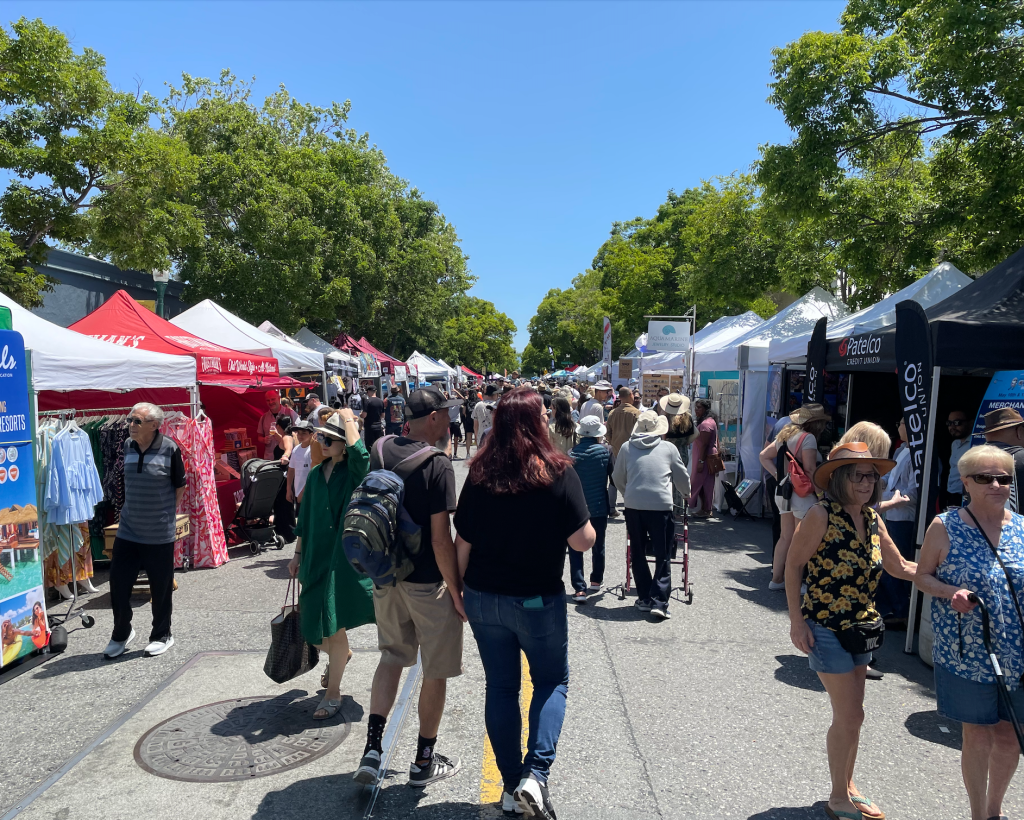
This weekend, downtown Campbell is the site of the 2024 Boogie Music Festival. I spent a few hours there yesterday enjoying the sights and sounds of the annual event. I especially enjoyed the music of Wandering Acoustics, a local band that performs in downtown Campbell and around the South Bay quite often. I’ll be back at the festival this morning as a volunteer, assisting with ticket sales for those of legal drinking age who would like to enjoy beer or wine throughout the day.
Theatrical producer David Binder had this to say about community festivals: “Festivals promote diversity, they bring neighbors into dialogue, they increase creativity, they offer opportunities for civic pride, they improve our general psychological well-being. In short, they make cities better places to live.”
The City of Campbell’s annual Boogie Music Festival accomplishes all these things. A quick look around during the event reveals that it is a multi-generational, multi-cultural activity which features dozens of vendor booths with artists of all types selling their goods. On several occasions yesterday, I found myself engaged in pleasant conversations with others who were there to enjoy the festivities of the day. This two-day event is, without a doubt, a tremendous source of civic pride. As for improving one’s psychological well-being,… well, the festival offers music representing a variety of genres, as well as food reflective of the diversity of the community. Oh, and as I’ve mentioned, downtown Campbell is home to the Campbell Creamery.
Food, music, and ice cream. What more is needed for an ideal spring weekend gathering?
-
Just Begin

“If a story is in you,
it has to come out.”
William FaulknerI’ve had the pleasure of meeting a number of people recently who have written manuscripts, or who plan to write something, and have questions about how to get their work published. I’ve met even more people, however, who have mentioned that they have a desire to write either their life story or a book about some of their life experiences, but who are convinced that they don’t possess the skill to do so. I encourage them all to just write. One cannot edit a blank page. One can, however, put one’s thoughts down on paper. One can, to the best of their ability, provide specific details about some of the unique situations and people they’ve encountered along their life journey. For them, the Nike slogan is perfect: Just do it!
The most challenging stage of any writing endeavor is getting started. Where do we begin? What do we say about ourselves? What do we write about other people? How much detail should we provide to make our story understandable, believable, interesting? These are all valid questions which can be answered later in the writing process. The important thing is to just get started. The first draft doesn’t have to be perfect. It just needs to get written.
I believe that everyone has a story to tell. Everyone has had numerous life experiences which have provided them with unique wisdom and perspective which could be beneficial to others. Sadly, many believe that they lack such experience and perspective on life. They discount their own experiences as being ordinary — too ordinary to write about. Who would want to read my story?
I get it. I felt the same way. When I started blogging on the topic of gratitude back in December 2006, the possibility of publishing my work was not on my radar. Who was I? What did I have to say which might be of interest to others? It’s easy for us to discredit our lives as being ordinary or mundane.
Everyone has the opportunity to ask themselves a few motivating questions: What are some of the highlights of my life? What are some of the experience through which I’ve learned important life lessons? What unique experiences do I have to share with others? Who are some of the most influential people in my life? How have these experiences and individuals contributed to shaping me into the person I am today? How did these people and experiences affect my life journey? What have I learned along the way which was of value to me and might be of value to others, as well?
We don’t need exceptional writing skills to share our stories. What is needed is determination, courage, and a strong desire to make a positive difference in the lives of other people. Proofreaders and editors, whether they be professional or simply proficient, can help a person put their thoughts, ideas, memories, and perspectives into coherent form. The ease and affordability of self-publishing enables anyone to create a manuscript which might make a significant impact on the life of a reader.
A story is in you. Are you ready to share it?
-
Childhood Memories
“What one loves
in childhood
stays in their heart
forever.”
Mary Jo PutneyA local author, Ann Lamott, has created a new website to encourage writers to write. She sends out writing prompts for those who need a bit of guidance to get them started. Normally, I’m not in need of such urging. I encounter ideas for my blog posts pretty much every day. Today, however, I’m responding to the prompt I received from Ann yesterday, as it brought back vivid memories of my childhood. The prompt was: Describe a place from your childhood that holds significant memories for you.
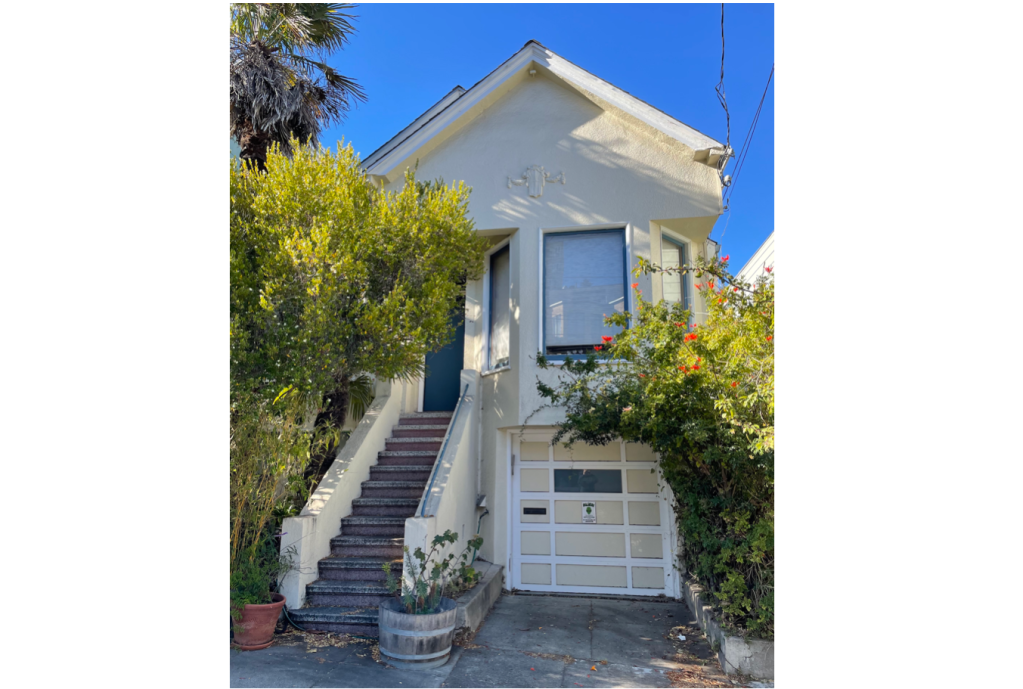
It didn’t take much thought for me to identify that place for me. It was a house in the Noe Valley area of San Francisco — the home of my mother’s uncle and aunt. I knew them as Uncle P.D. (for Patrick Daniel) and Auntie Mary. P.D. was my maternal grandmother’s brother. Their home on 26th Street was the venue for many large family gatherings.
My first memory of this house is of sitting at the kitchen table enjoying my Auntie Mary’s Irish soda bread and tea. This was always a special time, although P.D. was often disappointed that I would never join him for a shot or two of Irish whiskey.
Many larger family gatherings were held at this home. In the hours before dinner, the women would gather in the kitchen, while the men would hang out on the small back porch, which was well-stocked with a variety of adult beverages. A number of children, including my siblings and cousins, would move around from what I remember as the TV room, adjacent to the dining room, to the back yard, which featured a strip of grass bordered on three sides by flowering plants. These were special times which enabled me to enjoy the company of my cousins Kathleen, Maureen, and Pat Twomey, John and Debbie Young, Pat, John, and Maria Healy, and the Kelly family — Marie, Lori, Jim, Nancy, Dan, and Theresa. The house wasn’t big, but there was always enough room for everyone.
After dinner, we would gather in the living room/dining room area for a variety of traditional family activities. There would be a bit of group singing of a few Irish songs, then Uncle P.D. would recite the poem “I’m the Daddy of a Nun,” much to everyone’s delight. My Uncle Dan Healy, my Godfather, would play his bagpipes for a while, then my father would sing “Danny Boy.” After that, the women would move the large table out of the way so that they could do some Irish dancing on the hardwood floor in the dining room. That was always a treat to watch.
P.D. and Mary were the epitome of hospitality. Everyone knew that they were welcome in P.D. and Mary’s home any time of day or night. It was in this home, more so than anywhere else, that I experienced the love and acceptance offered by my extended family. Definitely a source of gratitude in my life.
-
Brendan’s Gift

“A plant is
the most patient
and forgiving teacher.”
Srikumar RaoWhen I first met Kathy back in August 1984, to welcome me to my new job at Saint Lawrence Parish in Santa Clara, she gave me a beautiful plant for my office. It was a nice addition to what was otherwise a fairly bland workspace. For the first few months, the plant was situated on my desk. I enjoyed it immensely, as it was a constant reminder of Kathy’s gracious hospitality. Sadly, it struggled to survive, as there was insufficient sunlight in the room. My secretary at that time recommended that we move the plant into her office, adjacent to mine. Two of her four walls were floor-to-ceiling glass, one with a western exposure. The afternoon sun in that location was plentiful. The plant thrived for ten years.
When my responsibilities at Saint Lawrence changed in 1994, I moved out of that office and into one of the classrooms of the parish high school where I worked for the next 21 years. I brought the plant with me. For a while, it seemed to be doing well in its new environment, but as time went on, it began to show signs of distress. Hoping to give it new life, I brought the plant home. The lack of sufficient sunlight there, combined with my own lack of attentiveness, resulted in the plant experiencing a slow death. Nurturing plants was definitely not a gift with which I was blessed.
A little more than a year ago, our youngest son, Brendan, asked if it might be possible for him to move back home for a while. He had been living in a rental house in Santa Clara with two friends, but the landlord informed them that the rent would be increasing sharply, so all three sought alternative living situations. Kathy and I were happy to welcome Brendan back into our home.
Kathy and I enjoy and appreciate Brendan’s presence. One of the perks of having him living here is that we get to enjoy the beauty of the various plants Brendan is growing in and around our home. Some are in his room, while others are strategically placed in the living room, the dining room, the guest bathroom, our front patio, and in various spots around the perimeter of our home. He meticulously cares for these plants and, unlike me, seems to know exactly what each type of plant needs to flourish. Our home environment is much improved thanks to Brendan’s gift of growing plants.
As I’ve mentioned so many times previously in my writing, I am tremendously grateful for this sacred space we call home. We’ve lived here for almost 38 years. This residence, and the community in which it is located, has served us well. The addition of Brendan’s plants, and Brendan’s presence himself, has created an even more welcoming, nurturing environment for Kathy and me to live… and thrive.
American horticulturist, Liberty Hyde Bailey, pointed out, “A garden requires patient labor and attention. Plants to not grow merely to satisfy ambitions or to fulfill good intentions. They thrive because someone expended effort on them.” This is exactly what Brendan has done.
More than two thousand years ago, the Roman philosopher, Marcus Tullius Cicero, stated, “If you have a garden and a library, you have everything you need.” Gratefully, my home has been blessed with both.
-
Genuine Kindness
“Every saint has a past
and every sinner
has a future.”
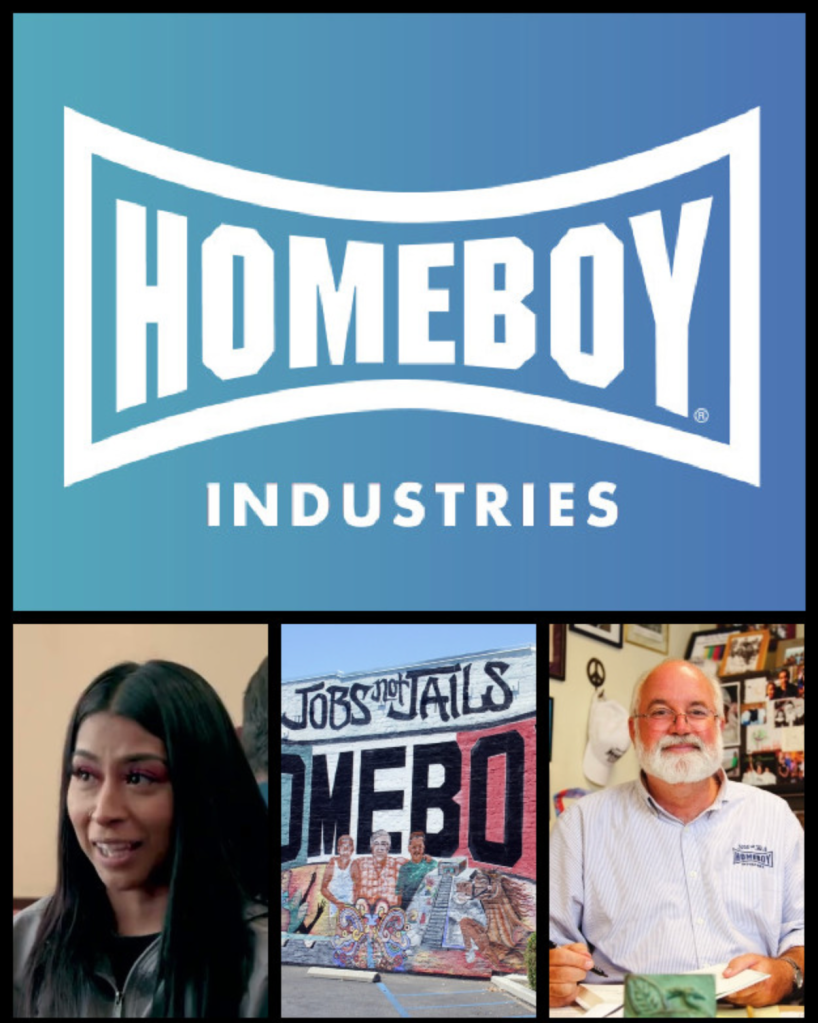
Oscar WildeStephanie’s story was heartbreaking. She spoke of the violence in her home during her formative years. She described the dangers of the constant gang activity in the neighborhood in which her family home was located, which included the death of her younger brother. She shared her feelings of hopelessness for a better future for herself, and later for her children. She disclosed some of the desperate measures she had taken in an attempt to survive in her East Los Angeles environment. Then her tone changed, significantly, as she recounted her experience at Homeboy Industries, the largest and most successful gang intervention program in the world.
I had the pleasure and privilege of taking a tour of the Homeboy facility last Wednesday. I was overwhelmed with the warm hospitality and genuine kindness offered by dozens of people I met, many of whom were graduates of the Homeboy program. My tour guide was Stephanie.
Stephanie’s story is not unusual. Those who work with the clients at Homeboy have heard thousands of similar stories from women and men with a desire and commitment to improve their lives. The mission of Homeboy Industries is to provide hope, training, and support to formerly gang-involved and previously incarcerated men and women, allowing them to redirect their lives and become contributing members of the community.
Homeboy Industries provides an 18-month reentry program which is offered to 400 men and women each year. Founded by Father Greg Boyle, S.J. in 1988, the organization’s motto is “Nothing stops a bullet like a job.” Despite the odds, Fr. Greg has earned the trust and respect of rival gangs in the Los Angeles area. His organization offers gang members a viable alternative to the hopelessness of the gang lifestyle. Homeboy services include case management, legal assistance, education, mental health services, substance abuse and anger management classes, parenting workshops, tattoo removal, and much more.
Another catch phrase at Homeboy Industries is “Jobs, not Jail.” Upon completion of the 18-month reentry program, a variety of job opportunities are made available to graduates including, but not limited to, the Homeboy Bakery, the Homegirl Café, Homeboy Silkscreening, Homegirl Catering, Homeboy Electronics Recycling, the Homeboy Farmers Market, and https://shophomeboy.com/.
Those with an affiliation with gangs are not the only individuals struggling to cope with the myriad challenges of living in the world today. As we go about our daily routines, we may find ourselves standing next to someone who is doing their best not to fall apart. It may be a family member, a coworker, a neighbor, an employee in a store or restaurant, or another customer sitting in a local coffee shop. We just never know, so it’s imperative that whatever we do each day, we do it with kindness in our heart. The kindness we offer someone might be just what they need to keep it all together for one more day.
As I walked through the various areas of the Homeboy Industries facility, I encountered nothing but kindness and gratitude every step of the way. I felt more welcome by the homeboys and homegirls there than I have ever felt at a local parish church. This incredible experience motivates me to share a message penned by author Lisa Currie, who wrote, “You may not always see the results of your kindness, but every bit of positive energy you contribute to the world makes it a better place for us all.”
-
Mother’s Day
“If I know what love is,
it is because of you.”
Hermann HesseIn our home this morning, we will celebrate Mother’s Day. Our three boys and their families will be here for a feast of breakfast burritos from La Victoria Taqueria in San José. There will be a dozen of us altogether. I’m fairly certain that no one will walk away hungry.
Kathy most certainly deserves to be recognized and appreciated on Mother’s Day. She has been, and continues to be, an amazing mother to our three boys. She is also a loving, nurturing grandma (or “Mama”) to our five grandchildren. The love Kathy has and shares with our sons and grandkids is reflective of the unconditional love God has for us.
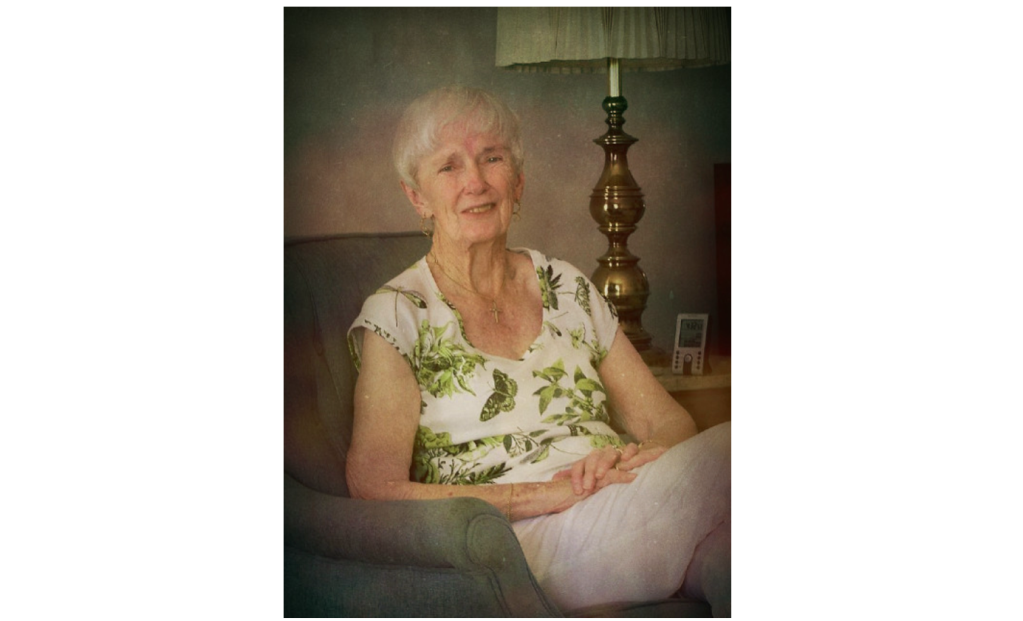
For me, today has a bit of a different focus. I’m grateful that Kathy has embraced her role as “Mom” and “Mama” to the next two generations, but she is not MY mother. Even though my mother has been gone for more than a year now, I am overwhelmed with gratitude for everything she did for me throughout my lifetime. Mom’s love, too, was unconditional. There were a number of times when she might have been disappointed by something I said, did, or failed to do, yet she never wavered in her love for me. Her love was not dependent upon my actions. It was just there — always. A sacramental experience, for sure.
The way Mom loved my siblings and me is a perfect example of my favorite definition of “love,” which is: “to seek the highest good for the other person.” Mom committed herself to doing this until the day she died. She was kind, generous, understanding, supportive, and courageous. She taught me how to be aware of the needs of others. She taught me how to treat people with respect and dignity. She taught me the importance of punctuality, self-reliance, honesty, hard work, and self-care. She taught me how to express myself clearly in both written and spoken forms. When it comes right down to it, Mom was not only my first teacher, but also my best.
So as we gather today as a family to celebrate Kathy’s ministry of motherhood, I do so with fond, grateful memories of my own Mom, as well.
-
Life is Good
“My favorite place
to vacation
is anyplace
by the ocean.”
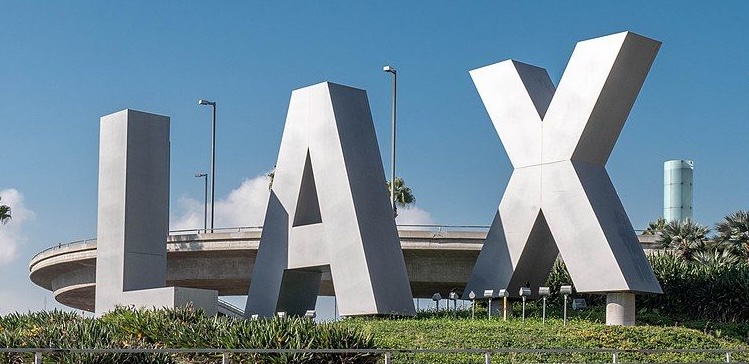
Nina AriandaIt’s been a brief getaway, and now it’s ending. I’m sitting at a small table in Los Angeles International Airport waiting to board my flight back to San José. The duration of this visit was ideal — four days. Any shorter would have been insufficient. Anything longer would have been too much. I’m looking forward to getting home, celebrating Mother’s Day, and returning to my daily routine.
My brother, Tom, was a gracious host. I was able to stay in a guest room at Loyola-Marymount University, where Tom lives and works. His fellow Jesuits were equally hospitable, each welcoming me warmly and engaging in casual conversation at various times. The weather could have been better. It’s been cooler than usual for May in LA, with a brisk wind that made it feel even colder, but it was good weather for walking — and we did a lot of walking.
I got to see much of the Los Angeles metro area these past few days, including Santa Monica Pier, Will Rogers State Park, Homeboy Industries (with lunch at the Homegirl Café), Union Station, and the Los Angeles Cathedral in downtown LA. Tom and I also enjoyed a pleasant walk along the promenade along Hermosa Beach, about ten miles south of the LMU campus. The white sand and ocean air made for a pleasant experience.
From the Jesuit Community residence at Loyola-Marymount, it’s possible to see the Pacific Ocean, in the general direction of Santa Monica. While the visibility wasn’t ideal this week, just being near the ocean was enough to nourish my soul. Today, as I prepare to fly home, I feel both incredibly relaxed and energized. Oh,… and yes, grateful.
As summer approaches, I am hoping to get to the water, in both Santa Cruz and San Francisco, on a more regular basis. There’s definitely something special about time spent near the ocean.
On a final note,… I was reminded, yet again, that it is a small world. Sitting here at LAX I met a young woman who attended Holy Family School in San José, Presentation High School (2011), Loyola-Marymount University, and Santa Clara University Law School. Not surprisingly, we knew several people in common. She’s flying home to the South Bay for Mother’s Day.
Life is good.
-
Subscribe
Subscribed
Have a WordPress.com account? Log in now.

