-

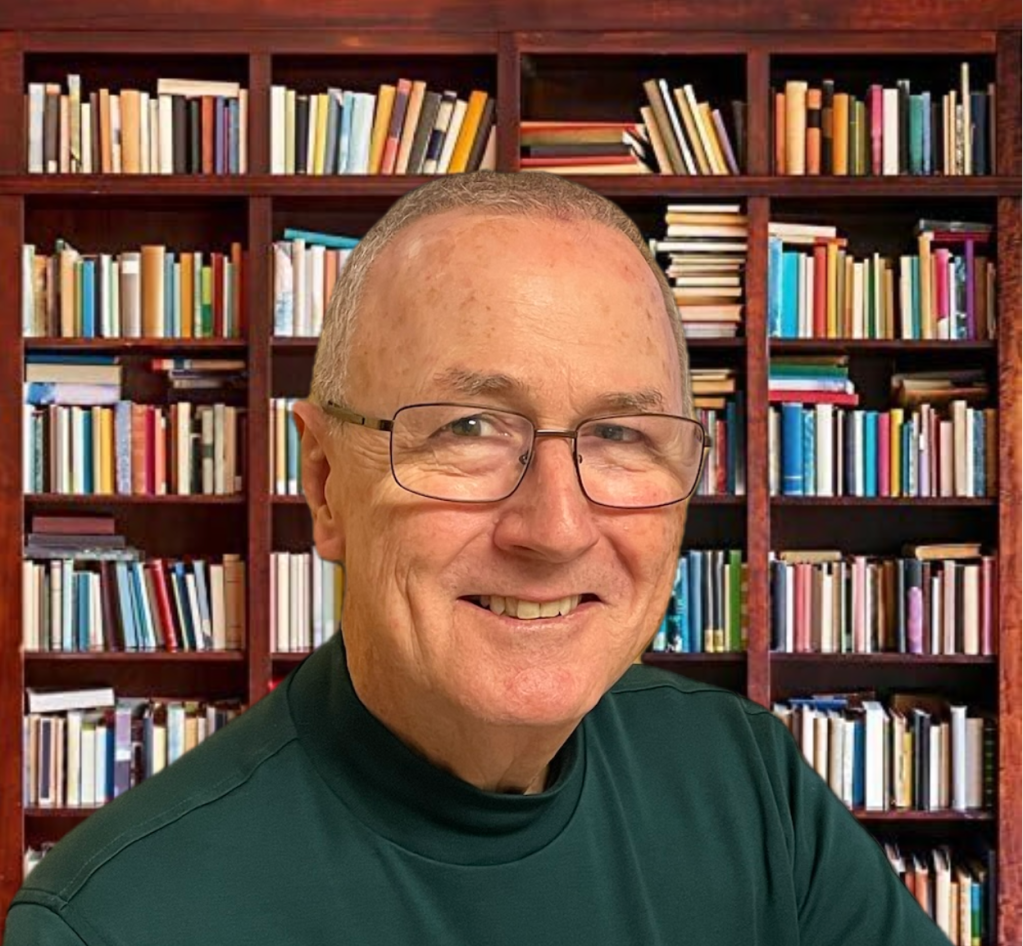
My name is Kevin Carroll. I was born and raised in San Francisco, California, where I attended Saint Ignatius College Preparatory. I am a graduate of both Santa Clara University and the University of San Francisco. Following a 40-year career in teaching and pastoral ministry, I launched a new career as a writer and speaker.
I live in San José, California. My wife, Kathy, and I have three adult sons and five precious grandchildren. I have much for which to be grateful.
I can be reached via email at kmc43sjc@gmail.com
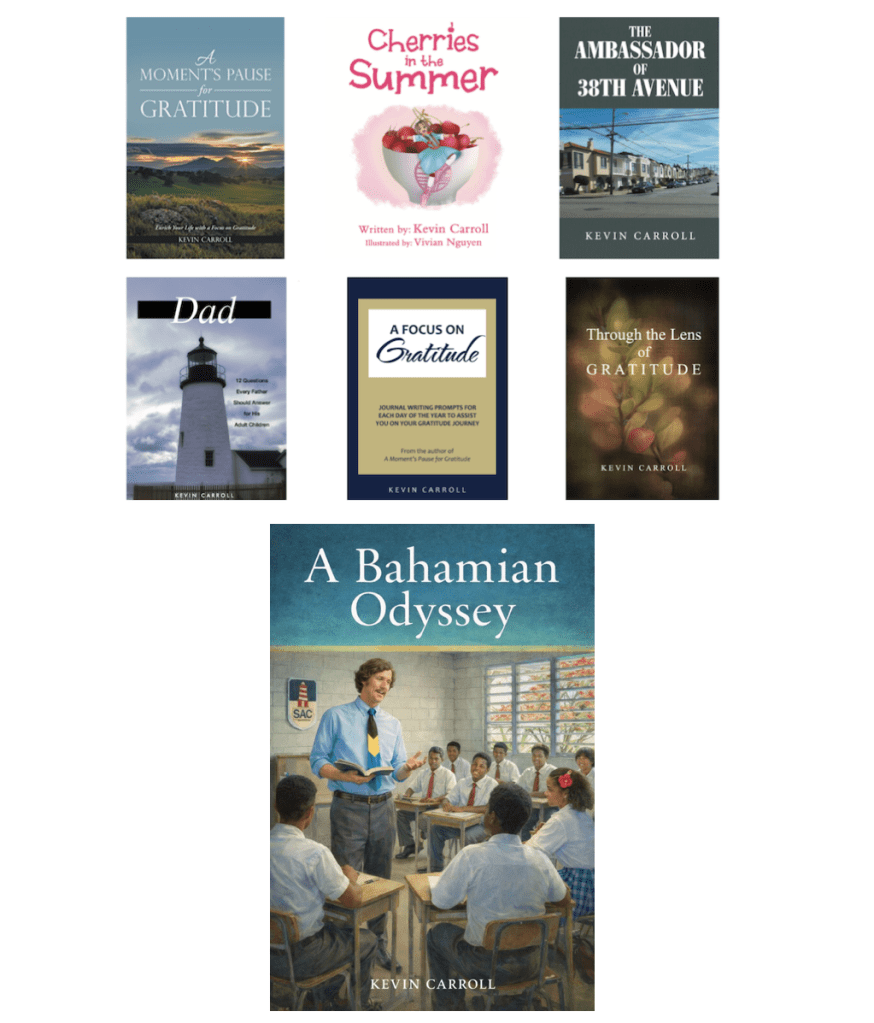
My books are available for purchase online from Amazon. I also have copies of some of these titles at my home for those who would like to buy them directly from me.
A Moment’s Pause for Gratitude (2017)
Cherries in the Summer (2021)
The Ambassador of 38th Avenue (2022)
Dad: 12 Questions… (2023)
A Focus on Gratitude (2024)
Through the Lens of Gratitude (2024)
A Bahamian Odyssey (2026)
-

- October 2026
- September 2026
- August 2026
- July 2026
- June 2026
- May 2026
- April 2026
- March 2026
- February 2026
- January 2026
- December 2025
- November 2025
- October 2025
- September 2025
- August 2025
- July 2025
- June 2025
- May 2025
- April 2025
- March 2025
- February 2025
- January 2025
- December 2024
- November 2024
- October 2024
- September 2024
- August 2024
- July 2024
- June 2024
- May 2024
- April 2024
- March 2024
- February 2024
- January 2024
- December 2023
- November 2023
- October 2023
- September 2023
- August 2023
- July 2023
- June 2023
- May 2023
- April 2023
- March 2023
- February 2023
- January 2023
- December 2022
- November 2022
-
Healing Our Wounds

“A wound does not heal
by being told to heal.”
Joe PrimoDealing with wounds from our past seems to be a universal experience. Despite the fact that each person’s life is a gift, life inevitably involves challenges, suffering, loss, and grief. Coping with these realities can, for some, be overwhelming. To make matters worse, difficult experiences are not equally distributed. While some individuals seem to skate through life unscathed (most likely, we’re simply unaware of what these people have gone through), others are burdened with a plethora of painful situations which can challenge their faith and leave them with significant emotional wounds. How, then, can we heal from our woundedness?
As Chilean-American writer, Isabel Allende, tells us, “Everybody has losses — it’s unavoidable in life.” Yes, it is. Yet, as our life goes on, we are challenged to find healthy ways to acknowledge and embrace our pain so that we are not paralyzed by it. Allende recommends that sharing our pain can be incredibly healing. This may be true, but does anyone really want to listen to us complain about the painful experiences with which we’ve been confronted in our lives? Fortunately, there are therapists whose calling in life is to do just that.
Keanu Reeves has had an astounding career as an actor, starring in The Matrix, Speed, Constantine, and many other successful movies. Just two years ago, Time magazine named him one of the 100 most influential people in the world! Despite his professional success, Reeves has endured both personal and professional setbacks which have tested his strength and resilience. The actor shares these words of wisdom: “Every struggle in your life has shaped you into the person you are today. Be thankful for the hard times, they can only make you stronger.” Reeves acknowledges that gratitude does, indeed, make a difference.
Through all the ups and downs of his life, Keanu Reeves is known for being humble, kind, and down-to-earth. These admirable traits have endeared him to friends and fans throughout the world. They also remind us that we have the power to decide how to live our own lives, even when confronted with painful experiences.
Jalaleddin Rumi, better known simply as Rumi, is remembered for being a great spiritual master. He, too, encouraged us to see the positive side of life’s challenges. He wrote, “Grief can be the garden of compassion. If you keep your heart open through everything, your pain can become your greatest ally in your life’s search for love and wisdom.” It is through our own pain that we are able to develop the empathy to care for others.
The Greek philosopher, Socrates, also puts an optimistic spin on coping with life’s difficulties. Referring to the changes any crisis in our life might bring about, he said, “The secret of change is to focus all of your energy not on fighting the old, but on building the new.” These words, along with wisdom from a number of other sources, empowered me to retire from teaching at the age of 61. Rather than resisting the misguided leadership in the school at that time, I chose to venture off into a new career as a writer and allow the future of the school to play out as it would. As I suspected might be the case, the school permanently closed at the end of the following academic year. Retiring prematurely is a decision I will never regret.
Although it’s been sixty-one years since his passing, Swiss psychiatrist and psychoanalyst Carl Jung continues to be a powerful source of information, inspiration, and wisdom. These simple words can be of significant benefit to any person questioning their lot in life: “I am not what happened to me. I am what I choose to become.” Jung’s words serve as a gentle reminder that the responsibility for our life, and our outlook on life, is in our hands. Healing the wounds of our past may be difficult, but we have the power to do so.
-
The Gift of Time

“It’s really clear that
the most precious resource
we all have is time.”
Steve JobsWhen I was in my twenties, I was confident that I had a long life ahead of me. I was healthy, active, and optimistic. I played a lot of basketball and tennis, rode my ten-speed bike for both transportation and pleasure, and took advantage of opportunities to travel. Of course, the reality of the situation was that I was never guaranteed the next day. No one is. Despite this fact, I felt invincible and immortal.
When I was in my thirties and forties, I was too busy to think about time or mortality. I got married, we had children, and our lives were filled with the predictable challenges of balancing our work commitments with our family responsibilities. Time passed quickly, but we were having too much fun to notice.
During my fifties, our three sons were transitioning into confident young men. High school graduations, college classes, jobs, and participation in intercollegiate sports took up much of their time — and mine. It was an exciting time for all of us.
Turning 60 didn’t bother me at all. I was still teaching, our sons had achieved appropriate levels of autonomy, and Kathy and I enjoyed a little more time to ourselves. As my sixties progressed, wonderful changes brought incredible joy and new challenges. Marriages and the births of five grandchildren have literally transformed our lives. All three of our boys (I guess I’ll always call them that) have settled into respectable, productive careers which provide for them and their families while also making a positive difference in the world. To say that I am proud of them would be an understatement.
A little more than a month ago, I turned 70. Unlike any previous birthday, this one got me thinking about my mortality. I’m still healthy and relatively active, though not to the extent to which I was in my younger years. I don’t feel old, but there is no denying that I am older than I’ve ever been. My knees remind me of this fact on a daily basis. I am well aware that most of the sand in my hourglass of life has made its way to the bottom. The only question is how much sand (time) remains in the upper chamber? There’s just no way for me to know.
Acknowledging the limitations of time in my life has allowed me to reorganize my priorities. Earning money is no longer a major consideration. I no longer have a need to be right. If someone disagrees with me, I’m finding that life is more pleasant when I simply recognize the disagreements and not let them interfere with my relationships. While it may be easy for me to think that now that I’m retired, I am no longer a contributing member of society, I wholeheartedly reject this notion. I am committed to making a positive difference in the world every day. The things I do don’t have to be earth-shattering. I do simple things, like acknowledging people I encounter each day. If I see a piece of trash on the ground, I’ll pick it up and dispose of it appropriately. I intentionally focus on the good in the world, since I am convinced that there is far more good than evil in our community. And I make myself available to others for support, friendship, and, at times, simple compassionate presence.
At the age of 70, I am well aware that when I share my time with someone, I am giving them a portion of the limited time I have remaining on this earth. I cannot think of anything more valuable to share with them. Time truly is a gift.
-
A Lazy Day

“Rollin’, rollin’,
rollin’ on the river.”
Creedence Clearwater RevivalKathy and I woke up this morning in The Dalles, Oregon aboard the riverboat American West. The boat departed The Dalles at 8:45 A.M. for an all-day cruise up the Columbia River. We will dock just after midnight in Richland, Washington where, tomorrow, we will celebrate the Fourth of July.
Moving slowly up the river today has been incredibly relaxing. No stops or excursions were scheduled today, though we did enjoy the unique experience of passing through several locks along the way. A variety of on-board activities were offered throughout the day. This afternoon, Kathy attended a session facilitated by the executive chef on how to prepare shrimp scampi. After dinner this evening, she also attended a presentation by our on-board historian about the strange tale of D.B. Cooper. I opted to spend much of the day reading, relaxing, and socializing with other passengers. I also took advantage of the opportunity for a brief afternoon nap.
We have been blessed to experience this trip with a delightful assortment of fellow passengers from around the United States. Just about everyone we’ve met has been friendly and positive. Most of the passengers are a bit older than Kathy and me, so we’ve learned quite a bit about cruising and life in general from these people. I’m confident that we’ll keep in contact with a few folks we’ve met long after this cruise has ended.
I’ve also been impressed with the professionalism and hospitality offered by the crew — servers, housekeeping staff, deckhands, and the administrative team. They are consistently polite and friendly to the guests.
I’ve been told that the riverboat is traveling about fifteen miles per hour as it makes its way up the river between Oregon and Washington. The views along the first segment of the cruise were highlighted by trees… lots of trees, along with some spectacular riverfront homes. As we continue to make our way east, the terrain has changed dramatically. Brown hills and cliffs, interrupted by an occasional small community, line both sides of the river. Unlike the choppy waters between Astoria and The Dalles, the river is like glass this evening. As it works its way toward Richland, the America West gently rocks starboard to port. Before we boarded the vessel on Saturday, I was a bit concerned about the effect such rocking would have on me. Fortunately, I have not experienced any motion sickness at all. In fact, I find the rocking to be incredibly relaxing.
Those of us on the cruise will enjoy a Fourth of July picnic in Kennewick, Washington during the day tomorrow. The predicted high temperature for tomorrow is 95º. That might seem a bit uncomfortable, but I’m feeling quite grateful. One week from today, the expected high in Richland is 111º.
Timing is everything.
-
A Small World

“Once a year, go someplace
you’ve never been before.”
Dalai LamaThere was a time when I loved to travel. During my early childhood, my family used to spend a week or so each summer vacationing in Boulder Creek, then, in later years, on Cobb Mountain in Lake County. We also took two road trips to Southern California in those years, one for a family funeral and one to spend a few days at Disneyland. Our big family vacation happened in the summer of 1968 when we flew to the East Coast. We visited New York City, Boston, Niagara Falls, Philadelphia, and Washington, D.C. I vividly recall being shocked when, while standing on the deck of the U.S.S. Constitution in Boston harbor, a 21-canon salute acknowledged that it was noon on the 4th of July.
Since that time, I’ve been blessed with a number of travel opportunities, including numerous international trips to Jamaica, the Bahamas, and Japan. Here in the U.S., I’ve driven across the country on I-80 from San Francisco to New York, and traveled to New Orleans, Hawaii, Orlando, FL, the upper Michigan peninsula, Seattle and Spokane, WA, Eureka, CA, San Diego, and a number of other cities and towns closer to home. Although I have never been to Canada, Mexico, or anywhere in Europe, I don’t feel travel-deprived in any way.
This summer, Kathy and I decided to try something new. We’re taking a river boat cruise along the Columbia and Snake Rivers, between Oregon and Washington. We boarded the vessel on Saturday morning. After spending the day in Astoria, OR on Sunday and Kalama, WA yesterday, today we explored The Dalles, OR. We’ll conclude our journey in Clarkston, WA on Saturday morning. The trip has been delightful so far.
My only previous experience on a river boat was riding the Mark Twain paddle boat ride at Disneyland. This week, we’re traveling on the American West, one of the boats of American Cruise Lines. It’s a small vessel, with a capacity of 200 guests. Our stateroom is comfortable and has a private patio deck with a northern exposure. The meals served in the classic dining hall have been exquisite. Each day offers a variety of excursion options, while in the evenings, live entertainment is available in the River Lounge.
As happens so often in my life, I had another “small world experience” today. While visiting the Maryhill Winery in the town of Goldendale, WA, I met Dave, our host for the wine tasting adventure. He mentioned that he had moved to Goldendale a few years ago. I learned that he was originally from Santa Clara, CA! Of course, I asked him where he attended high school: Archbishop Mitty (’76), and elementary school: St. Clare (’72). Then we began the Do You Know? game. He threw out a number of family names of a few friends he remembered from his youth. One of the names rang a bell: Pasquinelli.
“Did he have an older sister named Gina?” I inquired. Dave assured me that, indeed, he did. “I went out with her once!” I responded.
Back in 1979, Jenifer Jatta, one of my eighth grade students at St. Christopher School in San José, thought it might be a good idea for me to meet her Aunt Gina, assuring me that we would be perfect for each other. We went out to dinner one evening. When I called her to invite her out for a second date, she declined — three different times. I got the message.
We’re a little more than halfway through our cruise. I wonder who else I’ll meet along the way with whom I might have something or someone in common.
-
A Long Time

“Pray as if God
will take care of all;
act as if all
is up to you.”
Ignatius of LoyolaForty years ago today, my brother, Tom, was ordained to the Jesuit priesthood at Saint Mary’s Cathedral in San Francisco. It goes without saying that he was strongly influenced by his experience as a student at Saint Ignatius High School from 1964-68. Saint Ignatius of Loyola was the Spanish priest who founded the Society of Jesus (Jesuits) in 1534.
In the Sacred Scriptures, the number 40 seems to be used to represent “a long time.” In the story of the great flood, it rained for 40 days and 40 nights. Moses fasted for 40 days. Jesus spent 40 days in the wilderness where he fasted and was tempted by the devil. And the Jewish people wandered in the desert for 40 years. In each case, the number 40 could be replaced with “a long time.”
In these Bible stories, we can see that the number 40 was associated with being tested, and with the hardships one endures in their journey to becoming more spiritually enlightened.
Yes, my brother, Tom, has been a Jesuit priest for a long time. His various ministerial responsibilities took him to Los Angeles (Loyola High School), Boston (Jesuit Urban Center), Los Altos, California (El Retiro Jesuit Retreat Center), Rome (where Tom provided spiritual direction to young Jesuits in formation from around the world), and then back to Los Angeles (Loyola-Marymount University). Through these experiences, some of which included periods of testing and hardship, Tom has clearly become more spiritually enlightened. What is clear to so many people who know him is that Tom’s strength, the gift he willingly and generously shares with so many, is that of spiritual direction.
Ignatian Spirituality is grounded in the Spiritual Exercises of Saint Ignatius of Loyola, written around the years 1522-1524, an organized program of prayer and reflection. The Exercises are not meant to be read, but to be experienced. The purpose of the Exercises is to help people deepen their relationship with God. Through the years, Tom has facilitated this process of spiritual growth for countless women and men. He continues to do so today from his new home base at Loyola-Marymount University.
While I may be considerably taller (and a bit heavier) than Tom, he will always be my big brother. I am proud of who he is and what he is doing with his life. I am grateful for the myriad ways he has shared his priestly ministry with our family at weddings, funerals, baptisms, and with the gift of his presence. I also appreciate the effort Tom makes to visit and connect with his six nephews (Peggy & Jim’s three boys: Pat, Dan & Sean, and Kathy’s and my three boys: Tom, Steve & Brendan) — and now, seven grand-nieces/nephews!
Tom’s life has certainly reflected the thoughtful words of former President Jimmy Carter, who said, “I have one life and one chance to make it count for something… My faith demands that I do whatever I can, wherever I am, whenever I can, for as long as I can, with whatever I have, to try to make a difference.”
-
Friday 06/14

Creator: Paul Chinn | Credit: The Chronicle It was a perfect storm. A Friday in June. Spectacular weather forecast for the weekend. Road construction. Egotistical drivers, most in Teslas and BMWs, attempting to impress other drivers with their Indy 500 racing skills on a congested highway. More road construction. Cars, trucks, motorcycles. A horrific accident which required closing two lanes of I-80 to accommodate emergency responders. Did I mention road construction?
A drive which, under normal conditions, would take about two hours took almost four today. Fortunately, I was in no hurry. I had a large iced green tea from… oh, sorry,… a venti iced green tea from Starbucks, a nice selection of CDs in the 6-disc changer (yes, my car is that old: a 2005 Honda), a couple of protein bars, and an unlimited amount of patience for the journey. All were needed to make the most of the unexpectedly-long ride from San José to Roseville, CA.
When I arrived at my destination, I checked-in to the hotel, got settled in my room, then took a two-hour walk to get my steps in for the day. Thinking that I wasn’t expecting any calls, I left my phone in the room. So much for counting steps. Oh, well,… taking the steps is more important than counting them, right?
I stopped at Subway and picked up a turkey & tomato sandwich, which I ate sitting by the pool at the hotel. I was surprised, pleasantly so, to find that the pool area was vacant. On a warm June evening, I would have expected a good number of folks to take advantage of the facilities. I guess everyone went out for dinner tonight.
Now I’m back in my room. It’s too early to go to bed, so I’ll either do some reading or walk over to the lounge near the pool where the Celtics-Maverics game is showing on a big-screen TV. I have no interest in the game itself, but the idea of hanging out where other people might be is appealing to me. It won’t be a late night, because everything around here seems to close down at 9:30 — the pool, the jacuzzi, the lounge,… Oh, that’s right. I’m in Roseville!
-
They Called Him “Coach”
“It isn’t what you do,
but how you do it.”
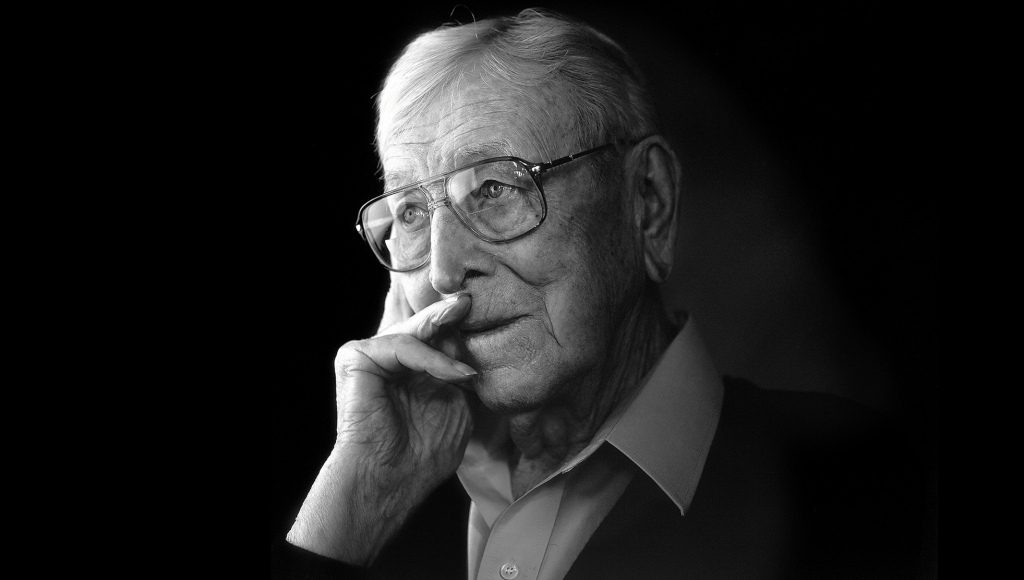
John WoodenIt’s a morning I will never forget. In June 1974, with the resident students at Bellarmine College Prep having moved out of the dormitory for the summer, I had the responsibility of being the live-in liaison between the school and outside groups that would be renting Bellarmine facilities during the summer months. The first group arrived in mid-June. It was the Wooden-Sharman Basketball Camp.
Coach John Wooden was the legendary head coach of the 10-time NCAA champion UCLA Bruins. Coach Bill Sharman was the head coach of the Los Angeles Lakers. More than fifty young boys participated in the weeklong camp. Players and coaches lived in the dormitory, ate their meals in the Liccardo Center, and worked out in the old gymnasium.
One morning that week, I walked over to the Liccardo Center to get my breakfast. As I did each day, I entered the facility through the side door, through which one could access the Jesuit dining room or the kitchen. I’d walk through the kitchen each morning and tell Tom, the head chef, what I wanted for breakfast. He would make cook-to-order meals for me. On this particular morning, after getting my plate of food, I passed through the doors to the main dining room. Normally, I would be the only person there at that early hour. On this day, however, there was one other person sitting at a table already enjoying his breakfast. It was Coach Wooden.
I approached him and asked if I might join him at the table. He welcomed me warmly. I knew the coach was famously successful at UCLA, but, at that time, I didn’t realize that he was much more than just a basketball coach. He explained to me that, first and foremost, he was a teacher. He had taught high school English for a number of years prior to accepting the coaching role at UCLA. In his years on the Westwood, California campus, while he was well-known as the head basketball coach, Wooden still considered himself to be a teacher. Yes, he coached his players on the fundamentals of quality basketball, but he also taught them important life lessons along the way. To be a good person was more important to Coach Wooden than to be a successful basketball player. His lessons have made a significant impact on the young men he coached.
One of my favorite Wooden quotes touches on the topic of gratitude. “If we magnified blessings as much as we magnify disappointments, we would all be much happier.” I concur wholeheartedly.
After a lengthy conversation about basketball, teaching, and life in general, Coach invited me to stop by his room in the dormitory. He had two things he wanted to share with me. The first was a three-page handout on the proper mechanics of shooting a free-throw. In my years of coaching (and parenting), I shared this information with my players (and sons). The information provided in Wooden’s handout enabled these athletes to develop effective shooting skills which served them well during their playing days.
The second item he shared with me was a copy of his Pyramid of Success. If you are not familiar with this document, I urge you to check it out through this link.
It’s been fifty years since my brief encounter with Coach Wooden, yet that experience continues to be one of the most treasured memories of my life. Even as we spoke, I was aware that I was in the presence of greatness. I am so grateful for his positive influence in my life.
-
A Sacred Space

“Your sacred space is
where you can find yourself
again and again.”
Joseph CampbellAfter graduating from elementary school in June 1968, I attended Saint Ignatius High School at Turk & Stanyan Streets in San Francisco. In the fall of 1969, which was the beginning of my sophomore year, the school moved from the Stanyan Street campus into a new facility on 37th Avenue in The Sunset District. With the change in location came another significant change. The official name of the school became Saint Ignatius College Preparatory.
In that first year on 37th Avenue, while classes were held in the new H-shaped, three-story classroom building, construction continued on other parts of the campus. McGucken Hall, which would be the residence for the Jesuit community, the Carlin Commons, a large multi-purpose room used for lunch, assemblies, and school dances, and the Orradre Chapel were still under construction. Those structures were all completed by the beginning of the 1970-71 academic year.
At the start of my junior year, I got involved in a group which provided liturgical music for school liturgies, including a weekly Sunday night Mass in the new chapel. The Sunday night liturgies were amazing. Each week, the chapel was filled to capacity with students from S.I. and a good number of students from the local girls’ high schools. There were only a few chairs set up in the back of the chapel. To accommodate the number of attendees, students sat on the carpeted floor for these Masses. The music was contemporary. The homilies by Jesuit priests were thought-provoking, challenging, and interesting. And after Mass each week, a gathering was held in the Carlin Commons, just a few steps from the chapel, at which the high school youth could enjoy cookies, beverages, and good conversation. It was truly an experience of a Eucharistic community.
Difficult as it may seem to comprehend, the “new S.I.” that opened on 37th Avenue in 1969 is already more than fifty years old. Times have changed. Needs have changed. With only a couple of Jesuits still working at the school, there is no need for the large Jesuit community building. McGucken Hall, because it was constructed as a residential building, does not meet the required codes to be used for any other purpose. Also, since S.I. became a coeducational institution 35 years ago, the number of students on campus has increased. The need for additional learning space, configured in ways more compatible with current educational practices, requires significant changes to the campus.
In the coming months, McGucken Hall, the Carlin Commons, and Orradre Chapel will be demolished. In that space at the north end of the S.I. campus, a new state-of-the-art learning center will be built. The new structure will include a new chapel.
This past Saturday evening, I had the honor of attending the final Mass to be celebrated in Orradre Chapel. It was a bittersweet event. I couldn’t help but reflect back on the Sunday night liturgies I attended in the early 70s. My mind was filled with images and names of those who were regular participants in those celebrations, as well as the Jesuit priests who presided at them. For me, and for so many others, Orradre Chapel has been a sacred space. It was, without a doubt, a place where I found God… and myself.
• Check out the plans for the new learning center:
https://www.siprep.org/giving/what-to-support/building-our-future-forward?src=bug -
On Turning 70

1954 Chevy Truck
“70 might be the new 40,
but 9:00 p.m. is the
new midnight.”I received a number of birthday messages today. I appreciate all those who expressed their condolences on my turning seventy. One email in particular is worth a share. It began with a welcome to The Wonder Years, as in:
• I wonder where I parked my car?
• I wonder where I left my phone?
• I wonder where I left my glasses?
• I wonder where I left my keys?
• I wonder why I came into this room?This was followed by The Senility Prayer:
“Grant me the senility
to forget the people I never liked,
the good fortune to
run into the ones I do,
and the eyesight
to tell the difference.”Yes, as of 8:16 a.m. this morning, I am officially 70 years old. While there’s something about turning 70 which I find quite disconcerting, I’m well aware that the proper response to celebrating this milestone birthday is gratitude. No small number of my former classmates from elementary school, high school, and college were not given this opportunity. This is also true of a number of relatives and former colleagues.
I had a relaxing day today. I walked 13,000+ steps. I stopped for a salad at Jack’s Restaurant on Saratoga Avenue. From there I walked to Paris Baguette Bakery for a slice of birthday cake. At 5:00, we had a family barbecue at our home, followed by Oreo cookie ice cream cake for dessert. I could not have asked for a better day.
I still find the number 70 to be a bit bothersome, but I’m confident that, in time, I’ll get used to it. I’m realizing that it’s important to accept the aging process with gratitude, humility, and a bit of humor. There seems to be a fine line between “old” and “vintage.”
Comedian/actor George Burns, who, having lived to the ripe old age of 100, might be considered an expert on aging. He maintained a sense of humor about getting old. He said, “You know you’re getting old when you stoop to tie your shoelaces and wonder what else you could do while you’re down there.”
I can relate!
-
Subscribe
Subscribed
Have a WordPress.com account? Log in now.

