-

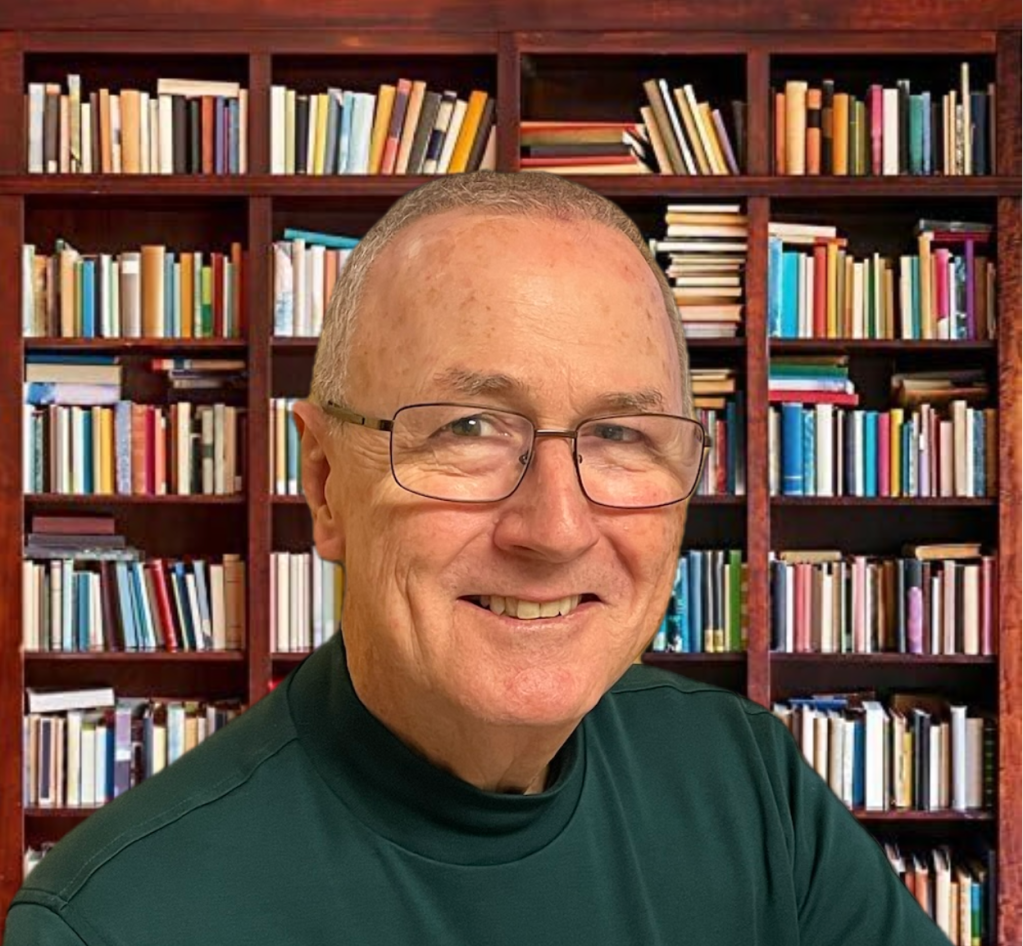
My name is Kevin Carroll. I was born and raised in San Francisco, California, where I attended Saint Ignatius College Preparatory. I am a graduate of both Santa Clara University and the University of San Francisco. Following a 40-year career in teaching and pastoral ministry, I launched a new career as a writer and speaker.
I live in San José, California. My wife, Kathy, and I have three adult sons and five precious grandchildren. I have much for which to be grateful.
I can be reached via email at kmc43sjc@gmail.com
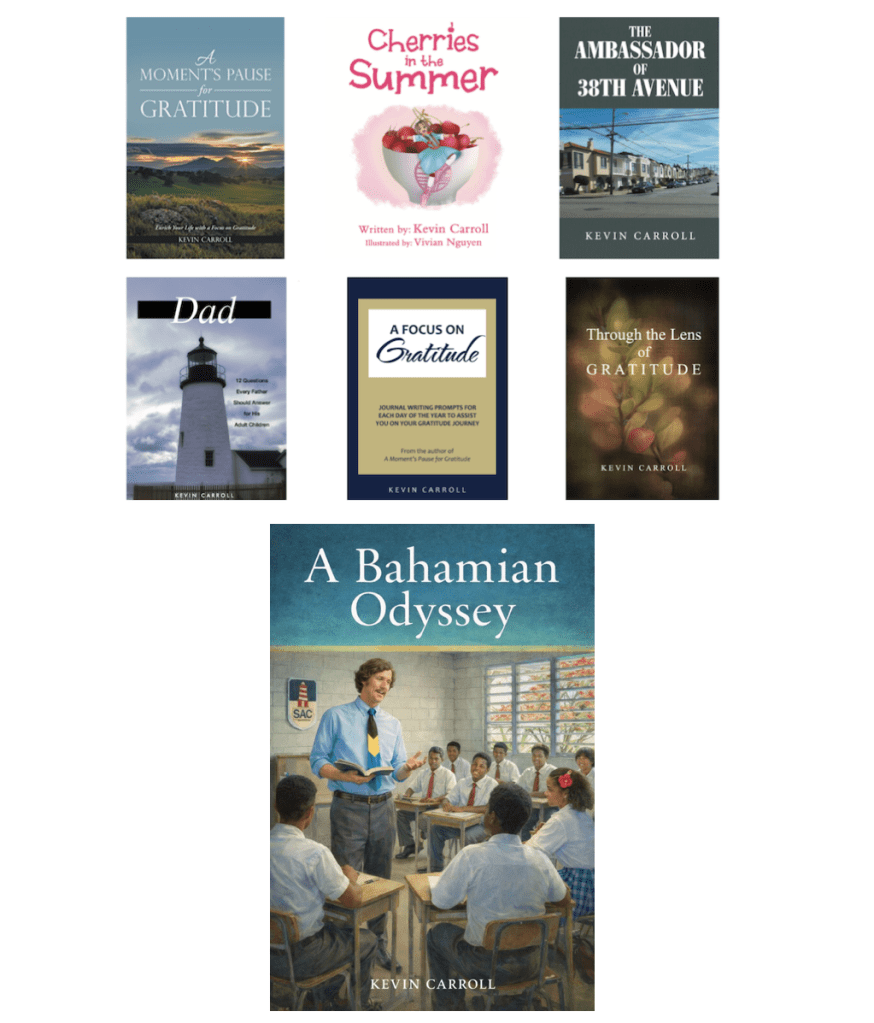
My books are available for purchase online from Amazon. I also have copies of some of these titles at my home for those who would like to buy them directly from me.
A Moment’s Pause for Gratitude (2017)
Cherries in the Summer (2021)
The Ambassador of 38th Avenue (2022)
Dad: 12 Questions… (2023)
A Focus on Gratitude (2024)
Through the Lens of Gratitude (2024)
A Bahamian Odyssey (2026)
-

- October 2026
- September 2026
- August 2026
- July 2026
- June 2026
- May 2026
- April 2026
- March 2026
- February 2026
- January 2026
- December 2025
- November 2025
- October 2025
- September 2025
- August 2025
- July 2025
- June 2025
- May 2025
- April 2025
- March 2025
- February 2025
- January 2025
- December 2024
- November 2024
- October 2024
- September 2024
- August 2024
- July 2024
- June 2024
- May 2024
- April 2024
- March 2024
- February 2024
- January 2024
- December 2023
- November 2023
- October 2023
- September 2023
- August 2023
- July 2023
- June 2023
- May 2023
- April 2023
- March 2023
- February 2023
- January 2023
- December 2022
- November 2022
-
Pumpkin Spice
“The heat of autumn
is different from
the heat of summer.
One ripens apples,
the other turns them
to cider.”
Jane HirshfieldWhen I think of the season of autumn, I think of words like brisk, cozy, chilly, and colorful. I also find myself immersed in a pumpkin-spice culture: pumpkin-spice latte, pumpkin-spice breads and muffins, pumpkin-spice milkshakes, pumpkin-spice Oreos and protein bars, pumpkin-spice shoe laces,… well, that might be going a bit too far. Generally speaking, however, it’s a wonderful time of year. And although the inevitable cooler days of autumn will eventually arrive, it’s not uncommon for us to experience a few warmer-than-usual days in this season of transition. Such will be the case in this upcoming week.
Predicted temperatures for the next four days in the West-San José/Campbell neighborhoods are as follows: Monday – 97º, Tuesday – 104º, Wednesday – 102º, and Thursday – 97º. A more seasonable 85º is predicted for Friday. While this might prompt some to point out the reality of global warming, late-summer and early-autumn heat waves are nothing new. In the greater San Francisco Bay Area, the term “Indian Summer” has been used for decades to justify the hotter-than-usual days of September and October. By the end of October, I expect that we’ll be back to seasonal norms here in Silicon Valley.
I have to admit that I enjoy the warmer weather, knowing that it’s temporary and that it will soon be replaced by those brisk, cozy, and chilly days of November we’ve come to expect. Tuesday’s high of 104º is a bit daunting. I’m hoping to escape the heat and enjoy another day of walking in San Francisco, where the high will be only 85º, which, for San Franciscans, is roasting or hella-hot, depending upon your generation. And if I happen to pass a Jamba Juice shop along the way, I’ll probably stop-in to pick up a pumpkin-spice smoothie.
-
The Guru of Gratitude
Brother David Steindl-Rast has made a name for himself as the “Guru of Gratitude.” His insights into what it means to be happy in life, and his claim that gratitude is the key to happiness, has inspired thousands of women and men around the world.
I invite you to take a break — a 24-minute break — and listen to the words of this simple, grateful, enlightened man:
-
The Question

“Here is the test
to find whether your
mission on Earth
is finished:
if you’re alive,
it isn’t.”
Richard Bach“Why am I here?” Four simple words. One fundamental question.
When I was a child, the question was posed as a cute invitation to dream about my future. “What do you want to be when you grow up?” There were no right or wrong answers to this question.
During my adolescence, the question took on a bit more meaning, yet it was still a harmless, perhaps somewhat challenging query inviting me to identify a potential direction and purpose for my life.
In my young adult years, the question took on a bit more urgency. I was old enough to give serious consideration to what I wanted to do with my life, as well as to what, if anything, I was being called to do. It was more important at this point that decisions I made regarding my education, my values, and my lifestyle be consistent with my life goals. No longer was I being asked about my dreams for the future. Those dreams, by this point, were expected to be reflected in a tangible plan of action with an identifiable sense of direction.
When I got married, my answer to the “Why am I here?” question was still not fully formed. At this point, it was essential that I consider the needs, desires, and well-being of others — specifically my wife and our children. No longer did I have the luxury of thinking only of myself. I was part of a team now.
Throughout my professional career, I often contemplated the question “Why am I here?” I spent 31 years of my life employed at St. Lawrence parish and high school in Santa Clara, California. I felt called to be there. Literally. In the spring of 1984, I received an unsolicited phone call from an acquaintance who worked at the parish elementary school. He told me of a position the pastor was looking to fill which required a diversity of skills, all of which I possessed. I initially declined the offer, but when urged to do so, I agreed to attend an interview with the pastor. Much to my surprise, I walked out of that meeting having accepted the job. It proved to be providential, as this is where I met my wife.
In 1994, after ten years of working primarily for the parish, with limited responsibilities in the high school, I again received an unexpected phone call. This time, the principal of the high school invited me to accept a full-time position in the school. The timing of his invitation was opportune, as leadership at the parish level had changed and the work environment had become increasingly distressing.
During my first six years working in the high school, I had a strong sense of why I was there. The school was providing a unique learning environment for some of the most vulnerable Catholic students in the Santa Clara Valley. I had a sense of purpose. I experienced a strong sense of community among the faculty, students, and parents. I knew I was making a positive difference in the school and in the lives of my students. Unfortunately, in the spring of 2001, the pastor of the parish overstepped his bounds and needlessly replaced the principal, the man who, more than anyone else, was responsible for the emerging success of the school.
I continued to work in the high school for fifteen more years, during which time I witnessed a slow, but steady deterioration of the treasured institution it had become. During those years, there was a consistent decline in enrollment, a loss of the sense of the identity and mission of the school, and a sharp downturn in morale among faculty, students, and parents. By 2015, I’d had enough. At that point in my career, I was unable to come up with an answer to the “Why am I here?” question. Out of concern for my own physical and mental well-being, I submitted my resignation effective June 2015.
In the nine years since my retirement, I regained a sense of purpose in life. I learned to embrace the reality that gratitude makes a difference. For this reason, I devoted much of my time during this period to publishing six books and speaking on the topic of gratefulness.
I turned 70 in June. With both my teaching and writing careers behind me, I am again confronted with the “Why am I here?” question. I reflect on this question every day. My three sons are self-sufficient adults. They, along with my wife and five grandchildren, continue to enrich my life. Still, I can’t help but ponder the reason for my existence at this point. With inspiration from a few books I’ve read and, recently, from a number of podcasts I’ve listened to, I am able to answer the question yet again. I am here today to be kind.
Opportunities to be kind to others present themselves every day — multiple times each day. It may be just a smile, an acknowledgment that the other exists, or it might involve a lengthy conversation with someone who just needs someone to listen attentively to them. It may be helping someone carry their bags of groceries or preparing a cup of hot coffee for a construction worker doing a small job in my home. It may be making time to have breakfast or lunch with someone who is lonely or feels isolated in the world today, or it might involve expressing my condolences to a friend who has recently lost a parent or spouse.
Every day there are countless opportunities to simply be kind to others. In 2024, this is my job. This is my calling. This is my response to that fundamental question: “Why am I here?”
-
Island Life

“The beauty of memories
lies not in their clarity,
but in the warmth
they bring to our hearts.”
Author UnknownOn Saturday, August 24, 1974, my friend and high school classmate, Dan Pasini, and I boarded a 10:00 p.m. flight from San Francisco to Miami. From there, we took a connecting flight to the Bahamas. We arrived at Nassau International Airport around mid-day on Sunday, August 25th. That was fifty years ago today. After going through immigration and customs, we were greeted warmly by our host, Father Elias Achatz, a 63-year-old Benedictine priest who served as Prior of the St. Augustine’s Monastery community. Dan and I had met Father Elias at a social gathering in Kingston, Jamaica in July 1971. Much to our surprise, in April 1974, he invited us to teach at St. Augustine’s College in Nassau during the 1974-75 academic year. We accepted his offer.
At that time, Dan and I were completing our second year of college. I’m fairly certain that the term “gap year” had not yet emerged, but that’s exactly what the opportunity turned out to be for us. There we were, two 20-year-olds, embarking on the experience of a lifetime.
St. Augustine’s College is a Catholic, 7th through 12th grade comprehensive high school. Dan and I were both given full teaching schedules in the Religious Studies Department. In addition to our academic responsibilities, we took on additional roles as coaches of various sports, and I was asked to serve in a quasi-administrative position overseeing the academic and social involvement of one-quarter of the SAC student body.
The experience at St. Augustine’s was transformative for me, and I know it was for Dan, too. One cannot help but be changed when given the opportunity to live in a different country for a year and to immerse oneself in a new culture.
The memories of that year are still vivid for me: SAC students in uniform transitioning from one class to the next; getting acclimated to the heat and humidity of September days in classrooms with no air conditioning; preparing for the arrival of Hurricane Fifi, which fortuitously shifted course and passed well south of the Bahamas before crossing the Gulf of Mexico and devastating the small country of Belize; and having seasoned Bahamian veteran educators such as Mr. Lou Adderley and Mr. Winston Carter to mentor us throughout the year.
Dan and I also enjoyed the camaraderie of a number of other young Bahamian and expatriate teachers with whom we enjoyed an active social life throughout the year. We joined them for many Friday evening happy hours at The Bridge Inn, followed by music and dancing to the tunes of Kenny & the Beach Boys at The Rum Keg, a small night club located on the lower level of the Nassau Beach Hotel.
Of course, we took advantage of some of the beautiful Bahamian beaches, too. Our favorites were Cabbage Beach on Paradise Island and Cable Beach on West Bay Street. Occasionally, Dan and I would drive to the Palmdale district after dinner to get milkshakes at Dipper Dan’s before driving out to the end of the Nassau wharf where the large cruise ships docked. The unobstructed view from Nassau harbor of the sun setting on the horizon was awe-inspiring. On other evenings, we would hang out at the casino on Paradise Island watching the tourists trying to beat the house in craps, blackjack, and roulette. (Locals, and those of us with Bahamian work permits, were prohibited from gambling in the casino.) And it was not uncommon for us to drive out to Howard Johnson’s restaurant, in the Nassau Beach Hotel, for a late-night snack.
The friendships made, the experience gained, and the memories associated with Nassau and St. Augustine’s College are as vivid and valued today as they were when I first experienced them fifty years ago. I will be forever grateful for this amazing, undeserved opportunity.
-
Something New

“There is no trouble
so great or grave
that cannot be diminished
by a nice cup of tea.”
Bernard Paul HerouxI grew up in a tea family. The rich smell of coffee brewing in the morning permeated our home only when my paternal grandmother stayed with us after a number of hospital visits. For this reason, perhaps, while I find the taste of coffee repugnant, the aroma calls up wonderful memories from my childhood.
Tea was the drink of choice of my parents. I can easily recall the day I attempted to surprise my mother by making tea for her. I was in second grade. I’d seen her make tea many times, so I did my best to replicate her actions. I filled the stainless steel teapot with water and put it on the stove. When the teapot began to whistle, I turned off the gas and poured the contents of the teapot into Mom’s favorite cup. I was surprised to see that it was still clear. It wasn’t tea at all. It was just a cup of hot water. That’s when Mom introduced me to the magic of Lipton tea bags!
Throughout most of my life, my go-to hot beverage of choice was hot chocolate. It’s only in recent years that I’ve transitioned to tea. I began with Lipton, of course, but as time went on, I was introduced to flavored tea by Bigelow (Lemon Lift, Earl Grey, English TeaTime, Orange & Spice, and Perfect Peach), and Celestial Seasonings (Peppermint, Country Peach, Cinnamon Apple SpIce, and Black Cherry Berry.)
In my teaching years, I relied on Throat Coat tea to get me through the first week of school each year. After a summer of casual conversations, each new academic year required that I project my voice to the back of a classroom for five periods per day. The annual strain on the vocal cords was soothed by the medicinal tea.
In the fall of 2017, after publishing my first book, A Moment’s Pause for Gratitude, I was invited to participate in a video interview on the topic of gratitude at Santa Clara University’s Markkula Center for Applied Ethics. The morning of the interview, I woke up with a persistent cough. On my way to the interview, I stopped at Starbucks and asked if they had anything which might soothe a sore throat and minimize my cough. The barista immediately responded, “Yes. Sick tea.” On the Starbucks menu, it’s actually called Honey Citrus Mint Tea, but whenever I order sick tea, they know exactly what I want. (In Seattle, they call it Medicine Ball!)
Yesterday, in a conversation with my dental hygienist after a routine cleaning, we shared our mutual enjoyment of the Orchard Valley Coffee Shop in downtown Campbell. Daniela asked if I had ever tried their Masala Chai Latte. I had to admit that I’d never had any type of latte. I thought anything called latte was a coffee drink. Masala Chai Latte is black tea infused with fragrant spices such as cinnamon, clove, ginger, cardamom, and black pepper. The beverage, which originated in India, has gained popularity throughout South Asia and, more recently, in the United States. In addition to its unique flavors, Masala Chai Latte is said to have numerous health benefits, including reducing one’s stress and anxiety levels.
I enjoyed my first Masala Chai Latte this morning. The fragrance was delightful and the taste was pleasant, with a bit of a bite to it due to the spices. It paired nicely with the cinnamon almond croissant I ordered.
I may be getting older, but life continues to surprise me with new experiences.
-
A Mother’s Love
“When you look at your mother,
you are looking at the purest
love you will ever know.”
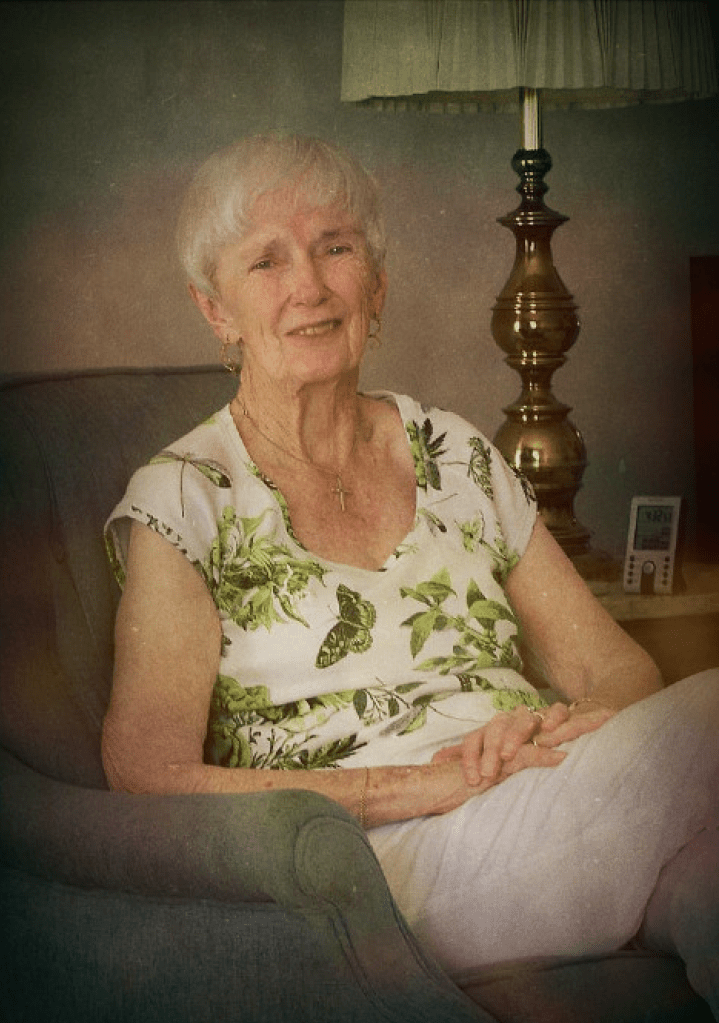
Mitch AlbomMy mother died two years ago today. Her death was not unexpected. Mom, who was less than a month shy of her 93rd birthday, passed away peacefully in her home at the Villa Siena Retirement Community in Mountain View, California. She had lived there for just over ten years.
The death of a parent has a particular sting to it. My father’s unexpected death in July 2008 was like a punch to the gut. I didn’t see it coming. The intense grief I experienced in the months following his death was more painful than I would have imagined. I felt as though my life had been derailed, and it took quite a while for me to get back on track. My experience of Mom’s death was different.
While there was still a sense of tremendous loss, my response to Mom’s passing was, and continues to be, intense gratitude. She was the emotional switchboard of our family. If I wanted to know how my Dad was doing, I most often found out from Mom. With my three siblings and I immersed in our own lives, even though we communicated regularly, it was not unusual for me to learn about the news of their lives from Mom.
People often refer to the cycle of life. More so than anywhere else, I experienced this reality in my interactions with my mother. In my childhood, Mom held my hand. Mom helped me to do the things I was not yet capable of doing for myself. Mom drove me to the places I needed to go until such time as I was able to do so myself. And Mom loved me — unconditionally.
By the time Mom reached the age of 90, the cycle of life had come full-circle. There was an increasing number of things Mom was no longer able to do for herself. I held her hand. I helped her with simple tasks which had become challenging for her. I drove Mom to the places she needed to go, mostly to medical appointments. Through all this, there was a tangible sense of mutual love and respect.
I think of Mom pretty much every day, not with grief, but with gratitude. The way she lived her life continues to inspire me, and to provide me with a valuable blueprint for how to live my life to the fullest. Mom taught me the importance of self-care, compassion for others, honesty, kindness, and gratefulness. She taught me to be confident in my own abilities and to use those abilities to serve others. She taught me how to be assertive without being aggressive.
Mom taught me how to be financially responsible, as well as the importance of never giving up on myself. She taught me how to live a life of integrity, and how to love unconditionally (a lesson I’m still struggling to embrace). And Mom taught me not only to be grateful for the many blessings I have received in my life, but to express my gratitude to others appropriately and often.
As the opening words of the traditional Irish ballad claim, “A mother’s love is a blessing.”
It most certainly is.
-
Unplug

“It takes courage
to say yes to rest and play
in a culture where exhaustion
is seen as a status symbol.”
Brené BrownIn his book, Live Life from the Heart, Mark Black writes about the importance of relaxation. He cites that rather than being an indicator of laziness, relaxation can actually be both beneficial and productive. When we take care of ourselves, we are better able to improve our overall health and well-being, while enjoying an increased sense of balance and focus in our lives.
I’ve said this before, and I’ll say it again here. Self-care is not selfish. Just as the batteries in our tech devices need to be recharged, so do we. Given the demands of everyday living, however, finding time for re-creation, time set aside to nurture our soul, can be a challenging task. There’s so much we need to do, right?
Stress management expert Elizabeth Scott echoes Black’s concerns in her own book, 8 Keys to Stress Management. She urges readers to let go of any feelings of guilt associated with self-care and to embrace the practice as an essential component of a healthy life.
There’s a wonderful concept which has the potential to change and improve one’s life. Working for the Catholic Church for more than forty years, I know of many individuals who have taken sabbaticals — extended periods of paid leave from their usual work. The large majority of those I know who have been given this opportunity are members of the clergy. The purpose of a sabbatical is to offer a period of rest and relaxation, and to provide an opportunity for the professional to work on a dedicated project, acquire new skills, or participate in some type of professional development. Sadly, such opportunities are rarely, if ever, provided to dedicated lay women and men who tirelessly serve the Church in various capacities.
Despite the biblical root of a sabbatical, the practice is not reserved for the exclusive use of ordained men working in ministry in the Church. A small number of people I know, who live here in Silicon Valley and work at some of the well-known tech companies, have been offered such an opportunity. A number of these workers have been given the option to take six months off with full pay, or one full year off with half-pay. This practice is certainly consistent with the words of local author, Anne Lamott, who wrote, “Almost everything will work again if you unplug it for a few minutes, including you.” Powerful words from a wise woman.
Even in my retirement, I have a strong desire to set aside some time for the purpose of enjoying a period of intentional rest and relaxation, and to devote a fair amount of time and energy to writing in an environment void of the distractions of everyday life. How long of a sabbatical would I like? I’ve given this considerable thought in recent years. One month would be ideal. Where would such a sabbatical take place? That’s the big question, one I hope to resolve before the end of 2024.
-
Dad’s Last Ride

“They say that
time heals all wounds,
but we never live
long enough to
test that theory.”
José SaramagoSixteen years ago tonight, I gathered with my mother and siblings at San Francisco General Hospital to say goodbye to my father. Earlier that evening, Dad had taken a fall down the back steps of our family home. He sustained major head trauma and was officially pronounced dead a little after 11:00 p.m. It was July 31, 2008. Dad was 82 years old.
In the days, months, and years following Dad’s untimely and unexpected death, I struggled to cope with the loss. Even though I was well-aware that, at some point, Dad would die, I was totally blindsided when it actually happened. The emotional pain I experienced was brutal at first, but over time, the level of grief would dissipate and I would feel better. Then, without warning, something would trigger the memory of his death and I would find myself overwhelmed with grief yet again. This pattern continued for several years.
Today, perhaps for the first time since Dad’s death, I did not experience grief. I was certainly aware of the date and its significance, but that awareness did not trigger a renewed sense of grief. Instead, I was able to think of Dad today with gratitude.
I took time to reflect on the many sacrifices he made throughout his lifetime to provide a good life for our family. I thought about how proud I always was to tell people that my father was a San Francisco firefighter. Dad’s diligent preparation for promotional examinations resulted in his appointment as a lieutenant in 1967, then captain in 1968. After several years working at Truck 8 on Bluxome Street, Dad was promoted to battalion chief. My pride for his professional accomplishments is as strong today as it was during his lifetime.
It was a long drive back to my home in San José that night sixteen years ago. I cried. A lot. The most difficult challenge, however, awaited me when I arrived home. Despite the late hour, Kathy and my three sons were awake, awaiting my return. I don’t know that I’ve had a more painful experience than sitting on the edge of one of the beds and telling the boys that their Grandpa had died.
It is now 11:45 p.m. As I head off to bed tonight, I am able to embrace the memory of Dad with gratitude, rather than grief. It took me a long while, but I’ve finally accepted the death of my parents (Mom passed away two years ago) as an inevitable part of the cycle of life. What a blessing it was to have them in my life for so many years.
-
Eight Teachers
“In the middle of every difficulty
lies opportunity.”
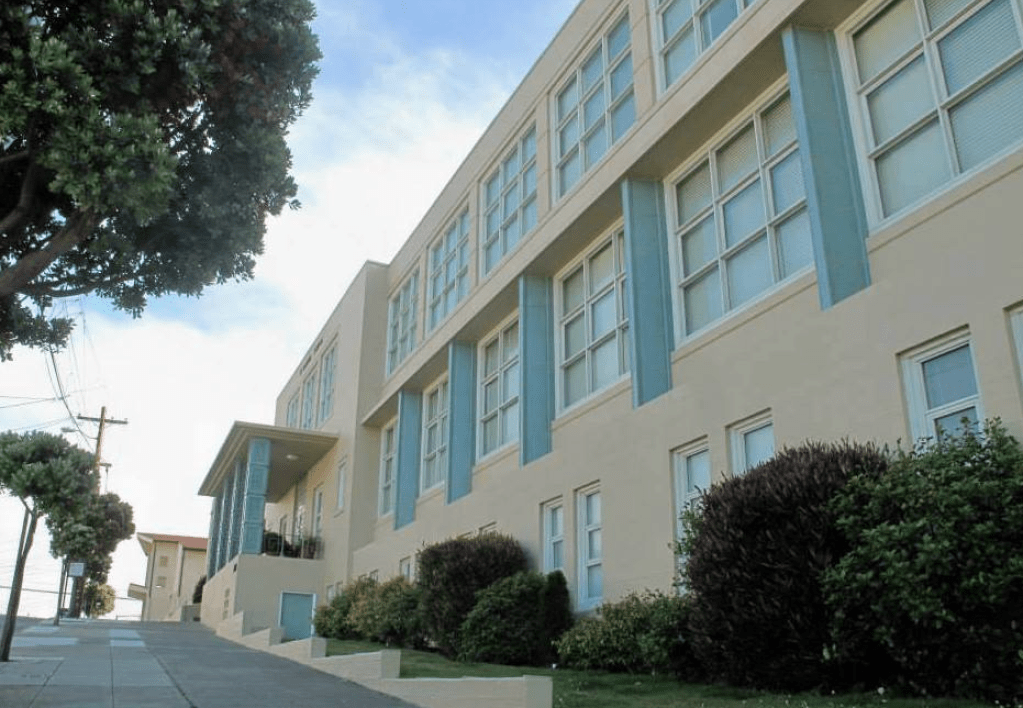
Albert EinsteinI began my elementary education as a first grader at Saint Gabriel School in San Francisco in September 1960. I had attended kindergarten at our local public school, as Saint Gabriel did not offer a kindergarten program at that time. My brother, Tom was in 5th grade that year, and my sister, Cathy, was in 4th. They, like my Saint Gabriel classmates, all have their own memories of their elementary school years. My memories are mine alone. I accept full responsibility for them. When I began to write this piece, I decided to write about the first memory that came to mind for each grade level.
1st Grade
My only memory of 1st grade is being put in the corner after making a hat out of my art paper. One of the girls in my class had made a hat out of her paper and she got a few good laughs. When I did it, hoping for a similar reaction from my classmates, Sister James Mary made me sit in the corner of the classroom facing the walls for the remainder of the day.
2nd Grade
The fear of God was put into me by Sister Mary Sharon that if I did not successfully memorize three prayers — the Act of Faith, the Act of Hope, and the Act of Love — I would not be allowed to receive my First Communion. I was sure that I was going to be the only kid in my class to be denied this sacrament. In the end, it didn’t matter. Although I had not successfully memorized the prayers, I was still allowed to participate in the special event.
3rd Grade
Sister Mary Roberta was older than the other teachers in the school. It wasn’t until many years later that I learned just how much older. She was born in Santa Clara, CA in 1889! She was the best teacher I had at Saint Gabriel School. When I was struggling with math, specifically the process of “borrowing” in subtraction, I was invited (required?) to meet with Sister in one of the parlors inside the entry of the convent after school for several days. There, she patiently and compassionately tutored me one-on-one until I mastered the concept.
4th Grade
My most vivid memory of 4th grade is one shared by many, I would think. On November 22, 1963, President John F. Kennedy was assassinated in Dallas, Texas. I recall the details of that day vividly even today. Word of the shooting started going around the school cafeteria while I was eating lunch, but some claimed it was just a rumor. When the boys in our class arrived at South Sunset Playground for our lunch recreation period, the two adult supervisors, Mr. Grove Mohr and Mr. Don Ybaretta, were sitting solemnly on the grass at the corner of 40th & Vicente listening to the news on a transistor radio. Tears rolled down Mr. Mohr’s face. It was then that I realized that the president had actually been shot and killed.
5th Grade
The unexpected death of my best friend, Mike Celeski, is the most vivid memory I have of 5th grade. I was sitting at the kitchen table in our home when my mother told me of Mike’s death. My parents, along with Sister Mary Roberta, took me to the Carew & English Funeral Home on Masonic Avenue after school a few days later. Mike’s body was lying in a casket in the small chapel where the wake would be held later that evening. Sister Mary Roberta and I walked up to the casket and knelt down on the kneeler. I had been to enough wakes to know that I was supposed to say a prayer, but I don’t think I did.
6th Grade
6th grade was my first experience of feeling absolutely certain that a teacher strongly disliked me. I have very few memories of 6th grade. I cannot help but think about the well-known quote by Maya Angelou, who said, “People will forget what you said. People will forget what you did. But people will never forget how you made them feel.” That’s the truth.
7th Grade
Back in the ‘60s, we didn’t use the terms “junior high” or “middle school” to refer to students in grades seven and eight in catholic schools. We were simply called seventh or eighth graders. The now well-known characteristics of the middle school experience, however, were just as much of a reality in the catholic schools. Social cruelty, bullying, exclusion, and cliques were part of the everyday reality at Saint Gabriel School for many students. Sadly, in 7th grade, my teacher was an active participant in these things. She catered to the popular kids and turned a blind eye to the social cruelty taking place in the classroom and on the school yard. Just as I had experienced in 6th grade, I have no recollection whatsoever of what I learned in 7th grade, but I will always remember how I felt.
8th Grade
Sister Mary Brigid was my 8th grade teacher. She was new to Saint Gabriel School, having taught in a catholic school in Imperial Beach, California the previous year. She was young. She was kind. She was compassionate. She seemed to have a good understanding of the social dynamics going on among the students and did her best to neutralize the situation. Sister Mary Brigid believed in me. She encouraged me when I didn’t believe in myself. She empowered me by giving me tasks to do in the classroom. She restored my faith in humanity.
Despite the challenges, my years at Saint Gabriel School had tremendous value. I learned to write well and I developed excellent organization skills. I wish I had read more books. I also wish I had felt accepted enough by my peers to participate in school sports after sixth grade. I made a few good friends through the years, though it took me many years (50 to be exact) to recognize this.
The life lessons I learned at Saint Gabriel School were beneficial to me during my teaching career. I had a clear understanding of the dynamics of social cruelty, and, as an educator, I did everything possible to squelch it. I had compassion for students who struggled, both academically and socially. I was also uniquely qualified to offer a vision of hope for many of my students, and their parents, by sharing details of my own social/educational journey. I will always be grateful for the experiences that contributed to making me the person I became as an adult.
-
Buffering…

We’ve all encountered the icon — the spinning wheel notifying us that what we’d like to be doing on our computer cannot be done quite yet. In a world where we’ve come to expect technology to be instantly available to us, this can be a frustrating experience.
According to PC Magazine, “In streaming audio or video from the Internet, buffering refers to downloading a certain amount of data before starting to play the music or movie.” It is an all-too-common experience.
Since I began blogging in December 2006, it has been relatively easy for me to come up with ideas for my writing. Such has not been the case, however, in the past few months. I certainly have the time to write. I always have the desire to write. But I don’t want to write just for the sake of writing. It’s important to me that my words have meaning for myself and for those who take the time to read what I’ve written.
I still set aside time to write on most days, and I continue to collect quotes, images, and ideas to share. When I’m out walking each day, I’m constantly reflecting on possible topics for my writing. Despite these things, however, the motivation to actually sit down and put the words on paper has been conspicuously absent. I’ve come to the realization that, perhaps, what’s happening is that my brain is buffering.
In her book, Buffering: Unshared Tales of a Life Fully Loaded, author Hannah Hart writes, “Buffering is that time you spend waiting for the pixels of your life to crystallize into a clearer picture; it’s a time of reflection, a time of pause, a time for regaining your composure or readjusting your course. We all have a limited amount of mental and emotional bandwidth, and some of life’s episodes take a long time to fully load.”
That’s it! That’s exactly what’s been happening.
I’m not losing it. It’s definitely not writer’s block. I’m simply waiting patiently for those pixels to crystallize, and when they do, I fully expect to get back into the flow of sharing my thoughts, observations, and feelings, with both insight and clarity, on a more regular basis.
-
Subscribe
Subscribed
Have a WordPress.com account? Log in now.

