-

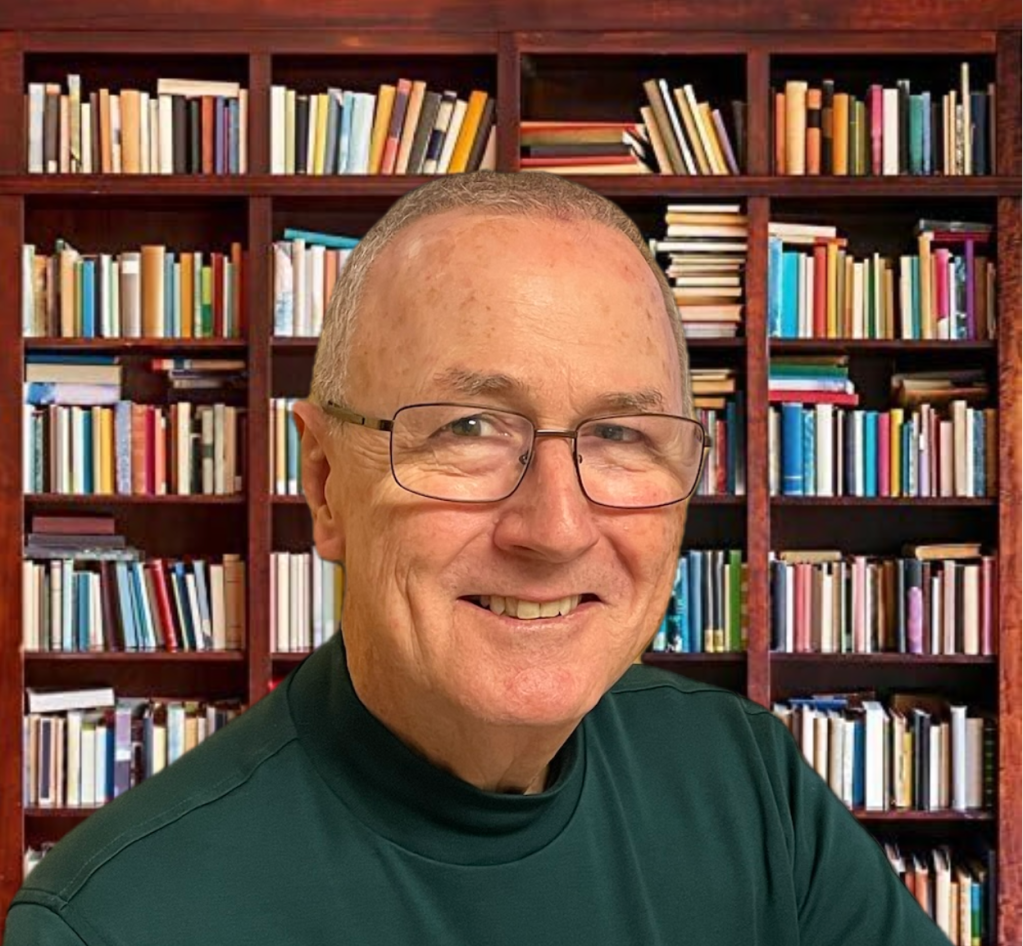
My name is Kevin Carroll. I was born and raised in San Francisco, California, where I attended Saint Ignatius College Preparatory. I am a graduate of both Santa Clara University and the University of San Francisco. Following a 40-year career in teaching and pastoral ministry, I launched a new career as a writer and speaker.
I live in San José, California. My wife, Kathy, and I have three adult sons and five precious grandchildren. I have much for which to be grateful.
I can be reached via email at kmc43sjc@gmail.com
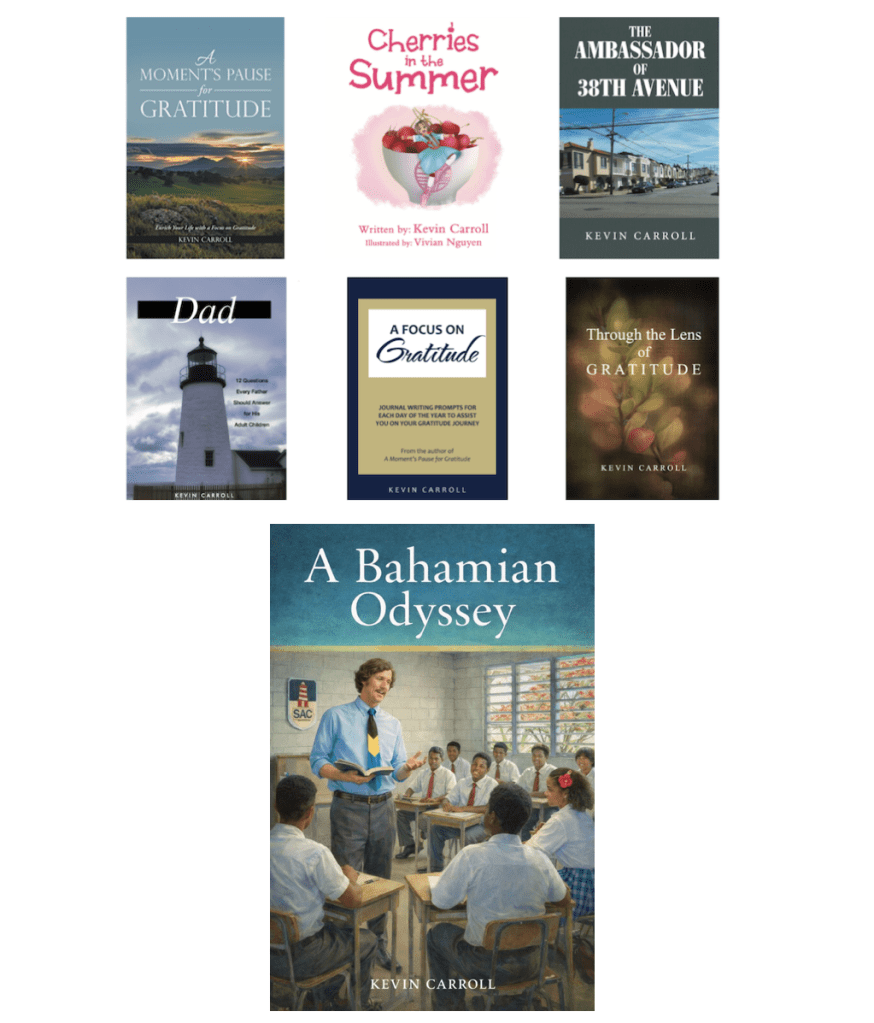
My books are available for purchase online from Amazon. I also have copies of some of these titles at my home for those who would like to buy them directly from me.
A Moment’s Pause for Gratitude (2017)
Cherries in the Summer (2021)
The Ambassador of 38th Avenue (2022)
Dad: 12 Questions… (2023)
A Focus on Gratitude (2024)
Through the Lens of Gratitude (2024)
A Bahamian Odyssey (2026)
-
- October 2026
- September 2026
- August 2026
- July 2026
- June 2026
- May 2026
- April 2026
- March 2026
- February 2026
- January 2026
- December 2025
- November 2025
- October 2025
- September 2025
- August 2025
- July 2025
- June 2025
- May 2025
- April 2025
- March 2025
- February 2025
- January 2025
- December 2024
- November 2024
- October 2024
- September 2024
- August 2024
- July 2024
- June 2024
- May 2024
- April 2024
- March 2024
- February 2024
- January 2024
- December 2023
- November 2023
- October 2023
- September 2023
- August 2023
- July 2023
- June 2023
- May 2023
- April 2023
- March 2023
- February 2023
- January 2023
- December 2022
- November 2022
-
Just Admit It!

“To realize that you
do not understand
is a virtue.”
~ Lao TzuI have had extensive experience in life with being asked questions to which I did not know the answer. This happened quite regularly in the classroom during my elementary and high school years. Why did my teachers have to ask me to explain concepts from the text book when I hadn’t gotten around to doing the assigned reading? This also happened when I took the California Driver’s Test and questions were asked about the consequences of driving under the influence of alcohol or drugs. While preparing to take the test, I had skipped over that section in the driver’s handbook, since I didn’t drink or use drugs.
Later in life, I was challenged with a number of questions on various topics to which I did not know the answer. I’m embarrassed to admit that, at times, rather than admitting my ignorance, I did my best to bullshit my way through a response. Sometimes it worked, but not always. I think that’s a guy thing.
In my years as a teacher, there were many times when students would ask me about things I knew little or nothing about. I never had a sense that they were intentionally trying to trap or embarrass me. They simply had valid questions to which I was unprepared to respond. I had been warned, early in my teaching career, that students have a built-in BS detector, so the best way to handle such a question was to honestly admit that I didn’t know. Then I had two options. I could tell them I’d get back to them the next day with an answer, or I could compliment the student on the quality of their question and ask them to research the answer and share it with the class the next day. Both strategies seemed to be effective.
German-born teacher and writer Eckhart Tolle wrote, “Sometimes surrender means giving up trying to understand and becoming comfortable with not knowing.” While this may be true for some, teachers don’t have this option when confronted with a valid question from a student. It also wasn’t true when I found myself in a transitional job working at Kennedy Business Machines in San José. I was hired by someone who knew me, someone who had recognized my strong organizational skills. I was totally unprepared for the job, yet there I was as the new Operations Manager of the organization. During my first week on the job, one of the salesmen stopped by my desk and inquired, “When are the 300’s coming in?” I had no choice but to humble myself and ask a series of questions:
“Um,… what are 300’s?
The look on the salesman’s face was priceless. “Uh,… typewriters.”
“Who makes them?” My question was greeted with another disconcerted look.
The salesman slowly and clearly responded, “Canon!”
Only then could I turn to the file cabinet to find the purchase order which would indicate the expected arrival date for the products. I’m sure the salesman returned to the sales office with some choice words about the new Operations Manager.
Television and magazine writer Nell Scovell pointed out, “Sometimes, not knowing what you’re doing allows you to do things you never knew you could do.” This was certainly my experience working at Kennedy. In the brief six months I worked there, I learned the job, familiarized myself with the products they sold, and reorganized both the purchasing desk and warehouse to improve production. No one was more surprised than I was.
Susan Wojcicki is the former CEO at YouTube. Acknowledging that our world is ever-changing, she said, “Part of being successful is being comfortable with not knowing what’s going to happen.” When we recognize that we don’t know what’s going to happen, we are less likely to get broadsided by the unexpected when it happens.
The idea of acknowledging that which we do not know is not a new concept. The philosopher Socrates said, “True wisdom comes to each of us when we realize how little we understand about life, ourselves, and the world around us.”
So the problem is not that there are things we do not know. The problem arises when we fail to recognize, or refuse to acknowledge, what we do not know.
-
Safe at Home
“A ship in harbor
is safe,
but that’s not what
ships are built for.”
~ John A. SheddTo read the title of today’s blog post, one might think I’m writing about the conclusion of last night’s San Francisco Giants’ home opener against the San Diego Padres. With the score tied at 2-2, Thairo Estrada’s double off the left-center field wall in the bottom of the ninth inning knocked-in the winning run and sent Giants fans home happy. Yes, it was a close play at the plate, but the home plate umpire immediately called the runner safe to end the game. With that said, today’s blog post is not about baseball.
It might be upsetting for some to acknowledge this, but leaving home and returning safely is an underrated blessing, something most of us take for granted. All too often, someone who wakes up, gets dressed for the day, grabs a bite to eat for breakfast, then heads out the door — to work, to school, or to run errands — is deprived of the opportunity to return home safely. For some, it’s a medical emergency. For others, it’s an auto- or work-related accident. And for a few, it’s an act of violence which prevents them from returning home at the end of the day. This is simply a reality of life.
Helen Keller reminds us, “Life is either a daring adventure or nothing at all.” Let the truth be told. While the chance that we will return home safely each day is very much in our favor, it cannot be denied that life is a daring adventure.
Does this mean that we should do what we can to avoid the possibility of some harm coming to us? This is an option, I suppose, but not one most of us would choose. Brazilian author Paulo Coelho offers a thought about this. He wrote, “If you think adventure is dangerous, try routine, it’s lethal.”
There is no doubt that life involves a level of risk, so it might be prudent to consider the word risk as an acronym: Responsibility, Insight, Safety, Knowledge. To live our lives in such a way that we integrate these four factors into everything we do, we can certainly minimize the risk of unexpected harm coming to us. Attentiveness to these factors is critical to our personal safety and well-being.
The words of a traditional Irish blessing are also comforting:
“May angels fly with you
wherever you roam
and guide you back safely
to family and home.” -
Sacred Spaces
“All space is sacred space
when you remember that
God is within you.”
~ Christiane NorthrupLife can be complicated. We all experience this challenge from time to time, some more frequently than others. Occasionally, the words of the Southwest Airlines television commercial seem to call out to us: Wanna get away? Yes, that would be nice. Unfortunately, escaping to an island paradise for a week or two isn’t always an option. It is critical for our physical and mental health to find ways to get away right where we live.
Kathy recently met a woman with whom she has developed a warm friendship. They met at a conference in Ojai, California in February. The woman, Jules Blaine Davis, is the author of The Kitchen Healer, a book Kathy had purchased and started reading just a few weeks before the conference. When she bought the book, Kathy was unaware that she would have the opportunity to meet and befriend the author.
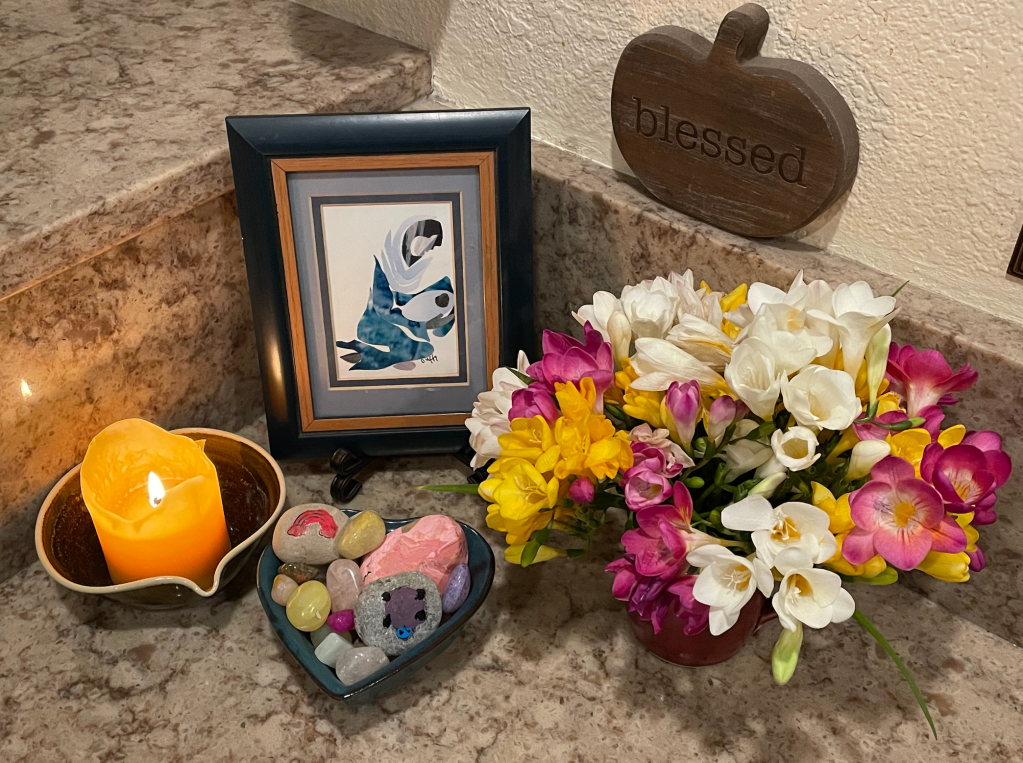
I have not read the book myself, so I cannot tell you what it’s about. I can tell you, however, that it has made a positive difference in Kathy’s life, and in mine. Since reading the book and conversing with Jules, Kathy has created a few sacred spaces in our home. These are areas set aside for personal reflection, meditation, and prayer, or to help us create a sense of the sacred in a particular room. One sacred space now occupies a corner of the kitchen counter. (See photo above.) Setting it up required a bit of rearranging of kitchen appliances, but the payoff has been significant.
Kathy included some flowers, a collection of rocks, a candle, and a framed painting for the sacred space in the kitchen. When preparing meals, Kathy lights the candle and is reminded of the presence of the sacred in the ordinary.
Each morning, and sometimes later in the evening, Kathy sets up a sacred space in the living room. This one has to be taken down prior to the arrival of the grandkids each day. In this space, Kathy uses one or more candles, an arrangement of flowers, and relaxing music. Sometimes she reads material that nourishes her soul, or engages in journal writing. And there are times when she simply sits in her comfortable chair, savoring her morning coffee, and reflecting on life. What a great way to start each day.
The benefits of creating and making use of sacred spaces are plentiful. Doing so relieves stress, brings new energy to one’s life, and increases self-awareness. Spending time in our sacred space provides the “me time” so often lacking in our lives, time which allows us to process our thoughts and feelings. This practice also opens the doors of possibility to experiencing sacramental moments, periods when we are consciously aware of and attentive to the presence of God in our life.
Creating a sacred space is not difficult, nor is it expensive. The return on the investment, however, is priceless.
-
Doing for Others
“One of the deep
secrets in life
is that all that is
really worth doing
is what we do for others.”
~ Lewis CarrollWhen I think back on all the life lessons I’ve learned, and all the wisdom I’ve gained, throughout my lifetime, this Lewis Carroll (no relation) quote just might be the most important of all. I learned this lesson at a very young age, yet only today did I realize that it is attributed to the famous author.
I first learned about the importance of caring for the needs of others from two other Carrolls — Tom and Peg Carroll, my parents. From my earliest days, through their words and example, they impressed upon my siblings and me the value of being aware of the needs of others and of doing whatever we can do to respond to those needs. It is a lesson we have all embraced.
My brother, Tom, has devoted his life to ministry as a Jesuit priest. In that role, he has been a teacher, counselor, and spiritual director to countless men and women around the world. My sister, Cathy, used her love of math to teach in both Catholic and public schools. She then accepted a position with an educational consulting organization which allowed her to travel the country and the world instructing math teachers in more effective methods of teaching math in the classroom. My sister, Peggy, worked as an occupational therapist, helping patients who had experienced a stroke or debilitating spinal cord injury to develop the physical agility skills they would need to enable them to be as independent and self-reliant as possible upon their return to their own homes.
My professional career in education and pastoral ministry was focused on serving others and teaching my students about the importance of doing so in their lives.
As I prepare to celebrate the conclusion of my 70th year on earth two months from today, I do so with a tremendous sense of accomplishment. The opportunities I’ve had to make a positive difference in the lives of my students have been an absolute blessing. My Dad always urged me to follow my heart, rather than the money. It’s true that he was saddened that I did not accept the job with the San Francisco Fire Department when it was available to me in the late ‘70s, but his disappointment was not so much with the financial implications of that decision. His frustration had more to do with the fact that it was through a career in firefighting that he had lived a life of service to others.
I would be remiss not to mention my mother’s role in reinforcing the importance of a life lived for others. In my lifetime, Mom’s vocation was one of constant service, care, and unconditional love from the moment I was born in 1954 right up to the moment of her death in 2022. As a mother, grandmother, and great-grandmother, Mom served as a beacon of inspiration for all who knew her. Even in her final years, when she lived at the Villa Siena Retirement Community in Mountain View, Mom found ways to be of service to a number of the residents she met there. Doing for others was simply what she did. It was what she had done throughout her entire lifetime.
“Life’s most persistent
and urgent question is:
What are you doing for others?”
~ Martin Luther King, Jr. -
Kindness

“True kindness expects
nothing in return.”
~ Roy T. BennettI’m sitting on the deck of my sister’s home in San Mateo as I write this. It’s comfortably warm and partly sunny. Clouds are slowly moving in with rain predicted for later tonight. The sound of the traffic on the street below is tolerable. The occasional horn blasts of the trains passing through San Mateo are actually a bit romantic. What an ideal setting to do a little writing.
My sister, Cathy, underwent a significant medical procedure at Mills Peninsula Hospital yesterday. The surgery went well and her prognosis for a full recovery is very good. She’s fortunate to have a wonderful friend who was an oncology nurse at Stanford Medical Center for many years. Maureen has been assisting Cathy throughout this process, but had a scheduling conflict for today — volunteering at bingo in her local parish, where they would be celebrating the 100th birthday of three parishioners today. So I’m here in San Mateo providing a bit of companionship for my sister.
It is an absolute pleasure and honor for me to have the opportunity to be with Cathy again today. Her entire life has been one of kindness to me and to many others. People often speak of karma. Well, Cathy has accumulated a healthy supply of good karma for all the things she has done through the years for so many people. Now, in her time of need, her family and friends are grateful for the opportunity to care for her the way she has cared for us.
For the next few weeks, friends will be providing dinners for Cathy. If last night’s dinner is any indication of what’s to come, she will be eating quite well. I didn’t ask her how many people will be providing meals, but I get a sense that Cathy won’t have to cook for quite a while. I’m sure others feel as I do — that caring for her during this time is a gift for which we are grateful, rather than an expectation or chore.
Kevin Heath, the CEO of More4Kids, said, “Wherever there is a human in need, there is an opportunity for kindness and to make a difference.”
Cathy has spent her life offering kindness to others, professionally, socially, and personally. In doing so, she has made a positive difference in the lives of countless individuals. Now, in her time of need, Cathy is experiencing the joy of being on the receiving end of the kindness of others. It is heartwarming to see so many people reaching out to her to provide assistance.
Cathy has clearly embraced the words of the Dalai Lama, who said, “Be kind whenever possible. It is always possible.”
The clouds seem to have overtaken the sun. Only small patches of blue sky are still visible, and a cold wind has picked up. So grateful for this day.
-
Seize the Day!
“The first of April
is the day we remember
what we are the other
364 days of the year.”
~ Mark TwainIn their popular 1976 hit song Fly Like an Eagle, the Steve Miller Band sang about the passage of time: “Time keeps on slippin’, slippin’ slippin’ into the future.” Without a doubt, it most certainly does. And as many have pointed out through the years, getting older is a bit like using toilet paper. The closer we get to the end of the roll, the faster it spins.
Another March is in the books. April 2024 is upon us, and with it, a glimmer of hope for a future of unlimited possibilities. As I look ahead to the next four weeks, I’m grateful for numerous opportunities to get together with family and friends. I’ll also give one presentation on the topic of gratitude in Mountain View, attend a book launch for a friend who recently published two new titles, give one guided tour of San Francisco to a friend who grew up in Southern California, and attend another concert, a tribute to Paul McCartney, with Kathy. April promises to be a memorable month.
Today and tomorrow, we get a brief preview of the warmer, sunny days ahead. No doubt, we’ll get more rain in April, but that’s to be expected. We all learned as children that “April showers bring May flowers,” so even the inevitable rain is a good thing. Like most people I know, I am more than ready for the arrival of summer weather.
I’m also anticipating the publication of my newest book, Through the Lens of Gratitude. This book follows the format of my first publication, A Moment’s Pause for Gratitude (2017). In that book, I shared fifty brief stories of gratitude. Each story is followed by a couple of questions to encourage readers to reflect on gratitude in their own lives in light of the story told. Through the Lens… follows this same format, with fifty new stories. The book, which I’m confident is my best yet, should be available for purchase by May 1, 2024.
Yes, time does keep on slippin’, so it is incumbent upon each of us to live in the moment, to be consciously aware of the joy and potential each day has to offer. When I was a teen, like most kids that age, I felt that I was invincible — that I would live forever. Well,… things have changed. I am well-aware of my mortality now, but I’m not afraid of it. I continue to be grateful for each new day given to me, and for the opportunities each new day presents. I will always remember and treasure the words of wisdom offered by Richard Jatta, the father of one of my former students, Jenifer, who lived his brief life embracing the Latin phrase, “Carpe diem,” which translates to “Seize the day.” He understood the importance of living in the present moment.
Happy April!
-
Flower Power!

“In joy or sadness,
flowers are
our constant friends.”
~ Okakura KakuzoFor the past month or so, Kathy and I have been visiting the downtown Campbell Farmers Market on Sunday mornings. Along with a variety of fresh fruit, health drinks, and other organic products, Kathy has also purchased several plants and bunches of colorful fresh flowers for our home. When we return home, she puts the flowers into decorative vases which are then placed throughout the living room, dining room, and kitchen. These flower arrangements have made a positive difference in the ambiance of our home. They certainly did today as we celebrated Easter with the family.
Providing more than just an ornamental improvement to the home environment, fresh flowers have a number of documented health benefits, as well. Dr. Jeannette Haviland-Jones, a professor of psychology at Rutgers University in New Jersey, explained, “Science shows that not only do flowers make us happier than we know, they have a strong positive effect on our emotional well-being.”
By increasing levels of serotonin in our body, flowers can significantly improve our moods, emotions, energy level, memory, sleep, happiness, and overall emotional well-being. At the same time, flowers have the ability to decrease levels of anxiety, stress, and depression.
Research conducted at the University of Pittsburgh Medical Center found that different types of flowers can be used to enhance different aspects of our health:
Lavender promotes feelings of relaxation. Roses can be used as an anti-inflammatory and to treat coughs and colds. Chamomile soothes anxiety and headaches while aiding sleep and digestion. Honeysuckle has antiviral and antibiotic properties, enabling them to treat colds, flu, and sore throats. Chrysanthemums are used to treat dry eyes, fevers, and headaches. Magnolias can minimize nasal congestion and sinus headaches.
All this sounds very promising, but the simple presence of flowers around our home has added a touch of class to our residence. Again today, I am grateful for the simple things in life.
-
Warming Up

“March comes in like a lion
and goes out like a lamb.”
~ English ProverbIt appears that the words of this well-known proverb, the origin of which is uncertain, will prove to be accurate once again this year. It was raining with the high temperature in the mid-50ºs on Friday, March 1st. Today, on the last day of the month, after a light morning shower, South Bay residents will enjoy a partly-sunny day with a high temperature of 67º predicted for this afternoon. Then, as we transition into April, the lamb makes its presence known. How ironic as we celebrate Easter Sunday today.
The weather forecast for the first two days of April indicates a respite in the rain, with a high of 72º on Monday and 75º on Tuesday. What a great way to begin the new month.
It’s been a good winter. With above-average rainfall, the water supply in the Bay Area is sufficient to get us through the summer and fall. I can only speak for myself, but I would think I’m not alone in being more than ready for warmer, dryer weather. Winter was nice, but I’m definitely looking forward to spending more time outside in the months ahead.
March roars in like a lion
With a bluster and a slam!
And tiptoes out so gently
Like a quiet little lamb. -
Candlelight
“Man loves company —
even if it is only that
of a small burning candle.”
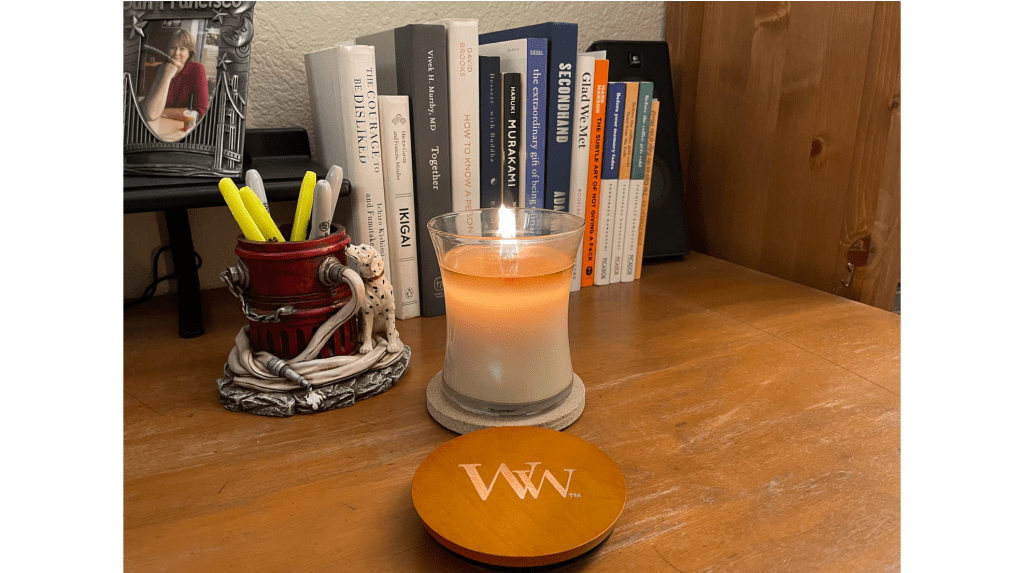
~ G.C. LichtenbergThere are many things in life that nurture my soul. A lighted candle is one of them. Last month, while shopping at CVS, I happened to see a candle which caught my attention. It was made by WoodWick and, not surprisingly, it had a wooden wick. The selection of scents was minimal, so I selected one I thought I might like. In the month it sat on my desk here in my home office, I enjoyed it immensely. I lit it almost every night until, one night, it went out. The entire candle had been used up.
Kathy and I were walking in the Valley Fair Mall the other night when we passed the Yankee Candle store. We stopped in to look around. Much to my delight, I found an extensive selection of WoodWick candles. I purchased two: one with a vanilla scent, the other with three levels of wax which create three different scents before the candle dies out.
What’s special about these candles is the wooden wick. It makes a gentle crackling sound as it burns. Having the candle on my desk is much like experiencing the coziness of a small fireplace in my work space. It is relaxing, soothing, and, yes, nurturing to my soul.
The vanilla candle is burning on my desk this evening. The aroma is captivating. The flickering of the light is calming, and the crackling sound is mesmerizing. The candle contributes to a perfect environment for writing.
I must admit, I’m spoiled now. I’ve always enjoyed having a lighted candle in my work space, but now that I’ve experienced the WoodWick candle, no other candle will suffice.
-
$1.00 Sixty Years Later

“Dollars do better
if they are
accompanied by sense.”
~ Earl RineyOne dollar. Two 50¢ pieces. Four quarters. Ten dimes. 100 pennies. Their value is all the same, and compared to its purchasing power in my childhood, it’s not worth much today.
What could $1.00 buy sixty years ago — in 1964? Here are a few examples:
• A dozen donuts
• 20 Hershey’s bars
• Two McDonald’s Big Macs
• Three gallons of gas
• One gallon of milk
• One movie ticket
• 20 first-class postage stamps
• Four large boxes of CheeriosThings are a little different today:
• A dozen donuts – $21.00
• 20 Hershey’s bars – $27.80
• Two McDonald’s Big Macs – $12.78
• Three gallons of gas – $14.28
• One gallon of milk – $5.99
• One movie ticket – $14.50
• 20 first-class postage stamps – $13.60
• Four large boxes of Cheerios – $33.96And then there’s real estate. My parents purchased their 38th Avenue home in San Francisco in 1956 for $18,500. My mother sold it in 2014 for more than one million dollars. Go figure.
The website amortization.org reports that $1.00 in 1964 is equivalent to $9.93 in 2024!
Okay, to be fair, income has increased, as well. The minimum wage in the State of California in 1964 was $1.30/hour. The State’s minimum wage as of January 1, 2024 is $16.00/hour, and as of April 1, 2024, some fast food workers will begin receiving a $20.00/hour minimum wage.
When I began my teaching career in the Catholic Diocese of San José in 1979, my first-year annual salary was $7,900. A first-year teacher today earns close to $50,000/year. I cringe to think what a lay teacher in a Catholic school was making in 1964.
One thing, for certain, has not changed. In the words of the ancient Roman philosopher Seneca, “It is not the man who has too little, but the man who craves more, that is poor.”
-
Subscribe
Subscribed
Have a WordPress.com account? Log in now.

