-

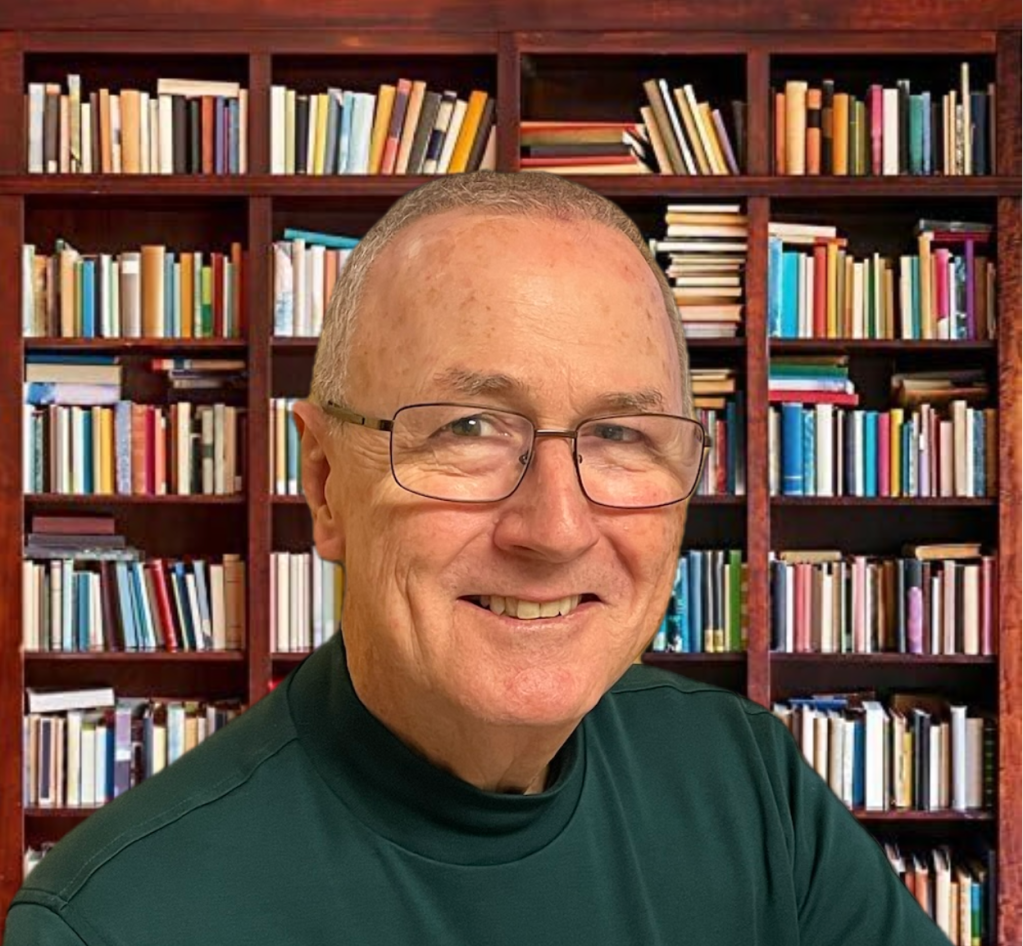
My name is Kevin Carroll. I was born and raised in San Francisco, California, where I attended Saint Ignatius College Preparatory. I am a graduate of both Santa Clara University and the University of San Francisco. Following a 40-year career in teaching and pastoral ministry, I launched a new career as a writer and speaker.
I live in San José, California. My wife, Kathy, and I have three adult sons and five precious grandchildren. I have much for which to be grateful.
I can be reached via email at kmc43sjc@gmail.com
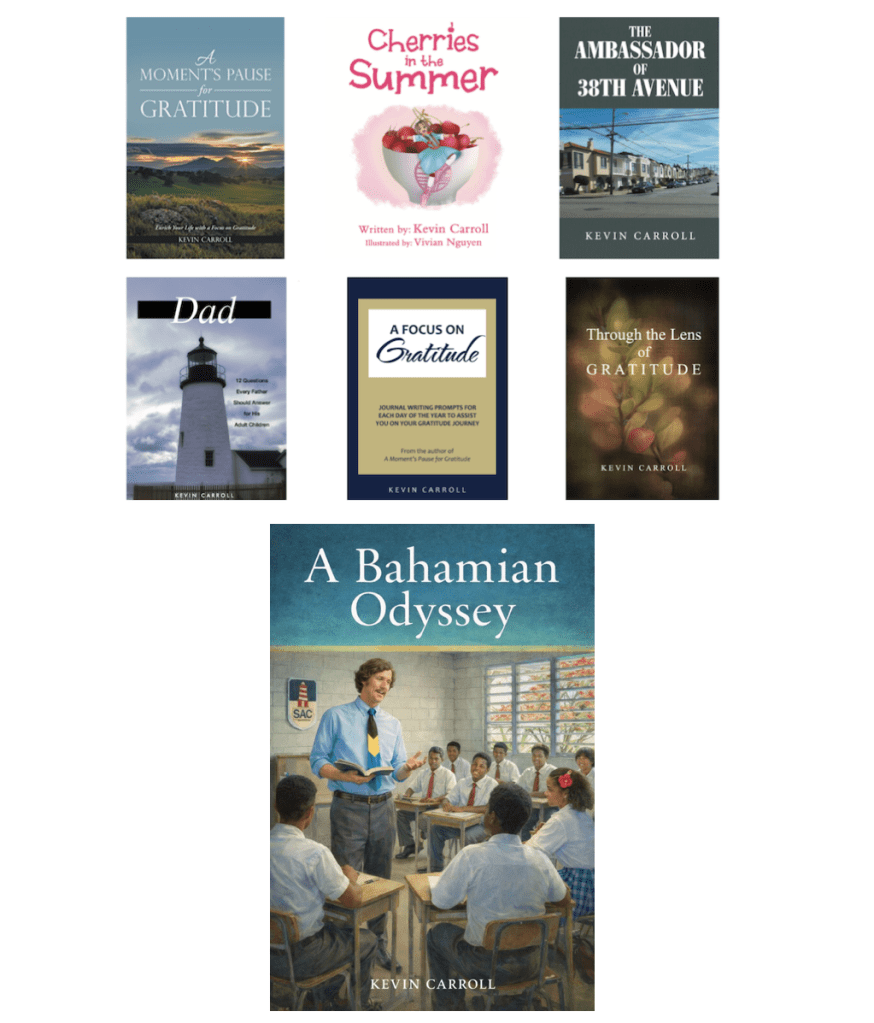
My books are available for purchase online from Amazon. I also have copies of some of these titles at my home for those who would like to buy them directly from me.
A Moment’s Pause for Gratitude (2017)
Cherries in the Summer (2021)
The Ambassador of 38th Avenue (2022)
Dad: 12 Questions… (2023)
A Focus on Gratitude (2024)
Through the Lens of Gratitude (2024)
A Bahamian Odyssey (2026)
-

- October 2026
- September 2026
- August 2026
- July 2026
- June 2026
- May 2026
- April 2026
- March 2026
- February 2026
- January 2026
- December 2025
- November 2025
- October 2025
- September 2025
- August 2025
- July 2025
- June 2025
- May 2025
- April 2025
- March 2025
- February 2025
- January 2025
- December 2024
- November 2024
- October 2024
- September 2024
- August 2024
- July 2024
- June 2024
- May 2024
- April 2024
- March 2024
- February 2024
- January 2024
- December 2023
- November 2023
- October 2023
- September 2023
- August 2023
- July 2023
- June 2023
- May 2023
- April 2023
- March 2023
- February 2023
- January 2023
- December 2022
- November 2022
-
Sun Days

“Those who bring
sunshine
into the lives of others
cannot keep it
from themselves.”
James M. BarrieGrowing up in the Sunset District of San Francisco in the 1960s, where the typical summer day was characterized by persistent fog throughout much of the day, I was unaware of the need for sun protection unless my family and I were vacationing at the Russian River, in Boulder Creek, or on Cobb Mountain. The only sun products with which I was familiar were Sea & Ski and Coppertone, though some people I knew used Johnson’s Baby Oil to assist them in developing the sought-after tan skin color. In my family, we used Sea & Ski.
In a 2010 New York Times article, Dr. Darrell Rigel, past president of the American Academy of Dermatology, acknowledged that the SPF (Sun Protection Factor) in sun protection products available in the 1960s was only 2 to 4. Today, it is highly recommended that consumers use products with a minimum of 15-30 SPF. In fact, in my childhood, Sea & Ski was not advertised as sunscreen at all. It was marketed as suntan lotion. This product, and others like it, reduced the risk of sunburn, but did not filter out the UVA light, leaving generations of kids vulnerable to developing skin cancer in later years.
In the summer of 1971, I spent six weeks in Jamaica. During that time, we were fortunate enough to spend a fair amount of time at the beach. I’d been warned that the intensity of the sun in the Caribbean was not to be ignored. Still, I relied on Sea & Ski. I managed to avoid getting sunburned that summer. The “healthy tan,” with which I proudly returned home in August, lasted for almost a full year.
During my college and young adult years, it was all about the tan. Having a bronze face and body was evidence of being happy, healthy, and living a good life. I’m fairly certain that one of the best overall tans I ever got was in the summer of 1977 when I worked outdoors eight hours each day at the Santa Clara Mission Cemetery. By ten o’clock each morning, my shirt was off. I wore cut-off jeans which exposed my legs to the sun, as well. Sunscreen? To be honest, I never gave it a thought. Other than my cut-off jeans, the only protection I had from the sun came from wearing shoes and socks. I paid dearly for this in early August when I spent a day on the beach in Santa Cruz with some friends. I wasn’t worried about getting burned, because I already had a deep, dark tan on most of my body. The next morning, I realized that I had sustained a severe sunburn on my ankles and feet. For several days, I was unable to wear shoes.
Not surprisingly, as the years passed, I found myself making regular visits to the Dermatology Department at Kaiser to have small spots removed from my forehead, nose, and arms. In 2013, it was determined that a small patch of skin cancer needed to removed from my left shoulder. When I consider the lifelong disregard I had for the damaging effects of the sun on my body, I am fortunate, and grateful, that the situation wasn’t any worse.
I’ve been applying sunscreen to my face every day on a year-round basis for about twenty years now. I also seek shade, rather than direct sunlight, when sitting outdoors. I wear a hat now, too, whenever I’m walking outdoors during the day. I’m hoping that these modest changes will help to minimize any future damage.
There are certainly health benefits to getting direct sunlight. Exposure to sunlight boosts vitamin D levels. Vitamin D is an essential nutrient which reduces the risk of heart disease. Sunlight also has a positive effect on our moods, which helps us to fight depression. Improved sleep patterns are another benefit of consistent exposure to the sun, especially in the morning hours. Finally, sunlight has been shown to improve blood pressure.
Like anything else in life, it’s all about balance. Too much or too little of just about anything can be detrimental to our overall well-being. Even if we cannot tolerate sunshine as we did when we were younger, we can still make a conscientious effort to be the sunshine in the lives of those around us.
-
Seeking Happiness
“It is not joy
that makes us
grateful;
it is gratitude
that makes us
joyful.”
David Steindl-RastIt is astounding to consider the numerous elements which contribute to who we are, how we feel from one day to the next, and how others perceive us. A quick review of some of these components might be beneficial for us to have a better understanding of the various factors that influence our lives today.
Through the years, but most notably in the past year, I have come to understand and appreciate the significance of the food I eat, the sleep I get, and the exercise I do, and the impact these three factors have on my life. I count calories now. I log what I eat every day. I weigh myself every morning. I find that doing these things helps me to make better choices about what I am willing to ingest. I have also been more intentional about my sleep patterns, ensuring that I get eight hours of sleep each night — no more, no less. I have always been well aware of the importance of exercise in one’s life. Despite this, until recently, I struggled to find the motivation to get up and move on a regular basis.
I have also come to understand and appreciate the skills I’ve learned, the importance of reading good books, and the music I listen to. If I were asked to identify my #1 skill, I would have to say writing. I love to write. Writing helps me to process what’s happening in the world around me — and within me. I find writing to be therapeutic. Reading well-written books is beneficial therapy for me, as well. I have been inspired by the writings of Hal Urban, Roland Merullo, Anne Lamott, Viktor Frankl, Ron Pevney, Kristin Neff, Frank McCourt, Paulo Coelho, and Angela Duckworth, to name just a few. All of these authors have had a positive influence on who I am today. Similarly, music plays an important role in my life. There is music I listen to when I’m writing (Brian Crain, Jim Brickman), walking (Laid Back Beach Music Radio on Pandora), or just relaxing (Kenny G., Nora Jones, Autumn Jazz Radio on Pandora). These sounds enrich every day from morning until night.
Not surprisingly, I have also come to understand and appreciate the positive consequences of the habits I’ve cultivated, the challenges I face, and the thoughts I entertain. Life is never perfect. My life is no exception. From my earliest years, beginning with lessons learned from my parents, I have developed habits which continue to serve me well even as I approach the age of seventy. Good hygiene, punctuality, empathy, and basic social skills allow me to interact effectively with those around me. As for challenges, we all have them. No one is exempt from situations which create angst in one’s life. How we deal with such situations, however, determines how well we navigate the rough waters of life. I find it helpful to remind myself that in each crisis we face, there is both danger and opportunity. I do my best to focus on the opportunity and let the danger do what it will. Our thoughts, too, can create anxiety in our lives. I have found the words of the Serenity Prayer to be especially consoling when my mind starts blowing situations out of proportion.
I think it’s safe to say that happiness is a state of mind every person hopes to achieve. All of the factors I’ve mentioned, as well as some I have not mentioned, play a part in determining one’s level of happiness. Most of all, however, it is the lens through which we choose to look at the world around us that determines our happiness. We can view the people and things around us with cynicism, anger, resentment, hopelessness, or even apathy. These world views rarely allow us to see and appreciate all the good that exists in our world. I prefer to view the world through the lens of gratitude. When I do, even though I can still acknowledge the evil which exists in our world, I am able to focus on and embrace the good which is constantly being done by so many compassionate women and men, and I am able to do so with a tremendous sense of gratitude.
-
Anytime, Anywhere

“Life is beautiful
not because of the things
we see or do.
Life is beautiful
because of the
people we meet.”
Simon SinekI love meeting people. Getting to know someone new energizes me. It nourishes my soul. To the best of my recollection, I’ve always been this way. Perhaps this is what prompted my childhood neighbor, Sam Young, to bestow upon me the unofficial title The Ambassador of 38th Avenue when I was just a kid. It might also explain why some have said that I could strike up a conversation with a fire hydrant! While I think that’s a bit over-the-top, I readily admit that I thoroughly enjoy opportunities to meet someone new — anytime, anywhere.
In recent months, while walking at the Valley Fair Mall in San José to get my exercise on rainy days, I’ve connected with two different men. Both happen to work as security guards. Victor was guarding one of the doors connecting the mall to Nordstrom. Greg was standing, as he does for eight hours per day five days per week, outside the entrance to an upscale women’s clothing store. He was so personable, and smartly dressed in a suit, I had to ask him if he was working hospitality or security. Meeting both men was providential. In my twenty-minute conversation with Victor, we realized that my sister, Cathy, had been one of his teachers at Corpus Christi School in San Francisco back in the ’70’s. I enjoyed listening to him share his fond memories of time spent with his favorite teacher. I’ve enjoyed multiple conversations with Greg, a retired hospital worker, who lives in a home close to Bellarmine College Prep. We are close in age, so we often discuss the challenges and opportunities of getting older.
I have met some of the most wonderful people unexpectedly in random locations. I’ve mentioned in previous blog posts that I met and enjoyed a one-on-one breakfast with the legendary UCLA men’s basketball coach, John Wooden, in the dining hall at Bellarmine in the summer of 1974. During my yearlong stay in the Bahamas, I met the original Fuller Brush Man at a resort on the island of Exuma. And I met Hall of Fame 49ers running back Roger Craig standing on the sidelines of a high school football game in the late ’90’s.
In the early ’80’s, the father of one of my students invited me to join him for lunch. While on my way to Lake Tahoe for a short vacation, I had stopped to watch a preseason 49ers practice session at the summer training facility at Sierra College in Rocklin, California. My student’s Dad was the defensive coordinator for the Niners. I accepted his invitation to lunch, not realizing until I got inside that I would be sitting at a table for four with him, 49ers head coach Bill Walsh, and CBS sportscaster John Madden. I felt just a tad out of place, but what an amazing experience.
In August 1984, having just started my new job at Saint Lawrence Parish in Santa Clara, I attended a social event celebrating the 25th anniversary of the parish. It was there that I met my wife, Kathy. I sure didn’t see that one coming!
Poet N.R. Hart wrote, “Some souls just understand each other upon meeting.” I could not agree more. When I met Kathy, there was something there, something different, that drew us together. Similarly, but to a different degree, there are others I’ve met in my lifetime with whom I also connected instantaneously.
Author Erin Matlock pointed out, “There are people you meet who become impossible to forget. They were not sent to you by accident, but instead, were destined to open a doorway to a different version of your life.” I feel blessed to have had this experience multiple times in my 70 years on earth.
Avijeet Das is a poet and writer. He wrote something with which I completely agree. He said, “We don’t meet anyone by chance.” The serendipitous meeting of significant people seems to be a recurring theme in life. Whether we meet someone at a social event, in the workplace, at a church service, standing in line at the grocery store, or in the lobby of an island hotel, meeting new friends, friends with whom we have a strong, natural connection, offers tremendous possibilities for our lives.
Who knows? Maybe there’s someone out there right now, someone you haven’t met yet, wondering what it would be like to meet someone… like you.
-
Gifted!

“This world is
but a canvas
to our imagination.”
Henry David ThoreauFor most of my life, I willingly admitted to being artistically challenged. When I think back to art classes in my elementary school years, I recall four images I relied upon to be an active participant in those classes. The first was the brick wall. Using colored pencils, I covered the art paper in red. Then, with the precision of a professional mason, I used my black pencil and a ruler to cover the red background with offset rectangles. The finished product looked like… yes, a brick wall. I know I submitted this image multiple times.
The second image was a road through a desert which led to a gap in the distant mountains, behind which the sun was setting. I tossed in a few cactus plants along the side of the road for good measure. The effort I devoted to creating a colorful sunset apparently compensated for my overall lack of artistic ability. This image, too, was submitted more than once.
At some point, maybe around fifth or sixth grade, I learned how to create a cherry blossom tree. I began with a blob of black India ink at the bottom of the page. Using a plastic straw, I carefully blew through the straw, causing various veins of ink to climb toward the top of the paper to create the effect of tree branches. Once the ink dried, I added small clusters of pink flowers to the branches of the tree.
Finally, in eighth grade, I recall drawing a scene one might see looking out over the Pacific Ocean. I drew the dark blue water of the ocean with a perfectly straight horizon. Using a grey colored pencil, I added puffy clouds just above the horizon, with a bit of light blue sky above it. And on the water, I placed one small boat. That’s it.
I don’t recall ever taking an art class after eighth grade, so I was spared the embarrassment of continuing to draw simplistic scenes.
It’s not that I don’t appreciate art. I honestly do. In most cases, however, I don’t understand what I’m viewing. A couple of years ago, I went to the Vincent Van Gogh exhibit in San José. I was impressed. I was looking at real art, produced by a famous artist. Did I understand the meaning of his works? Not at all. Despite this, I could enjoy and appreciate the colors and creativity on exhibit.
It was only in later years that I came to the realization that painting is but one form of art. Writing is art. I do this fairly well. Poetry is art. This, too, is something I can do with relative competence. Music and drama are also forms of art which I can appreciate. Much of the artwork painted on canvas, however, remains a mystery to me — and yet, I can look at a piece of art with a sense of awe and gratitude.
I was in San Francisco today to have breakfast with a friend. Following breakfast, I walked from Tennessee Grill at 22nd & Taraval back to my car, which I’d parked on Sloat Boulevard, directly across from Java Beach Café. It was lunch time, so I decided to get a sandwich before beginning the hour-long drive back to San José. It was there that I met Nikki. She is an artist. A real artist. What I mean by this is that painting is more than just a hobby for her. It’s what she does. Our conversation was brief, but she gave me her business card, so I checked out her website when I returned home this evening. The image above includes just three of the many paintings on display on her web site. Nikki is definitely a gifted artist.
While I lack the ability to look at these works of art and comprehend a deeper meaning behind them, if such meanings even exist, I can readily appreciate the creativity, the color, and the placement on the canvas which make them what they are. I may never know the true meaning of a work of art, but I know what I like when I see it. Seeing Nikki’s work this evening, I like it.
When it comes to collections of fine art, I can relate to the words of Polish-American novelist Jerzy Kosiński who wrote, “I collect human relationships very much the way others collect fine art.” And I treasure my relationships no less than one would cherish the most exquisite collection of masterpieces.
-
A Better Way
“Do not let the
behavior of others
destroy your
inner peace.”
Dalai LamaA dictionary definition of the word detach reads: “detach: verb – to disengage and separate; disconnect.”
Here are a few other thought-provoking insights on the practice of detachment in one’s life:
Author Mahatma Prabhu tells us that “detachment means to not be owned by what we own.” This is certainly worthy of serious reflection.
Certified Life Coach John B. Bejo wrote, “Detachment is an art of enjoying something while always being open the the possibility of losing it someday.” This concept, too, is worthy of our consideration, since the reality of our lives is that nothing is permanent.
Shane Steele, in The Mind’s Journal, boldly states, “Detachment is power.” He recommends that we release all those things in our lives that no longer work for us. Difficult as this may be for some, Steele’s advice is well-founded.
Saint Ignatius of Loyola, founder of the Society of Jesus (Jesuits), wrote that the only way to spiritual freedom is to detach ourselves from our preferences and embrace things as they are rather than dwelling on how we wish they would be. Again, a challenging task for most.
Finally, clinical social worker Vicki Tidwell Palmer tells us, “Detachment is the art of accepting powerlessness, and experiencing serenity, especially in difficult situations.” Two things about this statement intrigue me. The first is this: Is serenity the result of accepting powerlessness? And the second: Isn’t accepting powerlessness an indication of weakness? My gut response to these questions is Yes and No.
Yes, letting go, accepting powerlessness, going with the flow,… whatever words one chooses to use are likely to result in a tremendous sense of peace and serenity. And no, accepting powerlessness is not a sign of weakness. In fact, it takes tremendous courage to accept powerlessness. Isn’t this one of the lessons learned from the crucifixion on Calvary?
From time to time, most of us experience periods of overwhelming stress. The causes of this stress are limitless — work, relationships, finances, overcommitment, time restraints, personal health… The list could go on for quite a while. One effective way to cope with this type of stress is to intentionally detach from those things which are no longer serving us well — and those people who no longer nourish our soul. As a good friend said to me recently, “Trim the branches, but nurture the roots.”
Healthy detachment allows us to step back and observe what is happening, not only what’s happening around us, but what’s happening within us and to us. When we do so, we allow the stressful feelings to dissipate. Only then are we free to live our lives with love, empathy, and acceptance.
-
Means to An End

“Treat people as an end,
and never a
means to an end.”
Immanuel KantSince November 1998, when I first visited Nagasaki, Japan as part of a student exchange program I coordinated, I have had the opportunity to assist countless Japanese students, teachers, and others to better understand spoken English. Schools in Japan do an excellent job of teaching written English beginning in junior high school. Unfortunately, the lack of native English speakers teaching English in Japan often results in the spoken language being much more challenging for students to learn. It was for this reason that our student exchange program was created.
One of the most enjoyable aspects of the English language for me to share was the challenge of helping students to understand idioms. I can only imagine what must be going through the minds of non-English speaking learners when they hear such phrases as “She’s under the weather today,” “You drive, and I’ll ride shotgun,” or “It’s raining cats and dogs!” To take statements such as these literally simply doesn’t make sense.
Though not quite as visually imaginative, there is an idiom that is used quite freely in our country which, if taken literally, would be unintelligible to many: “a means to an end.”
This idiom refers to something which is a way of reaching a goal or achieving something one wants. Volunteering to do grunt work in a law office could be a means to an end if it provides a pathway for the person to enter the legal profession. I would think that most minor league baseball players would consider their years at that level to be a means to an end — hoping to ultimately play for a professional baseball team. Going to college is also a means to an end.
It may be acceptable, and even wise, to invest one’s time and energy in a venture which is only a means to an end. In such cases, the means to an end becomes the stepping stone to achieving one’s desired goal. German philosopher Immanuel Kant, who would celebrate his 300th birthday in April this year, had no issues with the concept of individuals using actions as a means to an end. He was adamant, however, that people must never be used in such a way.
Kant wrote, “Every man is to be respected as an absolute end in himself; and it is a crime against the dignity that belongs to him as a human being to use him as a mere means for some external purpose.”
I regretfully admit that there have been times in my life when I’ve used individuals as a means to an end. It’s easy to do. And, at first, it seems so harmless. Quite often, we can do this without even being aware that we’re doing it. For me, it is only in retrospect that I can recognize and acknowledge my wrongdoing.
Perhaps it’s healthy to occasionally engage in a process of self-evaluation in regards to our relationships. Why are we associated with the friends we choose? Why are they associated with us? Is our relationship mutual and equally-beneficial, or might I be using someone for my own longterm personal gain?
The questions are tough, but worth the challenge. The answers to these questions might prove to be incredibly enlightening.
-
Venting
“Be not angry that you
cannot make others
as you wish them to be,
since you cannot make yourself
as you wish to be.”
Thomas à KempisWhile walking in the Sunset District of San Francisco yesterday, I saw one of those “little library” boxes on a post in front of someone’s home. I noticed that the box was completely filled with books. Out of curiosity, I looked through the glass window to check out some of the titles. I was pleased to see a copy of You Just Don’t Understand: Women and Men in Conversation by Dr. Deborah Tannen. As I continued my walk, I found myself reflecting on one of the most valuable lessons I learned when I read that book many years ago.
Tannen’s book explores the communication differences between women and men. It’s a fascinating read. One point which stood out for me was that, quite often, when women speak to men, they’re not asking for advice or for a solution to their issue. They simply want to share what’s on their mind with someone who will listen attentively to them. This was critical information for me, and for most men I would think, because men have a tendency to be problem-solvers and answer-givers, especially when listening to a woman vent about something or someone in her life.
This powerful pearl of wisdom has enabled me to listen to others, particularly women, with compassion and empathy, rather than judgmentally or with a need to offer a solution to a problem.
When people vent to me today, I often enjoy listening to their stories. It’s not that I want or need to hear about the struggles they are enduring. What I enjoy and appreciate is that they trust me to listen to them without judgment. I am well aware of how it feels to keep my emotions bottled-up inside. I’m equally aware of how therapeutic it is to share what’s weighing me down with someone who will attentively listen to me.
Venting can be a healthy practice. Doing so allows us to purge what is weighing us down so that we are better able to allow more positive energy to nourish us.
There is a difference, however, between “healthy venting” and “emotional dumping.” Healthy venting includes such characteristics as not playing the victim, owning up to one’s own mistakes, and sticking to one topic. Emotional dumping, on the other hand, often involves blaming others. It is not open to finding a solution to the issue, and can be characterized by a mindset of victimization. Emotional dumping can also overwhelm the listener with multiple issues.
There is a viable alternative to verbal venting. For some people, writing about what’s on their mind can be similarly beneficial. Rather than involving anyone else in the situation, a person has the option to put their thoughts and concerns into writing. The process of doing so can also be curative. There might be a significant feeling of relief to discarding what has been written once it has been expressed. There is a difference between keeping things “bottled-up” and keeping things “to ourselves.” Writing provides us an opportunity to express ourselves (vent) without involving others.
We are fortunate when we have someone to whom we can vent in a healthy way. As Ambrose Bierce, author of The Devil’s Dictionary, warned, “Speak when you are angry and you will make the best speech you will ever regret.”
-
Class of ’68

“There is nothing
on this earth
more to be prized
than true friendship.”
Saint Thomas AquinasElementary school friends. We have so many of them during our early childhood years. We run and play together. We accept each other without judgment. We grow together day after day and year after year without even noticing that we’re changing. We savor the time we spend together. And, sadly, we take it all for granted. It never really crosses our minds that we’ll all change, but then we transition to middle school and we are more selective about who we run and play with. No longer do we accept friends unconditionally. Cliques form, exclusion is common, we judge and are judged, and life is different for all of us.
Eventually, we move on to other chapters in our lives — high school, college, launching a career, or, perhaps, getting married and starting a family. Responsibilities change. Interests change. Needs change. It is quite common that we lose touch with many of our elementary school friends. Despite the good times we shared and the countless hours we spent together in those early years, and without even saying goodbye, we move on. People we’d seen every day for seven, eight, even nine years are suddenly no longer a part of our lives.
For a while, perhaps even a long while, we don’t miss them. We’re too busy living our own lives, pursuing our own dreams, and building a life for ourselves. The years pass by more quickly than we could have ever imagined, and suddenly, we find ourselves coming to terms with being retired. For many, adjusting to retirement can be a time of crisis. We ask ourselves questions such as “What am I going to do now?” and “Who am I now?”
Retirement, for me, has included reconnecting with a number of long-lost friends. It has been an absolute pleasure to reestablish contact with a number of individuals who, at one time, were significant to me. I have also had the opportunity to develop friendships with some of my former classmates from my elementary years who I never really got to know beyond simply surviving our Catholic education. Amazingly, we’ve all turned out to be pretty good people.
Reconnecting with a number of my former classmates from Saint Gabriel School has been an absolute gift for me. It’s been 56 years since we graduated from that school and moved on to our respective high schools. A group of us has been getting together a few times each year for the past ten years. We might gather at a park with our lawn chairs and brown-bag lunches or enjoy fine dining experiences at any number of Bay Area restaurants. Classmate John Kearney mentioned to me, “One of the things I’ve found interesting about reconnecting with our Saint Gabriel class is that we all came from somewhat similar backgrounds, but everyone has taken a different path in life.” John enjoys hearing about what our classmates have been doing for the past 50+ years.
Pat Casserly, another member of the Class of 1968, shared this with me: “We all spent about eight years together at Saint Gabriel, day in and day out, seeing the same faces. It felt like it would never end. So, the get-togethers are great and they have made some changes in my life.” He went on to describe how he and a few other classmates have enjoyed motorcycle rides together, a three-day trip to Avila Beach with their spouses, and have plans for a few days in Yosemite next month. Pat mentioned that none of these events would have taken place if he hadn’t gotten back together with his Saint Gabriel classmates.
Classmate Cathy (Koppel) Gibbs told me, “I am so very grateful to have reconnected with my classmates from the SG class of ‘68. I have gone through some very tough times these past few years and they have helped me get through each and every day with their love, prayers, and support!”
The friendships we share with each other today remind me of an anonymous quote I read not too long ago: “A friend is one who overlooks your broken fence and admires the flowers in your garden.” In getting reacquainted with these women and men over the past few years, I’ve noticed that one of the bonding realizations contributing to these quality relationships is that friendships are cemented when one person says to another, “What? You too? I thought I was the only one.”
When it comes right down to it, friendships are a bit strange. We meet (or re-meet) someone, and after a brief initial conversation, we think to ourselves, Yeah, I like this one. Then we just start doing stuff with them. It’s an absolute joy.
My personal experience of reconnecting with my Saint Gabriel classmates can best be summed-up in the wise words of Ralph Waldo Emerson. He wrote, “The only way to have a friend is to be one.”
Absolute truth!
-
A Legend

“Success is a journey,
not a destination.
The doing is often more important
than the outcome.”
Arthur Ashe“It was the best of times, it was the worst of times, it was the age of wisdom, it was the age of foolishness,…” These immortal words written by Charles Dickens accurately describe my experience as an eighth grade student at Saint Gabriel School in San Francisco. While my junior high years were challenging for me both academically and socially, I found solace in a most unlikely place: the tennis court.
Dan Graham and I had been classmates since our kindergarten days at Ulloa Annex. It wasn’t until our eighth grade year that we started hanging out together. He introduced me to the world of photography (he even had his own darkroom in the garage of his home) and to the joy and wonder of maintaining a home aquarium of tropical fish. Of all the species represented in Dan’s tank, the neon tetra was my favorite, as it sported the red and blue colors of the high school Dan and I would attend a year later.
In September 1967, the start of our eighth grade year, Dan asked if I might be interested in joining a recreational tennis team at Sunset Playground. I had played around on the tennis courts at both South Sunset Playground near my home and at Washington Park in Burlingame. I was familiar with the rules of the game, but I’d never played competitively. The tennis program at Sunset Playground was mostly recreational. Team members played against each other for a place on the ladders of round metal tags with our names on them. In the spring of 1968, those at the top of the ladders (boys’ singles, girls’ singles, and mixed-doubles) would be invited to compete in the San Francisco City Tennis Championship Tournament at the Golden Gate Park Tennis Center.
Participating in this tennis program was the highlight of my eighth grade year. I enjoyed the friendly competition, the camaraderie of my teammates, and the guidance provided by our energetic coach. As a result of my newfound interest, I began paying attention to professional tennis, as well. Two of the top players at that time were San Francisco native Billie Jean King and Arthur Ashe, a native of Richmond, Virginia, who was the first and, so far, only African American male player to win the U.S. Open (1968) and Wimbledon (1975).
In the spring of 1968, I had the opportunity to participate in the city championship tournament in Golden Gate Park in the mixed-doubles division. My partner, Francesca Perotti, and I finished in first place. A short time later, the four tennis courts at Parkside Playground on Vicente Street were refurbished and dedicated to James B. Moffett, who was considered to be the founder of youth tennis in San Francisco. The dedication ceremony included an exhibition tennis match between Moffett’s daughter, Billie Jean King, and another San Francisco tennis legend, Peanut Louie. My friend Dan and I were the ballboys for that match.
At the end of the summer, as I was beginning my high school days at Saint Ignatius, I found myself interested in following the 1968 U.S. Open Men’s Tennis Tournament. In the championship match, Arthur Ashe defeated Tom Okker in five sets.
Ashe was much more than just a tennis player. Following his career on the court, he went on to become an author (A Hard Road to Glory: A History of the African-American Athlete), an advocate for AIDS research, and the founder of the Arthur Ashe Institute for Urban Health. He was committed to creating programs to educate inner city residents about the importance of health care.
Arthur Ashe died 21 years ago today. He once described his life using the exact same phrase I would use to describe my own — as a “succession of fortunate circumstances.”
-
Grandkids

“Grandchildren are
God’s reward for
not killing your kids.”
Tony CampoloA barbecue on the first Saturday in February? Why not? Despite the cool air and dark sky, it was an opportunity for us to gather our family together before the big storm arrives. Another one of those “atmospheric rivers” is headed our way and predicted to arrive tonight. Local weather reporters have been warning us that we should expect to be pummeled through the night, throughout all of tomorrow, and into Monday. So today was a good day to gather for some family fun and a great meal.
Kathy did the bulk of the shopping early this morning. Tom, Steve, and Brendan took care of grilling the burgers and hotdogs. Steve’s wife, Morgan, and Tom’s wife, Hillaray, organized the food table for the feast. I got to play with the grandkids!
Today was the first time all five of our grandkids were together. Liam and Emily had not yet met Henry, who was born in mid-January. While Henry is not yet able to keep up with his siblings and cousins, he was certainly well cared for by them. It won’t be long before he’ll be chasing them all around.
Author Janet Lanese wrote, “Grandchildren are loving reminders of what we’re really here for.” What a powerful statement for grandparents. We’ve done our job of raising our kids. We’ve completed our careers and now have time to be available for the grandkids. In my younger years, I had this mistaken belief that retirement was all about cruises around the world and playing shuffleboard or bocce ball with friends. Fortunately, this has not been my experience at all, and I am grateful for this. Spending time with the little ones is an absolute delight.
I once heard someone say that if he had known that grandchildren were this much fun, he would have had them first! Sadly, that’s not an option for us. I think Tony Campolo, the American sociologist I quoted at the top of this post, has the right idea. Grandkids are God’s reward. For what? I don’t exactly know. To be blessed with little ones with so much unconditional love to give is not something I deserve because of anything I’ve done — or anything I didn’t do! It is pure gift. No strings attached. How could I not be grateful?
Kathy and I have been blessed with five beautiful grandkids. I wouldn’t change them for the world. What I would do if I could, however, is change the world for them. With all the technological innovations that have been introduced in the past fifty years, products designed to make life easier for us, it seems that the world is far more complicated today than ever before. I worry about what the world will be like for these little ones as they get older.
I have to remind myself that parents and grandparents of previous generations must have had similar concerns for their children and grandchildren. Again, I am reminded of the words of Dag Hammarskjöld, former Security General of the United Nations. He said, “For all that has been, thanks; for all that is to be, yes!”
-
Subscribe
Subscribed
Have a WordPress.com account? Log in now.

