-

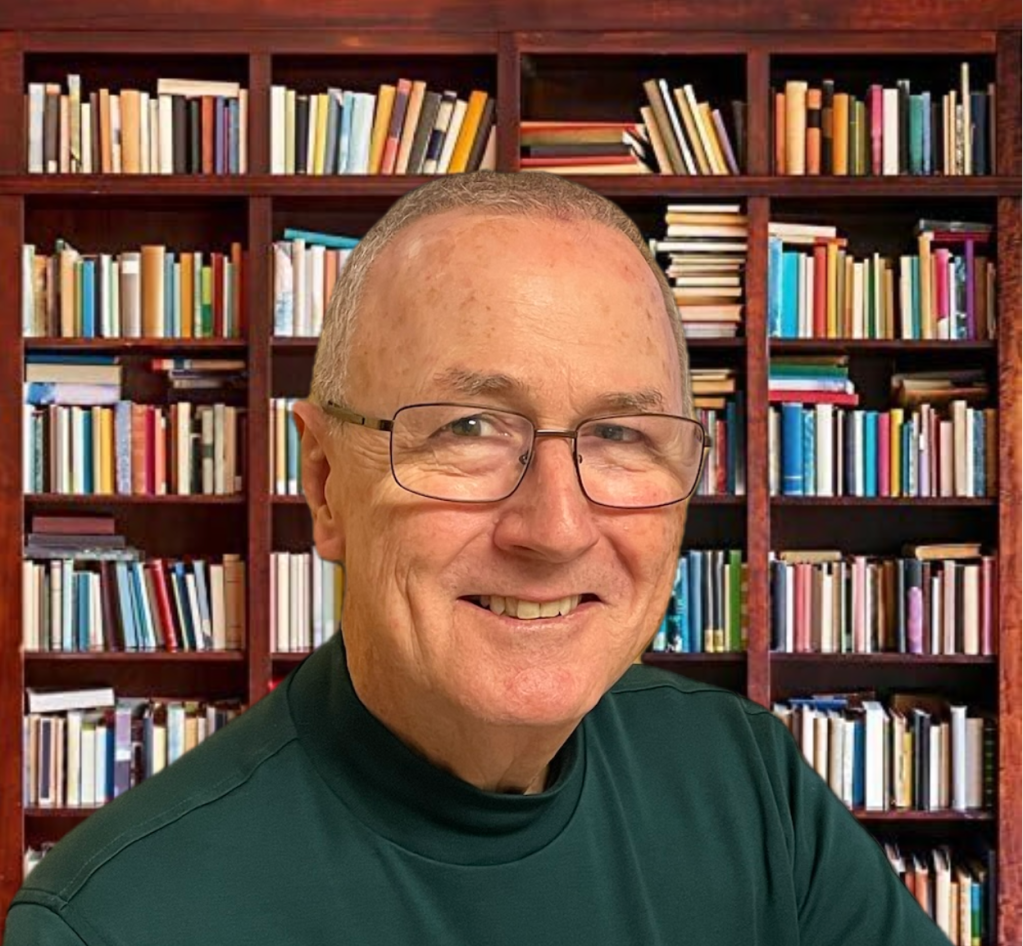
My name is Kevin Carroll. I was born and raised in San Francisco, California, where I attended Saint Ignatius College Preparatory. I am a graduate of both Santa Clara University and the University of San Francisco. Following a 40-year career in teaching and pastoral ministry, I launched a new career as a writer and speaker.
I live in San José, California. My wife, Kathy, and I have three adult sons and five precious grandchildren. I have much for which to be grateful.
I can be reached via email at kmc43sjc@gmail.com
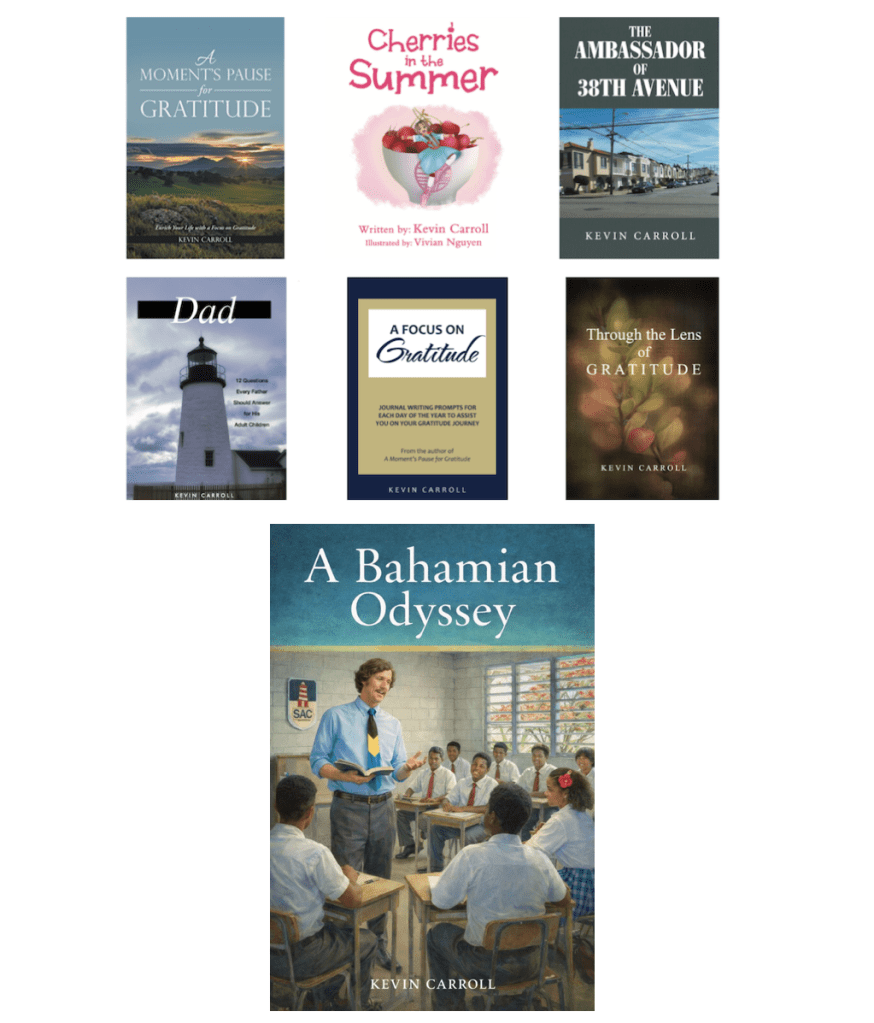
My books are available for purchase online from Amazon. I also have copies of some of these titles at my home for those who would like to buy them directly from me.
A Moment’s Pause for Gratitude (2017)
Cherries in the Summer (2021)
The Ambassador of 38th Avenue (2022)
Dad: 12 Questions… (2023)
A Focus on Gratitude (2024)
Through the Lens of Gratitude (2024)
A Bahamian Odyssey (2026)
-

- October 2026
- September 2026
- August 2026
- July 2026
- June 2026
- May 2026
- April 2026
- March 2026
- February 2026
- January 2026
- December 2025
- November 2025
- October 2025
- September 2025
- August 2025
- July 2025
- June 2025
- May 2025
- April 2025
- March 2025
- February 2025
- January 2025
- December 2024
- November 2024
- October 2024
- September 2024
- August 2024
- July 2024
- June 2024
- May 2024
- April 2024
- March 2024
- February 2024
- January 2024
- December 2023
- November 2023
- October 2023
- September 2023
- August 2023
- July 2023
- June 2023
- May 2023
- April 2023
- March 2023
- February 2023
- January 2023
- December 2022
- November 2022
-
www.classmates.gulp!

“I have learned that
to be with those that I like
is enough.”
Walt WhitmanOn November 11, 2013, seven members of the St. Gabriel School Class of 1968 gathered for an informal lunch at the Beach Chalet Restaurant in The City. I didn’t know what to expect that day, as I had not seen most of my classmates for forty-five years. The event completely exceeded my expectations. At the conclusion of our meal, we all agreed that we should meet-up again at some future time.
Several years later, a small group of us met at the Delancey Street Restaurant on the Embarcadero in The City. A few of the original group attended, and a handful of new classmates joined us. In the years since that time, many of us have continued to gather every few months for lunches in restaurants or picnics in parks, either in The City or in Pleasanton. These venues are central to those of us who live in various parts of the Bay Area.
Our most recent lunch was today. Four of the original seven from the Beach Chalet group attended, along with eight others. Due to the weather, a picnic was out of the question, so we met at Scott’s Seafood in Jack London Square in Oakland. The food was delicious, but the highlight of the afternoon was the camaraderie and lively conversation we enjoyed for three hours. We never ran out of stories to tell as we reminisced about our days at St. Gabriel School and shared details of what we’ve done with our lives over the past half-century.
One “rule of thumb” for these gatherings is this: Be there, or be talked about! Those who did not attend can be assured that nobody’s name was taken in vain. There truly is a genuine interest in the well-being of our classmates from fifty-five years ago.
We’re planning to get together again in May.
-
The Best Pizza Around

“Unless you are a pizza,
the answer is yes,
I can live without you.”
Bill Murray
_______________________________________I wanted to find the best pizza around,
since options for excellent pizza abound.
I thought I should start in the east — in New York.
I ordered a pizza with sausage (from pork).I have to admit it was really quite good.
It tasted delicious, as all pizza should.
So then I moved on. There was much to be done
to find the best pizza pie under the sun.I went to Chicago to locate a place
where I could find pizza that I could embrace.
They claim that their pizza is better than most.
I tried it. They really have nothing to boast.A quick stop in Denver, and then in L.A.,
were quite disappointing. What more can I say?
In Denver, they added a cucumber topping.
I truly regret that I wasted time stopping.Los Angeles isn’t a place to get pizza.
They told me that they’d never heard of linguiça!
“Would you like chorizo?” I heard someone say.
My last stop would be where I live — San José.Eureka! I found it! A nice little space.
On Stevens Creek Boulevard there is a place
which offers, by far, the best pizza around.
The service and food there will simply astound.My journey is over. The answer is clear.
The best crafted pizza and excellent beer.
I traveled the country, from east coast to west.
Tony & Alba’s is simply the best!©kmc2023
-
A Pentecost Experience

“Blow, blow, thou winter wind
Thou art not so unkind,
As man’s ingratitude.”~ William Shakespeare
It’s been a long time since I’ve quoted my old friend, Bill. He and I became well-acquainted when I studied Renaissance Literature and Shakespeare’s Tragedies at Santa Clara University back in the late 70s. I’ll admit that I was a bit taken aback when my professor, Dr. Diane Dreher, casually referred to Shakespeare as “Bill” during a class discussion. When I thought about it, though, it made sense. Shakespeare was just an ordinary guy with extraordinary talent. The familiarity with which Dr. Dreher spoke of him was refreshing.
As much as I might want to discuss such topics as the moral development of the major characters in Hamlet, for the past several hours my attention has been focused on the weather. It was a bit breezy when I woke up this morning, but I was unprepared for the biblical-force winds which developed throughout the day and have continued well into the evening. By 3:00 this afternoon, as I was driving from my home in West San José to a restaurant on Stevens Creek Boulevard, debris was being violently blown across the streets. Large and small branches from neighborhood trees littered the roadways. Even my 2005 Honda Accord was fighting the force of the wind.
This evening, here in my home office, I’ve had what I can only describe as a Pentecost experience. The wind has been howling outside the windows, mercilessly whipping the long branches of the redwood trees. A check with the local news informed me that we were experiencing wind gusts up to 54 miles per hour. I can only imagine that this is what it must have been like for the apostles in the upper room. Fortunately, I had nowhere I needed to go tonight, so I’ve just hunkered down here with a large cup of hot chocolate and some raspberry Milano cookies.
Perhaps I’ve simply forgotten, but I cannot recall extremes in the weather such as we’ve experienced in the San Francisco Bay Area in the past year or so. After several years of drought conditions here in California, we got a soaking in the month of January. In some Bay Area locations, this year’s rainfall is more than 200% of normal. Several weeks ago, the heavy rain was accompanied by gale-force winds, prompting one local television news channel to declare a Level 5 storm, the most severe on the storm impact scale. And now, with moderate rain in the forecast for the next few days, the wind is wreaking havoc throughout the greater San Francisco area once again.
Getting back to Bill’s quote above, I don’t want to sound ungrateful. We needed the rain, lots of rain, and we got it. The wind, despite the destruction it has caused, is doing an effective job of cleaning out the trees, which, after years without rain, were in desperate need of a good wash and dry. I’m grateful for this, as well.
So you won’t hear me complaining about the wind, nor the rain. Nature is doing what nature does. I’ll just stay inside, do a little reading, a bit of writing, and enjoy a peaceful night’s sleep.
-
Teachers Have Favorites!

“The thing I loved the most…
about teaching…
is that you can connect
with an individual or a group
and see that individual or group
exceed their limits.”Mike Krzyzewski
Former Duke Men’s Basketball CoachBreaking news? Well, maybe not exactly, but in this world of equality, equity, and political correctness, one might be surprised to hear a retired educator admit that he had “favorite” students. I did. And I firmly believe that every one of my colleagues, without exception, did, too.
Just as students have their favorite — and not so favorite — teachers, it’s only natural that teachers would have some students they enjoy teaching more than others. It’s human nature. In my formative years, I had teachers at almost every level who inspired me, who I respected, and who I enjoyed being around. These teachers, for the most part, positively influenced my feelings about the subject being taught — and about myself. Similarly, I had teachers at several levels who I disliked, some intensely. Rarely, if ever, did my dislike for any teacher have anything to do with the subject being taught. A student’s feelings about a teacher are most often a response to their perception, right or wrong, of the teacher’s feelings about them. This was certainly my experience.
Educator Beth Morrow wrote, “The strength of our student relationships makes the difference in translating our passion for teaching into their passion for learning.” Exactly!
It would be unreasonable for anyone to expect that all teachers should feel the same way about all their students. That’s just not possible. Despite this, we should expect that all teachers treat all their students with respect, professionalism, and integrity. The fact that we might prefer some students over others is not problematic, but should not be readily evident.
Justin Tarte, a teacher and administrator from Missouri, wrote, “Teachers who put relationships first don’t just have students for one year. They have students who view them as their teacher for life.” In other words, developing positive, professional relationships with students is a good strategy for effective educators. Sadly, our human nature, and that of our students, makes it challenging for some students to benefit from this opportunity.
As Tarte predicted, I have many former students who, even today, see me as their teacher. Some occasionally seek advice. Others simply want to keep in touch. Some have become my friends on social media, sharing photos of their children and grandchildren. (Keep in mind that some of my former students are already well into their 60s!) I am grateful for the opportunity to have lifelong relationships with these women and men. This confirms to me that their perception of me is that I cared about them and treated them with respect.
I am well aware that some of my former students want nothing to do with me. I’m okay with this, but it saddens me. Olympic skater Scott Hamilton tells a story about a ninth grade teacher who told him he was much smarter and much better than he was allowing himself to be. Isn’t this the role of an effective educator? Jesuit priest Greg Boyle urges us to “see in (our students) what they don’t see in themselves… until they do.”
Unfortunately, a few years ago, I shared a message, similar to the one Hamilton received from his ninth grade teacher, with one of my students. I copied his parents on my email to him so that they would be aware of my concerns. This student was capable of so much more, yet he consistently chose to devote much of his time and attention to non-academic pursuits. This resulted in schoolwork well below his ability level. Unlike Hamilton, however, who appreciated the wake-up call, my message was considered offensive — not by the student himself, but by his mother!
Well,… I tried. Hopefully, the young man’s mother can look back now and recognize that I cared enough about her son to challenge him. The student seemed to understand this from the start.
-
Munch, Crunch, Gulp!

“Eating out of boredom
happens to the best of us…”
Kaki OkumuraI mentioned at the conclusion of yesterday’s blog post that today I would introduce another word from the Japanese language. This word has a very special place in my heart, because I can relate to it so easily. I’m guessing it will hit home with many readers of this blog, as well. You might even realize that you’ve been doing this for many years!
Kuchisabishii is a word which describes a (recurring) moment in a person’s life when they’re not hungry, but they eat because their mouth is lonely. Seriously! This word exists in the Japanese language, and I love it!
The word literally means “lonely mouth.” We might also think of it as mindless eating, or eating when we are not hungry. We often do this, do we not? I know I do. I was thinking that, perhaps, I should claim to have an acute case of Kuchisabishii Syndrome, thus justifying the frequency with which I engage in mindless eating.
The quote I shared above is just a part of a longer quote by Japanese author Kaki Okumura. She wrote, “Eating out of boredom happens to the best of us, but kuchisabishii is about shaping it as a natural feeling and a forgiving experience, rather than to shove down those feelings. For once we recognize and confront it, we end up making better decisions after the fact than exacerbating self-sabotaging behavior on guilt-triggered impulses.”
I like this woman. She gets it!
The concept of kuchisabishii gained worldwide attention during the Covid-19 pandemic, when people across the globe were basically restricted to the four walls of their home. No small number of people, possibly due to either boredom or the close proximity of the kitchen, indulged in binge eating. Some even claim that the term “Covid 19” refers to the weight gained during the pandemic.
Just as the Japanese word omotenashi is not familiar to most Americans, the same is true for the word kuchisabishii. For those who learn about it, though, it can be quite reassuring. In the midst of the pandemic, Amanda, a Twitter user, wrote: “Just read about the Japanese word kuchisabishii, which is used to describe the feeling when you’re not hungry, but you eat because your mouth is lonely, and I don’t think I’ve ever loved a word more.”
I’m right with you, Amanda!
-
A Culture of Hospitality

“True hospitality consists of
giving the best of yourself
to your guests.”
Eleanor RooseveltA little more than seven years ago, I came across an interesting article online. The title was “11 Beautiful Japanese Words That Don’t Exist in English.” It was the subtitle that caught my eye — “Untranslatable words from Japan, the polite and nature-loving country.” I was intrigued by what I read.
The polite and nature-loving country. Those words accurately describe my experience of Japan and Japanese people since my first visit there in 1998. Japanese people are the epitome of politeness. From respectful bowing to the tradition of gift-giving, the people of Japan have made a name for themselves as gentle, humble, peace-loving, courteous, and hospitable people. When I travel to Japan, the experience begins at the departure gate at San Francisco International Airport, where the All Nippon Airlines (ANA) staff enthusiastically welcome passengers for boarding. That same level of courtesy and graciousness can be observed throughout the flight across the Pacific and upon arrival at Narita Airport in Tokyo. In fact, it can be seen just about everywhere in Japan.
The Japanese have a word for this art of selfless hospitality — Omotenashi. It is considered to be a cornerstone of Japanese culture. Whether they are welcoming someone into their home, school, workplace, or business establishment, Japanese people see it as a privilege to be able to anticipate their guest’s every need.
It’s amazing that Japan could develop such a well-deserved and much-admired reputation a mere seventy-plus years after the conclusion of World War II. I wasn’t alive in 1945, but I know that Americans’ perceptions of Japan were notably different at that time in history. I am curious to know how a country, any country, could change public perception in such a brief time span.
In the business world, it’s called “re-branding” — taking steps to change the public’s perception of a product or organization. Schools use this strategy, as well. It takes time. It takes buy-in from all stakeholders. And, when done well, it can be incredibly effective. Unfortunately, some efforts at “re-branding” are nothing more than putting a fresh coat of paint over a tainted product, which is why the strategy does not always achieve its intended outcome. Re-branding has to be done well. In Japan, they accomplished this. It has been done well.
It’s been said that “All saints have a past, and all sinners have a future.” The people of Japan do not disown their past. They have, however, chosen a very different future for themselves, and it seems to be serving them well. Perhaps the time has come for the United States to consider a re-branding process — one characterized by honesty, integrity, and a firm desire to reclaim the values on which our country was founded.
It would be nice if, some day, I could come across an article about the United States which referred to our country as “the polite and nature-loving country.”
Tomorrow, I’ll write about another of my favorite words in the Japanese language.
-
Why Do People Have to Suffer?

“My goal is to share good news.
I want people to know that
happiness is possible.”
Sister Thea BowmanMany people I know are suffering. Some are dealing with potentially life-threatening illnesses. Some are grieving the death of a loved one. A few are struggling with non-life-threatening conditions which leave them dealing with varying degrees of physical pain every day. A number of people I know are doing their best to cope with assorted infirmities associated with aging. Still others are suffering due to the day-to-day mental health struggles of loved ones. And there are those who are tormented by addiction, shame, or other issues which erode their self-confidence and prevent them from living life to the fullest. Life is not easy, and suffering is inevitable. It’s a universal experience.
One person we can look to for support and inspiration in our suffering is Sister Thea Bowman, a Franciscan sister from Mississippi. Thea was born in 1937 and converted to Catholicism at a young age. Her ministry in the Franciscan order included teaching children, something she did with tremendous success. In 1984, at the age of 46, Thea was diagnosed with breast cancer. Her prognosis was not good. She began preparing for her death.
Thea did not withdraw from ministry and wait to die. She continued teaching. She also shared her experience of suffering in speaking engagements with various groups across the United States. When a writer for U.S. Catholic magazine asked her why people have to suffer, Thea responded with honesty and compassion. She said, “I don’t know… Perhaps it’s an incentive for struggling human beings to reach out to one another, to help one another, to be blessed and strengthened and humanized in the process… I know that suffering gives us new perspective and helps us to clarify our real value… Perhaps suffering stops us in our tracks and forces us to confront what is real within ourselves and in our environment.”
Those are powerful words. Sister Thea did not allow her diagnosis to interfere with her ministry. She did not allow her cancer to diminish her love for life. She consciously chose to share her journey of suffering, helping people to understand that happiness is possible, even when the situation may seem bleak. Her humble words continue to inspire me today. She said, “I think the difference between me and some people is that I’m content to do my little bit. Sometimes people think they have to do big things in order to make change. But if each one would light a candle, we’d have a tremendous light.”
Sister Thea died in 1990 at the age of 52, but not before leaving a prodigious legacy of hope for those enduring suffering in their own lives. In 2018, the United States Conference of Catholic Bishops endorsed her for sainthood. Yet another reminder that, despite all the evil we see and hear about in our world today, there are still saints among us.
-
What’s Your “Why”?

“Find a purpose to serve,
not a lifestyle to live.”
Criss Jami, Author“Who am I now?” I’m fairly certain this is a common question pondered by retirees who spent thirty to forty years of their life identifying themselves with what they did for a living rather than who they were as individuals. Some seem better equipped to handle this question than others.
Well, I used to be Battalion Chief Tom Carroll of the San Francisco Fire Department, but now… For years, this was a difficult one for my Dad.
I’m Hobie Landrith. I used to play major league baseball, but now… Indeed, he did. On July 19, 1960, Landrith, now in his mid-90s, was the catcher for the San Francisco Giants when pitcher Juan Marichal made his major league debut. Marichal pitched a no-hitter into the seventh inning. He ended with a complete-game, one-hit, 2-0 victory over the Philadelphia Phillies. I ran into an aging Hobie at a podiatry office in Mountain View just a few years ago.
My wife, Kathy, struggled with the same question after her retirement from the phone company. I remember her saying, “It used to be ‘Hi, I’m Kathy Carroll with AT&T,’ but now who am I?” The struggle is real.
With all the perks that come with one’s retirement, many feel the burden of identity loss. Who am I now? I’ve been giving this some thought lately. I used to be Mr. Carroll, the teacher. Then, some got to know me as Kevin Carroll, the author. But do either of these impressions do justice to who I am? I don’t think so.
Many of my former students and colleagues experienced me as a good educator. Others, I’m sure, had a very different opinion of me. Many readers of my books consider me to be a competent writer. No doubt, there are those who think otherwise. That’s just how life works. So do I really want to be identified by what I did, rather than by who I am?
Okay, I find myself getting a little off-topic here, but rather than delete and restart, I’ll press on. Psychologist Viktor Frankl is remembered for being a survivor of the Holocaust. He is also recognized as an inspiring author. In his book, Man’s Search for Meaning, he wrote, “He, who has a why to live for, can bear almost any how.” This statement explains why some prisoners in concentration camps survived while others perished. Frankl never gave up hope that he would have a future. He envisioned a purpose for his life after the horrors of the concentration camp experience. This helped sustain him, and strengthen him, to endure the hardships of Auschwitz.
While Frankl’s situation was markedly different from ours, his statement can serve as an inspiration for all of us. It invites us to ask the question, “What’s my ‘why?’”
For those of us who spent half of our life being productive, earning a living, and, perhaps, providing for others, retirement can be a humbling reality. I have a modest pension, and yes, I draw on Social Security, but I don’t have the earning power I had in the prime of my life. So what motivates me now? What enables me to get up in the morning and look forward to the day ahead? For our own mental health, we must have a response to these questions.
I had some vague ideas of what I hoped my retirement would be. I envisioned traveling. I looked forward to getting together on a regular basis with friends for lunches. And I intended to do some reading and writing. Only the reading and writing have become realities. So what do I do? I help Kathy with the task of taking care of my younger two granddaughters while their parents go to work each day. This is not what I expected to be doing, but I wouldn’t want it any other way. They are my purpose to serve. They are my “Why.”
-
A Close Call
“Sharing food with another human being
is an intimate act that should not
be indulged in lightly.”
~ M.F.K. FisherI didn’t exactly forget that today is Valentine’s Day. I mean, I knew that yesterday’s date was February 13th. I knew that I would be taking Penny to her preschool class this morning and that she would have a bag of valentines for her classmates. I knew that I had a routine dental cleaning today and that the appointment was scheduled for Valentine’s Day. So when I woke up this morning without a sweet, romantic Valentine’s Day card for Kathy, I felt terrible.
To make matters even worse, Kathy remembered this year! She gave me a beautiful card with a heartfelt message:
Valentine’s Day is a good day
for looking back.And when I look back,
I smile at the man who
first won my heart,
at the tenderness, love, and
friendship we’ve shared since then…I smile at how far we’ve come —
through trials and triumphs,
tears and joys —
to the closeness we share today.My love, my partner, my best friend,
I celebrate us with all my heart.Nice, huh? To exacerbate the situation even more, Kathy thoughtfully inserted two $25 gift cards to See’s Candies. It’s absolutely true what Peanuts cartoon creator Charles Schulz said about love: “All you need is love, but a little chocolate now and then doesn’t hurt.”
Oh, boy. I was in quite a predicament. I had to think quickly.
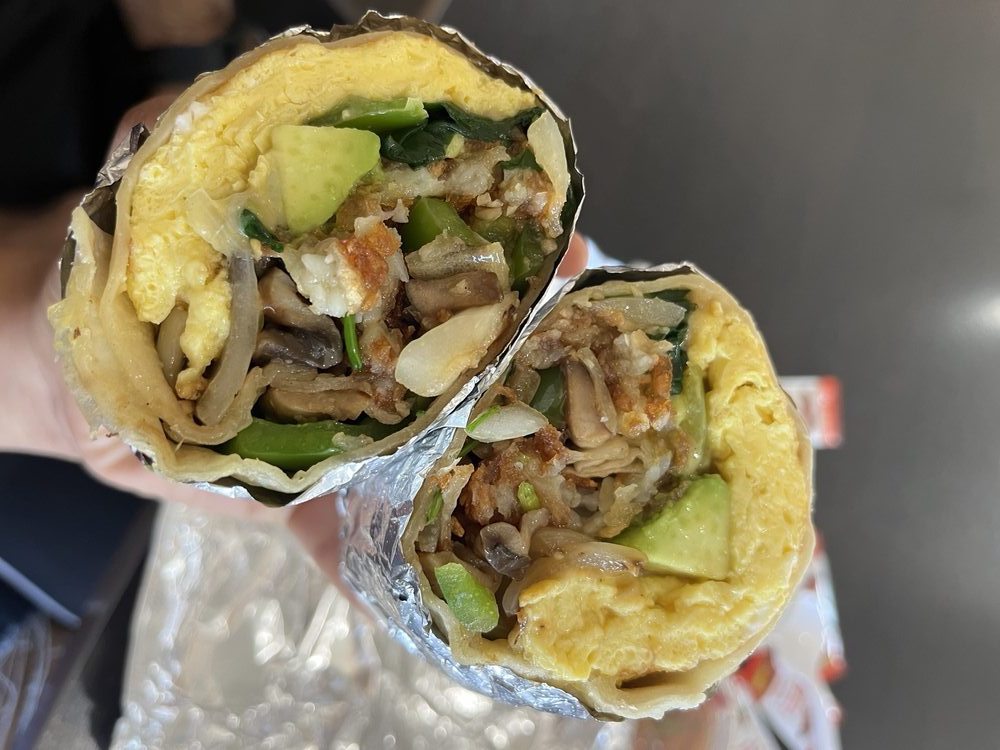
After getting dressed, I told Kathy that I had to take my car down the street to get gas. This was actually a genuine need, so I wasn’t being dishonest. Before returning home, however, I stopped by Rose Café at the corner of Saratoga & Williams Road and picked up a veggie breakfast burrito for Kathy. When I got back home, I put it on a plate and gave it to her.
I’m grateful for the words of author Alan D. Wolfelt, who wrote, “Food is symbolic of love when words are inadequate.”
Whew!
-
Golfing with Dad

“Life doesn’t come with
an instruction book.
That’s why we have fathers.”
H. Jackson BrowneMy Dad enjoyed the game of golf. He occasionally watched television coverage of professional tournaments on Sunday afternoons. He spoke highly of his golf heroes, which included the legendary Ben Hogan, as well as Arnold Palmer, Jack Nicklaus, Ken Venturi, Al Geiberger, Sam Snead, and the lovable Lee Trevino. He spoke of them as if he knew them personally. I had the pleasure of watching Dad play golf on several occasions when I was just a kid. He hit a good ball off the tee, but like so many other recreational golfers, struggled with his short game.
Dad didn’t have the opportunity to play golf as often as he would have liked. He embraced the traditional paternal role of provider for our family, often balancing multiple jobs, which left little time for golf. During his years in the San Francisco Fire Department, he continued to work a variety of side jobs on his days off. And by the mid-1960s, he devoted countless off-duty hours to preparing for SFFD promotional exams. Opportunities to get out with his friends for a round of golf came few and far between.
I’ll never forget the day Dad invited me to caddy for him. He and some buddies were going to play a round of golf in Sonoma. I’m not sure if it was a summer day or if Dad actually allowed me to take a day off school, but I remember it as a special day. I was probably in fourth or fifth grade at the time. I’m fairly confident that it was on that day that I developed a genuine interest in the game.
Dad and I would occasionally spend an hour or two at the driving range at Harding Park in The City. On other days, usually in the late afternoon or early evening, we’d practice putting on the public practice greens at 19th & Wawona Street. I listened attentively as Dad would teach me both the fundamentals and the etiquette of the game. Eventually, I found the courage to venture out on my own. I began with several rounds on the 9-hole Jack Fleming Course, which is located in the middle of Harding Park. When I gained a bit of confidence, I was ready to take on the challenge of the big course, knowing full well that on the 18th tee, I would have to hit my drive over a corner of Lake Merced to reach the fairway. More than just a few of my golf balls found their final resting place at the bottom of the lake.
Strangely, I can recall only once when I played a round of golf with Dad. We played at Harding Park. By the time I was beginning to play regularly, Dad was dealing with significant back issues which precluded him from swinging a club. I know I caddied for him a few times early on, and that, on several occasions, Dad met up with me on the eighteenth tee at Harding Park just to check-in and watch me play the last hole. He also surprised me one day when I reached the 10th green at Lincoln Park Golf Course. He was standing there, just outside the back of the Palace of the Legion of Honor, with my son, Tom, who was about two years old at the time. Great memories, but I would have enjoyed playing more rounds of golf with him.
Author Roland Merullo, in his entertaining novel, Golfing with God, wrote, “There are 8,187 golf courses in heaven.” Perhaps it’s not too late after all.
-
Subscribe
Subscribed
Have a WordPress.com account? Log in now.

