-

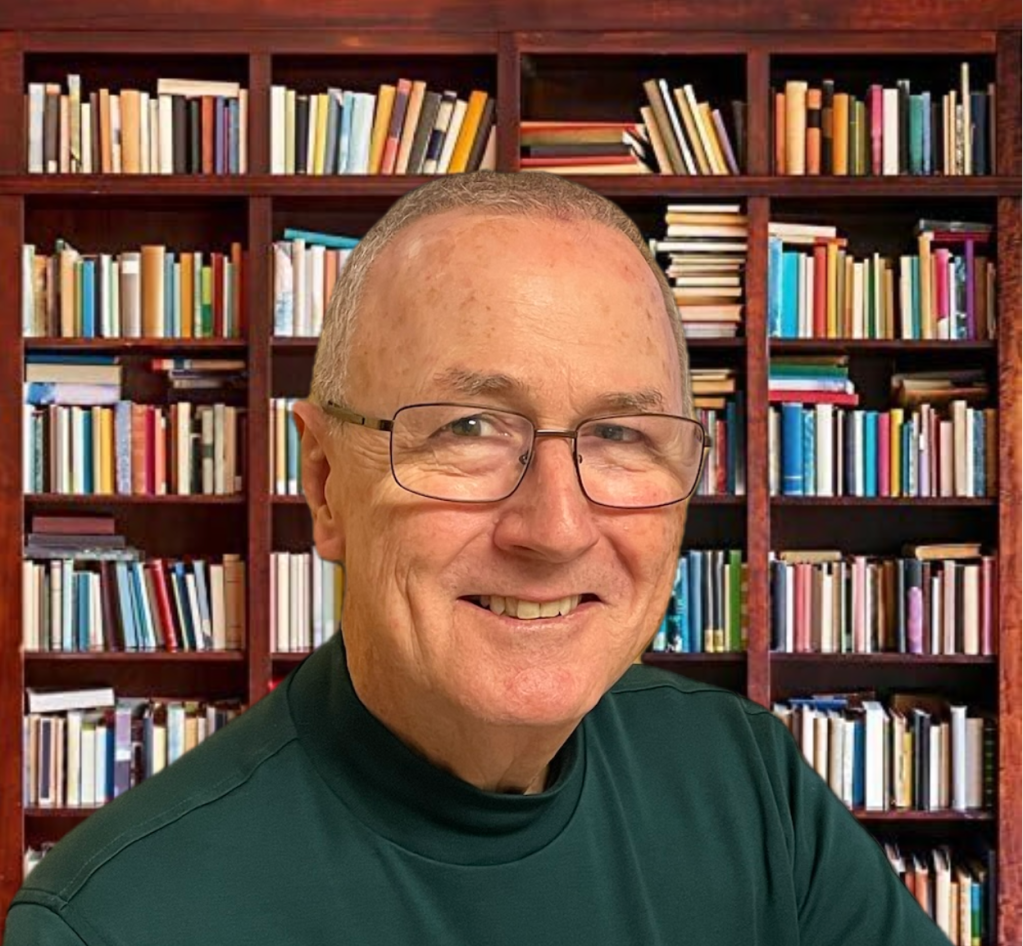
My name is Kevin Carroll. I was born and raised in San Francisco, California, where I attended Saint Ignatius College Preparatory. I am a graduate of both Santa Clara University and the University of San Francisco. Following a 40-year career in teaching and pastoral ministry, I launched a new career as a writer and speaker.
I live in San José, California. My wife, Kathy, and I have three adult sons and five precious grandchildren. I have much for which to be grateful.
I can be reached via email at kmc43sjc@gmail.com
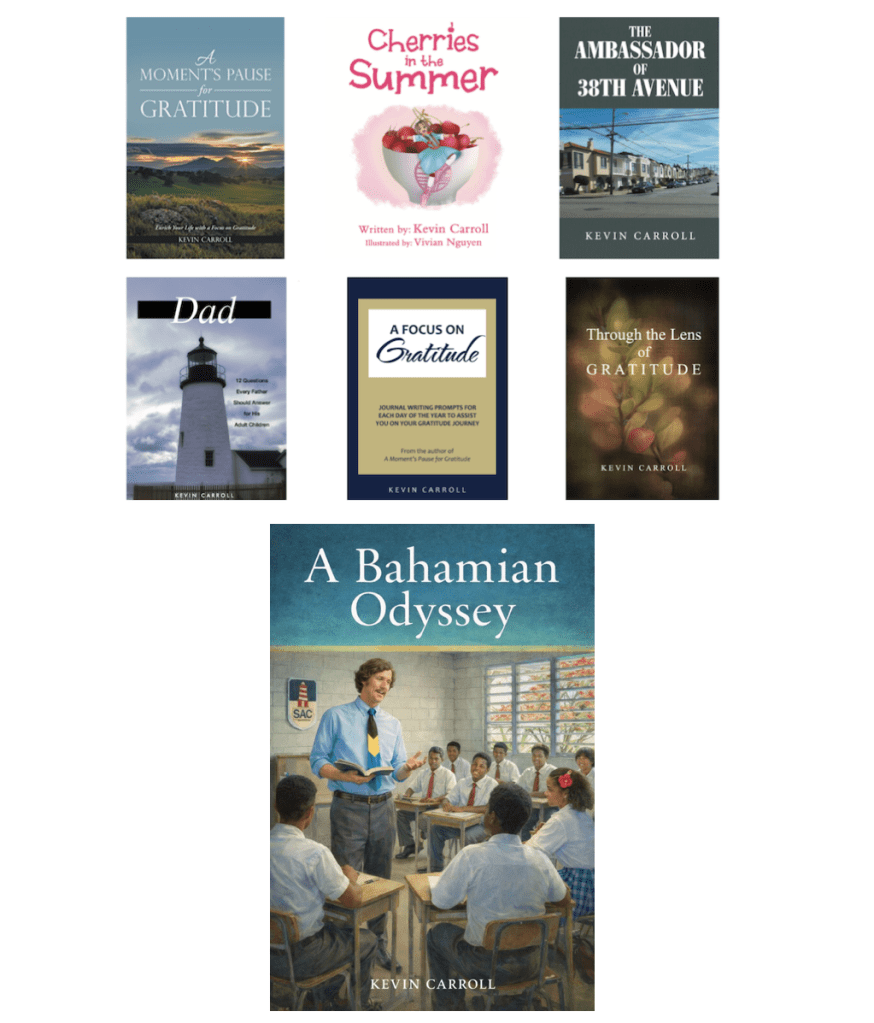
My books are available for purchase online from Amazon. I also have copies of some of these titles at my home for those who would like to buy them directly from me.
A Moment’s Pause for Gratitude (2017)
Cherries in the Summer (2021)
The Ambassador of 38th Avenue (2022)
Dad: 12 Questions… (2023)
A Focus on Gratitude (2024)
Through the Lens of Gratitude (2024)
A Bahamian Odyssey (2026)
-

- October 2026
- September 2026
- August 2026
- July 2026
- June 2026
- May 2026
- April 2026
- March 2026
- February 2026
- January 2026
- December 2025
- November 2025
- October 2025
- September 2025
- August 2025
- July 2025
- June 2025
- May 2025
- April 2025
- March 2025
- February 2025
- January 2025
- December 2024
- November 2024
- October 2024
- September 2024
- August 2024
- July 2024
- June 2024
- May 2024
- April 2024
- March 2024
- February 2024
- January 2024
- December 2023
- November 2023
- October 2023
- September 2023
- August 2023
- July 2023
- June 2023
- May 2023
- April 2023
- March 2023
- February 2023
- January 2023
- December 2022
- November 2022
-
I Could Use Some Help
“I write to discover what I know.”
Flannery O’ConnorAs much as I would like to do so, I cannot, in good conscience, refer to myself as a bestselling author. Yes, I’ve published three books. This is an accomplishment in which I take great satisfaction. More than twenty years ago, I identified “Writing & Publishing a Book” as my #1 bucket list item. The sad reality of the publishing world is that it is quite difficult, and incredibly expensive, to market a self-published book.
In the past few years, I’ve received hundreds of email offers to “take my books to the next level.” These don’t miss opportunities promise national, or even global exposure. My books would be featured at national book fairs. Press releases would be sent to television and radio stations across the nation, which could result in interviews to promote my books. Or not. Who knows? Even Oprah might want to spend a morning chatting with me about my books on Super Soul Sunday. Of course, all this would come at a cost — a hefty cost.
It has never been my intention to be a bestselling author. I’ll readily admit, however, that if it happened, I’d be totally okay with it. It was also never my intention to get rich from writing books. Authorship, for most writers, is rarely a lucrative endeavor. My publishing goal was fairly simple: to use my God-given gift of writing to inspire readers in whatever way possible.
Other than a few articles, shared in publications such as Genesis (the St. Ignatius College Prep alumni magazine), the Santa Clara Weekly, and the Sunset Beacon, my marketing has been limited to word-of-mouth, Facebook, and a few book talks at various venues. The Cherries in the Summer book, which was illustrated by a 12-year-old student from St. Victor School in San José, caught the attention of Garvin Thomas at NBC Bay Area. He produced a nice video story about the book on his Bay Area Proud segment.
While sales of all three books have exceeded my expectations, none of them fall into the category of bestseller. What saddens me, though, is not the number of books that have sold. It is that even people I’ve known for many years have admitted to me that they were unaware that I had written and published any books. For this reason, I think it’s important for me to put out occasional reminders, and to seek the support of people I know. Perhaps one of the books would be an appropriate gift for a friend, neighbor, or coworker.
I love to write. Doing so nourishes my soul. My experience of writing is similar to that expressed by author Isaac Asimov who wrote, “Writing, to me, is simply thinking through my fingers.” Unfortunately, this blog, like my books, has limited readership. I’m grateful to those who read what I write, and I’m grateful to those who have subscribed to A Beacon of Light. (It’s free!) Subscribers receive a link to each blog post in their email. I’m well aware that what I post on social media reaches a relatively small number of readers. Having the help of family and friends to market my books, and this blog, would be greatly appreciated.
If you find my writing to be interesting, entertaining, or inspiring, I invite and encourage you to share the link to this blog with family and friends: https://abeaconoflight.life/
-
The Curse of Self-Doubt

“You will find yourself in spaces
no one thought you would be in,
including you.
When you get there,
and you will get there,
trust that you belong there.”Nakeia Homer
Throughout my life, there have been many times when I questioned the validity of who I was and what I was doing. I honestly believed that if people actually knew me as well as I know myself, they would be incredibly disappointed. I believed that if people knew my background and my credentials, or lack thereof, they would consider me a fraud.
At the age of 17, I found myself teaching a once-a-week sixth-grade religion class at Our Lady of Mercy Parish in Daly City. At the age of 18, I was hired to supervise boarding students at Bellarmine College Prep in San José. At the age of 20, and lacking a college degree, I was a full-time faculty member at a catholic high school in the Bahamas. When I was 21, I was accepted to Santa Clara University in a somewhat non-conventional way. At the age of 24, I graduated from Santa Clara with a Bachelor’s degree in English. Me,… a college graduate. Imagine that!
A couple of years later, my principal at St. Christopher School in San José urged me to get my Master’s Degree in school administration from the University of San Francisco. After an initial rejection by the university, I was admitted to the program in, again, a non-conventional way. At the age of 30, I completed the two-year program and earned my Master’s degree. Imagine that!
In my second year at U.S.F., I accepted a job as vice principal at a catholic school in Los Altos. Due to less-than-desirable circumstances at the school, I requested, and was granted, a mutually-terminated contract just three months into the academic year. In need of a job, I stopped by Kennedy Business Machines in downtown San José to get my typewriter fixed. I needed to update my resume. While there, the owner, Frank Fonteyn, invited me up to his desk on the mezzanine level of the building. When I told him I was looking for a job to get me through the next few months, after which I would return to teaching, he said, “Come in tomorrow morning by 7:30,… and wear a tie.” The next morning I was introduced to the leadership team as the new Operations Manager for the company. Me? A role in management? Imagine that!
Time and time again, I found myself in places I didn’t expect to be, doing things I didn’t know I could do. Yet, as Nakeia Homer promises in the quote above, when I got there, I had an unexplainable sense of belonging. I never doubted my ability to successfully perform the various jobs for which I had been hired. Still, I thought, “If people really knew…”
I guess I’m not the only person to deal with this apprehension, because there’s even a name for it: Imposter Syndrome. Wikipedia describes the condition as “a psychological occurrence in which an individual doubts their skills, talents, or accomplishments and has a persistent internalized fear of being exposed as a fraud.” I even struggled with this malady after publishing my first book. Was I really a legitimate author or was I, somehow, trying to come across as something I really wasn’t?
Only now, in my retirement, do I possess a true sense of authenticity. I’m a parent, and a good one. I’m a grandparent, and a good one. I’m a husband, and… well,… you’ll have to ask Kathy about this one.
-
I’m Doin’ Okay!
“Sharing tales of those we’ve lost
is how we keep from
really losing them.”Mitch Albom
In reference to my mother’s passing last August, a good friend asked me the other day, “How are you doing?” I’m grateful to say that my response was brief, but honest: “I’m doin’ okay!”
For most people, the death of a loved one is a painful experience. First of all, the actual death, even when we know it’s coming, can leave us feeling a bit disoriented. When there is no prior warning that our loved one is going to die, we can be left feeling absolutely devastated. I’ve experienced both. Secondly, the rituals of paying our respects to the deceased, even when we call these events celebrations of life, can be agonizing. Whether it be a multi-day affair with a wake followed by a formal church funeral and cemetery burial, or a simple memorial service with an urn, the public farewell to our beloved can be excruciating.
Finally, and this just might be the most difficult part, in the weeks and months after the death of our loved one, while everyone around us is returning to business as usual, we continue to experience the sting of our loss. Seeing our family and friends moving on with their own lives can result in feelings of abandonment, or even betrayal.
So how do we cope? After my Dad’s unexpected death in 2008, I was overwhelmed with the reality that those around me had apparently moved on — rather quickly. I, on the other hand, struggled through a process of profound grief which lasted close to a year. No one did anything wrong, but few seemed to recognize or understand the depth of my desolation.
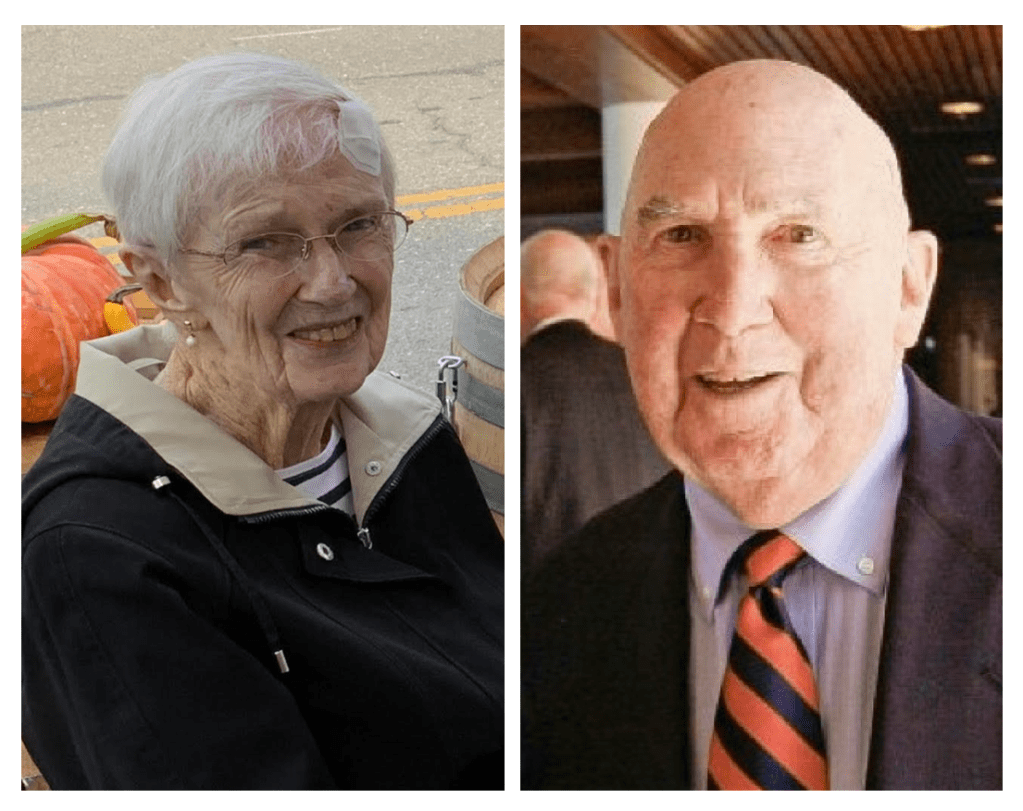
My Mom’s death last August was a very different experience. We knew it was coming. We said our goodbyes. We accompanied her on her journey to death. It was a spiritual experience. Despite this, the sense of loss was real — and still is. I find tremendous solace in sharing stories about my parents. I’m not obsessed with doing so, but when I have an opportunity to mention something I learned from either Dad or Mom, I find tremendous peace in doing so. I might tell a story about my Dad’s experience as a San Francisco firefighter, or brag about Mom’s special way of treating everyone she encountered with kindness and compassion. I thoroughly enjoy doing this when the opportunity presents itself. It is a healing experience for me.
So often, when someone we love has lost a loved one, we feel awkward mentioning the deceased person, fearing that doing so might upset the grieving person. I’ve found that, in most cases, the exact opposite is true. When we ask a friend about the person who died, we not only remind our friend that we have not forgotten their loss, but that we still care about the deceased person and are comfortable mentioning them in our conversation.
Death makes us uncomfortable, whether the loss is our own or that of someone we care for. I think it’s important to reflect on this, to realize, as Mitch Albom reminds us, that talking about those we’ve lost helps keep the deceased person in our lives. Ernest Hemingway poignantly reminded us, “No one you love is ever truly lost.”
-
The Calm Before the Storm

I began my formal education when my parents enrolled me in Tiny Tots at South Sunset Playground in the fall of 1958. Mrs. Virginia Bartleson was my teacher. Having successfully completed the rigorous requirements for graduation, I moved on to kindergarten at Ulloa Annex (38th & Ulloa) the following year. There were two kindergarten teachers at the school. One was Mrs. Bamberger. Of course, the kids all called her “Mrs. Hamburger.” I had the other teacher, Mrs. Malone. My most vivid memories of kindergarten are of snack time (graham crackers and lukewarm milk in half-pint cartons), and nap time. These two years of academia prepared me well to begin my eight-year career at Saint Gabriel School.
Of the years I was enrolled at Saint Gabriel School, the 1964-65 academic year was the most memorable. It was my fifth grade year. I had spent the previous summer enjoying a variety of activities. I spent two weeks as a camper at Silver Tree Day Camp, located in The City behind Glen Park Playground. My family enjoyed a summer vacation at Disneyland. I earned a bit of money cutting lawns for several neighbors. Despite the ever-present Sunset District fog, it was a great summer.
My fifth-grade teacher was Miss Juanita de Leon. Born on February 9, 1936, if she were still alive, today would be her 87th birthday. She was only 28 years old when the 1964-65 school year began. She loved baseball, especially the San Francisco Giants and the Houston Astros. In October, she let us watch some of the World Series games between the St. Louis Cardinals and the New York Yankees during class time. She encouraged my love for writing, which I appreciated. She also asked me, on several occasions, to sit in a chair next to her desk and read off the scores on student tests and assignments as she entered those scores into her grade book. I felt pretty special. After more than 50 years in the classroom, most of those years at Saint Gabriel School, Miss de Leon retired from teaching in June 2013. She passed away in January 2021 at the age of 84.
The 1964-65 academic year was a good year for our sports teams, too. I played on the fifth grade soccer, basketball, and baseball teams. Our baseball team won the CYO city championship that year. I cannot claim to have been a significant contributor to the success of the team, but I enjoyed the experience immensely.
The summer following fifth grade was pretty good, too. Again, I spent two weeks as a camper at Silver Tree Day Camp. My family enjoyed a summer vacation at Pine Grove Resort in Lake County. My parents let my siblings and me sleep outside on the deck of our cabin. It was the first time I had ever experienced sleeping under the stars. Never before had I seen so many stars in the night sky! And to earn a little money for myself, I continued to cut lawns for a few of our neighbors.
I felt pretty good about myself in fifth grade. That would change the following year.
-
A Subtle Reminder
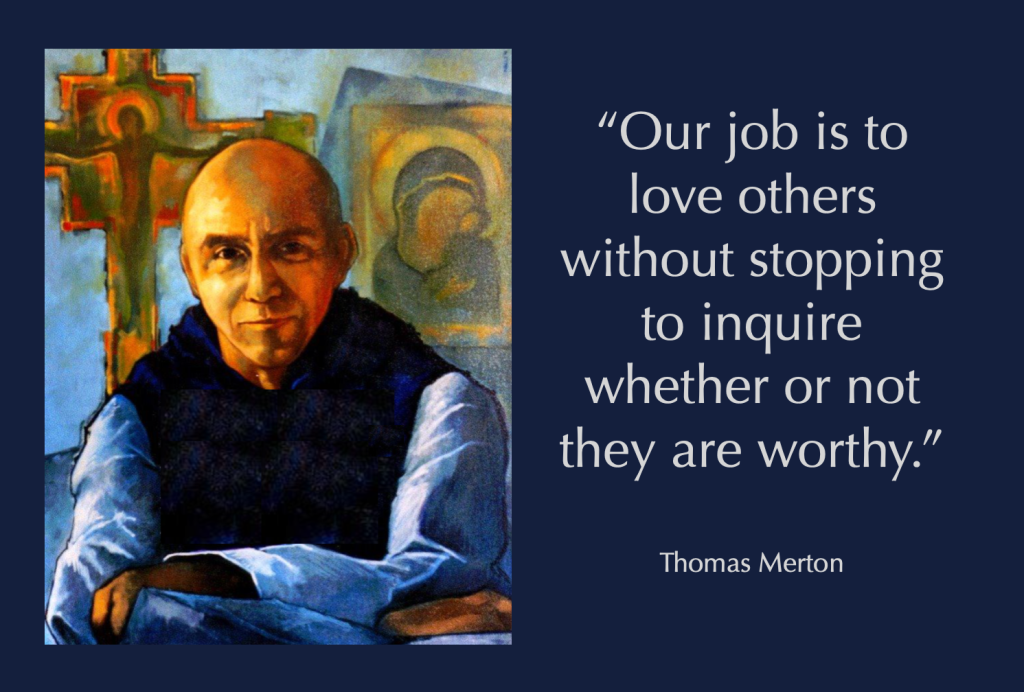
Thomas Merton’s quote is more than just an invitation. It is a challenge to all of us to do exactly what the Gospel message calls us to do.
It’s not always easy.
-
It’s Really That Simple

“Be kind whenever possible.
It is always possible.”Dalai Lama
For sixteen years (2006-2022), I blogged regularly on the importance of gratitude in one’s life. In 2017, I published my first book on the same topic. During these years, I became increasingly aware that there is a related topic of equal, perhaps even greater importance: Kindness.
Opportunities to be kind to others are readily available to all of us. Lucius Annaeus Seneca, a philosopher more commonly referred to simply as Seneca, lived around the time of Jesus. Even at that point in human history, he recognized the value of being kind to others. He said, “Wherever there is a human being, there is an opportunity for kindness.” Yes, it’s that simple.
In my younger years, there were a number of factors which contributed to the level of admiration I had for people. Some of those characteristics were pretty shallow. Others are valid even to this day. As I’ve aged, however, one trait stands out above all the rest. Yes, kindness!
Showing kindness to others is what one might describe as self-serving, even if that is not the intention of the person extending the kindness. Generally speaking, when we are kind to others, most of us experience greater happiness, as well as an increased sense of inner peace. This is how kindness works. And on a more cosmic level, the nicer we are to those around us, the nicer we are treated by others. This, too, is how kindness works.
I’m sure there are some for whom kindness is a sort of currency. We invest in others by doing nice things for them with the expectation that they, or others, will recognize what we’ve done and reward us with praise and recognition. Even in such a case, while the motivation may be less than ideal, the act of kindness itself has tremendous value for the recipient.
There may be some few who, when provided with an opportunity to be kind to others, choose not to help the person at that time, believing that they don’t have the time, or that the person in need of kindness is undeserving of their compassionate care. Two thoughts come to mind. As Ralph Waldo Emerson once wrote, “You cannot do kindness too soon, for you never know how soon it will be too late.” Similarly, the French essayist, Joseph Joubert, reminds us that “A part of kindness consists in loving people more than they deserve.” Now there’s a counter-cultural concept.
Treating someone with kindness when there is no reason nor expectation to do so, is a potent act of courage. Bob Kerry, the former governor of Nebraska, pointed out, “Unexpected kindness is the most powerful, least costly, and most underrated agent of human change.” Compelling words.
The choice to be kind is available to all of us. We encounter countless opportunities to do so every day. Jane Goodall, the English primatologist who has devoted her life to showing genuine kindness to both humans and chimpanzees, challenged us all when she said, “What you do makes a difference, and you have to decide what kind of difference you want to make.”
Goodall exemplifies the reality that kindness is not simply an act. It is a lifestyle.
[Note: For Facebook users looking
to be inspired by the kindness of others,
check out the Daily Dose of Kindness page.
It will lift your spirits.] -
That’s My Home!
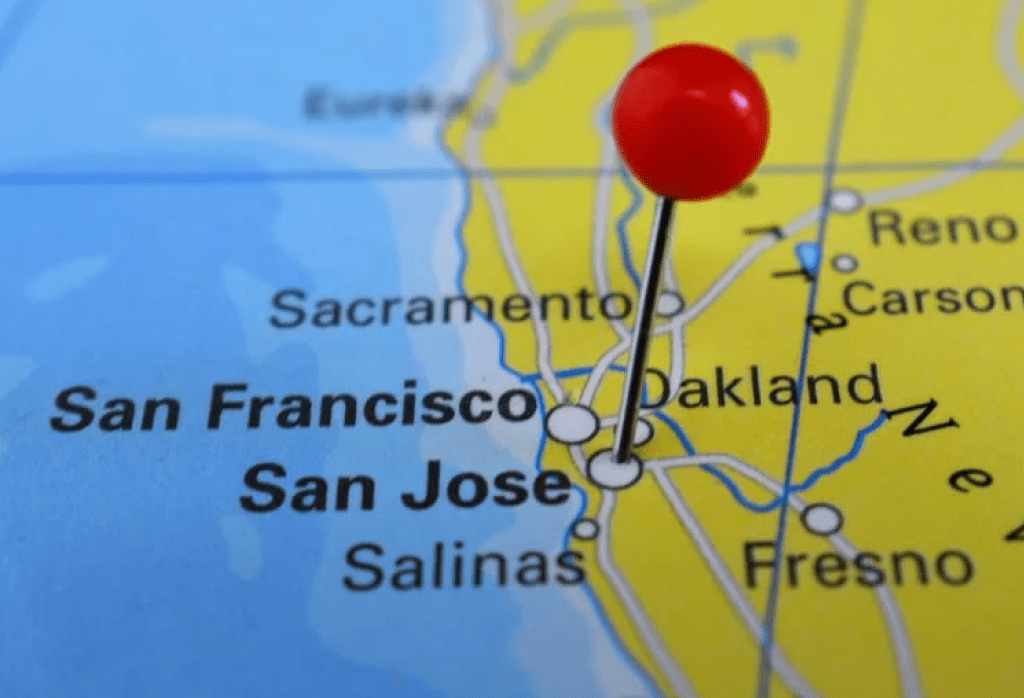
I graduated from high school in June 1972. In late August, I moved into the student dormitory at Bellarmine College Prep in San José. No, I didn’t have to repeat my senior year of high school, although that might not have been a bad idea. About a dozen college students, mostly juniors and seniors, were employed as prefects in the dormitory to supervise the boarding students in the afternoon and evening hours and on weekends. I was a college freshman, but one of my Jesuit teachers at St. Ignatius College Prep in The City had invited me to consider a job in the Bellarmine dorm. It was a good call.
San José and the Santa Clara Valley were quite different in 1972 than they are today. The term “Silicon Valley” did not exist fifty years ago. Apple Computers was founded in 1976. Intel had been around since 1968, but I’m not sure anyone knew what was happening there. Hewlett-Packard had been around for a long time — since January 1939, but I had never heard of them in 1972. Microsoft made their debut in 1975, Yahoo! in 1994, and Google in 1998. Facebook was the new kid on the block in 2004. In 1972, the “sun-kissed Santa Clara Valley,” as Jack London called it in Chapter 1 of The Call of the Wild, was affectionately known as the Valley of Heart’s Delight. The fertile farmland here was home to hundreds of acres of cherry, apricot, prune, peach, pear, and apple orchards. That’s the San José I experienced in 1972.
From the very beginning, I loved living in the South Bay. Having grown up in the cold and foggy Sunset District in San Francisco, I savored the opportunity to go outside wearing shorts and a t-shirt, even in the evenings during the summer and fall. The pace was much slower here than what I had experienced in The City. Public transportation wasn’t so good, so I learned to rely on my 10-speed bicycle to get around. When I had the time, I’d ride my bike to visit friends in Los Gatos, Willow Glen, Almaden, Santa Clara, and other parts of the valley. One day, one of the other Bellarmine prefects and I rode our bikes to Pleasanton for the day to spend some time at the Alameda County Fair. I even ventured up to The City on my bike, mostly along the El Camino Real.
To enhance the furnishing in my room at the Bellarmine dorm, I purchased two dozen square cinder blocks and some pressboard shelving at The Handyman on Stevens Creek Boulevard in Santa Clara. My cousin, Dan, hooked me up with a guy at Santa Clara University who used to collect appliances which had been abandoned in SCU dorm rooms at the end of each school year. He sold me an old, but functional full-size refrigerator and freezer for $25. I made sure to keep a healthy supply of Wilson’s Bakery chocolate chip cookies in my room at all times. For my basic grocery items, I walked around the corner from the dormitory to Bob’s Market on Emory Street, just off Elm. And even though my meals were provided in the Bellarmine dining hall, just up University Avenue, at the Alameda, was Sambo’s, where I could get breakfast, lunch, or dinner any time of day or night.
The primary downside to living in San José fifty years ago was the air pollution. Unleaded gas had just been introduced, but was not yet available everywhere. There were many days when the hills to the east of downtown San José were completely obscured by a thick layer of smog. I recall playing tennis and having difficulty breathing due to the poor air quality. Much improvement has been made in this regard in the past fifty years.
After graduating from Santa Clara University, I made the decision to stay here in the South Bay. For seven years, I rented a cozy two-bedroom home on Lincoln Street in Santa Clara. Then, a year after getting married, Kathy and I moved into our current home in West San José. The orchards are gone. Traffic on the roads can be brutally congested at any hour of the day, with an alarming number of drivers paying little heed to driving laws. Bicycle riding is a dangerous venture now. Crime is far more prevalent than it was in 1972, as is homelessness. Despite it all, as proud as I have always been of being a native San Franciscan, I am grateful to call San José my home.
-
02.05.2023 – Wanna Dance?

It was the summer of 1958. I was four years old at the time. My brother, Tom, was eight, my sister, Cathy, was seven, and my younger sister, Peggy, would celebrate her first birthday a few months later. Our parents took us on a family vacation to Monte Rio, California, along the Russian River. We stayed at a place called Sunny Side Court, which was located just off Highway 116. For the purposes of this article, you may refer to the photos above. Sunny Side Court was small. We had a suite at the top of the stairs.
I have vague recollections of spending our days at the beach on the river. It was different from Ocean Beach near our home in The City. Rather than sand, the beach was covered with rocks. A small portion of the river was roped off for supervised swimming — or, in my case, just playing in the water. I also recall a slide which allowed kids and adults to climb the ladder and slide down into the river. I don’t think I ever tried it.
Looking to the right down the beach, the Bohemian Highway crosses over the river at that point on the Monte Rio Bridge. (As you might imagine, Google Maps was quite helpful in putting my thoughts together for this post.) On the other side of the bridge, there was a small miniature golf course. And, for some reason, I vaguely recall that another family we knew from The City was renting a home adjacent to the mini golf venue, though I do not know who that might have been.
Most of the memories I have of our Russian River vacation are a bit sketchy, but there is one experience I remember vividly. Keep in mind that it’s been almost 65 years since this happened. This event, apparently, was a bit traumatic for me.
One evening, Tom, Cathy, and I went to a dance located in what is now the Russian River Hall. I’m guessing that one of my parents walked us over to the hall, which was just a half-block from our room at Sunny Side Court. (Again, see photo above.) There were a fair number of people of all ages at this dance. My parents had invited guests to our rental for the evening, so I assume we were left under the supervision of some other adult. I seem to recall seeing Tom and Cathy having a great time, but I didn’t want to be there. I most certainly didn’t want to dance.
After sitting on the side for awhile, I was approached by a woman I did not know. She asked me to dance with her daughter. I declined. I’m not sure how quickly it escalated, but she eventually told me, in no uncertain terms, that I had to dance with her daughter. I refused. She was furious. At that point, despite my age, I walked out of the hall — alone — and down the road to Sunny Side Court. After climbing the steps, I sat on a chair outside the front door crying, knowing that my parents had company and not wanting to ruin their night. Before too long, my Dad, who must have heard my whimpering, came out and found me. He picked me up and carried me through the living room and into the bedroom, my head buried in his shoulder. I was so embarrassed.
That’s it. That’s the memory. I cannot say for certain, but I’m pretty sure that experience is the reason I have never liked dancing. Poor Kathy has put up with me, and this dancing phobia, for almost forty years. I used to be willing to dance after three beers, but now I rarely drink. Therefore, I rarely dance. Perhaps some day, I will enlist the help of a therapist to help me work through this issue.
-
02.03.2023 – Prophetic Words
Having completed my Master’s degree in June 1984, I began what turned out to be a 31-year stint in pastoral ministry and education at St. Lawrence Parish and Academy in Santa Clara. I began that work in August with a fair amount of experience for a 30-year old. Previously, I’d worked as a prefect in the dormitory at Bellarmine College Prep in San José for five years. I’d spent a year as a full-time teacher at St. Augustine’s College in Nassau, in the Bahamas. I’d taught part-time at Bellarmine for three of the five years I worked there as a dormitory prefect. And I’d spent four years at St. Christopher Parish and School in San José, where I taught middle school literature for three years and served as the parish Director of Youth & Young Adult Ministry for three years. For two of those four years, the second and third, I balanced both jobs concurrently.
So in the summer of 1984, as I prepared to begin my work at St. Lawrence, someone shared these words with me: “Be careful! Working for the Church will challenge your faith.”
My previous experiences at the three other Catholic institutions had been, for the most part, quite positive. Yes, there were a few incidents at both Bellarmine and St. Augustine’s which were alarming, but they certainly did not “challenge my faith.” Little did I know that the warning I received in the summer of 1984 would be so prophetic.
I should point out that there is a significant difference between my “faith” and my relationship with God. The issues I will mention have not interfered with my relationship with God. We’re good! My faith in the Catholic Church as an institution, however, most notably as I have personally experienced it at the local level, has most definitely been a challenge for me.
There was a time when I believed the Catholic Church was a credible institution characterized by honesty and integrity. I have since learned otherwise. It took awhile, but I finally realized that Church leaders often use the terms “process” and “focus groups” to deceive parishioners and employees into believing that their input is valued and given serious consideration in making significant decisions in the parish and diocese. In my experience, it’s not. And with little accountability for finances, a parish or diocese has the opportunity to manipulate funds to serve their own interests.
There was a time when I believed that all Catholic priests were “men of God,” deserving of the trust and respect of their communities. Wrong again. Certainly there are some priests, maybe even many priests, who are deserving of our trust and respect. In 2023, we all know this is not true for an alarming number of ordained clergy. And sexual misconduct by priests is only part of the problem. I truly empathize with those priests who serve with integrity, who legitimately live the vows they’ve taken, and who understand that their status as ordained ministers does not mean that they are any closer to God than anyone else.
There was a time when I believed that the role of ordained ministers was to “humbly serve” the people of God. Sadly, it seems that too many priests today consider their “vocation” to be a business venture, a source of status, or simply a laid-back job opportunity which requires little effort or accountability on their part. I’ve found it amusing to hear so many priests, when introducing themselves to a new parish community, tell the assembly how successful they had been in the business world and how they sacrificed a lucrative salary to become a priest. That story has gotten old.
There were times, in the sixty years since Vatican II, when I believed the Church would continue moving forward to meet the needs and challenges of the ever-changing modern world. Sadly, it seems that many seminarians and newly-ordained priests today are doing everything possible to drag the Church back to the 1950s.
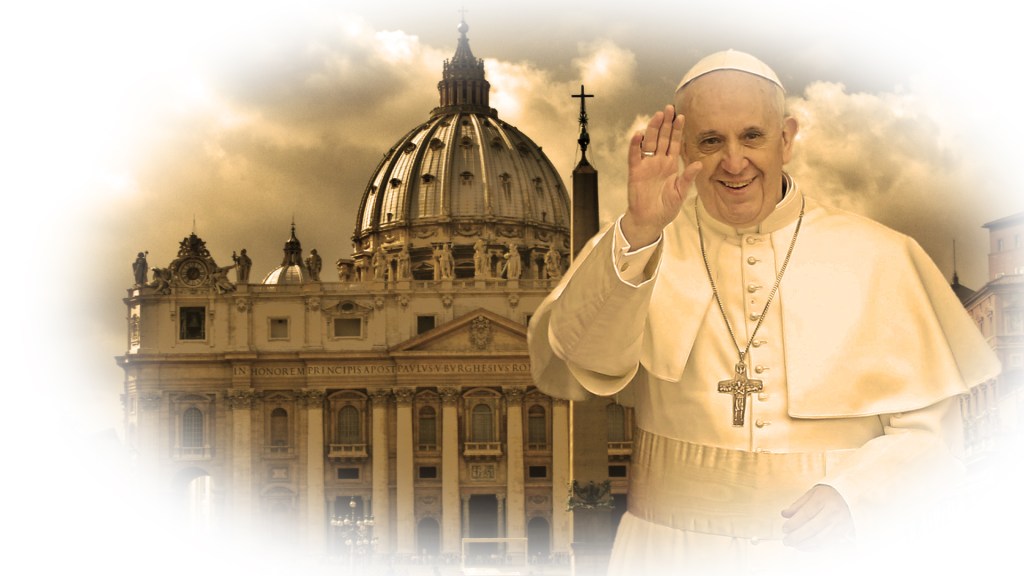
I’ve been impressed by the leadership of Pope Francis I and the efforts he has made to support the vision of the Second Vatican Council. It is sad to see those efforts thwarted by bishops and priests who would prefer to wallow in the Church of the ‘50s. As a result of these bishops and priests, the Catholic Church, at least in the United States, is becoming increasingly obsolete and irrelevant to educated Catholic women and men.
Yes, working for the Church has challenged my faith — my faith in the Church as an institution.
-
02.01.23 – Challenging Times

I enjoyed a nice visit with my longtime friend, Dan Pasini, yesterday morning. We shared our thoughts on a variety of topics, but one particular thing he said was on my mind when I woke up this morning. He mentioned that of all the people he and I know in common, he is the only one who still has a living parent. I think he might be right.
Dan had asked me how I was doing after the death of my mother. I appreciated his asking, and I was grateful to be able to tell him that I’m doing well. How blessed I was to have Mom in my life for 68 years. How blessed I was to see a woman continue to grow spiritually and emotionally into her ‘90s. How blessed I was to have the opportunity to walk the journey with Mom in her final weeks. Yes, I’m doing well, thank you.
It’s no secret that, for so many others, death comes prematurely. Even as I write this, I question my use of the word prematurely. While there is much I don’t understand about life and death, I believe that God has a plan for each of us. This makes me realize that a person who dies in their thirties, forties, or fifties has not necessarily died prematurely. This word simply means that, for those of us who are coping with the loss of a loved one, the person died before we were ready to say goodbye.
Mom did not die prematurely. Even my Dad, who died at age 82, did not necessarily die prematurely. His death was sudden and unexpected at that time, but his death was inevitable. I only considered it to be premature because I wasn’t prepared for such a significant loss at that particular time in my life.
I came across an interesting quote this morning. In his book, The Wild Edge of Sorrow: Rituals of Renewal and the Sacred Work of Grief, author Francis Weller discusses how we might respond to the loss of a loved one. He wrote:
“We may be able to honor the losses
and live our lives as carriers
of their unfinished stories.”My first thought, upon reading this, was that my mother had no unfinished stories. She lived a full life, complete with countless joys and sorrows. She died less than a month before her 93rd birthday. Unfinished stories? Well,… yes.
Should Mom have lived to the ripe old age of 100, which is something she had no desire to do, she would have continued to do what she did. And what did she do? Throughout her life, and even into her final days, she cared about people. She treated people with kindness. She empathized with the losses of others. She listened intently as people shared their stories. And, from time to time, she imparted little pearls of wisdom for those of us who are still trying to find our way in this world. In other words, she was quite busy!
Anyone who is grieving the loss of a loved one has the opportunity to honor that person by continuing the good work that person did in their lifetime. By consciously doing this, we might be better able to embrace the grief — and honor our loved one.
-
Subscribe
Subscribed
Have a WordPress.com account? Log in now.

