-

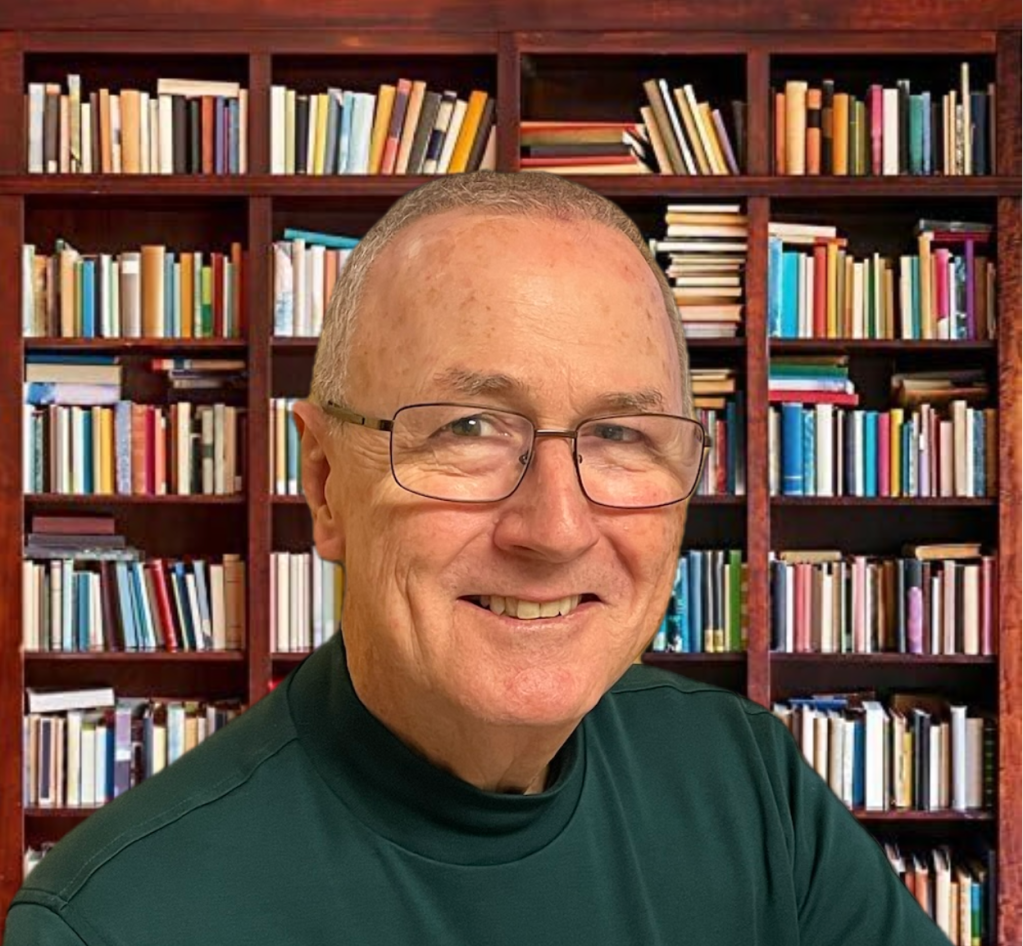
My name is Kevin Carroll. I was born and raised in San Francisco, California, where I attended Saint Ignatius College Preparatory. I am a graduate of both Santa Clara University and the University of San Francisco. Following a 40-year career in teaching and pastoral ministry, I launched a new career as a writer and speaker.
I live in San José, California. My wife, Kathy, and I have three adult sons and five precious grandchildren. I have much for which to be grateful.
I can be reached via email at kmc43sjc@gmail.com

My books are available for purchase online from Amazon. I also have copies of some of these titles at my home for those who would like to buy them directly from me.
A Moment’s Pause for Gratitude (2017)
Cherries in the Summer (2021)
The Ambassador of 38th Avenue (2022)
Dad: 12 Questions… (2023)
A Focus on Gratitude (2024)
Through the Lens of Gratitude (2024)
A Bahamian Odyssey (2026)
-

- October 2026
- September 2026
- August 2026
- July 2026
- June 2026
- May 2026
- April 2026
- March 2026
- February 2026
- January 2026
- December 2025
- November 2025
- October 2025
- September 2025
- August 2025
- July 2025
- June 2025
- May 2025
- April 2025
- March 2025
- February 2025
- January 2025
- December 2024
- November 2024
- October 2024
- September 2024
- August 2024
- July 2024
- June 2024
- May 2024
- April 2024
- March 2024
- February 2024
- January 2024
- December 2023
- November 2023
- October 2023
- September 2023
- August 2023
- July 2023
- June 2023
- May 2023
- April 2023
- March 2023
- February 2023
- January 2023
- December 2022
- November 2022
-
Magical!

“One of the
most spectacular
North American
train trips.”
New York TimesOperating in Mendocino County since 1885, The Skunk Train has earned acclaim for its scenic route through the redwood forest. Yesterday, Kathy and I enjoyed a ride on the Wolf Tree Turn, a breathtaking two-hour journey departing Willits and traveling over the highest point of the rail line and down into the picturesque Noyo River Canyon.
The experience began at the train depot in Willits. The old-style train chugged through town, across Main Street, then up into the hills to the west. One of the conductors used the exceptionally-effective sound system to provide information about various points along the way, and to share the interesting history of the rail line.
One of the other conductors was a gifted guitarist and singer. He meandered through the train cars serenading passengers with a variety of mostly train-themed songs.
Near the town of Crowley, the train made a 30-minute stop for lunch at a remote picnic area where the famous Wolf Tree is located. The tree gets its name from its sprawling branches and a distinctive overgrowth off one side. We had pre-ordered our lunches and picked them up prior to boarding. The sandwiches and drinks were packed in thermal lunch bags to keep them cold. We enjoyed our meal sitting at a shaded picnic table under a large tree.
Kathy and I enjoyed meeting some of the other passengers on the train. It’s amazing how a shared experience like riding the Skunk Train can provide a tangible sense of connection among strangers. Two of the couples we met happened to be from Austin, Texas, though they were not traveling together. We had a delightful conversation about the differences between living in California and the Lone Star State.
Overall, the experience was well worth the cost. More than likely, however, I consider it a one-time adventure for us. Though we enjoyed it immensely, and would highly recommend it to friends, it’s unlikely that we will ride the Skunk Train again.
I must say that I question the validity of the New York Times quote above. Was it a spectacular train trip? I would say yes, it was. Is it one of the most spectacular in North America? Given the many other opportunities to travel by train in the United States and Canada, I sincerely doubt it. If I ever take an extended journey by train, I want it to be on the “Journey Through the Clouds” trip on the Rocky Mountaineer. Until that time, if it ever happens, I’ll stick with taking CalTrain from Santa Clara to San Francisco. I wouldn’t describe that particular route as scenic, but when travelers arrive on CalTrain in The City by the Bay, they experience one of the most beautiful cities in North America.
-
Small Towns
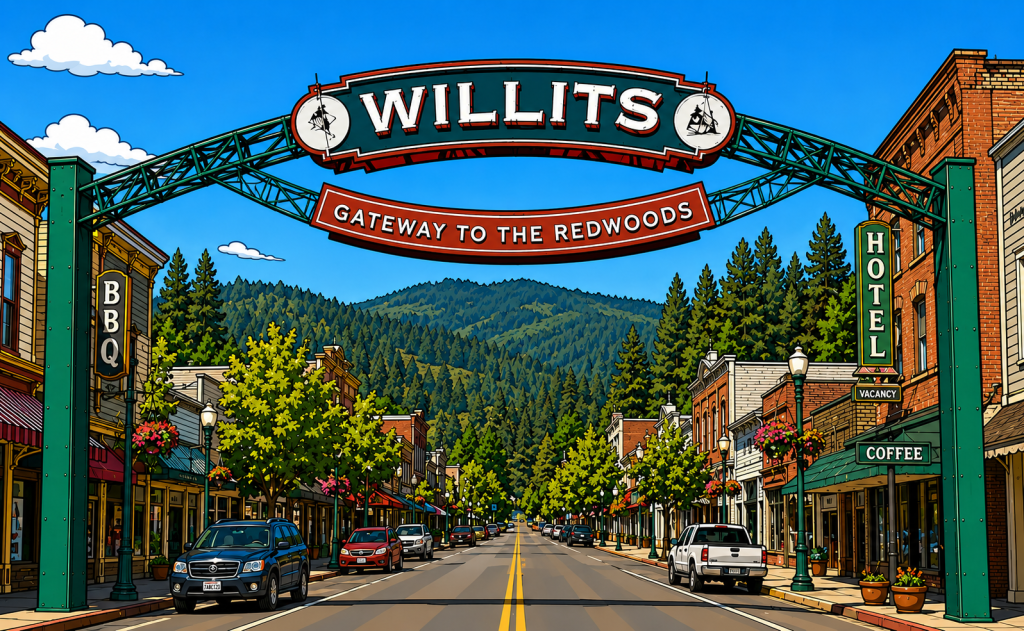
“Small towns are
beautiful reminders
that community
and connection matter.”
Arthur VanceI’ve been a “City Kid” my entire life. Born and raised in San Francisco (population 826,000), I’ve spent my adult years living and working in San José (population 874,000). I’ve grown accustomed to traffic congestion, multiculturalism, and the convenience of having just about anything I need (social, spiritual, medical,…) within close proximity. This has been my life, and I have no regrets.
On the drive from our home in San José to visit Kathy’s brother in Eureka, we’ve passed through several small towns. I’ve often considered what it would be like to live in a small community where everyone knows everyone else. I doubt that I’ll ever know.
As we passed Santa Rosa on Highway 101 (I used to consider Santa Rosa to be a small town, but that’s not the case today), we came upon the town of Healdsburg (population 11,500). Kathy’s brother had recommended that we stop there, claiming it was a quaint little place with a nice vibe to it. He was right. With a charming town square, still decked-out for the 4th of July, Healdsburg offers a refreshing change from the hustle and bustle of the San Francisco Bay Area.
After passing the communities of Geyserville, Cloverdale, Hopland, and Ukiah, we arrived in the town of Willits. I had reserved a room at a local hotel for two nights, enabling us to enjoy a ride on the famous Skunk Train today. Willits encompasses about 2.8 square miles in Mendocino County and has less than 5,000 residents. To put this in perspective, the seating capacity at Levi’s Stadium for a 49ers game is 68,500!
I was told by a local resident that Willits has a “small town mentality,” which he described as a mindset characterized by a strong attachment to tradition, a close-knit but highly observant community, and a general skepticism toward change or outsiders.
My personal observation of Willits is that the people who live here are genuinely hospitable, and have no desire to live anyplace else.
There is a simplicity to a small town like Willits. German philosopher Immanuel Kant once said, “The nice thing about living in a small town is that when you don’t know what you’re doing, someone else does.”
-
On the Road

“If you want
to go fast,
go alone.
If you want
to go far,
go together.”
African ProverbSo many things in life are relative. For example, in San Francisco, any temperature above 85º is officially classified as “extreme heat.” Due to The City’s coastal marine layer, standard summer highs only reach the low 70s. In Palm Springs, however, “hot” weather generally begins when daily temperatures consistently exceed 100º, typically from June through September. “Extreme” conditions are classified as anything above 110º. So what, exactly, is “hot weather”?
Time, too, is relative. A person who flies from San Francisco to Los Angeles on a regular basis, a trip which normally takes only about an hour, might consider the five to six-hour flight from San Francisco to New York City to be quite long — until, that is, they compare it to their once-in-a-lifetime 11-hour flight from The City to Tokyo. Yes, time is relative. So, too, is distance.
Kathy and I embark on what I consider to be a long road trip today. Quite regularly, I drive from our home in San José to The City. I don’t consider that to be a long trip. The 50-mile ride generally takes just about an hour, except during commute times. I can handle that without a problem. Today’s trip, however, begins in San José with our ultimate destination 365 miles away in Eureka, California. This trip is expected to take more than six hours. At my age, that’s a challenge I’m not willing to take on.
For this reason, we’ll only drive as far as Willits, California today. We’ll spend a full day there tomorrow so that we can enjoy a two-hour ride through the redwoods on the Skunk Train. The highlight of the trip will be a visit to the historic Wolf Tree near the town of Crowley Lake (population 980), which sits at an elevation of 6,939 feet above sea level.
On Monday morning, we’ll continue on our way to Eureka where we will have the opportunity to visit with Kathy’s older brother, John, and his wife, Linda. John moved to Eureka back in the 70s to attend Humboldt State University. He loved the area so much that he decided to make it his permanent home. We’re looking forward to our visit with him.
So yes, I do consider a drive from San José to Eureka to be far. For this reason, I’m grateful to be taking this trip with Kathy. As the African proverb quoted above states, “If you want to go far, go together.”
-
07.17.2026

-
A Modest Proposal

“Do not spoil
what you have
by desiring
what you have not.”
Ann BrasharesThere’s a fine line between being content and being complacent, but that’s not what I want to focus on this morning. Today I would rather focus on gratitude — being grateful for what we already have.
Kathy and I have a home. It has three bedrooms, two bathrooms, a laundry room big enough for a full-size washer and dryer, and a two-car garage. Of course, it also features a living room, dining room, and kitchen. Our condominium home is located in West San José, California.
Driving around the Santa Clara Valley, also known as Silicon Valley, I see some amazing homes in various parts of San José, Santa Clara, Sunnyvale, Cupertino, Saratoga, and Los Gatos. Some of the homes are palatial with professionally landscaped yards. Others are more simple, yet still visually appealing. Some include features which my home does not have — specifically, a large redwood deck or a spacious yard. I look at these homes not with envy, but with appreciation for the beauty they bring to the area.
Would I like to live in one of these homes? Sometimes I think I would, but when I stop and give serious consideration to the possibility, I can honestly say that I am content to live where I do. This is a good thing, since most, if not all, of the homes that catch my attention are out of our price-range. Being content with what we have is a blessing.
Socrates provides some food for thought regarding this matter. He said, “He who is not contended with what he has would not be contented with what he would like to have.”
Plato, too, addressed this topic with the simple statement, “The greatest wealth is to live content with little.” For me, I just try to live my life content with what I have.
Alan Cohen, the author of 22 inspirational books, wrote, “Contentment is not achieved by having stuff. It is achieved by enjoying the stuff you have.” Absolutely.
I believe that most of us have purchased items which, at the time we bought them, seemed like they would provide us such happiness, only to find that, over time, they lost their importance to us. Like so many other possessions we own, we end up taking them for granted. They lose their specialness, and we lose our appreciation for them.
In her book, Voyage to Happiness, Sanchita Pandey wrote, “Never let the things you want make you forget the things you have.” And yet, we do. Perhaps it’s just human nature to do this, but I’ve learned that it’s a sure path to discontent.
I can relate well to Canadian author Marty Rubin’s words. He wrote, “It is so relaxing to want nothing.” The problem with this idea is that it brings me back to the question of the difference between contentment and complacency. Is such an attitude a virtue or a character flaw?
“It’s a funny thing about life,” says American journalist Germany Kent. “Once you begin to take note of the things you are grateful for, you begin to lose sight of the things that you lack.” As I’ve said many times before, gratitude makes a difference!
-
07.15.2026

-
You Matter!

“It is in
our hands
to make a
difference.”
Nelson MandelaFinding meaning in life often comes from recognizing our impact on others. Throughout my professional career, I found meaning in the work I did as an educator. I honestly believe that, despite my imperfections, I made a positive impact on the lives of most of my students.
It’s not enough to simply live. Nelson Mandela pointed this out when he said, “What counts in life is not the mere fact that we have lived. It is what difference we have made to the lives of others that will determine the significance of the life we lead.”
Making a difference is not just the purpose of our work. It is the purpose of our lives. Ralph Waldo Emerson wrote, “The purpose of life is to be useful… to have it make some difference that you have lived and lived well.”
Finding meaning in one’s life can be a bit more challenging during the retirement years. No longer do we have the measuring stick of our jobs to validate that we are somehow contributing to the world in which we live. Surely, there must be other ways we can do this. Thankfully, there are.
The challenge begins with the question of what kind of difference we want to make,… and to whom? Jane Goodall told us, “What you do makes a difference, and you have to decide what kind of difference you want to make.” Bingo! Yes, what we do does make a difference, but is that difference positive or negative?
In his bestselling book, Tuesdays with Morrie, Mitch Albom shares a pearl of wisdom he learned from his former college professor, Morrie Schwartz: “So many people walk around with a meaningless life. They seem half-asleep, even when they’re busy doing things they think are important. This is because they’re chasing the wrong things. The way you get meaning into your life is to devote yourself to loving others, devote yourself to your community around you, and devote yourself to creating something that gives you purpose and meaning.”
I’ve been retired for a little more than eleven years now. In those years, I have continued to write articles for this blog. I have written and published seven books. As a result of the books, I have received invitations to speak on the topic of gratitude at schools, libraries, churches, retirement communities, and a Young Authors Book Festival. I’ve facilitated two retreats, one for nurses at Lucile Packard Children’s Hospital at Stanford, the other for the faculty and staff of Saint Leo the Great School in San José. And I was invited to be the keynote speaker for the YMCA Youth Development Leadership Conference in Morgan Hill.
More importantly, I have made a conscientious effort to nurture the relationships in my life — with family, friends, neighbors, and people I’ve recently met. In this way, I know that despite my stage in life, I am committed to making a positive difference in the lives of others. The sense of meaning this provides for me is incalculable.
News anchor Tom Brokaw summed it up succinctly when he said, “To make a buck is easy. It’s a lot tougher to make a difference.”
-
Sunday

“A Sunday
well-spent
brings a week
of content.”
English ProverbMy Sunday was well-spent yesterday. This is not to say that other Sundays have been wasted, just that yesterday was one of the better ones. I woke up early, drove to San Francisco, and spent a good part of the day visiting with friends at Java Beach Café on Judah Street. Despite being somewhat overcast, the air temperature was noticeably warmer than a normal Sunset District morning.
So what, exactly, made the day so special? For starters, I ordered a breakfast burrito and hot chocolate. Then I met Marco and Carla, who were visiting The City from their home in Monterrey, Mexico. They were enjoying a breakfast burrito at a table next to me. At one point in our conversation, Carla asked me if I am still working or if I’m retired. I explained that I was an educator for many years and that now, in my retirement, I write. This caught her attention. Carla is a professor in the School of Education at a prestigious university in Monterrey. She prepares her students for careers in the teaching profession. I’m always amazed at the awesome people I meet at Java Beach.
After a while, Pat Maguire, the owner of Java Beach, walked in. We had a quick visit before he got his own breakfast burrito and took it to the back room to do some work. The flow of customers coming in the front door was non-stop.
My friend, Kalia, from Hawaii stopped by for a burrito, as well. We enjoyed a nice conversation, catching up on each other’s lives. It had been several months since we last ran into each other at the coffee shop. Then Beatrice, a neighbor who lives down the street, and her little dog, Buffy, dropped in for a visit.
I had a nice chat with Luis. He works in the kitchen preparing all the meals, including all those amazing breakfast burritos. A short while later, Mike Flaherty walked through the front door. He’s a big guy, also a Sunset District native, who provided security for Pat when they had the grand opening of Java Beach back in 1993. He and Pat have been lifelong friends. I always enjoy my conversations with Mike.
A while later, Ted, the handyman, walked into Java Beach with his dog. Ted just happened to be at 7-11 around the corner from Java Beach after midnight one night when someone decided to throw a rock through the window of the coffee shop. Pat called him. In a stroke of luck, he had a board in the back of his truck which turned out to be the exact dimensions of the window frame. He secured the building for the night.
Just before I left Java Beach to return home, Tom arrived with his guitar. Tom was a window guy. The morning after Ted put the temporary fix on the broken window, Pat called Tom to see if he might be able to replace the window that day. It was a Sunday. Tom was standing in line at Java Beach when the call came in. Pat told him about the window. He acknowledged that he had seen it when he arrived. He told Pat that he had an extra window in his truck that he thought might fit in the frame. It did. Perfectly. In less than twelve hours, the repair job was done.
Normally, I would have stayed to listen to Tom play and sing for a while, but I was ready to head home. Quite regularly, Tom sets up a chair outside the front door of the coffee shop and serenades anyone who will listen — and lots of people listen. He’s an accomplished musician. More often than not, a few other local musicians join him for an afternoon gig. The music is yet another feature that adds to the unique ambiance of Java Beach.
As I drove back to San José, the temperature outside slowly increased from 65º in The City to 89º in Cupertino. I spent the remainder of the afternoon reading in our patio.
Yes, my Sunday was well-spent, and yes, I feel quite content today.
-
< Yawn! >

“The more words
you use,
the less you
actually say.”
Jefferson FisherIt’s Sunday morning! I hope you have some exciting plans for your day. If, by chance, your Sunday schedule includes attending a church service, I hope you have the opportunity to experience a thoughtful, provocative, and inspiring homily.
I never take a good homily for granted. One reason for this is that good homilies are not the norm in Catholic churches. Every now and then, a well-prepared, well-delivered reflection on the Scriptures of the day leaves me wanting more. These tend to be homilies which do not exceed 8 to 10 minutes and which reflect awareness of the everyday lives of those attending the church service.
Sadly, on most Sundays when I attend Mass, the homilist drones on and on, often with no reference whatsoever to the Scripture readings. I’ve recognized a pattern to many of these homilies: In the first five minutes, the homilist tells the assembly what he’s going to tell them. In the second five minutes, he tells them what he told them he would tell them; and in the third five minutes, he tells them what he already told them — using the phrase “My dear brothers and sisters in Christ…” when transitioning from one part to the next. I increase my chances of hearing an excellent homily exponentially when I attend Mass at Mission Santa Clara.
It’s been said that the less you speak, the more weight your words carry. This certainly seems to be true when it comes to homilies. By reducing repetition and unnecessary chatter, the homilist is better able to command greater respect and project more confidence.
Pope Francis recommended that priests should limit their homilies to ten minutes. “After eight minutes,” he said, “preaching gets dispersive and no one understands.”
In his 2013 apostolic exhortation, Evangelli Gaudium (which translates to “The Joy of the Gospel”), Francis wrote, “The homily is the touchstone for judging a pastor’s closeness and ability to communicate to his people. In fact, we know that the faithful attach a great importance to it, and that they often suffer… because the homily is boring, or because it lacks substance, or because it wanders off into generalities that have nothing to do with the people’s real lives.”
Having taught in Catholic schools for more than forty years, I am well aware of the importance of classroom observations and evaluations. Catholic educators are expected to teach clearly, facilitate effectively, motivate appropriately, and communicate with students in a way that acknowledges who and where the students are educationally, developmentally, morally, personally, and spiritually. Catholic school administrators observe, both formally and informally, evaluate, and make recommendations where needed. This type of oversight seems to be missing when it comes to clergy giving homilies at liturgical celebrations.
Poor homilies is just one of many contributing factors to the decline in church attendance in the new millennium. Perhaps it’s time for bishops to require formal, informal, and regular observation and evaluation of those preaching at Catholic liturgies.

-
Just a Thought
-
Subscribe
Subscribed
Have a WordPress.com account? Log in now.

