-


My name is Kevin Carroll. I was born and raised in San Francisco, California, where I attended Saint Ignatius College Preparatory. I am a graduate of both Santa Clara University and the University of San Francisco. Following a 40-year career in teaching and pastoral ministry, I launched a new career as a writer and speaker.
I live in San José, California. My wife, Kathy, and I have three adult sons and five precious grandchildren. I have much for which to be grateful.
I can be reached via email at kmc43sjc@gmail.com
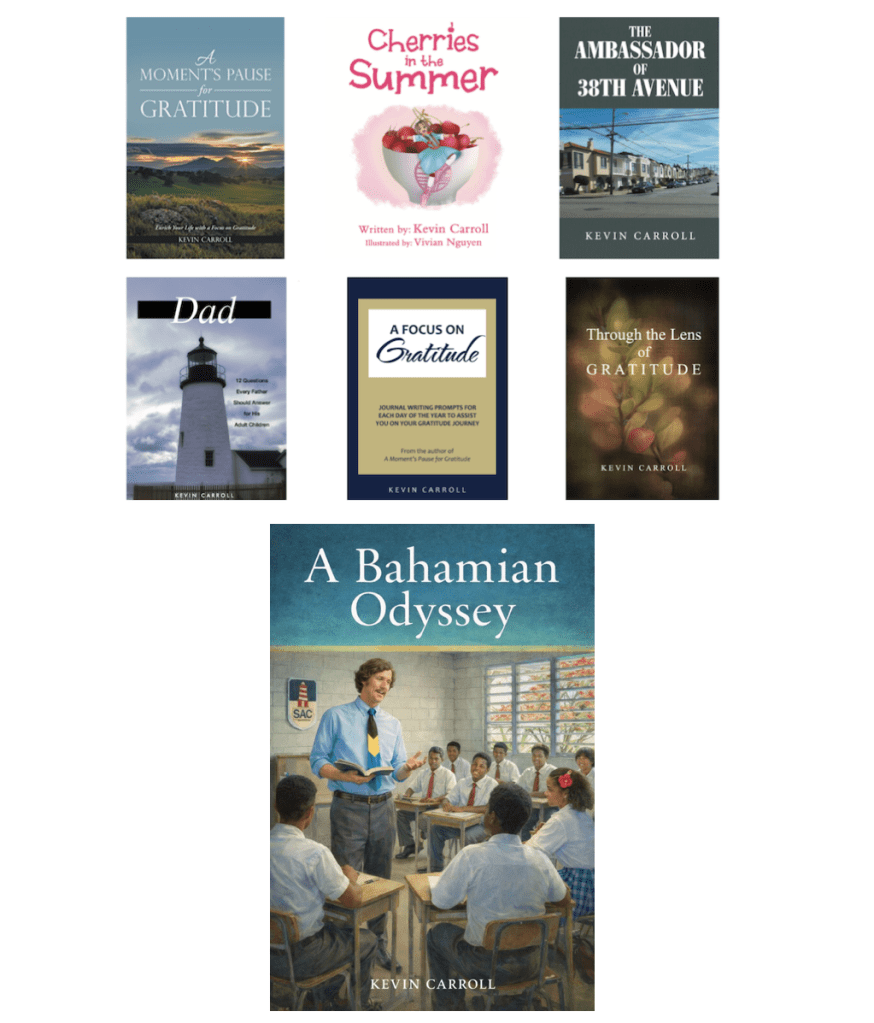
My books are available for purchase online from Amazon. I also have copies of some of these titles at my home for those who would like to buy them directly from me.
A Moment’s Pause for Gratitude (2017)
Cherries in the Summer (2021)
The Ambassador of 38th Avenue (2022)
Dad: 12 Questions… (2023)
A Focus on Gratitude (2024)
Through the Lens of Gratitude (2024)
A Bahamian Odyssey (2026)
-

- October 2026
- September 2026
- August 2026
- July 2026
- June 2026
- May 2026
- April 2026
- March 2026
- February 2026
- January 2026
- December 2025
- November 2025
- October 2025
- September 2025
- August 2025
- July 2025
- June 2025
- May 2025
- April 2025
- March 2025
- February 2025
- January 2025
- December 2024
- November 2024
- October 2024
- September 2024
- August 2024
- July 2024
- June 2024
- May 2024
- April 2024
- March 2024
- February 2024
- January 2024
- December 2023
- November 2023
- October 2023
- September 2023
- August 2023
- July 2023
- June 2023
- May 2023
- April 2023
- March 2023
- February 2023
- January 2023
- December 2022
- November 2022
-
A Package Deal
“Self-acceptance is
without condition;
it means that you
accept yourself as is,
flaws and all.”
Heather LonczakIn the mid-1980’s, U.S. Catholic Magazine published an article titled “Cafeteria Catholicism: Do We Have to Eat Everything on Our Plate?” I was coordinating a young adult ministry program at a Catholic parish in Silicon Valley at the time. The title of this article fueled a lively and thoughtful Sunday night discussion on whether it was permissible for people to pick and choose which parts of the Catholic faith to agree with and which to ignore.
In a similar way, women and men today are confronted with a more personal question: Is it healthy for us to accept only those parts of ourselves with which we are comfortable, and to reject the parts of ourselves that we don’t like and would like to disown?
This is a challenge for many of us. While we want to take ownership of those things which make us feel good and which make us look good in the eyes of others, we often attempt to conceal the parts of ourselves that might be embarrassing or that we believe may result in others thinking less of us.
I read an article yesterday in which the author stated, “Life is a package deal. It is not enough to look only at the parts we like (about ourselves). It is necessary to face the whole picture.”
It’s critical that we not allow ourselves to get into the habit of ignoring or concealing our faults and weaknesses. We need to avoid the trap of denial — acknowledging our weaknesses for what they are, and accepting ourselves entirely, imperfect though we may be.
Though it can be incredibly difficult for us to acknowledge certain things about ourselves, when we allow ourselves to identify our weaknesses and to embrace them as part of who we are, we will experience a level of serenity we might otherwise never enjoy.
Author Brené Brown said this about self-acceptance: “Because true belonging only happens when we present our authentic, imperfect selves to the world, our sense of belonging can never be greater than our level of self-acceptance.” Wise words.
American psychologist Tara Brach pointed out, “We don’t have to wait until we are on our deathbed to realize what a waste of our precious lives it is to carry the belief that something is wrong with us.”
Life is not about attaining perfection. It’s about making progress. A reasonable, attainable goal for all of us would be to be a better person each day than we were the previous day.
One day at a time.
-
Embracing Our Brokenness

“Kintsugi
has transcended
mere repair
to touch upon
values
and ways of
holding your heart.”
Sho TakeshitaThe Japanese art of kintsugi, sometimes called kintsukuroi, is the practice of repairing broken pottery with lacquer mixed with gold. As is illustrated in the photo above, kintsugi can turn a broken object into a masterpiece of art. The practice dates back to the 15th century, when a shogun broke a cherished bowl. He challenged Japanese craftsmen to find an aesthetically pleasing way to repair it. This challenge led to the creation of kintsugi.
Penny Reid, an American bestselling author, is credited with writing one of the most famous modern quotes about this centuries-old Japanese art form. She wrote, “A break is something to remember, something of value, a way to make the piece more beautiful, rather than something to disguise. They used gold, not invisible superglue, because mistakes shouldn’t be considered ugly.”
Kintsugi is not just a method for repairing pottery. It is also a philosophy based on the belief that damage, cracks, and repairs should not be hidden. Rather, they can become treasured and honored parts of an object’s history. By repairing the broken object in this way, the piece becomes more beautiful for having been broken.
Kintsugi has a lesson for all of us. It teaches us how to live happily and gratefully after being broken. Life is not about erasing or hiding the scars we incur, but how we can become more beautiful by embracing those scars. The brokenness and repair are part of who we are, not something to be ashamed of or hidden from others.
No one escapes the experience of brokenness, yet society often encourages us to hide our scars. Genuine healing from illness, disappointment, failure, broken relationships, or regret comes when we acknowledge our wounds and embrace them, instead of pretending they don’t exist. The painful experiences which once defined us can become valuable sources of wisdom, humility, empathy, and resilience.
The “gold” with which we, in our brokenness, are repaired can come in many forms: love and support from family and friends; faith and spirituality; forgiveness; counseling or therapy; recovery and healing communities, or a focus on gratitude. While none of these things can erase the cracks, they all have the ability to transform them into opportunities for growth.
We are not beautiful despite our brokenness. Like a kintsugi masterpiece, we can become more beautiful because our healing has transformed the brokenness of our lives into stories of hope and resilience we can share with others.
All of this invites us to ask ourselves: What cracks in our own lives have become places where compassion, wisdom, or gratitude now shine like gold?
-
And That’s Okay!
“Parting is such
sweet sorrow.”
William ShakespeareAs we grow older, one of the more difficult facts of life we learn to accept is that not every relationship is meant to last forever. It seems to be fairly common that people write others out of their lives for a variety of reasons. Some of those reasons are quite valid. Others, maybe not so much. Either way, it happens,… and when it does, letting go can be an act of self-respect.
People change over time. Life circumstances do, too. People’s values and priorities evolve through the years, occasionally leading to the demise of a relationship. When this happens in our lives, being angry or holding a grudge is pointless. Our task at times like this is to protect our own emotional and spiritual well-being and allow the other person to move on.
Every relationship teaches us something. Most help us come to a better understanding of ourselves. In time, we are better equipped to recognize which of our relationships are truly healthy for us, and which are not. We also have the opportunity to come to a better appreciation for those who truly support us, even when we’re going through difficult times.
For these reasons, it’s best to view the end of a relationship as an opportunity for growth, rather than a personal failure, rejection, or with indifference.
It’s been said that the kindest chapter we can write, for ourselves and for others, is the one in which we gently detach with love, let go, and turn the page.
And that’s an acceptable thing to do!
-
On Happiness

-
Panda-monium!

“Getting together
as a family is a
great way to
reinforce bonds
that have existed
for generations.”Today was “family day” at the pool. Kathy and I thoroughly enjoyed having all three of our boys, along with all five grandkids with us for an afternoon of swimming and snacks. Steve’s wife, Morgan, was able to join us, too. After four hours at the pool, I think we will all sleep well tonight.
American journalist Christopher Morley once wrote, “Cherish all your happy moments; they make a fine cushion for old age.” I have been blessed with an overabundance of happy moments in my life, and even now, I continue to experience them. Certainly, there have been challenging times in the lives of us all, but that’s to be expected. The secret to overall happiness is to focus on the blessings, rather than the hardships.
Happiness isn’t something we randomly find. It’s something we create. As President Abraham Lincoln once said, “Folks are usually about as happy as they make their minds up to be.”
There are two tasks I try to accomplish every day before I get out of bed: (1) to be grateful the many gifts with which I’ve been blessed, and (2) to make a conscious decision to be happy each day. Some days are easier than others, but whether my day turns out to be good or bad depends mostly on my own attitude and outlook on life, rather than the myriad things I experience throughout the day.
As author Roy T. Bennett pointed out, “Attitude is a choice. Happiness is a choice. Optimism is a choice. Whatever choice you make makes you. Choose wisely.”
“Spending time with family
is not a task,
it’s a gift.” -
A Different Vibe

“America celebrated
together at 200.
We won’t at 250.”
John Mark HansenThe day is upon us — the semiquincentennial (meaning half of a 500-year anniversary) of the United States of America. At this point in our nation’s history, I question whether we should continue to use the word “united” to describe our country. Clearly, we’re not.
I recall that in the months, weeks, and days leading up to the bicentennial of the USA in 1976, there was a tangible sense of excitement and national pride. Even though America faced partisan division and economic challenges at that time, as we do today, the 200th anniversary of our nation inspired a unified, grassroots celebration. As we mark the 250th anniversary of our country today, the polarization in our government and communities is exponentially worse.
Political scientist John Mark Hansen recently pointed out, “The vibe at 250 is completely different from the feeling at 200. We still had a sense of oneness then. We no longer do.” Hanson went on to say that amid “major crises of confidence about national values, vices, and virtues,” partisan polarization is significantly higher today than it was fifty years ago.
It seems that the current anniversary of our nation is overshadowed by Trump-centered pageantry. The president’s attempts to honor the birthday of our country seems to be more about him — the wrestling match on the White House lawn, demolishing parts of the White House, his attempt to build a triumphal arch in Washington, D.C., despite the disapproval of a majority of Americans. Trump also seems hell-bent on slapping his name or image on just about anything: Washington’s Dulles Airport, New York’s Penn Station, the Kennedy Center for the Performing Arts, the United States Institute of Peace, and the new stadium for the Washington Commanders professional football team, to name a few. He also wants his image on national park passes and a new $250 bill.
For those of us who remember the excitement of the bicentennial, the semiquincentennial is a complete bust. Throughout the nation, traditional celebrations of the 4th of July — parades, picnics, barbecues, and fireworks displays — will take place as they always do. Compared with the country’s 200th celebration, however, the 250th birthday feels like a total nonevent.
-
On 250 Years

“America means
opportunity,
freedom,
power.”
Ralph Waldo EmersonThe United States of America celebrates its 250th anniversary tomorrow. Throughout much of our nation’s history, Emerson’s quote (above) has been a valid observation. Sadly, this no longer seems to be completely accurate. The challenges of the current state of our union are concerning to many.
For me, this brings to mind the prophetic words of American guitarist, singer, and songwriter Jimi Hendrix. He said, “When the power of love overcomes the love of power, the world will know peace.”
I am hopeful.
-
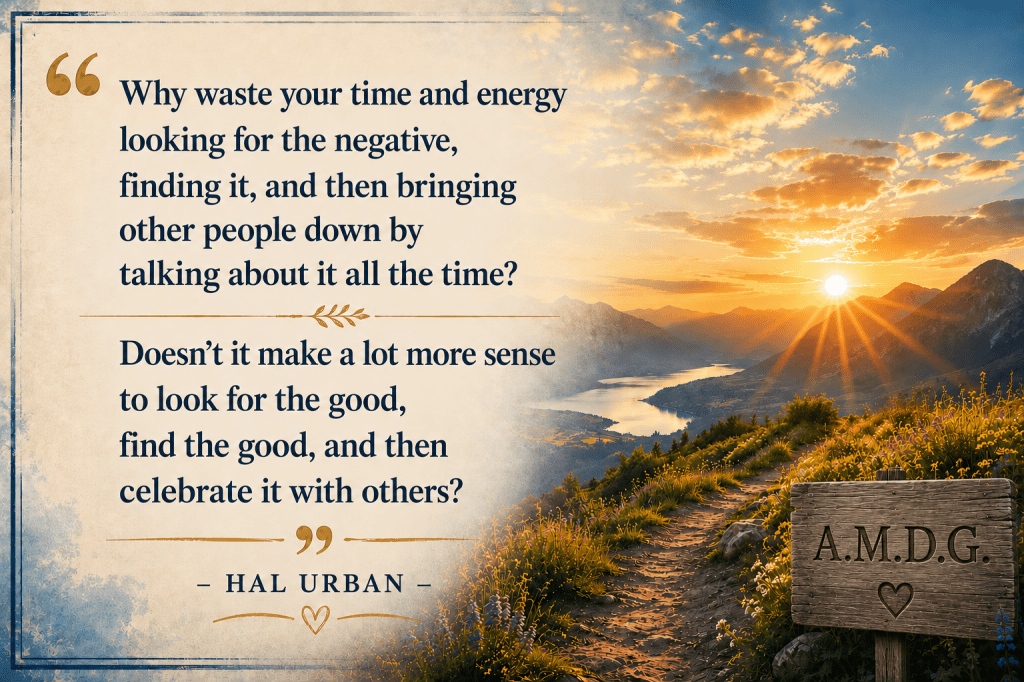
Positivity
-
Integrity
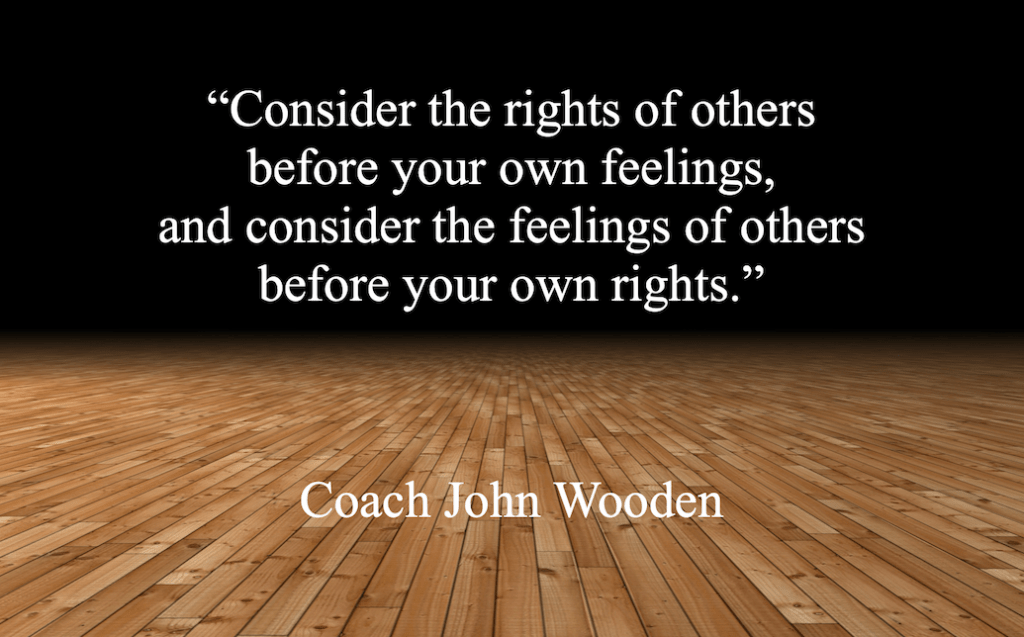
I had the pleasure of an unexpected, one-on-one breakfast with legendary U.C.L.A. men’s basketball coach John Wooden in the summer of 1974. During his years as head coach, the Bruins won ten national championships in twelve years. I have been a disciple of Coach Wooden since that memorable summer morning meal.
Wooden considered himself to be a teacher above all. He viewed coaching basketball as a form of education. In addition to preparing his teams for national competition, he devoted a fair amount of time and attention preparing them for life. He published a number of books, including They Call Me Coach, One-on-One, Wooden on Leadership, and Wooden: A Lifetime of Observations and Reflections On and Off the Court. He also published a book about his Pyramid of Success, a visual image of building blocks for a better life.
When I think about Coach Wooden, of course I remember his incredible success coaching the U.C.L.A. men’s teams through the years. More impressive than the ten national championships, however, was his unquestioned integrity and his desire to share practical wisdom with his players, and anyone who was open to hearing it.
If you’re not familiar with Coach Wooden, I highly recommend that you do a Google search. You will find ample resources to support my claim that he was one of the most respected men in my lifetime. Wooden passed away on my birthday, June 4, 2010, at the age of 99.
“Make each day
your masterpiece.”
Coach John Wooden -
3 Challenges
“Life is about
accepting the
challenges
along the way.”
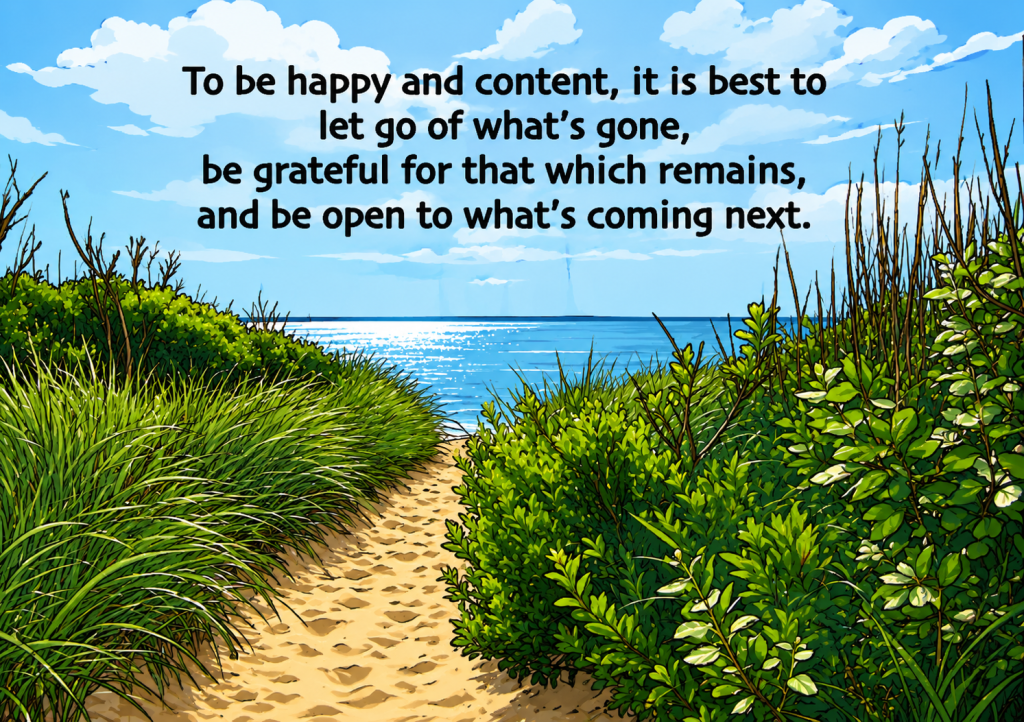
Roy T. BennettThree challenges: (1) to let go, (2) to be grateful, and (3) to be open to what’s coming next. The promise of accepting these challenges is that we will “be happy and content.” Sounds like a pretty good deal, right? Let’s take a quick look at each one.
To let go of what? Well,… let’s begin with negative experiences of our past which we continue to carry with us today. It may be getting cut from an athletic team in high school, or, perhaps, a heartbreaking loss in an athletic competition. It may be a relationship which, despite our bests effort, didn’t work out. It could be something someone said to us or did to us — something which we believe to be unforgivable.
We might also have a need to let go of some of the positive experiences of our lives, not allowing them to define who we are today. Holding onto past glories, identifying ourselves by who we once were or what we once accomplished, can limit our ability to be who we are today.
Why would it be a challenge to be grateful? The reason is simple. It seems to be a human trait to take what we have for granted. Many of us have been blessed with things in our lives which were not of our doing. They were pure gifts. Despite this, we have a tendency to look at the lives and possessions of others with envy, always wanting more than what we have. To be grateful for what we have, rather feeling deprived because of those things we do not have, can be a challenge for many of us.
Finally, why would anyone have a problem letting go of what’s coming next in their life? I think we can all agree that fear of the unknown is a reality with which we all struggle to some extent. Will I stay healthy in my old age? Will there be significant disappointments with which I will have to cope down the road? Do I even have a “down the road” or will my end come sooner than expected? These are all questions which can cause us to experience varying levels of fear and anxiety.
While these challenges might seem overwhelming at times, the payoff — “to be happy and content” — should be sufficient to consider accepting them with enthusiasm.
-
Subscribe
Subscribed
Have a WordPress.com account? Log in now.

