-

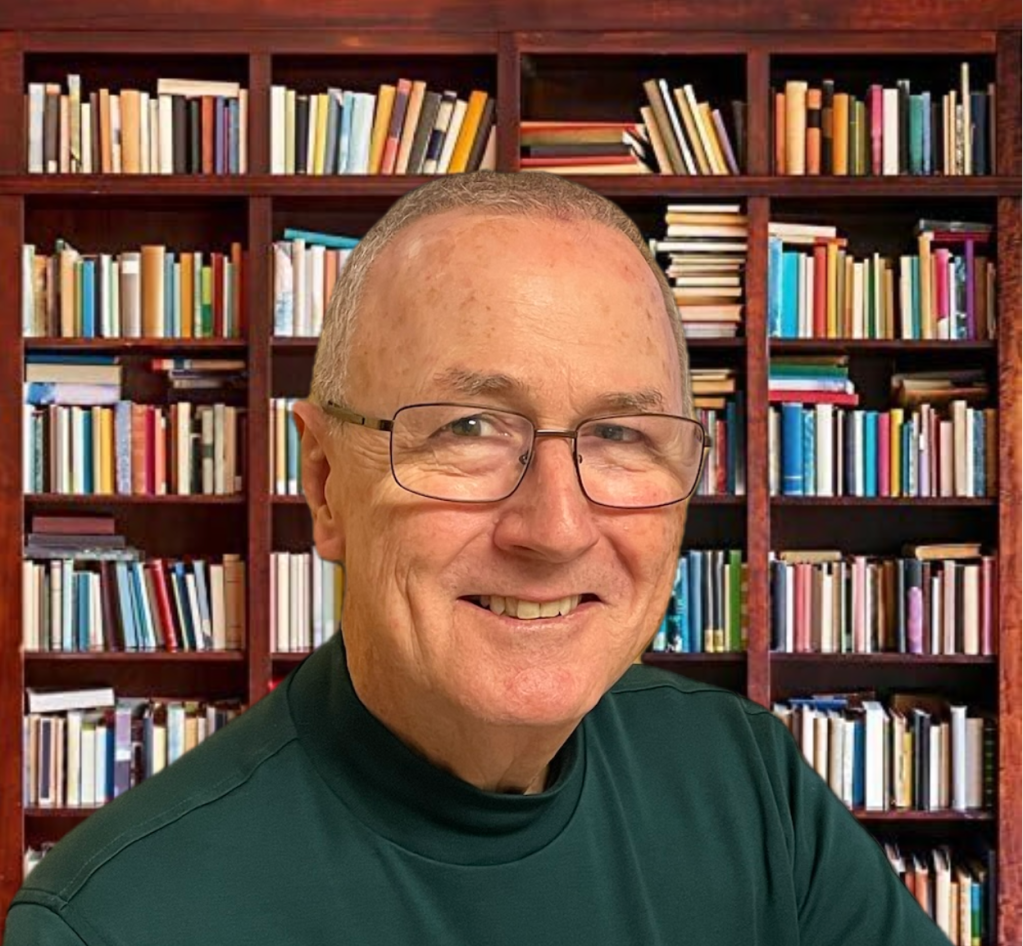
My name is Kevin Carroll. I was born and raised in San Francisco, California, where I attended Saint Ignatius College Preparatory. I am a graduate of both Santa Clara University and the University of San Francisco. Following a 40-year career in teaching and pastoral ministry, I launched a new career as a writer and speaker.
I live in San José, California. My wife, Kathy, and I have three adult sons and five precious grandchildren. I have much for which to be grateful.
I can be reached via email at kmc43sjc@gmail.com
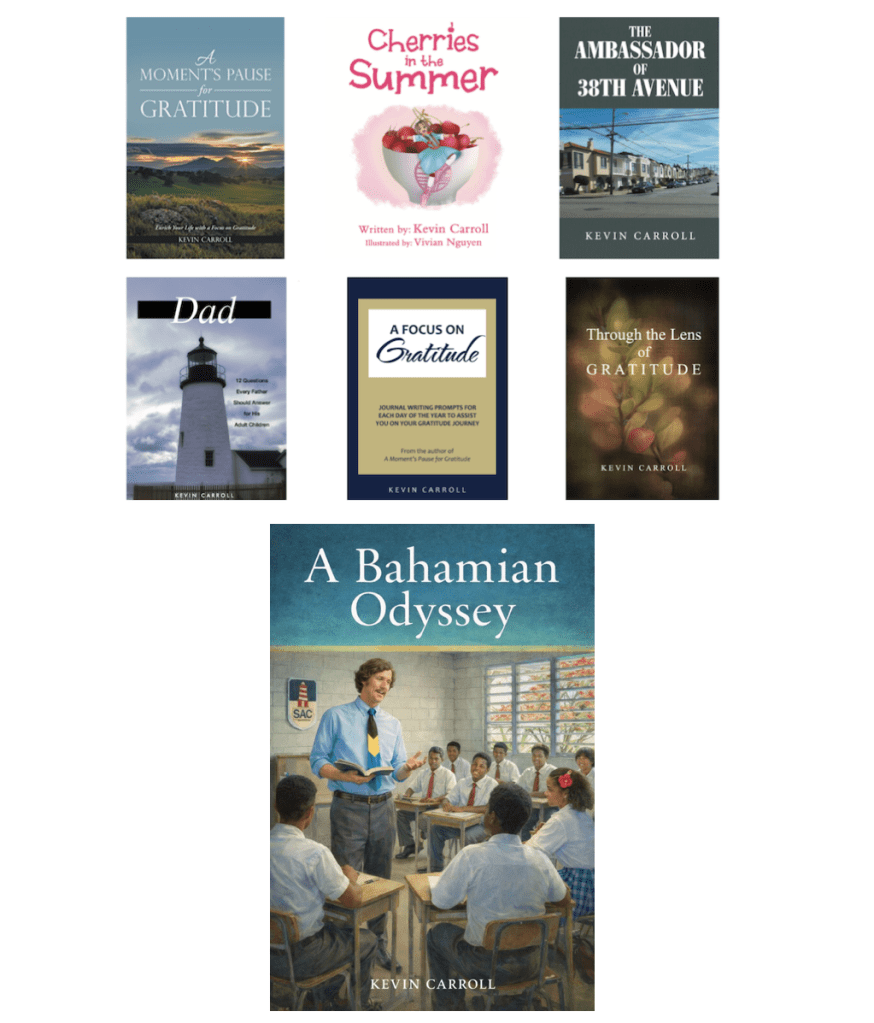
My books are available for purchase online from Amazon. I also have copies of some of these titles at my home for those who would like to buy them directly from me.
A Moment’s Pause for Gratitude (2017)
Cherries in the Summer (2021)
The Ambassador of 38th Avenue (2022)
Dad: 12 Questions… (2023)
A Focus on Gratitude (2024)
Through the Lens of Gratitude (2024)
A Bahamian Odyssey (2026)
-

- October 2026
- September 2026
- August 2026
- July 2026
- June 2026
- May 2026
- April 2026
- March 2026
- February 2026
- January 2026
- December 2025
- November 2025
- October 2025
- September 2025
- August 2025
- July 2025
- June 2025
- May 2025
- April 2025
- March 2025
- February 2025
- January 2025
- December 2024
- November 2024
- October 2024
- September 2024
- August 2024
- July 2024
- June 2024
- May 2024
- April 2024
- March 2024
- February 2024
- January 2024
- December 2023
- November 2023
- October 2023
- September 2023
- August 2023
- July 2023
- June 2023
- May 2023
- April 2023
- March 2023
- February 2023
- January 2023
- December 2022
- November 2022
-
Embrace the Funk

“There is no normal life
that is free of pain.”
Fred RogersIt seems to sneak up on me when I’m least expecting it. Life can be going along smoothly and everything is great. Striving to be positive in everything I do, and promoting positivity in my writing, seems to be an effective way for me to consistently see life through the lens of gratitude — to see the glass half-full, even when things aren’t perfect. Then, when I least expect it, the feeling gently taps me on the shoulder to get my attention, and I find myself lost in a thick fog of uncertainty. There are times when I know why I’m feeling the way I am, yet there are times when I’m clueless about why I’m in a funk. Yesterday was one of those days.
It’s a strange word — funk. Psychotherapist Amy Brodsky describes funk as a fairly short-lived bad day or couple of days. These experiences can be the result of something that’s happened to us, something someone has said to us, uncertainty about our future, or any number of other causes. Most often, people experience a funk for a couple of days before the clouds lift and the world around them seems brighter.
“Going through a funk or rut is extremely common,” Brodsky pointed out. “It happens to everyone now and again and there are no hard or fast rules to getting through it. Everyone is different, so you’ll need to adjust and learn what works best for you.”
One thing is certain. Digging oneself out of a funk is something one must do for oneself. Others may offer compassionate support, but in the end, this is something no one else can do for you. Sometimes it helps to just sit with your feelings, acknowledge them for what they are, and embrace the reality of the moment, confident that things will eventually get better.
One strategy I employ when I’m feeling this way is to sleep. When I’m asleep, I’m not aware of the funk, and time passes, allowing the fog to clear a bit. I went to bed at 8:00 last night and got up at 5:30 this morning feeling much better. I’m still feeling a bit vulnerable today, but I’m in a much better space than I was last night.
I also find it helpful to avoid exposing myself to news coverage. Local and national news teams often exaggerate the actual scope of the issue being reported, leaving viewers with the uneasy sense that things are much worse than they actually are. This, too, can exacerbate the negativity we experience.
Another thing I enjoy doing when I’m feeling low is to go outside either to walk or to just sit in a quiet, nurturing space. Hakone Gardens in Saratoga is one of my favorite places to go. The traditional Japanese garden is an ideal venue for practicing the Japanese art of Shinrin-yoku, or forest bathing. There are benches surrounded by trees along the paths on the hillside overlooking the koi pond which are ideal for this practice. I’m heading up there this morning.
Self-care is essential to all of us, especially in times when we’re in a funk. Yesterday I got a haircut. Then I treated myself to a Haagen-Dazs vanilla milk chocolate almond bar at 7-11. Later today, I’m going to treat myself to a one-hour massage. Self-care is not selfish. It’s an absolute necessity to nurture our physical and mental health.
As I mentioned, most funks are short-lived. I expect this one will be, too. I am always inspired by the words of Anne Frank, who wrote, “What a wonderful thought it is that some of the best days of our lives haven’t even happened yet.”
-
Where I Live
“Silicon Valley is
a mindset,
not a location.”
Reid HoffmanIf you look at a map of Northern California, you will not see an area designated as “Silicon Valley.” This is because, as LinkedIn co-founder Reid Hoffman so astutely pointed out, “Silicon Valley is a mindset, not a location.”
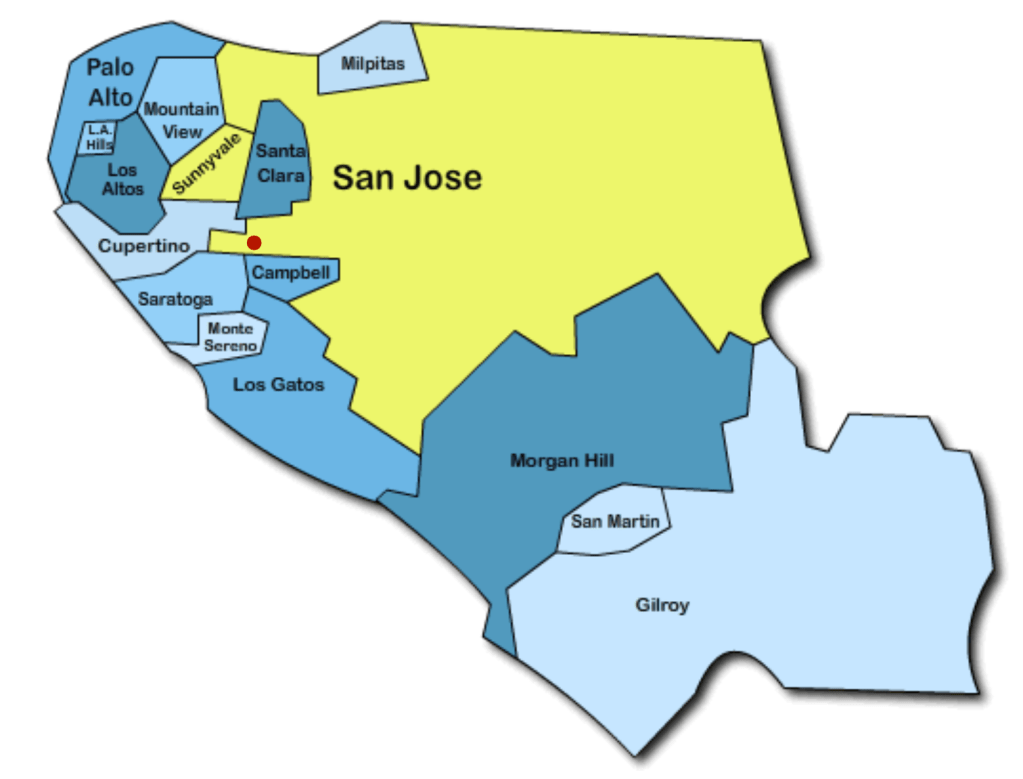
The term Silicon Valley is often used interchangeably with the names Santa Clara Valley or Santa Clara County. The term valley refers to the fact that the county is situated between the Diablo Mountain Range to the east and the Santa Cruz Mountains to the west. Santa Clara County is a conglomeration of cities and towns stretching from Palo Alto to Gilroy. The City of San José, which at one time served as the State Capital, is the largest city in the county. This is where I live.
To say that one lives in San José, however, is quite vague. If I were to travel from Home Depot on South DeAnza Boulevard (San José) to visit Rebecca the Balloon Lady on Pegasus Court (San José), the distance traveled would be about twenty miles. Keep in mind that San Francisco is only seven miles by seven miles — 49 square miles. San José is 180 square miles.
My home is located in West San José. (See red dot on image above.) It’s an ideal place to live, because I can easily walk from my home to the communities of Campbell, Cupertino, and Santa Clara. Of these destinations, my favorite, by far, is the City of Campbell. They have a charming downtown with a variety of excellent restaurants, a number of quaint coffee shops, a few pubs, and an awesome ice cream shop. From time to time, live music is performed inside or outside some of the local businesses. During the summer months, the city hosts free weekly outdoor concerts for the community. Downtown Campbell is located a mere three miles from my home.
Living in West San José also affords easy access to the Westgate Shopping Center (2 miles), Santa Row (2 miles), and Westfield Valley Fair Mall (2.2 miles). Oh, and I should mention that it’s a short one-mile walk to the Paris Baguette Bakery!
To be honest, I don’t relate to the term Silicon Valley. I didn’t work in the tech sector. If I did, perhaps I’d be living in Saratoga, Monte Sereno, or Los Gatos. When I’m around techies, and they start conversing about the latest technological innovations, they may as well be speaking Greek. Not surprisingly, while I have a number of acquaintances who are techies, none are among those I would call close friends.
While the nickname Silicon Valley may be creative and attractive to many, I prefer to simply say that I live in the South Bay. This term refers to our location within the San Francisco Bay Area. With the options of Interstate 280 and Highway 101, The City (that’s San Francisco) is a comfortable one-hour drive from my home. And for those who prefer not to drive, a CalTrain ride from Diridon Station in San José to the San Francisco CalTrain station at 4th & Townsend takes only one hour and 18 minutes. It’s nice to have this option.
So that’s it. I live in West San José — where the weather is ideal, the traffic can be downright dreadful, home prices and rents are outrageously high, and our delightful neighbors come from every corner of the world to live here. It’s a mixed bag, for sure, but I am grateful to call San José my home.
-
Six Weeks
“Start where you are.
Use what you have.
Do what you can.”
Arthur AsheSix weeks ago today, on the morning of June 5th, Brendan was completing the first of his three workouts per day at 24 Hour Fitness in San José. Just a few months earlier, he had launched his new business — True Form Basketball. He had already started working with a number of clients for whom he provided individual basketball training, and was looking forward to slowly growing his business.
That morning, as Brendan drove to the hoop and elevated for a slam dunk, the patellar tendon in his right knee ruptured. The next day, he underwent surgery to repair the damaged tendon. The six weeks since that surgery have been spent patiently waiting for the tendon to grow together again. Brendan’s leg has been immobilized, yet it is weight-bearing. His physical therapy appointment last week went well. The therapist told him that she was impressed with his overall physical condition and pleased with the progress he’s made with the knee so far. She encouraged him, “Keep doing what you’re doing.”
This past Saturday, Brendan and I went for a walk. With his leg still in a brace to immobilize the knee, we walked from our home in West San José to Santana Row, then across the street to the Valley Fair Westfield Mall where we did even more walking. On a number of occasions, I asked Brendan how he was feeling. Each time he indicated that the knee felt good.
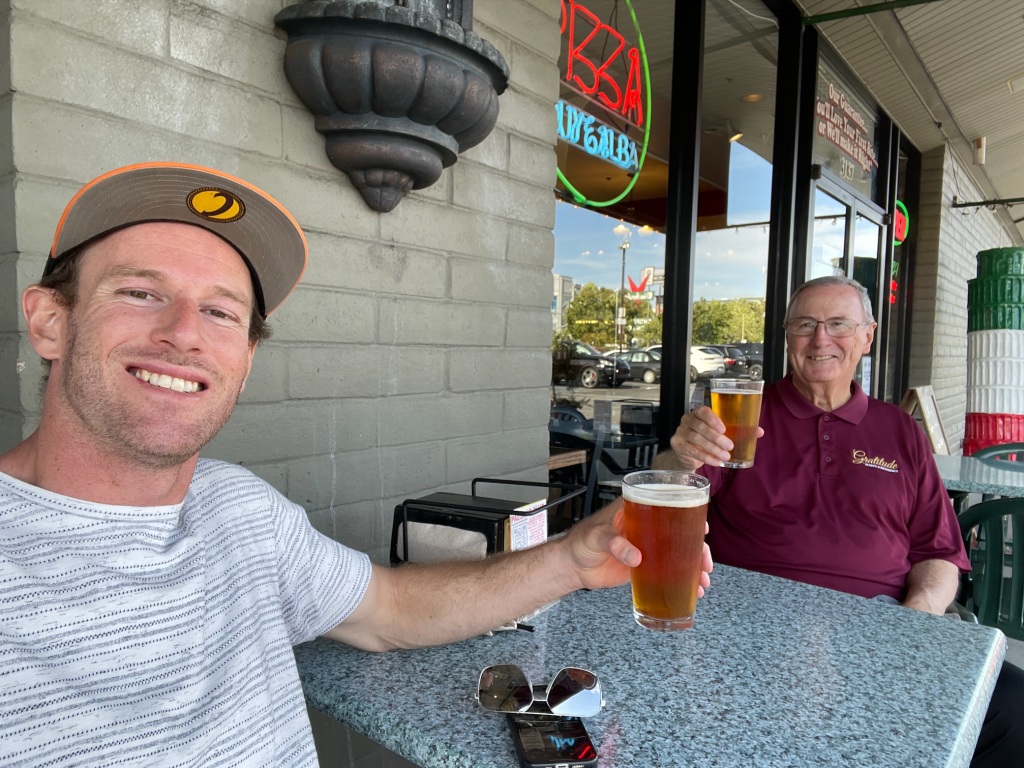
Before heading back home, we stopped for a break at Tony & Alba’s Pizza & Pasta to enjoy a cold beer. I don’t know that a beer has ever tasted better than it did that day. We then headed back home. In all, we walked just over six miles (15,000+ steps). Along the way, we enjoyed non-stop conversation on a variety of topics. It was a delightful day.
Brendan’s attitude throughout this ordeal has been impressive. At no point did he get discouraged. At no point did he point a finger of blame at anyone else. At no point did he take his eyes off his ultimate goal, which is to get healthy and back to work providing personal training for basketball players of all levels.
The doctor informed Brendan from the outset that recovery would be a 6-12-month process. Brendan has not forgotten this, but with his positive attitude, his courage to challenge himself a bit, and his willingness to do the recommended exercises, I get a sense that, perhaps, he will be back to 100% sooner than predicted.
-
This Moment

“In the name of God,
stop a moment,
cease your work,
look around you.”
Leo TolstoyThis moment, this very moment as you read these words, will never happen again. In fact, it’s gone already. It is a part of your history. You may not retrieve it, nor may you re-live it. This is the reality of life, and this is precisely why it is crucial that we give adequate attention to the present moment.
I think it’s safe to say that we are all guilty of overlooking the present moment from time to time — some more often than others. The degree of mindfulness required to stay focused on the present moment is incalculable, if it is even possible. It seems to be human nature to constantly reflect back on our past and to anticipate our future. These are both acceptable and sensible practices. The problem arises when we get stuck on one or the other at the expense of missing out on today. Our lives become more meaningful when we realize the simple fact that we will never get the same moment twice.
Maya Angelou, acknowledging the common practice of not being conscious of the present moment, wrote, “If you must look back, do so forgivingly. If you must look forward, do so prayerfully. However, the wisest thing you can do is be present in the present… gratefully.”
American psychologist Abraham Maslow issued a valid reason for making an effort to stay in the present. He said, “The ability to be in the present moment is a major component of mental wellness.” I would think so. When we find ourselves preoccupied with thinking about the past, we often experience a sense of frustration or regret, wishing that we had said or done things differently. And when we find our attention fixed on the future, we can be overcome with fear and anxiety as we anticipate all the worst-case scenarios which we may, in fact, never experience.
Natalie Imbruglia is a songwriter and actress from Sidney, Australia. She voiced a concern shared by many when she said, “Enjoy every moment: you never know when things might change.” Most of us, I would think, have already experienced such a time in our lives, often resulting in feelings of regret. Things do change. That’s how life works. All the more reason to pay closer attention to what’s happening in our lives at the present moment.
In 1979, Mother Teresa of Calcutta was awarded the Nobel Peace Prize for her humanitarian work in India. In 2016, she was canonized a saint in the Catholic Church. These are achievements most of us don’t expect to replicate in our lifetime. She once said, “Be happy in the moment, that’s enough. Each moment is all we need, not more.” While I am inspired by these words, I am well aware that her advice is incredibly challenging for most of us.
The two take-away words for today are present and grateful. Thank you for taking these few moments of your life to read today’s blog post. I hope it was well worth your time and attention.
-
Write Your Story
“There’s no greater
agony than bearing
an untold story
inside you.”
Maya AngelouEveryone has a story to tell. Everyone! Sadly, many believe that their story is insignificant and not worthy of being shared. People often think that their existence has had no real impact on the world or on the lives of those around them. Nothing could be further from the truth.
Over the past few years, I have encouraged several individuals to write and publish their stories. Some have completed the task. Some are currently working on their manuscript. Others are still thinking about it, perhaps not yet convinced that their story is worth telling, or believing they don’t have the writing skills to do it.
One person currently working on his manuscript is Pat Maguire, owner of Java Beach Café in San Francisco. Pat has had enough unique life experiences to fill the pages of several books, but he’s starting with one. A few months back, I had a lengthy conversation with Pat at his café at LaPlaya & Judah Streets. (There’s a second location at 45th & Sloat.) He share with me just a few of the myriad experiences he has endured in his lifetime. I encouraged him to share his story with others.
Today, I would like to share nine quotes from writers. My hope is that their wisdom will give you the confidence and courage to tell your story — a story only you can tell.
• “Here’s the thing: The book that will most change your life is the book you write.” ~ Seth Godin
• “Write about what should not be forgotten.” ~ Isabel Allende
• “Start telling the stories that only you can tell, because there will always be better writers than you and there’ll always be smarter writers than you. There will always be people who are much better at doing this or doing that — but you are the only you.” ~ Neil Gaiman
• “I think new writers are too worried that it has all been said before. Sure it has, but not by you.” ~ Asha Dornfest
• “Don’t forget — no one else sees the world the way you do, so no one else can tell the stories that you have to tell.” ~ Charles de Lint
• “Find a subject you care about and which you in your heart should care about. It is this genuine caring, not your games with language, which will be the most compelling and seductive element in your style.” ~ Stephen King
• “You own everything that happened to you. Tell your stories. If people wanted you to write warmly about them, they should have behaved better.” ~ Anne Lamott
• “Enthusiasm is common. Endurance is rare.” ~ Angela Duckworth
• “Don’t be seduced into thinking that that which does not make a profit is without value.” ~ Arthur Miller
I’ll end with this today: First drafts don’t have to be perfect. They just have to be written. And it’s okay to begin writing even if you don’t have a clear vision of what you’re going to write. Just write. You cannot edit a blank page!
-
What’s It All About?

”You do the
Hokey Pokey
and you turn
yourself around.
That’s what it’s
all about!”
Larry LaPriseYeah,… What is it all about? If your answer is “Alfie,” you’re old. The incomparable recording artist, Cher, sang this tune, written by Burt Bacharach, in 1966, two months prior to the release of the movie, Alfie. In the movie, according to Wikipedia, “The narrative follows a young, womanizing man leading a self-centered life, focused on his own enjoyment until events force him to question his uncaring behavior, his loneliness, and his priorities.”
This sounds like a modern day drama that could take place just about anywhere. I’ve never seen the movie, so I can’t really say much more about it, but it seems that the young man is contemplating the ultimate meaning of life. I won’t try to address this topic in a simple blog post. Instead, I’ll write briefly today about the meaning of A Beacon of Light. What is this blog all about? That’s a question I can answer with a degree of certainty.
After sixteen years of writing on the topic of gratitude in my Attitude of Gratitude blog, I decided to launch A Beacon of Light in 2022. My intent with this new blog was and is to focus on what’s good in life — good vibes only. I don’t want to talk about politics. I have no desire to proselytize. I’m not interested in highlighting the negativity which exists in our world. We get enough of that from various media sources every day.
This blog is devoted to positivity. Life is not perfect, but I do believe it is overwhelmingly good. Yes, there is evil in our world. I am convinced, however, that there is far more good than evil. We are inundated with information, and often misinformation, about the reality of evil each day on television news reports. This is precisely why I believe that evil is the exception, rather than the norm. News reports tend to focus on the unusual, the surprising, the outrageous, and the destructive things going on in the world. This is precisely what makes the stories newsworthy.
The good in the world is the norm. It doesn’t make for interesting news. It fails to get the attention it deserves because it doesn’t enhance TV ratings. Ratings are what bring advertising dollars to the networks. The more outlandish the news story, the higher the ratings. The higher the ratings, the greater the profits for stockholders.
What’s it all about? It’s about the best-kept secret in the world today: that people are basically good; that life is basically good; and that we can choose to focus on the good if we have the desire to do so.
As Viktor Frankl pointed out in his book, Man’s Search for Meaning, “The last of the human freedoms is to choose one’s attitude in any given set of circumstances.” In this blog, I choose positivity, and I want to share this positivity with all who take the time to read what I’ve written. Like so many other attitudes, positivity is contagious. Together, we have the potential to launch an epidemic of positivity.
-
Hurtful Words
“Words are potent weapons
for all causes, good or bad.”
Manly HallI remember them. You probably remember them, too — hurtful words that people have said to us or about us. I don’t think anyone is immune from the cruelty of others spewing malicious words with the sole intention of making us feel bad about ourselves.
This issue is addressed in the old adage: Sticks and stones may break my bones, but words will never hurt me. This is a lie — one of many lies we are told in our childhood. It may be a convenient response for adults to share when a child has been victimized by verbal abuse from others, but it’s simply not true.
Even at the ripe old age of 71, I have vivid recollections of unkind words spoken to me by a variety of people at different times in my life — words uttered with no other purpose than to hurt me. I remember hearing them from classmates on the school yard in elementary school. I’ve heard them from teachers in the classroom, coaches on the field, and neighbors at Homeowner Association meetings. I’ve even been the recipient of vicious words from individuals from whom one would never expect to hear such venomous rhetoric. These words are most likely not remembered by those who verbalized them. For the recipient of such words, however, as much as we might like to forget what was said to us, our memories do not afford such a luxury. Words have a way of sticking in our mind and heart, and having a profoundly negative impact on our spirit.
In his book, The Alien, writer Anoir Ou-Chad wrote, “Hurtful words lacerate the heart. Although it may heal over time, scars will never completely disappear.” It really is remarkable how hurtful words can unexpectedly return to one’s consciousness years after they’ve been uttered. They have the ability to replay in our mind, resurrecting the pain we experienced at the time they were spoken.
A short poem, attributed to Ruby Redfort, the main character in a series of children’s books by Lauren Child, challenges the traditional “Sticks and Stones” rhyme:
Sticks and stones
may break my bones,
but words can
also hurt me.
Stones and sticks
break only skin,
while words are
ghosts that haunt me.
Slant and curved
the word-swords fall,
it pierces and
sticks inside me.
Bats and bricks
may ache through bones,
but words can
mortify me.Pakistani-Egyptian writer Aisha Mirza wrote, “It is not the bruises on the body that hurt. It is the wounds of the heart and the scars on the mind.” Aisha has been there. She understands.
Words, once spoken, are irretrievable. This is a life lesson we should share with children at an early age, and revisit with middle school students, high school students, and again in the young adult years. In fact, this is one of those fundamental life lessons of which we need to be reminded in every stage of life. Sadly, it’s not only kids who use words as weapons.
-
Acts of Kindness

“How beautiful a day
can be when kindness
touches it.”
George EllistonMy cousin, Debbie, and I get together for brunch once each month. We’ve enjoyed meals at Jack’s in San Bruno, Copenhagen Bakery in Burlingame, Buck’s in Woodside, and a number of other fine dining establishments up and down the peninsula. Yesterday, we met at the Sunrise Café in Pacifica, just a few blocks from Debbie’s home. It was another one of those dark, damp, foggy mornings along the coast, but the warmth of the café more than made up for the gloomy weather outside.
Although it was around noon time, the restaurant was not crowded when we arrived. Deb and I sat in a booth. A few others were sitting at other tables and one gentleman was sitting alone at the counter on a swivel stool.
A young woman with two young boys, ages 7 and 2, sat at the booth behind us. The boys were quite active. The younger one liked walking up and down the aisle turning all the empty swivel chairs along the counter. His older brother seemed content to watch, quite entertained by his young sibling’s antics. At one point, the little one noticed something on one of the counter seats. It was a small crumb. With the precision of a surgeon, he picked it up with two fingers, walked directly to me, and placed it in my hand. I thanked him profusely for such a kind gift. He was clearly quite proud of himself.
A while later, the two-year-old again approached me with a “special gift.” I opened my hand and he placed the small item gently on my palm. To be honest, I’m not sure what it was. Another crumb, perhaps? Or was that a booger? Again, I told him how much I appreciated his generosity. His smile lit up the room.
On their way out, the woman and the boys stopped at our table for a moment. The boys wanted to say goodbye, while their mother thanked us for our tolerance and patience. The boys gave me fist-bumps. When they got up to the cash register, the boys waved to me again as their mother paid the bill. As the trio walked out the café door, the boys were smiling and still waving goodbye. It was one of those feel-good experiences.
A while later, when Debbie and I finished our meal and asked for the check, the waitress told us that the woman with the two young boys had paid for our lunches. Debbie and I were pleasantly surprised. I’ve seen that done by others, and both Debbie and I have done that ourselves for others, but this was the first time either of us had been the recipient of such kindness. We were both deeply touched by her generosity.
Actor Morgan Freeman once posed a question, and immediately answered it. He asked, “How do we change the world?” In the next breath, he said, “One random act of kindness at a time.”
Every day, each of us has an opportunity to make a positive difference in the lives of others. Yesterday’s act of kindness is just one example of what we can do to bring more positivity into the world. We are all invited and challenged to look for, and take advantage of, opportunities to be kind to others. A simple act of kindness creates feelings of joy and gratitude in others. It creates a similar response in us.
-
Interdependence

“There is no joy
in possession
without sharing.”
ErasmusI am not overly fond of the words “they” and “them.” These seemingly harmless words have the potential to convey, in some ways, that “I” am not a part of “them,” or that “they” are not a part of “us.” Of course, these words are essential to basic communication, but I think we need to be both cautious and conscious of how we use them.
Last Thursday evening, because the washer and dryer in our home is out of commission until some repair work is completed in our laundry room, I drove down to the local laundromat on Williams Road. Kathy and I have lived in our home for almost 39 years. This was my first visit to this laundromat. Only a handful of customers were using the facilities and, since it had been so long since I’d been in a laundromat, I wasn’t quite sure how to use the machines. Everything was a little different, and significantly more expensive, than the place where I did my laundry back in the early 80s.
It appeared that every customer in the laundromat spoke Spanish as their first language. For some, I’m sure it was their only language. I approached a middle-aged woman who I suspected might have ample experience using the facilities. I asked her to show me how things needed to be done. Her English speaking skills were more than sufficient for us to have a delightful conversation, and for her to teach me how to navigate the ins and outs of today’s laundromat.
Many people might enter such an environment believing that the other customers were “them,” and be too pretentious to ask them for assistance. I don’t speak Spanish. Yet there we were, all with a common need — to get our laundry done. I was a part of them, and I am a part of them, beyond my need for clean clothes.
The woman who helped me was, without a doubt, an angel sent by God! She was kind, patient, and meticulous as she overcame her shyness and limited English skills to instruct me on how to operate the machines. To say that I was grateful is an understatement.
Archbishop Desmond Tutu said, “The fundamental law of human beings is interdependence.” Humans are mutually reliant on each other for many things. We need professionals to take care of our medical and dental needs. I need an auto mechanic to care for my car. We all need other drivers on the road to operate their vehicles carefully and responsibly so that we can arrive safely at our destination. We need farmworkers in this and other countries to harvest the fruits and vegetables we enjoy at our meals. And last Thursday evening, I needed the woman in the laundromat to share her expertise on how to operate the washers and dryers.
Similarly, I have opportunities to be of assistance others — by proofreading a manuscript, writing a letter of recommendation, tutoring a student, motivating someone to share their life story with others in their own book, reaching for an item on the top shelf in a grocery store, helping a neighbor carry groceries into their home,… The list has no end.
Interdependence is a gift. It is a sign of neither superiority nor inferiority. We are all gifted in different ways. As Cesar Chavez told us, “Our ambitions must be broad enough to include the aspirations and needs of others, for their sake and for ours.”
Chavez also reminds us, “You are never strong enough that you don’t need help.”
-
Public Transportation

“You can’t understand a
city without using its public
transportation system.”
Erol OzanGrowing up in San Francisco, I relied on public transportation quite regularly. In my elementary school years, I would take the #72 bus from the corner of Sunset Boulevard & Vicente Street to 5th and Market to visit my Dad at his fire station on Jesse Street. I would take the “L” Taraval streetcar from 38th & Taraval to the Parkside Library at 22nd Avenue. I often took the #18 Sloat bus across the Sunset District to soccer games and practices at Beach Chalet in Golden Gate Park. These trips did not require the accompaniment of an adult. Taking public transportation was safe, even for kids.
In my freshman year of high school, I’d take the #72 to 19th & Lincoln, where I’d catch the #28 to get to the other side of Golden Gate Park. There, I would hop on either the #5 McAllister or #31 Balboa bus for the ride up the hill to St. Ignatius High School, which was then on Stanyan Street, adjacent to the University of San Francisco. For the next three years of high school, I could walk to the new S.I. campus, located just five blocks from our home.
When I moved to San José in 1972, public transportation was unreliable. My only viable option was to rely on my 10-speed bicycle to get around. I could use the Greyhound bus or Southern Pacific train to get me from San José to The City, but local public transportation was virtually nonexistent in the Santa Clara Valley.
Through the years, both VTA (Santa Clara Valley Transit Authority) and CalTrain, which replaced Southern Pacific trains, have become quite reliable. I use them quite often.
In my retirement, I enjoy regular visits to San Francisco, for which I rely on public transportation. I take CalTrain from Santa Clara to 4th & Townsend. From there, I can take the “N” Judah out to Ocean Beach, the “L” Taraval to my childhood neighborhood in the Sunset District, or the #30 Stockton bus to either North Beach or Crissy Field. It’s a convenient way to get around, since my Clipper Card can be used on all forms of transportation. Other than that, I walk from one place to another.
Gustavo Petro, the President of Colombia, said, “A developed country is not a place where the poor have cars. It’s where the rich use public transportation.” A handful of rich and famous Americans, such as actor Keanu Reeves, choose to use public transportation, but the percentage of those who do so is miniscule. This is a sad reality, as the most influential members of our community are missing out on experiencing the daily lived reality of average Americans.
As comedian Chris Gethard said, “Public transportation is like a magnifying glass that shows you civilization up close.” We need to be more attentive to this.
-
Subscribe
Subscribed
Have a WordPress.com account? Log in now.

